Engineering Manager Behavioral Interview Guide (2026)
Quick Overview
This guide covers behavioral and leadership interview topics for engineering manager roles, including how hiring committees grade candidates, common questions, and frameworks for structuring answers that emphasize leadership rather than individual heroics.
An engineering-manager behavioral answer should show how you improved a team’s decisions and working conditions. Technical detail is useful when it explains the stakes, but it should not obscure the coaching, scope negotiation or delegation you personally owned. Use real examples and be fair to the people in them.
Use behavioral and leadership practice to rehearse five themes: coaching, delivery, disagreement, prioritization and developing another person. The examples and rubric here are PracHub editorial practice, not an employer’s internal scoring system.
Explain the management decision, not just the technical fix
| Situation | Detail that helps an EM answer | Follow-up to prepare |
|---|---|---|
| A production incident | How you coordinated mitigation, communicated impact and assigned follow-up | What did you delegate, and why? |
| A missed commitment | What changed, when you raised the risk and how scope or capacity was renegotiated | What was your planning mistake? |
| A struggling developer | Observable expectations, their perspective, support and follow-through | What evidence changed your diagnosis? |
| An architecture disagreement | Shared criteria, decision owner and recorded trade-offs | How did you work with the person whose option was not chosen? |
| Career development | A suitable stretch assignment, feedback and growing independence | What could the person do afterward that they could not do before? |
Do not rewrite an individual-contributor story to imply authority you did not have. A first-time manager can describe mentoring or project leadership accurately; an experienced manager should explain the scope of formal responsibility. In both cases, distinguish your own decision from the team’s implementation.
Structure a story without making it mechanical
Use Situation, Task, Action, Result and Learning as a checklist. Keep enough context to understand the decision. Spend more time on alternatives and actions than on a long project chronology. Give an honest outcome, including what remained unresolved. There is no universal timing ratio that predicts success.
Here is a fictional delivery example. A four-person team is behind on a migration because the scope has changed twice. The manager reviews the changes with the team, agrees a thin first slice with Product, documents exclusions and renegotiates the milestone. An engineer owns the rollback plan and another owns data verification. The slice ships on the revised date, while a lower-priority report is deferred.
The follow-up matters: the manager initially failed to make scope changes visible, and the revised process made that trade-off explicit. The outcome is not “I saved the team” or “Product was wrong.” Explain why the slice was safe, how people participated and which evidence supports the claim that predictability improved. Use your own facts in an actual interview.
A coaching answer with a diagnosis, not a preset deadline
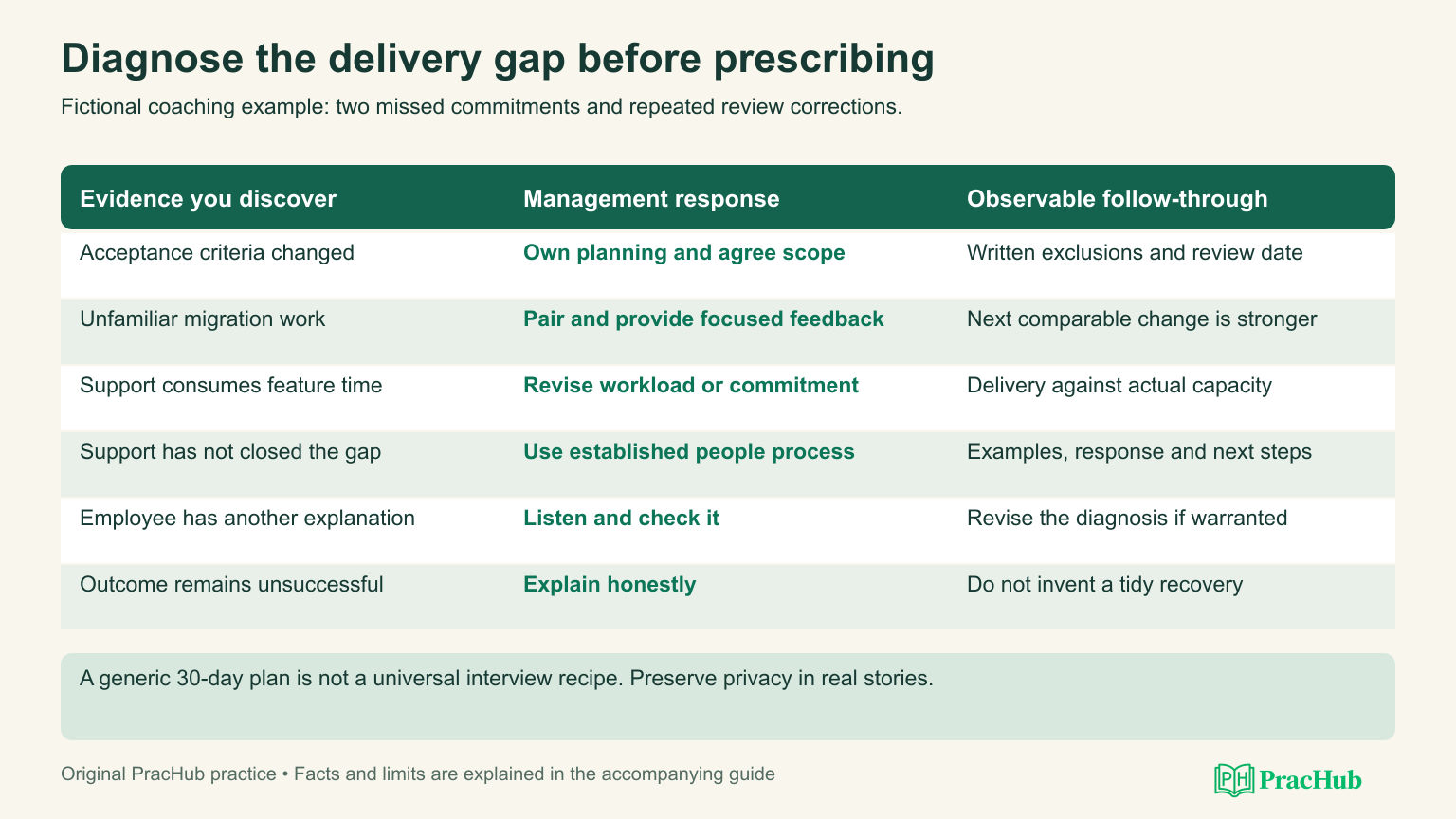
“How would you manage someone who is underperforming?” is easier to answer badly than well. A deadline alone does not explain what went wrong or what help you offered. Use this fictional example to practice the diagnosis; bring a real experience to the interview.
A developer has missed two release commitments. Their changes also need repeated corrections during review. Start with the evidence: which commitments were agreed, what changed after planning, which review comments recur, and what the employee understood the expectations to be. Speak privately and leave room for a different explanation. Your initial account may be incomplete.
| What you discover | A proportionate next step | Evidence to review together |
|---|---|---|
| The acceptance criteria changed twice and nobody renegotiated scope | Own the planning failure; agree a smaller deliverable and a clear definition of done | A written scope, explicit exclusions and an agreed review date |
| The scope is clear, but the developer struggles with unfamiliar database changes | Pair on one migration, provide a reviewed example and arrange focused feedback | They can explain rollback and implement the next comparable change with fewer corrections |
| Support rotations consume the time allocated to feature work | Change workload or the commitment before judging delivery | Actual support hours, interruptions and delivery against the revised capacity |
| Clear expectations and suitable support have not produced improvement | Discuss the remaining gap directly; follow the organization’s established people process with appropriate partners | Documented examples, the employee’s response, support provided and agreed next steps |
An answer might begin: “I initially treated this as a delivery problem. Reviewing the work with the developer showed that our acceptance criteria had changed after estimation and that their support rotation was consuming two days each week. I reduced the committed scope and arranged help on the migration. We agreed to review the next two milestones rather than use a generic deadline.”
Then explain the outcome and your uncertainty. Did predictability improve because you corrected workload, because the employee learned a skill, or both? If the outcome remained poor, say so. Do not invent a tidy recovery to make the story more impressive. Avoid sharing identifying or confidential employee details.
The useful signal in this answer is the chain from observation to diagnosis, support and follow-through. “I put them on a 30-day plan” skips most of that chain. A formal process, if applicable, depends on the organization and the situation; it is not a universal interview recipe.
Choose a preparation route for the level
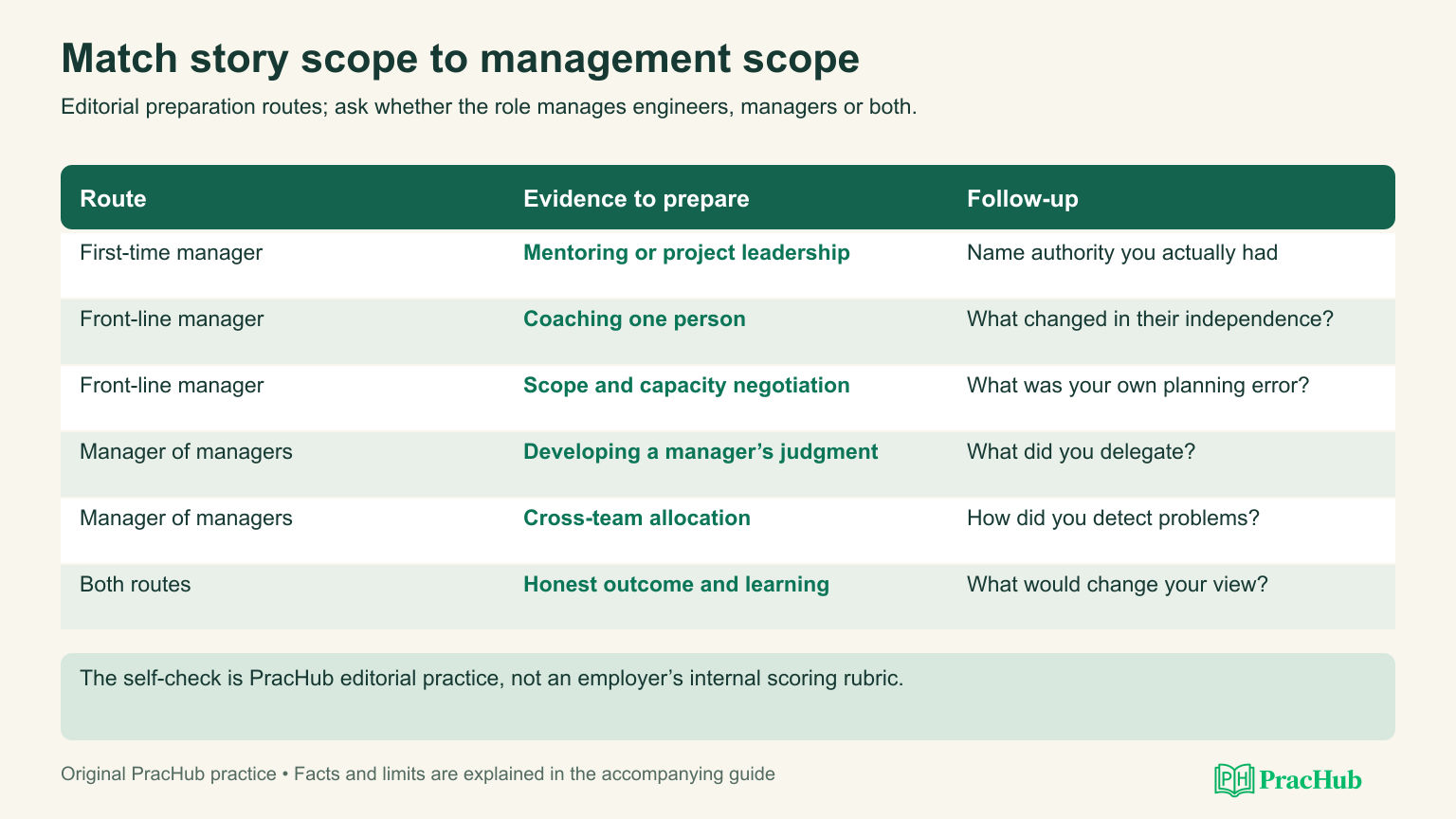
Ask the recruiter whether this role manages individual contributors, managers, or both. The title “Engineering Manager” does not settle that question. Treat these as preparation routes, not a claim about a particular employer’s rounds.
| Route | Prepare these three real examples | What the follow-up should establish |
|---|---|---|
| First-time or front-line manager | Coaching one person; resolving a delivery disagreement; balancing support and feature work | What you personally changed, how the team participated, and what you learned about managing people rather than doing their work |
| Manager of managers | Improving a manager’s judgment; allocating people across teams; changing an operating process | How you built decision-making capacity, what you delegated, and how you detected problems without bypassing your managers |
For a first-time manager, mentoring, project leadership and acting-manager experience can be useful evidence. Name the authority you actually had. Do not describe informal influence as formal line management. For a manager of managers, a story about personally fixing a ticket needs a clear reason: was an emergency intervention justified, and how did you prevent repeated dependence on you?
A 35-minute behavioral rehearsal
Prepare a one-page story sheet with the situation, your remit, the decision, alternatives, other people’s contributions, outcome and lesson. Use five prompts: coaching, disagreement, a missed commitment, a hiring or development decision, and a change you would handle differently. They are practice prompts, not disclosed employer questions.
Spend five minutes selecting a story, give a four-minute answer, then allow six minutes of follow-ups. Ask your partner to interrupt with: “What did you personally decide?”, “What did the other person say?”, “Why did you reject the alternative?”, and “What would contradict your explanation of the outcome?” Use the remaining time to repeat the weakest answer with less setup and stronger evidence.
PracHub’s editorial self-check has five dimensions: clarity of remit, quality of diagnosis, fairness to other people, observable outcome and learning. Mark each as missing, partial or clear. This is a tool for improving your answer; it does not reproduce an employer’s hiring rubric or predict a decision. A strong story can still contain an unsuccessful outcome if the reasoning and learning are credible.
A disagreement answer needs a decision owner
For an architecture conflict, begin with the decision and its stakes. Who owned the decision, who needed to contribute and what criteria were agreed? Compare the alternatives against those criteria. A short written proposal or a measured prototype can help when it resolves a real uncertainty; requiring a document is not automatically the right response to every disagreement.
After the decision, explain how you supported implementation and recorded the remaining risk. Do not claim that the person whose proposal lost became enthusiastic. Respectful disagreement can continue while the team commits to a shared plan. If the risk later materialized, describe the repair without turning the story into “I told you so.”
In preparation, ask what would have changed your view. If the answer is “nothing,” revisit whether you listened to the evidence. For technical debt, apply the same habit: name the observed cost, compare a bounded repair with a broader rewrite and discuss what product work would be delayed. A standing percentage of sprint capacity is one organizational choice, not a universal proof of sound management.
The useful evidence is judgment under the actual constraints. A story can be concise while still showing who decided, why the choice was defensible and how you treated the people involved.
Five prompts and the evidence each needs
Coaching: describe a specific gap and how you checked its cause. Include the other person’s perspective and the support you provided.
Missed deadline: explain when you saw the risk, what you communicated, what you changed and your own contribution to the miss.
Technical disagreement: name the decision criteria, alternatives and decision owner. Do not claim that agreement eliminated all disagreement; explain how the team proceeded respectfully.
Technical debt versus features: connect debt to observable effects such as incidents, support effort or delivery delay. Compare an incremental repair with a rewrite and state the opportunity cost.
Developing another person: show growing responsibility and independence. Sponsoring a promotion is one possible outcome, not the only evidence that someone developed.
Prepare and review your story bank
Collect six to eight real situations, then select the strongest examples for the expected level. Rehearse them aloud and invite follow-ups. Replace a vague “I usually” answer with one instance. Preserve confidentiality; names and private performance details are unnecessary for explaining your judgment.
For an employer with published principles, read that employer’s materials and connect your examples to their actual language. Amazon’s Leadership Principles and GitLab’s communication guidance are examples of company-specific materials; they do not establish a universal EM rubric. Confirm the role’s assessment scope, including whether coding or design is scheduled.
How should a manager of managers differ from a front-line manager?
Show how you developed managers and improved decisions across teams. A story about personally assigning every ticket may demonstrate intervention, but it needs an explanation of how you avoided becoming the permanent bottleneck.
What if the coaching did not work?
Say so, describe the evidence and follow the organization’s established people process. Do not invent a successful outcome or present a fixed disciplinary timeline as the default interview answer.
Is coding absent from EM interviews?
Not universally. Ask about the company, level and role. Prepare the assessment you are actually scheduled to take.
Sources and Further Reading
- Amazon Leadership Principles — employer-specific example
- GitLab engineering communication — employer-specific example
- Google interview preparation — general candidate guidance
Editorial revision: 8 October 2026. Worked fixtures and practice rubrics are original PracHub material. Current hiring details remain role-specific; unavailable source pages and unverified timings are identified in the text.
Comments (0)