How to Answer "What is Your Greatest Weakness?" in a Tech Interview
Quick Overview
This guide explains how to answer "What is your greatest weakness?" in tech interviews by recommending naming a genuine, non-critical weakness, describing how it appears in daily work, and detailing a concrete system to manage it, and it includes a repeatable three-step framework, three example answers for junior, mid, and senior roles, common answers that undermine interviews, a method to identify a personal weakness, and a short pre-interview checklist. It is aimed at software engineers at all levels preparing for behavioral interview rounds.
The best way to answer "What is your greatest weakness?" in a tech interview is to name a genuine, non-critical weakness, explain how it shows up in your daily work, and detail the concrete system you use to manage it. Skip canned lines like "I'm a perfectionist" or "I work too hard" - they read as rehearsed rather than honest, and experienced interviewers spot them instantly.
This guide is for software engineers at any level prepping for behavioral rounds. You'll get a repeatable 3-step framework, three full example answers tailored to junior, mid, and senior roles, the specific answers that quietly sink interviews, a fast method for finding your own real weakness, and a short pre-interview checklist to pressure-test what you've prepared.
Why interviewers ask this question
Interviewers, especially at large tech companies, ask the weakness question to test your self-awareness and intellectual humility. They already assume every engineer has blind spots. What they're listening for is the candidate who can name a real flaw and prove they actively manage it - because that's the engineer who works well in a shared codebase and takes feedback without getting defensive.
In practice they're scoring three things at once:
- Self-awareness - do you actually know where you fall short, or are you dodging?
- Coachability - when you got feedback, did you act on it or ignore it?
- Judgment - did you pick a weakness that's honest but not disqualifying for the role?
A non-answer ("I can't think of one") or a fake answer fails all three. A specific, well-managed weakness passes all three in about a minute.
Table of Contents
- The 3-Step Mitigation Framework
- 3 Example Answers by Experience Level
- The 4 Weaknesses You Must Never Say
- Strong vs Weak Answers: A Scoring Rubric
- How to Find Your Actual Weakness
- Pre-Interview Checklist
- FAQ
The 3-Step Mitigation Framework
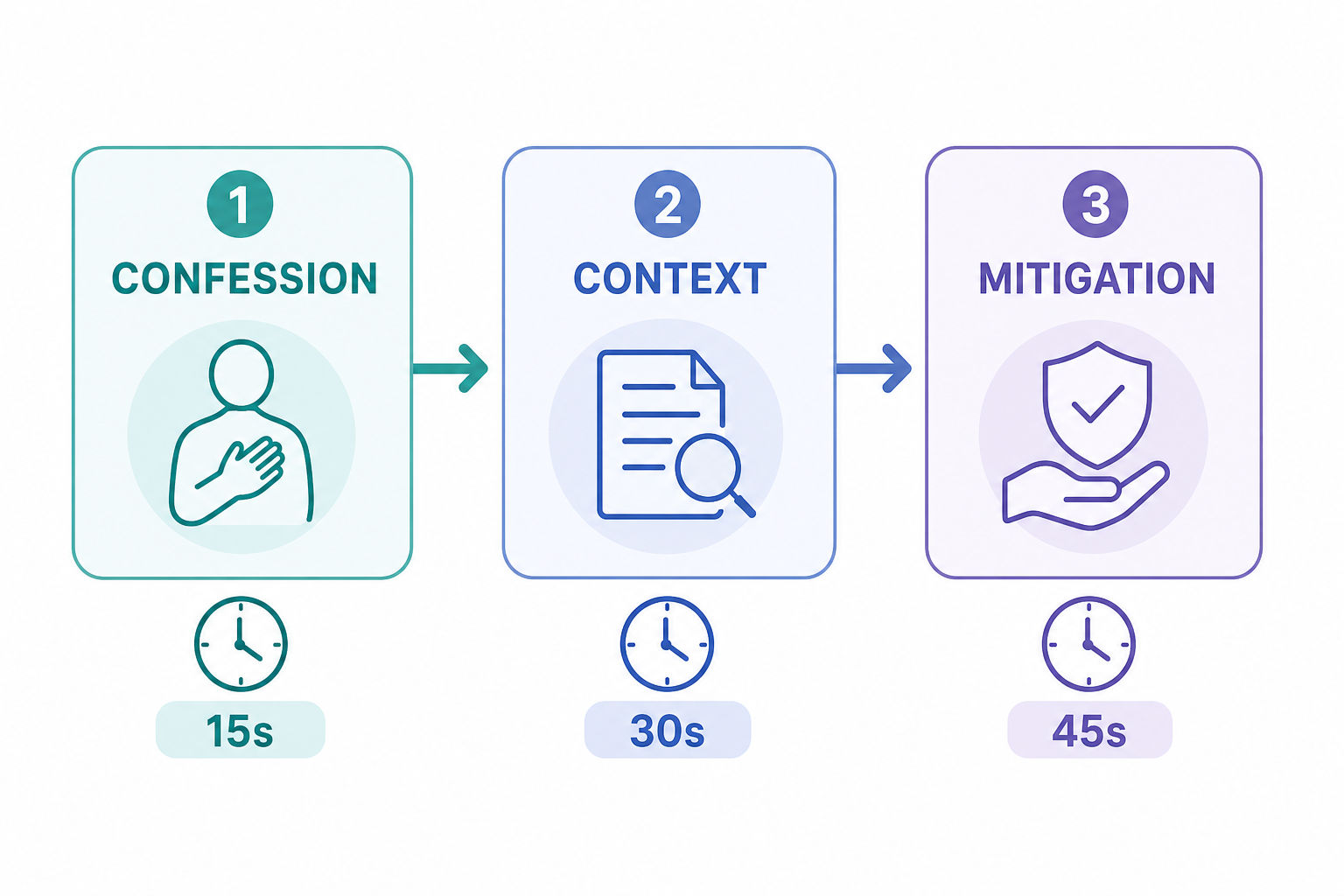
A strong answer to the weakness question usually runs about 60 to 90 seconds. To deliver it cleanly without rambling, structure it in three steps: Confession, Context, Mitigation.
Step 1: The Honest Confession (~15 seconds)
Name your weakness plainly. Don't apologize for it, and don't immediately spin it into a strength. The point of this step is to sound honest.
Template: "In the past, I've struggled with [specific weakness]."
Step 2: The Professional Context (~30 seconds)
Show how the weakness actually plays out in your engineering work. This proves you understand its impact on your team and your code - not just that you can recite a flaw.
Template: "For example, when I'm working on [type of project], I tend to [problem behavior], which leads to [concrete impact]."
Step 3: The Active Mitigation System (~45 seconds)
This is the part that earns the points. Describe the concrete, repeatable system you've put in place so the weakness doesn't damage your work. Interviewers don't want "I'm trying to be better" - they want a process and, ideally, a result.
Template: "To manage this, I now [specific action or system]. Since I started doing that, I've [positive result]."
The reason this framework beats a one-liner is the structure forces you off the humblebrag and onto evidence. By the time you reach Step 3, you're not describing a flaw anymore - you're describing how you operate.
3 Example Answers by Experience Level
These are illustrative scripts, not lines to memorize word-for-word. Swap in your own real weakness and your own real result, then say it out loud until it sounds like you.
Example 1: Junior Software Engineer (0–2 years)
Weakness: Getting stuck on a bug for too long without asking for help.
Example answer: "My greatest weakness is my tendency to try to solve every technical problem entirely on my own, which can sometimes lead to me spinning my wheels. When I first started my current role, I'd spend two or three days debugging a complex pipeline issue because I didn't want to bother the senior engineers.
I realized this was hurting our sprint velocity. To fix it, I gave myself a 'one-hour rule': if I'm blocked on a bug for more than 60 minutes, I write out exactly what I've tried and drop it into the team channel. That way I come to teammates with context instead of failing silently, and it's noticeably improved how fast I close tickets."
Example 2: Mid-Level Software Engineer (3–5 years)
Weakness: Over-engineering simple features.
Example answer: "In the past, my biggest weakness has been over-engineering. Because I'm genuinely interested in scalability and design patterns, I used to reach for highly abstracted, generic services when a simple CRUD endpoint would have done the job.
On my last major project I saw how that added unnecessary technical debt and slowed our launch. Now I lean on the YAGNI principle - You Aren't Gonna Need It. Before I write code, I draft a one-page design that explicitly scopes to the immediate business requirement, and I ask a peer to review it specifically for where I might be over-abstracting. It keeps my implementations pragmatic without dropping quality."
Example 3: Senior / Staff Engineer (6+ years)
Weakness: Struggling to delegate critical architecture work.
Example answer: "As I moved into a Staff role, my biggest weakness was failing to delegate critical-path architecture decisions. Because I knew I could design the systems quickly, I'd grab the hardest tickets myself instead of distributing them.
I realized I was becoming a bottleneck and stunting my team's growth. So I changed how I run technical specs: I no longer write the first draft of a design doc. I assign it to a mid-level engineer and act as reviewer and editor. It takes a bit longer upfront, but it builds real leverage across the team and the design conversations have gotten sharper because more people own them."
Notice the pattern in all three: a real flaw, its concrete cost to the team, and a specific mechanism that contains it. The result line at the end is what turns a confession into evidence of growth.
If you want to see how this overlaps with story-based questions, the same Action-and-Result muscle powers a good answer to "tell me about a time you failed" - and the broader STAR method guide covers the structure for the narrative questions in the same round.
The 4 Weaknesses You Must Never Say
These four answers tend to come across as canned or evasive. Avoid them:
| The Red Flag | Example | Why It Fails |
|---|---|---|
| The Humblebrag | "I work too hard," or "I'm a perfectionist." | Reads as dishonest. Signals you're either not self-aware or hiding a real flaw. |
| The Fatal Flaw | "I hate writing tests," or "I struggle with basic algorithms." | Directly contradicts core competencies the job requires. |
| The Blame Game | "I get frustrated when teammates write bad code." | Shows poor empathy, a lone-wolf mentality, and weak collaboration. |
| The 'Unfixable' Trait | "I'm just naturally disorganized." | Frames the weakness as a fixed personality trait instead of a process you can manage. |
The common thread: each one either fakes a flaw, names a disqualifying one, blames others, or offers no path to improvement. A good answer does the opposite on all four counts.
Strong vs Weak Answers: A Scoring Rubric
If you want to grade your own draft the way an interviewer mentally does, run it against these five dimensions. A strong answer clears every row.
| Dimension | Weak answer | Strong answer |
|---|---|---|
| Specificity | A vague trait ("I'm bad at communication") | A concrete, observable behavior in a real situation |
| Honesty | A disguised strength ("I care too much") | A genuine flaw you'd admit to a mentor |
| Relevance | A flaw that kills the role ("I avoid coding") | A flaw that's real but non-disqualifying |
| Ownership | Blames teammates, tools, or process | Owns the impact without excuses |
| Mitigation | "I'm working on it" | A repeatable system, plus a result |
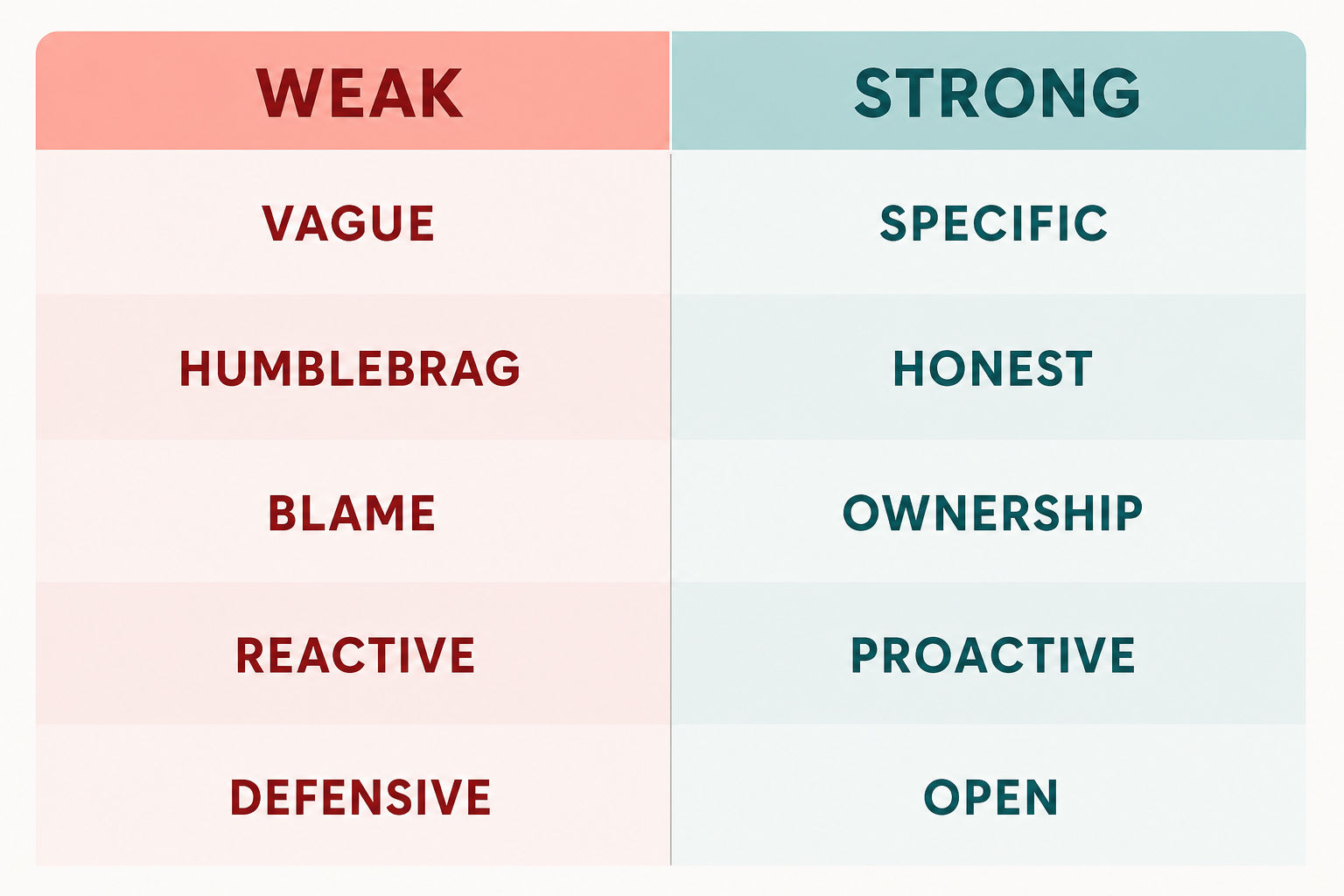
The most common failure isn't picking a "bad" weakness - it's stopping at the confession and never reaching the mitigation. The mitigation row is where the interviewer decides whether you're coachable.
How to Find Your Actual Weakness
If you don't know your genuine weakness, you can't answer this question convincingly. The fastest way to find it is to look at feedback you've already received rather than inventing something on the spot.
- Re-read your performance reviews and 1-on-1 notes. What constructive feedback has come up more than once?
- Look for recurring themes. Were you told to communicate more during incidents? To invest in documentation? To loop people in earlier? To scope down?
- Ask a trusted peer. A direct "what's one thing I should get better at?" often surfaces the honest answer faster than self-reflection.
- Run that real feedback through the 3-step framework. Confess it, give it context, and describe the system you've built to manage it.
Translate one piece of honest, repeated feedback into the Confession–Context–Mitigation structure and you'll have an answer that's both authentic and hard to poke holes in.
Once you have your weakness answer, round out the rest of the behavioral round with PracHub's behavioral interview question bank and the related guides on why we should hire you and the wider set of company-specific prep on the resources hub.
Pre-Interview Checklist
Run your prepared answer through this quick pass the night before:
- It names one specific weakness, not a vague trait or a list.
- It would be true if you said it to a mentor, not just to an interviewer.
- It does not undermine a core requirement of the role you're applying for.
- You can describe a concrete system you use to manage it.
- You have at least one result or change since you started managing it.
- You can deliver it in under 90 seconds without reading it.
- You've said it out loud at least twice so it doesn't sound scripted.
If you can check every box, your answer will land.
How to Use This Page as a Prep Plan
Do not treat this as passive reading. Convert the ideas in this page into a short weekly loop: learn one idea, practice it under interview conditions, then write down what changed. That is the fastest way to turn advice into visible interview behavior.
| Prep area | What you need to prove | Practice artifact |
|---|---|---|
| Story choice | Pick a real moment with stakes. | One sentence context and why it mattered. |
| Action detail | Show judgment, not just activity. | Three actions you personally owned. |
| Result | Make the outcome verifiable. | Metric, decision, lesson, or follow-up. |
| Reflection | Prove the story changed your behavior. | What you do differently now. |
For How to Answer "What is Your Greatest Weakness?" in a Tech Interview, the strongest candidates usually do three things well: they make their assumptions explicit, they use concrete examples instead of vague claims, and they review mistakes quickly enough that the next practice rep is better than the last one.
FAQ
Why do interviewers ask "What is your greatest weakness?"
To gauge your self-awareness, intellectual humility, and ability to act on critical feedback. They want to see that you recognize your own blind spots and have reliable, professional systems that keep those blind spots from hurting your team.
Can I say "I am a perfectionist" as my weakness?
No. "I'm a perfectionist" and "I care too much" tend to be penalized in tech interviews - hiring managers read them as fake weaknesses or disguised humblebrags. A fake weakness signals that you either lack self-awareness or are dodging the question, which is a fast way to lose credibility.
What is a good weakness for a software engineer to use?
A legitimate flaw that doesn't disqualify you, paired with a strong mitigation strategy. Common, defensible examples include over-engineering simple solutions, debugging alone too long before asking for help, struggling to delegate complex tasks, or under-investing in documentation when shipping fast.
How long should my answer to the weakness question be?
Aim for 60 to 90 seconds: roughly 15 seconds to name the weakness, 30 to give professional context, and 45 to explain the system you use to manage it.
Does the STAR method work for the weakness question?
You can adapt STAR (Situation, Task, Action, Result), but the 3-step Mitigation framework (Confession, Context, Mitigation) fits better. The weakness question isn't about retelling one past story - it's about an ongoing work-style trait and how you continuously manage it in the present. For the story-based questions in the same round, the STAR method guide is the better fit.
Should I give a different weakness for each interviewer?
Pick one strong, honest weakness and stick with it across the loop. Switching answers between interviewers looks like you're guessing what each person wants to hear, and loops often compare notes afterward. Consistency reads as authenticity.
Comments (0)