Top 25 Director of Software Engineering Interview Questions
Quick Overview
Practice 25 engineering director interview questions from real director of engineering loops. Each prompt focuses on what strong answers cover across strategy, org design, execution, leadership, cross-functional influence, and technical judgment.
To pass a Director of Software Engineering interview, you have to prove you can manage managers, scale an engineering organization past 50+ people, and tie a multi-year technical roadmap to the company's business goals. This guide is for senior engineering leaders - Engineering Managers stepping up, or sitting Directors moving companies - who want to walk in knowing the 25 questions that actually get asked and the exact signal each one tests.
An Engineering Manager (M1 / L6) is judged on execution: running sprints, unblocking engineers, shipping on time. A Director (M2 / L7) is judged on something different - organizational leverage and technical vision. Answer a Director-level question by describing how you personally tuned a CI/CD pipeline and the hiring committee reads you as "too tactical" and passes. At this altitude you're expected to think in headcount budgeting, resource allocation across teams, and cross-functional strategy.
Below, the 25 most common Director-level questions are grouped into the four pillars of executive engineering leadership, with the specific signal interviewers listen for in each - plus the budgeting "trap" question that splits manager-level candidates from director-level ones.
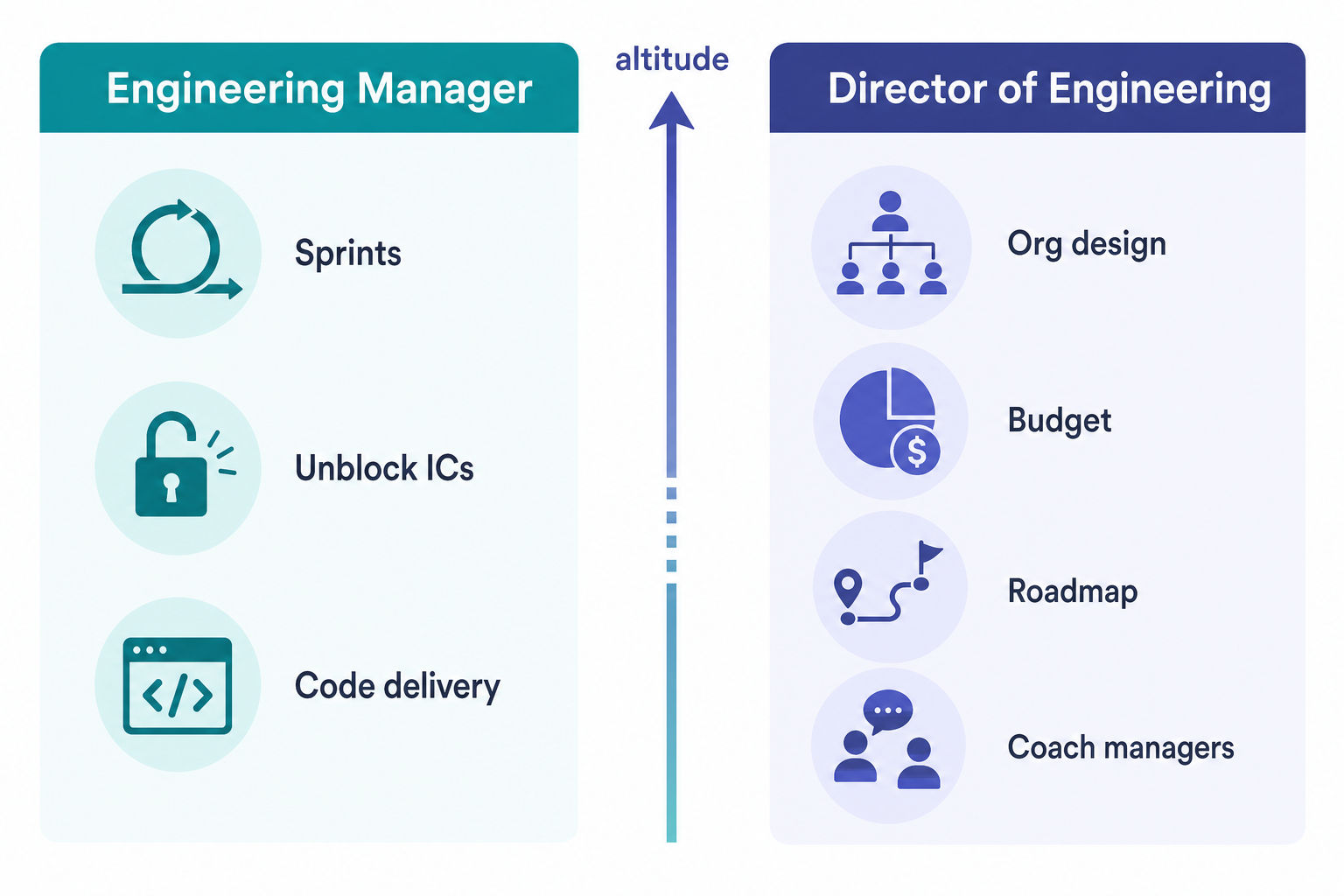
Table of Contents
- The shift: Manager vs. Director
- Pillar 1: Organizational design & scaling
- Pillar 2: Managing managers (M2M)
- Pillar 3: Technical vision & strategy
- Pillar 4: Executive alignment & business impact
- The trap question: budgeting and CapEx
- How to structure a Director-level answer
- FAQ
The shift: Manager vs. Director
Every answer you give should reflect the altitude difference between the two roles. Engineering Managers own how things get built; Directors own what gets built and who leads the building.
| Dimension | Engineering Manager (M1 / L6) | Director of Engineering (M2 / L7) |
|---|---|---|
| Primary reports | Individual contributors | Engineering Managers (and sometimes Staff/Principal ICs) |
| Span | One team, roughly 5–12 people | Multiple teams, often 50–150+ people |
| Owns | Sprint delivery, code quality, unblocking | Org chart, budget, multi-year strategy |
| Time horizon | Quarter / current roadmap | 1–3+ years |
| Key lever | Process & mentorship | Structure, hiring, capital allocation |
| Failure mode | Missed delivery, low team morale | Bad org design, no business alignment, weak managers |
| Behavioral focus | "Tell me how you shipped X" | "Tell me how you scaled / reorganized / decided" |
The single biggest mistake candidates make is answering Director questions with Manager-altitude stories. Whenever you're tempted to describe a thing you built, ask whether you can instead describe a thing your organization now builds repeatably because of a structure you put in place.
Pillar 1: Organizational design & scaling
Directors design the org chart deliberately to reduce communication overhead (Conway's Law - systems tend to mirror the communication structure of the organization that built them) and increase delivery velocity. Treat reorgs as refactors: you're reshaping the system that produces the software.
- Tell me about a time you reorganized your engineering department. What was the catalyst, and how did you minimize disruption?
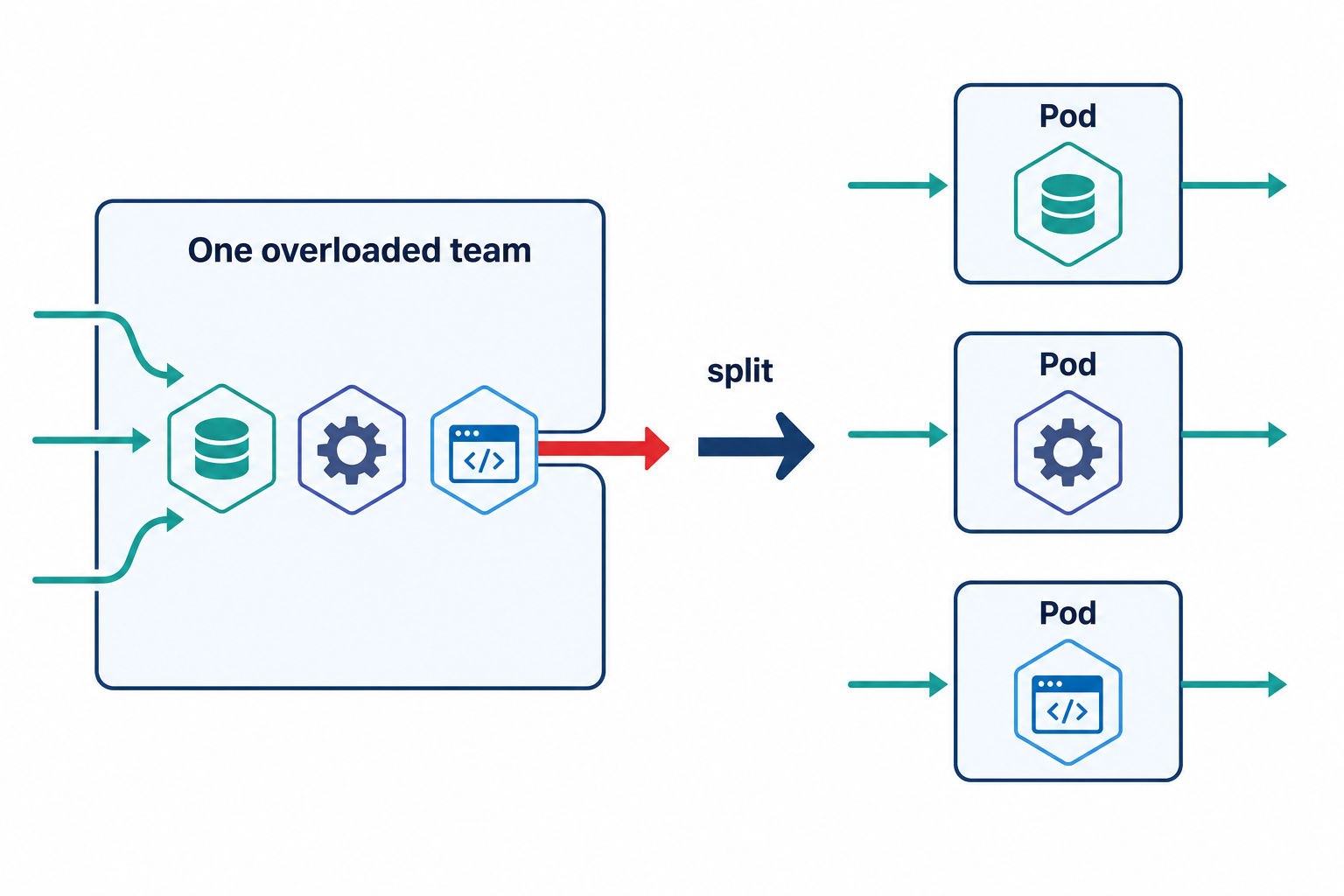
- How do you decide when to split a growing team versus when to add a layer of management?
- Describe your philosophy on cross-functional pods versus a specialized matrix.
- Give an example of how you maintained engineering culture across a globally distributed, remote-first organization.
- Your org scaled so fast that onboarding broke down - how did you systematize it?
- How do you balance the ratio of junior, mid, and senior engineers across your department?
- Describe a time you executed a Reduction in Force (RIF). How did you protect the morale and trust of the team that remained?
What they look for: you treat the organization itself as a system that needs debugging and refactoring as the company grows. Strong answers name the trigger metric (e.g. "PRs were sitting in review for days because one team owned three unrelated services"), the structural change, and the second-order effects you anticipated.
Watch out for the RIF question. It is asked specifically to see whether you can make a hard structural decision and preserve trust afterward. Weak answers dwell on how hard it was for you. Strong answers cover the decision criteria, how you communicated transparently, what you did for departing people, and how you re-stabilized the remaining team's roadmap and morale.
Pillar 2: Managing managers (M2M)
Your direct reports are no longer engineers - they're Engineering Managers. You lead through them without micromanaging, which means most of your impact is now indirect.
- Tell me about a time you noticed one of your Engineering Managers was struggling. How did you coach them?
- Describe your process for promoting a strong senior IC into their first management role.
- How do you gauge the health of the teams beneath you - skip-levels or otherwise - without undermining your EMs?
- Give an example of a time a direct report made a serious leadership mistake. How did you handle it?
- Tell me about a time you resolved a real conflict between two of your Engineering Managers.
- How do you keep performance reviews calibrated fairly across several teams with different managers?
What they look for: a "coach of coaches" mindset. You set guardrails, define success metrics, and empower managers to execute. You use skip-level meetings to read the org's real pulse without going around your EMs, and you have a deliberate calibration process so ratings mean the same thing across teams.
A common pitfall here is the "player-coach" trap - jumping in to do an EM's job when they stumble. For instance, if an EM is mishandling an underperformer, the Director-level move is to coach the EM through the conversation and the documentation, not to take over the conversation yourself.
Pillar 3: Technical vision & strategy
You're the final tie-breaker on architecture. You don't write the code, but you own the technical debt and the standards the whole org builds against.
- Describe a time you defined a multi-year technical roadmap. How did you build buy-in across the org?
- Tell me about a high-risk architectural decision you made. How did you mitigate the risk?
- How do you measure and systematically pay down technical debt across multiple product lines?
- Give an example of choosing to build a foundational platform service instead of patching individual microservices.
- Describe a time you migrated your entire organization to a new technology stack.
- How do you govern API standards, CI/CD practices, and security across hundreds of engineers?
What they look for: high-leverage thinking. Your decisions shape infrastructure for the next three to five years, so you reason in platforms, standards, and tradeoffs rather than individual features. Name the explicit tradeoff you made (cost vs. latency, build vs. buy, velocity now vs. flexibility later) and how you measured whether the bet paid off.
To keep the architecture rounds sharp, practice articulating tradeoffs out loud against real prompts. PracHub's system design and architecture questions pulled from actual senior-level interviews are a good way to rehearse the "final technical authority" voice.
Pillar 4: Executive alignment & business impact
Directors are executives. You have to speak the language of the CEO, the CFO, and the VP of Product - and translate engineering reality into business terms.
- Tell me about a fundamental strategic disagreement with the VP of Product. How did you resolve it?
- Give an example of killing an engineering initiative because it no longer aligned with the business.
- How do you translate a technical constraint (say, database latency) into business terms for the board?
- Describe a time you negotiated with Finance or the CEO to grow your engineering headcount budget.
- An external vendor or third-party API failed you - how did you manage the business fallout?
- How do you measure the ROI of your entire engineering department?
What they look for: business acumen. You don't build technology for its own sake - you build it to drive revenue, cut operating cost, or create defensibility, and you can say so in the board's language. The strongest answers convert an engineering decision into a number the CFO already cares about.
| Engineering reality | How a Manager phrases it | How a Director phrases it |
|---|---|---|
| Slow checkout API | "Latency is ~800ms, we should optimize." | "Checkout latency is costing us conversions on the highest-revenue page; the fix pays for itself in one quarter." |
| Mounting tech debt | "We have a lot of legacy code." | "Two product lines share a fragile module; one incident there risks the contracts up for renewal in Q3." |
| Headcount request | "I need more engineers." | "Three hires unlock the payments vertical; here's the revenue it opens and the timeline." |
| Migration | "We want to move to the new stack." | "The migration cuts annual cloud spend and unblocks the enterprise features sales keeps losing on." |
The trap question: budgeting and CapEx
The financial question is one of the clearest dividing lines between M1 and M2 leadership rounds.
"How do you approach budgeting, CapEx vs. OpEx, and vendor management for your org?"
Answer "I just ask Finance for what I need" and you fail. The interviewer wants to see that you treat your budget as a lever you actively own.
Example of a Director-level answer:
"I separate Operating Expenses (OpEx) - cloud spend, SaaS licenses, contractor costs - from Capital Expenditures (CapEx), like capitalizing internal engineering time spent building a major platform. Once a year I run a bottom-up vendor audit to kill duplicate SaaS tools. And when I request headcount, I don't ask the CFO for 'more engineers' - I bring a business case: here are three hires, here's the specific revenue vertical they unlock, and here's the timeline to impact."
The signal isn't the exact dollar figures - it's that you frame engineering investment as a business case the CFO can evaluate, not a wish list. If you're hazy on the OpEx/CapEx distinction, learn it cold before the interview; it comes up at this level often enough that fumbling it reads as a gap.
How to structure a Director-level answer
A useful scaffold for behavioral answers is STAR-L - Situation, Task, Action, Result, plus an explicit Learning. At the Director level the Action must describe structural, department-wide moves, not individual technical contributions.
| Element | Manager-altitude answer | Director-altitude answer |
|---|---|---|
| Situation | "Our team was missing sprint goals." | "Two of my five teams were missing roadmap commitments quarter over quarter." |
| Task | "I needed us to ship on time." | "I needed to find out whether this was a people, process, or structural problem across the org." |
| Action | "I re-prioritized the backlog and paired up." | "I ran skip-levels, found a structural ownership gap, reorganized two teams, and coached one EM out of a player-coach pattern." |
| Result | "We hit the next sprint." | "Delivery predictability recovered the next two quarters and the new ownership model held as we grew." |
| Learning | "Estimation matters." | "I now design ownership boundaries before a team grows past the point where they break." |
Two practical rules: keep one crisp story ready for each of the four pillars, and rehearse them out loud. A great answer reasoned silently still lands flat if you've never said it. To pressure-test your stories against real prompts, work through PracHub's bank of behavioral and leadership interview questions and the company-specific sets under /companies for the companies you're targeting.
How to Use This Page as a Prep Plan
Do not treat this as passive reading. Convert the ideas in this page into a short weekly loop: learn one idea, practice it under interview conditions, then write down what changed. That is the fastest way to turn advice into visible interview behavior.
| Prep area | What you need to prove | Practice artifact |
|---|---|---|
| Understand | Turn the prompt into a concrete goal. | Clarifying questions and success criteria. |
| Practice | Use realistic constraints and timed reps. | Worked examples with edge cases. |
| Explain | Make reasoning visible. | Tradeoffs, assumptions, and test strategy. |
| Improve | Review misses quickly. | A short feedback log and next action. |
For Top 25 Director of Software Engineering Interview Questions, the strongest candidates usually do three things well: they make their assumptions explicit, they use concrete examples instead of vague claims, and they review mistakes quickly enough that the next practice rep is better than the last one.
Video Walkthrough
This verified YouTube video gives a second pass on the same preparation area. Use it after reading the guide, then come back and turn the advice into a practice artifact.
FAQ
What is the difference between an Engineering Manager and a Director of Engineering?
An Engineering Manager usually runs a single team of roughly 5–12 individual contributors and focuses on tactical execution: sprint delivery, code quality, and unblocking the team. A Director of Engineering manages multiple EMs, commonly overseeing an organization of 50–150+ people, and focuses on strategic leverage: headcount budgeting, cross-team org design, and multi-year architectural roadmaps. The job changes from doing the work well to building a system that does the work well without you.
How technical is a Director of Engineering interview?
You're rarely asked to whiteboard LeetCode, but the interview is still deeply technical at the systems level. Expect demanding system-design rounds covering distributed architecture, CAP-theorem tradeoffs, data replication, and cloud-cost optimization. You're expected to be the final technical authority - able to spot a flawed design from a Staff engineer and explain why it's flawed, not just that it is.
What's the best way to prepare for a Director-level tech interview?
Elevate your perspective. Revisit your past projects and reframe each around business impact rather than technical detail. Have a few specific, well-rehearsed stories ready - coaching a failing EM, leading a department-wide reorg, killing a misaligned initiative, and turning technical debt into a financial case - then practice telling them at the right altitude. One story per pillar is usually enough.
Why do companies ask behavioral questions for executive tech roles?
At Director level and above, technical hard skills are largely assumed. Leaders rarely fail here because they can't read code; they fail on communication, organizational design, ego, or an inability to tie engineering output to financial goals. Behavioral questions are the main tool an interviewer has to probe those failure modes before making an expensive hire.
How many people should I have managed to be considered for a Director role?
There's no universal threshold, and titles vary widely between companies, so treat span as a signal rather than a rule. What committees consistently look for is evidence you've led through other managers - meaning you've managed managers, not just a large flat team of ICs. If you've run one big team but never had EMs reporting to you, expect questions probing whether you can operate at one level of indirection.
Should I bring metrics and numbers to a Director interview?
Yes, when you can attach them honestly to your own work - delivery predictability, attrition, deployment frequency, cost savings, revenue unlocked. Quantified results read as executive thinking. Just never invent or inflate a number; a precise figure you can't defend under follow-up does more damage than an honest qualitative description of the impact.
Related Articles
From Non-CS Major to Software Engineer: A Practical Guide to Cracking the Technical Interview
Prepare for technical interviews with a practical guide to DSA practice, live coding, mock interviews, communication, and interview mindset.
From Non-CS Major to Software Engineer: A Practical Guide to Cracking the Technical Interview
Prepare for technical interviews with a practical guide to DSA practice, live coding, mock interviews, communication, and interview mindset.
Design WhatsApp: the presence and receipt problems most candidates ignore
Design WhatsApp-style chat with WebSockets, offline inboxes, Kafka partitions, presence TTLs, receipts, and reliable delivery.
I Pinned Our Autoscaler for a Month to See What Would Break. Nothing Did.
Learn when Kubernetes autoscaling helps, when CPU-based HPA wastes money, and how capacity planning can cut cloud costs safely.
Comments (0)