Top 30 Behavioral Interview Questions for Tech (With Answers for 2026)
Quick Overview
This guide compiles 30 common behavioral interview questions for tech roles, grouped by the trait each question assesses and paired with a repeatable answer framework that emphasizes situation, ownership, and impact.
Behavioral interviews are where most strong engineers actually lose offers. You can clear the coding and system design rounds and still get rejected because you couldn't clearly explain how you work with other people, handle pressure, or recover from a mistake. This guide gives you the 30 behavioral questions that come up again and again in tech interviews, grouped by the trait each one tests, plus a single repeatable answer framework that works for almost all of them.
Hiring managers at companies like Google, Amazon, and Meta lean on behavioral questions to probe traits a whiteboard can't show: how you navigate ambiguity, resolve conflict with teammates, and respond when something breaks in production. The good news is that behavioral rounds are far more predictable than coding rounds. The questions cluster into a handful of recurring themes, so a little structured preparation goes a long way.
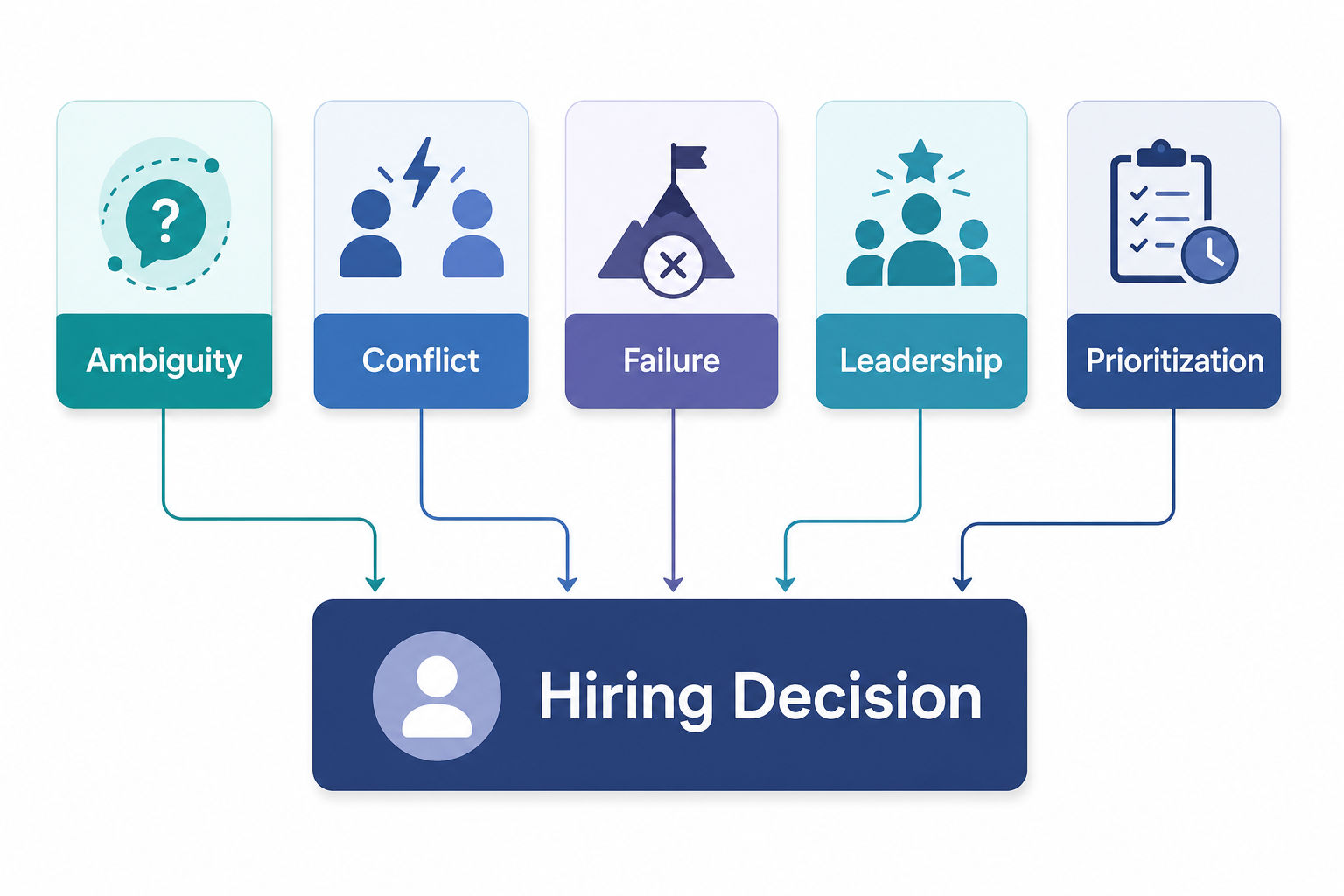
Table of Contents
- How to Answer: The STAR-L Framework
- Pillar 1: Navigating Ambiguity & Problem Solving
- Pillar 2: Conflict Resolution & Teamwork
- Pillar 3: Overcoming Failure & Mistakes
- Pillar 4: Leadership & Ownership
- Pillar 5: Time Management & Prioritization
- How to Practice Behavioral Questions
- FAQ
How to Answer: The STAR-L Framework
Never answer a behavioral question as a vague, rambling story. Structure every answer with the STAR-L method, and aim to keep each response to roughly two to three minutes.
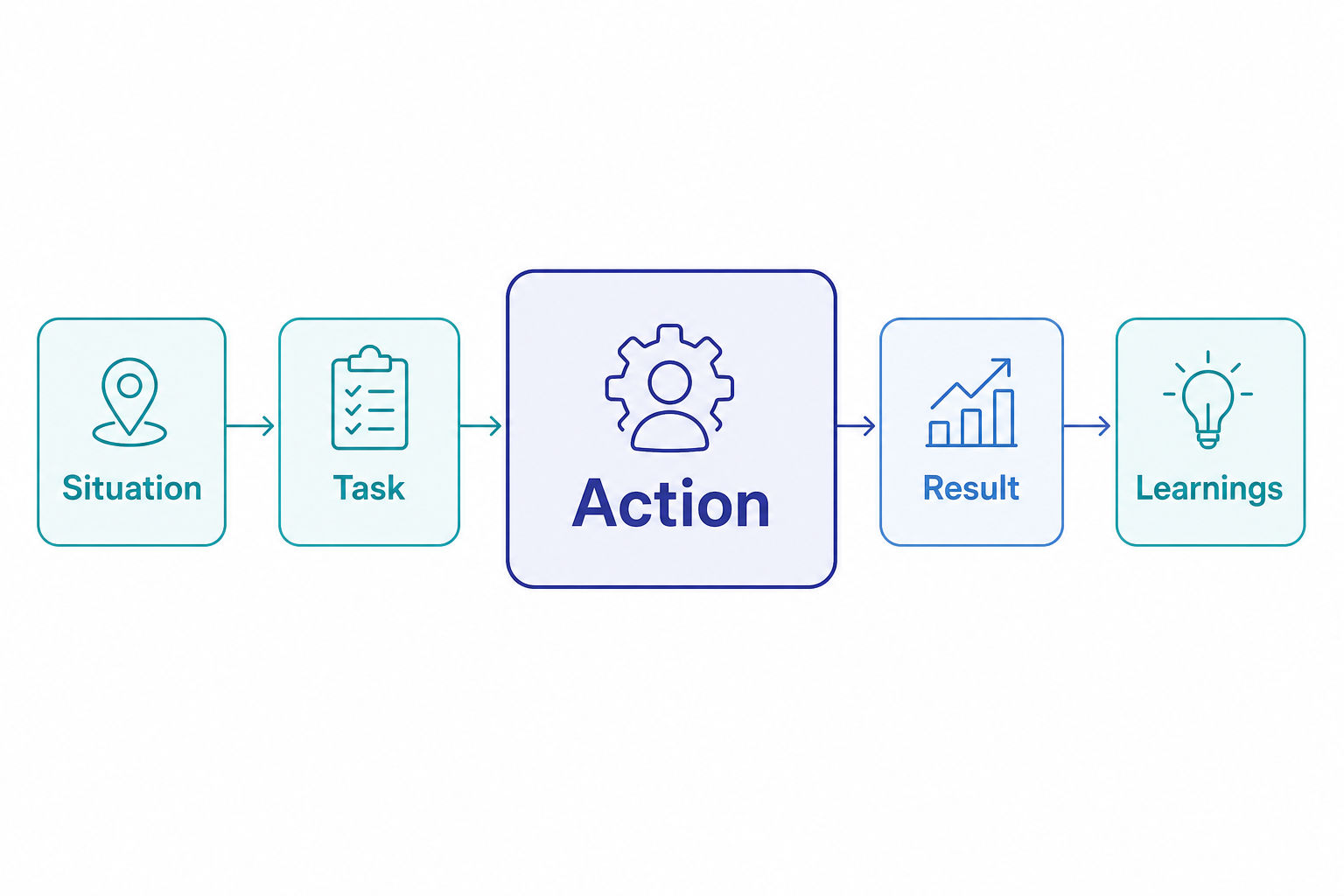
STAR-L is the classic STAR method (Situation, Task, Action, Result) with one addition that interviewers consistently reward: a short Learnings beat at the end. The percentages below are a rough guide to how much of your airtime each part deserves. The Action is where you earn the most credit, so spend the most time there.
| Beat | Airtime | What goes here | Example phrasing |
|---|---|---|---|
| Situation | ~10% | Set the context in one or two sentences. | "Our primary database was hitting its connection limit during peak hours." |
| Task | ~10% | State your specific responsibility. | "I owned resolving the 500 errors before the holiday traffic spike." |
| Action | ~50% | The core. Exactly what you did, step by step, using "I". | "I added a Redis caching layer in front of the hottest queries and wrote the migration script to cut over." |
| Result | ~15% | Quantify the impact wherever you honestly can. | "Database load dropped sharply and we held uptime through the spike." |
| Learnings | ~15% | What you took away and changed going forward. | "Now I set up dashboards and alerting before an infrastructure change, not after." |
Two rules matter more than the rest:
- Say "I", not "we". The interviewer is scoring you, not your team. If your whole answer is "we did X," they cannot tell what you contributed.
- Attach a number to your result whenever the data exists. A specific outcome ("cut median latency roughly in half") is far more convincing than a vague one ("made it faster").
For a deeper walkthrough with worked examples, see our STAR method guide with FAANG examples.
Pillar 1: Navigating Ambiguity & Problem Solving
Tech moves fast and requirements are often incomplete. Interviewers want to confirm you don't freeze when the spec is vague.
- Tell me about a time you had to build a feature with unclear requirements.
- Give an example of a time you had to rapidly learn a new technology to finish a project.
- Describe a situation where you made a technical decision without having all the data you wanted.
- Tell me about a time you spotted a problem and built a solution before anyone asked.
- How do you approach a bug in a legacy codebase that has no documentation?
- Describe a time you had to pivot your technical approach halfway through a sprint.
What they look for: Initiative. Show that you proactively gather information, build quick proofs-of-concept, and drive toward clarity instead of waiting to be told what to do.
Example answer (question 1): "The PM asked for 'a dashboard for the support team' with no further detail. Instead of guessing, I spent a day shadowing two support agents, listed the five metrics they actually checked daily, and shipped a thin v1 covering just those. I wrote down my assumptions in the ticket so the PM could correct any of them. We refined from a working thing instead of arguing over a spec."
Pillar 2: Conflict Resolution & Teamwork
Engineering is collaborative. Describing your teammates as "incompetent" is the fastest way to fail this section.
- Tell me about a time you strongly disagreed with a senior engineer's architectural choice.
- Describe a situation where a teammate's work was blocking yours. How did you handle it?
- Give an example of a time you had to push back on a product manager's unrealistic deadline.
- Tell me about a time you received harsh, critical feedback in a code review.
- How do you handle two teams (for example, QA and Dev) blaming each other for a delayed release?
- Give an example of a time you collaborated with a difficult stakeholder to get something shipped.
What they look for: Emotional intelligence. Resolve disputes with objective data and empathy rather than pulling rank or holding a grudge. The strongest answers end with the relationship intact, not just the technical argument won.
Example answer (question 7): "A senior engineer wanted to add a message queue for a flow that handled maybe ten requests a minute. I thought it was over-engineering, but instead of saying so in the review, I asked him to walk me through the failure modes he was worried about. He had a real concern about a downstream timeout. We landed on a much simpler retry-with-backoff that addressed his concern without the operational cost of a new queue. He proposed the simpler option himself once we'd named the actual risk."
Pillar 3: Overcoming Failure & Mistakes
Companies expect that you've broken things. They care about how you respond, not whether it ever happened.
- Tell me about a serious mistake you made that broke production.
- Describe a project that failed. Why did it fail, and what did you learn?
- Tell me about a time you missed a critical deadline.
- Give an example of a time you chose the wrong technology for a problem.
- Describe a moment you realized your code was creating significant technical debt.
- Tell me about a time you failed to flag a blocker until it was too late.
What they look for: A blameless, post-mortem mindset. Own the failure plainly, walk through your immediate response, and explain the safeguard or process change you put in place so it can't happen the same way again. The arc that lands is: I broke it → I owned it → I fixed it → I made it un-repeatable.
Example answer (question 13): "I pushed a config change that pointed a service at the wrong database and started returning stale data. I caught it in about ten minutes from an alert, rolled back immediately, and posted in the incident channel before anyone had to ask. In the post-mortem I added a check that blocks deploys when the target environment doesn't match the branch, so that specific mistake can't ship again."
Pillar 4: Leadership & Ownership
You don't need a manager title to demonstrate leadership. Individual contributors are expected to show "emergent leadership" - stepping up without being asked.
- Tell me about a time you led a project when no official leader was assigned.
- Describe a time you mentored a junior engineer who was struggling.
- Give an example of a time you fixed a broken internal process on your own initiative.
- Tell me about a time you championed an unpopular technical idea.
- Describe a situation where you led a post-mortem after a severe outage.
- How do you keep your code quality high when the rest of the team is rushing?
What they look for: Force multiplication. You raise the standards of the engineers around you, document your work, and take ownership of systems beyond your own tickets.
If you're prepping for a company that scores ownership and ambiguity heavily, our Amazon Software Engineer interview guide breaks down how the Leadership Principles map onto these exact behavioral themes.
Pillar 5: Time Management & Prioritization
Resources are always constrained. Prove you can prioritize ruthlessly and communicate tradeoffs.
- Tell me about a time you juggled multiple competing deadlines from different stakeholders.
- Describe a situation where you cut scope significantly to ship on time.
- How do you balance paying down technical debt against shipping new features?
- Give an example of a time you traded off code quality to meet a business deadline.
- Tell me about a time you realized a project couldn't be done in the time allotted.
- Describe how you prioritize when everything is marked "high priority."
What they look for: Pragmatism. You treat shipping software as a series of business tradeoffs, raise risks early, and deliver the most valuable slice first.
Example answer (question 29): "Two weeks before launch it was clear the full feature wouldn't make it. Instead of quietly hoping or grinding overtime, I mapped the work into 'must-ship for launch' versus 'fast-follow,' brought that to the PM with the tradeoff spelled out, and we shipped the core flow on time with the rest landing the following sprint. Raising it early gave the team a real decision instead of a surprise."
Strong vs. Weak Answers
Two candidates can describe the same project and land completely differently. The gap is almost never the story itself; it's how it's framed.
| Dimension | Weak answer | Strong answer |
|---|---|---|
| Ownership | "We fixed the outage." | "I traced the root cause, rolled back, and wrote the post-mortem." |
| Specificity | "It improved performance a lot." | "Median latency dropped from about a second to roughly half a second." |
| Conflict | "My teammate was wrong, so I overruled him." | "We disagreed; I asked what risk he was worried about and we found a simpler fix." |
| Failure | "It wasn't really my fault - the requirements changed." | "I missed the dependency. Here's the guardrail I added so it can't recur." |
| Structure | A five-minute ramble with no clear arc. | A tight STAR-L arc kept to two or three minutes. |
| Honesty | A suspiciously perfect, clearly invented story. | A real example, including the messy parts and what you learned. |
How to Practice Behavioral Questions
Don't try to memorize 30 separate answers. You'll sound scripted, and you'll blank the moment a question is phrased differently than you rehearsed.
Instead, prepare six to eight versatile stories from your own experience. The trick is that one good story can answer several different questions depending on how you frame it. A story about migrating a database under deadline pressure can demonstrate handling ambiguity, leadership, or time management - you just emphasize a different part of the same events.
For each story, get crisp on the STAR-L beats so you can stretch or compress it on the fly:
- Pick high-stakes stories. A real project or incident with real consequences gives you more to talk about than a routine ticket.
- Know your numbers. Have at least one concrete metric per story ready before you walk in.
- Map your stories to the five pillars. Make sure your set collectively covers ambiguity, conflict, failure, leadership, and prioritization, so you're never caught without an angle.
- Say it out loud. Practicing on paper hides the rambling that only shows up when you speak. Record yourself or run a mock with a friend.
A quick way to pressure-test your set is to map your stories against the five pillars in a grid:
| Your story | Ambiguity | Conflict | Failure | Leadership | Prioritization |
|---|---|---|---|---|---|
| Story A (e.g. DB migration) | ✓ | ✓ | ✓ | ||
| Story B (e.g. failed launch) | ✓ | ✓ | |||
| Story C (e.g. design dispute) | ✓ | ✓ |
If a column is empty, you have a gap to fill before interview day.
Want more reps? Browse real, company-tagged behavioral and technical prompts in the PracHub question bank, and pair this list with our 15 FAANG behavioral questions and the complete FAANG behavioral roadmap for a full study plan. If Google is your target, the Googleyness guide covers what their interviewers specifically look for.
How to Use This Page as a Prep Plan
Do not treat this as passive reading. Convert the ideas in this page into a short weekly loop: learn one idea, practice it under interview conditions, then write down what changed. That is the fastest way to turn advice into visible interview behavior.
| Prep area | What you need to prove | Practice artifact |
|---|---|---|
| Story choice | Pick a real moment with stakes. | One sentence context and why it mattered. |
| Action detail | Show judgment, not just activity. | Three actions you personally owned. |
| Result | Make the outcome verifiable. | Metric, decision, lesson, or follow-up. |
| Reflection | Prove the story changed your behavior. | What you do differently now. |
For Top 30 Behavioral Interview Questions for Tech (With Answers for 2026), the strongest candidates usually do three things well: they make their assumptions explicit, they use concrete examples instead of vague claims, and they review mistakes quickly enough that the next practice rep is better than the last one.
Video Walkthrough
This verified YouTube video gives a second pass on the same preparation area. Use it after reading the guide, then come back and turn the advice into a practice artifact.
FAQ
Why do tech companies ask behavioral interview questions?
Behavioral questions assess cultural fit, emotional intelligence, and how you operate under pressure. They rest on a simple premise: past behavior is the best available predictor of future behavior. Coding rounds verify that you can build software; behavioral rounds verify that you can build it with other people on a real team.
How many behavioral stories should I prepare for an interview loop?
Six to eight detailed, versatile stories in STAR-L format. Each should center on a meaningful project or incident from your career. With a core set of adaptable stories, you can map almost any question to one of them without memorizing dozens of scripts.
What is the most common mistake in behavioral interviews?
Two mistakes tie for first: failing to quantify the result, and saying "we" instead of "I." If you say "we improved the API's performance," the interviewer has no idea what you did. Say instead: "I added the caching layer that cut median latency from one second to roughly half a second." Be specific about your contribution and back it with a number whenever you have one.
What if I don't have a good story for a specific question?
If you genuinely lack a direct example, be honest and pivot to the closest related experience or to your approach. For instance: "I haven't faced that exact situation, but here's the framework I'd use," or "I haven't taken down production globally, but I did ship a bad deploy to staging, and here's how I ran the incident response." Interviewers respond well to honesty paired with clear reasoning; they react poorly to an obviously invented story.
How long should a behavioral answer be?
Aim for roughly two to three minutes per answer. Much shorter and you haven't given the interviewer enough signal; much longer and you'll lose them. The STAR-L structure naturally keeps you in this window if you keep the Situation and Task brief and spend most of your time on the Action.
Are behavioral questions the same across all tech companies?
The underlying themes - ambiguity, conflict, failure, leadership, prioritization - are remarkably consistent. What varies is emphasis and vocabulary. Some companies score answers against a published set of values or leadership principles, so it's worth checking whether your target company has its own rubric and mapping your stories to it. The five pillars in this guide give you broad coverage regardless.
Comments (0)