Analytical Integrity and Ethical Decision Making
Asked of: Data Scientist
Last updated
-
What it is Analytical integrity means doing rigorous, honest work with data: choosing sound methods, resisting p‑hacking, reporting uncertainty, and not cherry‑picking results. Ethical decision making adds a lens of stakeholder harms, fairness, privacy, and regulatory obligations when collecting data, building models, and shipping features.
-
Why interviewers ask about it Data scientists influence ranking systems, ads delivery, integrity tooling, and safety filters—errors can misallocate billions in spend or harm users at scale. Teams want people who can push back on bad metrics, detect leakage, surface subgroup harms, and navigate requirements like risk management and documentation rather than “making the graph go up” at any cost.
-
Core ideas to know
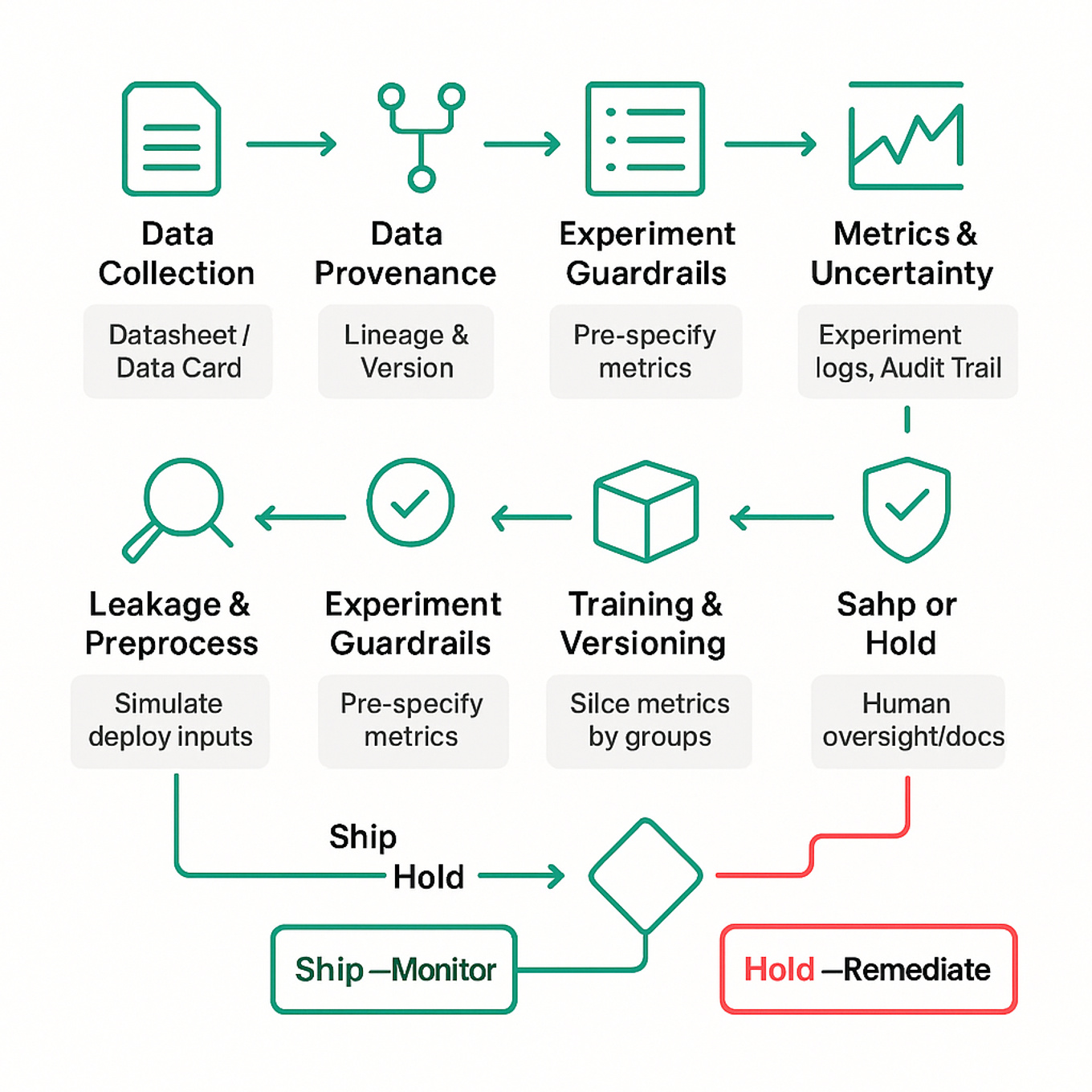
- Guardrails for experimentation: pre-specify metrics, avoid peeking, power properly, and respect holdouts.
- Data provenance: track lineage; use documentation artifacts (e.g., datasheets/data cards) for datasets and models.
- Leakage checks: simulate deploy-time inputs only; audit joins, lookahead features, and post-treatment variables.
- Fairness evaluation: slice metrics by sensitive attributes; compare trade-offs across equalized odds, demographic parity, or calibration.
- Communication: report confidence intervals, practical effect sizes, and limitations; make uncertainty legible to PMs.
- Reproducibility and auditability: version data/code/models; maintain experiment logs and decision records.
- Safety and compliance: identify high-risk uses, apply human oversight, and document risk mitigations before launch.
-
A common pitfall Candidates stay abstract (“be ethical”) instead of naming concrete controls. For example, they can’t explain how they’d prevent p‑hacking in a growth A/B test, or how they’d detect that a churn model used future information. Others ignore subgroup analysis, so they miss that a ranking change boosts overall CTR but depresses creator reach for small markets—a classic Simpson’s paradox. Strong answers pair principles with tactics, trade-offs, and a stop-ship threshold.
-
Further reading
- NIST AI Risk Management Framework (AI RMF 1.0) — Practical, lifecycle risk controls (govern, map, measure, manage) recognized across U.S. industry and agencies. [NIST publication] (https://www.nist.gov/publications/artificial-intelligence-risk-management-framework-ai-rmf-10)
- EU AI Act — Official summary of obligations (e.g., data quality, transparency, human oversight) as it entered into force on August 1, 2024. [European Commission] (https://commission.europa.eu/news/ai-act-enters-force-2024-08-01_en)
- Datasheets for Datasets — Canonical approach to dataset documentation that improves transparency and downstream decision quality. [Communications of the ACM, 2021] (https://cacm.acm.org/research/datasheets-for-datasets/)
Related concepts
- Stakeholder Influence And Analytical Integrity
- Integrity, Harm, And Fraud Measurement
- Integrity, Fraud, And Content Moderation Measurement
- AI Safety, Mission Alignment, and Leadership JudgmentBehavioral & Leadership
- Privacy-Preserving Analytics And Governance
- Data Quality, Reconciliation, And Observability