Classifier Evaluation, Calibration, And Thresholding
Asked of: Data Scientist
Last updated
What's being tested
Meta is testing whether you can evaluate a high-stakes binary classifier in a way that matches product risk, operational constraints, and user impact. The core skill is not reciting precision, recall, or ROC-AUC; it is choosing the right metric and threshold when false positives and false negatives have very different costs. Interviewers are probing whether you understand severe class imbalance, probability calibration, cost-sensitive decision rules, fairness across user segments, and how offline evaluation should connect to an online experiment. For a Data Scientist, the expected lens is: define the decision problem, quantify tradeoffs, validate labels and metrics, and recommend a launch or rollback plan with measurable guardrails.
Core knowledge
-
Confusion matrix terms must be automatic: true positives, false positives, false negatives, and true negatives. For fake-account or fraud systems, the business meaning matters: a false positive may lock out a real user, while a false negative may allow spam, scams, abuse, or financial loss.
-
Precision and recall answer different product questions. Precision asks, “When we take action, how often are we right?” Recall asks, “Of all bad actors, how many did we catch?”
-
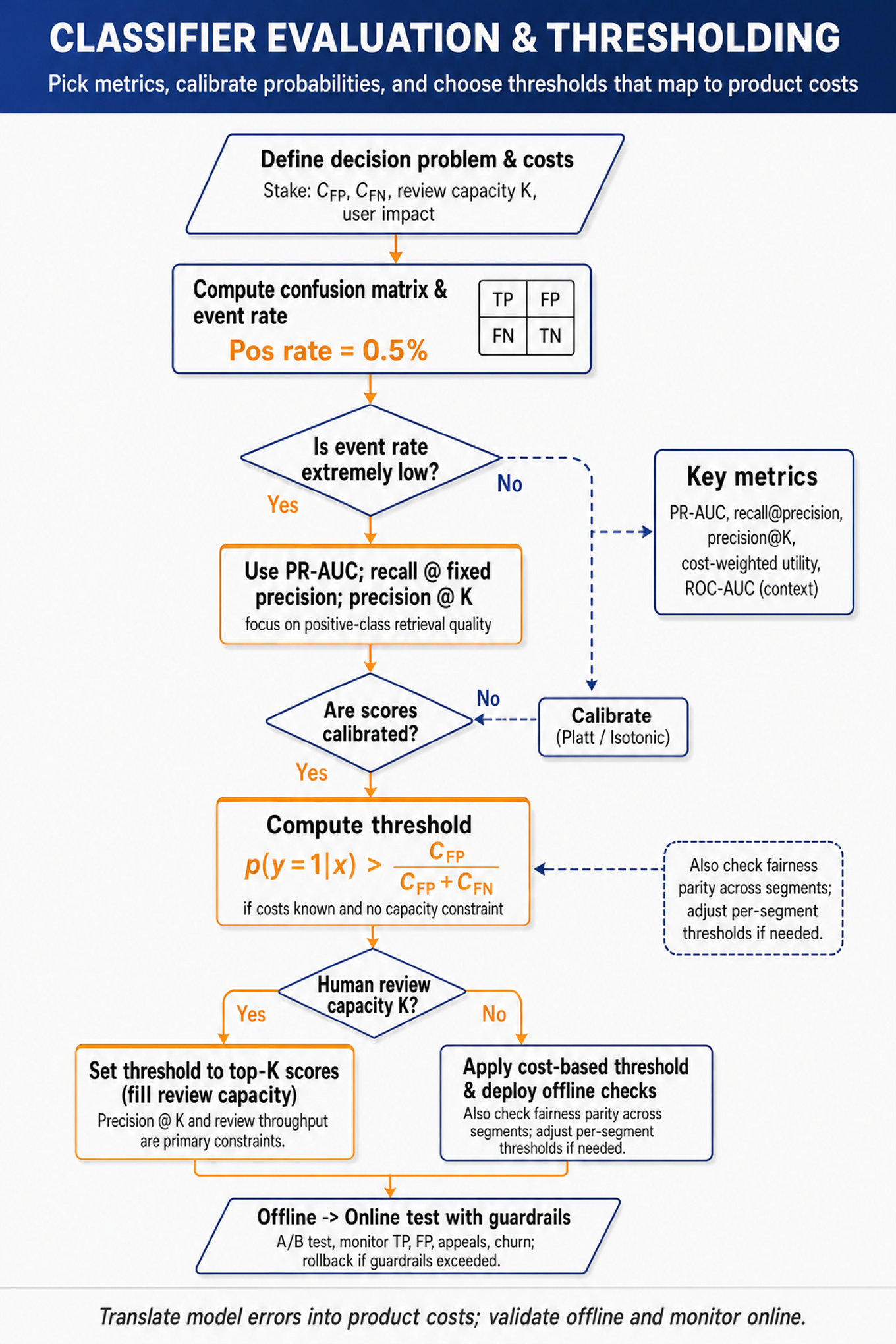
Class imbalance makes accuracy mostly useless. If fake users are 0.5% of accounts, a classifier that predicts “real” for everyone gets 99.5% accuracy but zero abuse prevention. Prefer
PR-AUC, recall at fixed precision, precision at fixed review capacity, and cost-weighted utility. -
ROC-AUC measures ranking quality across all thresholds, but it can look strong under extreme imbalance because false positive rate divides by many true negatives. PR-AUC is usually more informative for rare-event detection because it focuses on positive-class retrieval quality.
-
Thresholding converts model scores into actions. If scores are calibrated probabilities and costs are known, act when assuming one positive action and no capacity constraint. With human review limits, choose the top- scores or threshold that fills review capacity.
-
Cost-sensitive evaluation should translate model errors into product units: dollars lost, account takeovers, moderator hours, appeals, user churn, or integrity incidents. A simple expected utility is evaluated over candidate thresholds.
-
Calibration means predicted probabilities match observed frequencies: among users scored 0.8, about 80% should be positives. Check reliability curves, Brier score, and expected calibration error; improve with
Platt scalingorisotonic regressionon a validation set, not the training set. -
Ranking quality and calibration are distinct. A model can have excellent
ROC-AUCbut poorly calibrated probabilities, making cost-based thresholds unreliable. Conversely, a well-calibrated model can rank poorly. For enforcement decisions, evaluate both. -
Operating-point metrics should match the action. For automatic account disabling, require very high precision, perhaps 99%+, because user harm is severe. For sending to manual review, lower precision may be acceptable if reviewer capacity and downstream confirmation are modeled.
-
Label quality is often the limiting factor. Fraud and fake-account labels can be delayed, biased toward previously detected behavior, or noisy because some “negatives” are simply undiscovered positives. Strong answers discuss label windows, adjudication quality, sampling, appeals, and temporal validation.
-
Segmented evaluation catches hidden harm. Report metrics by geography, language, account age, device type, acquisition channel, and protected or sensitive-adjacent cohorts where legally and ethically appropriate. A global precision gain can mask worse false-positive rates for new users or specific regions.
-
Offline-to-online validation requires an experiment mindset. Offline metrics estimate model quality, but online launch should monitor
DAU, appeals, successful logins, abuse reports, reviewer load, and downstream engagement. Use holdouts, shadow mode, limited ramp, and guardrails before broad enforcement.
Worked example
For Evaluate fraud classifier with cost-sensitive metrics, a strong candidate would start by clarifying the action: are we blocking a transaction, sending it to review, adding friction, or just ranking cases for analysts? They would ask for base rate, historical fraud loss, false-positive cost, review capacity, label delay, and whether model scores are calibrated probabilities or arbitrary risk scores. Then they would frame the answer around four pillars: offline ranking metrics, threshold selection using cost or capacity, calibration and label validation, and safe online evaluation with guardrails.
The candidate might say: “I would not optimize accuracy; I would compare the new and old systems on PR-AUC, recall at fixed precision, and expected cost saved at candidate thresholds.” They would explicitly compute or request a cost matrix: false negative equals expected fraud loss, false positive equals user friction, lost revenue, support cost, and trust damage, while review has a per-case operational cost. A key tradeoff is that the threshold maximizing short-term fraud savings may over-block legitimate users, so they might define separate thresholds for auto-block, manual review, and allow. They would also flag calibration: if the model score of 0.9 does not correspond to 90% fraud probability, then cost-based threshold formulas are unsafe. They would close by saying that, with more time, they would validate labels over a delayed outcome window, segment by merchant/user cohort, and run a shadow-mode or small-ramp experiment before enforcing broadly.
A second angle
For Choose metrics for fake-user classifier, the same evaluation logic applies, but the constraint is often severe class imbalance plus limited enforcement or review capacity. Instead of asking only “What threshold minimizes expected dollar loss?”, the candidate should ask how many accounts can be reviewed, what harm fake users cause, and how costly it is to wrongly disable a real account. A strong metric set might include PR-AUC, precision in the top 10K highest-risk accounts, recall at 99% precision, appeal overturn rate, and fake-account prevalence removed. The candidate should also discuss segment fairness because fake-user systems can disproportionately affect new users, users from high-abuse regions, or people with sparse social graphs. The key framing shift is from transaction-level fraud loss to account-level integrity, user trust, and enforcement legitimacy.
Common pitfalls
Pitfall: Optimizing
accuracyor evenROC-AUCas the main answer for a rare-event classifier.
This is analytically weak because fraud and fake-user detection are usually highly imbalanced, and the action happens at a specific threshold or top- slice. A better answer names PR-AUC, precision/recall at the operating point, cost-weighted utility, and segment-level false-positive rates.
Pitfall: Giving metric definitions without tying them to a decision.
Saying “precision is TP over predicted positives” is necessary but not sufficient. Interviewers want to hear how precision maps to user harm, how recall maps to missed abuse, and how the threshold changes when review capacity, false-positive cost, or enforcement severity changes.
Pitfall: Ignoring calibration, labels, and temporal validation.
A tempting shallow answer is to compare the new model and old model on a random train/test split and pick the higher F1. A stronger answer asks whether labels are delayed or biased, evaluates on a forward-looking holdout, checks calibration, and validates performance across cohorts before recommending launch.
Connections
Interviewers may pivot from classifier evaluation into experiment design, especially how to run an A/B test or shadow launch when enforcement changes user behavior. They may also probe causal inference, fairness metrics, ranking/recommender evaluation, or metric design for integrity systems where the true outcome is partially observed.
Further reading
-
“The Relationship Between Precision-Recall and ROC Curves” — Davis and Goadrich, 2006 — classic paper explaining why
PRcurves are often more informative under class imbalance. -
“Predicting Good Probabilities with Supervised Learning” — Niculescu-Mizil and Caruana, 2005 — foundational comparison of calibration behavior across common classifiers.
-
“Fairness and Machine Learning” — Barocas, Hardt, and Narayanan — rigorous treatment of fairness definitions, tradeoffs, and measurement issues relevant to classifier evaluation.
Practice questions
- Choose threshold under asymmetric costsMeta · Data Scientist · Onsite · medium
- Replace legacy ads model safelyMeta · Data Scientist · Onsite · hard
- Detect leakage and evaluate a prediction modelMeta · Data Scientist · Onsite · hard
- Select interest thresholds under skewness and costMeta · Data Scientist · Onsite · hard
- Evaluate fraud classifier with cost-sensitive metricsMeta · Data Scientist · Technical Screen · hard
- Evaluate and Experiment with Harmful Content Detection ModelMeta · Data Scientist · Technical Screen · medium
- Evaluate New Model's Performance Against Existing SystemMeta · Data Scientist · Technical Screen · medium
- Evaluate Product-Ranking Algorithm with Precision and Recall MetricsMeta · Data Scientist · Onsite · medium
Related concepts
- Classifier Evaluation, Calibration, And Thresholds
- Classifier Evaluation, Thresholding, And Calibration
- Machine Learning Model Evaluation And CalibrationMachine Learning
- Classifier Evaluation And Cost-Sensitive ThresholdsMachine Learning
- Classification Thresholds, Imbalanced Learning And RiskMachine Learning
- Model Evaluation, Calibration, And Thresholding