Leadership Under Ambiguity And Prioritization
Asked of: Data Scientist
Last updated
What's being tested
Ability to lead and make high-impact decisions when requirements, data, or resources are incomplete. Interviewers want to see structured prioritization, stakeholder alignment, and tradeoff reasoning under uncertainty.
Core knowledge
- Common prioritization frameworks: RICE, ICE, MoSCoW, cost-benefit and opportunity-cost analyses.
- Decision roles: DACI/RACI for clarifying accountability and preventing ambiguous ownership.
- Key product/business metrics: revenue lift, conversion rate, retention, DAU/MAU, LTV/CAC tradeoffs.
- Experiment vs. analytics tradeoff: when to A/B test versus run retrospective analysis.
- Engineering constraints: latency, throughput, cost-to-serve, SLOs, and model maintenance burden.
- Data readiness checks: lineage, freshness, sampling bias, and missingness impact on decisions.
- Risk assessment: privacy/compliance, model bias, technical debt, and rollback plans.
Worked example
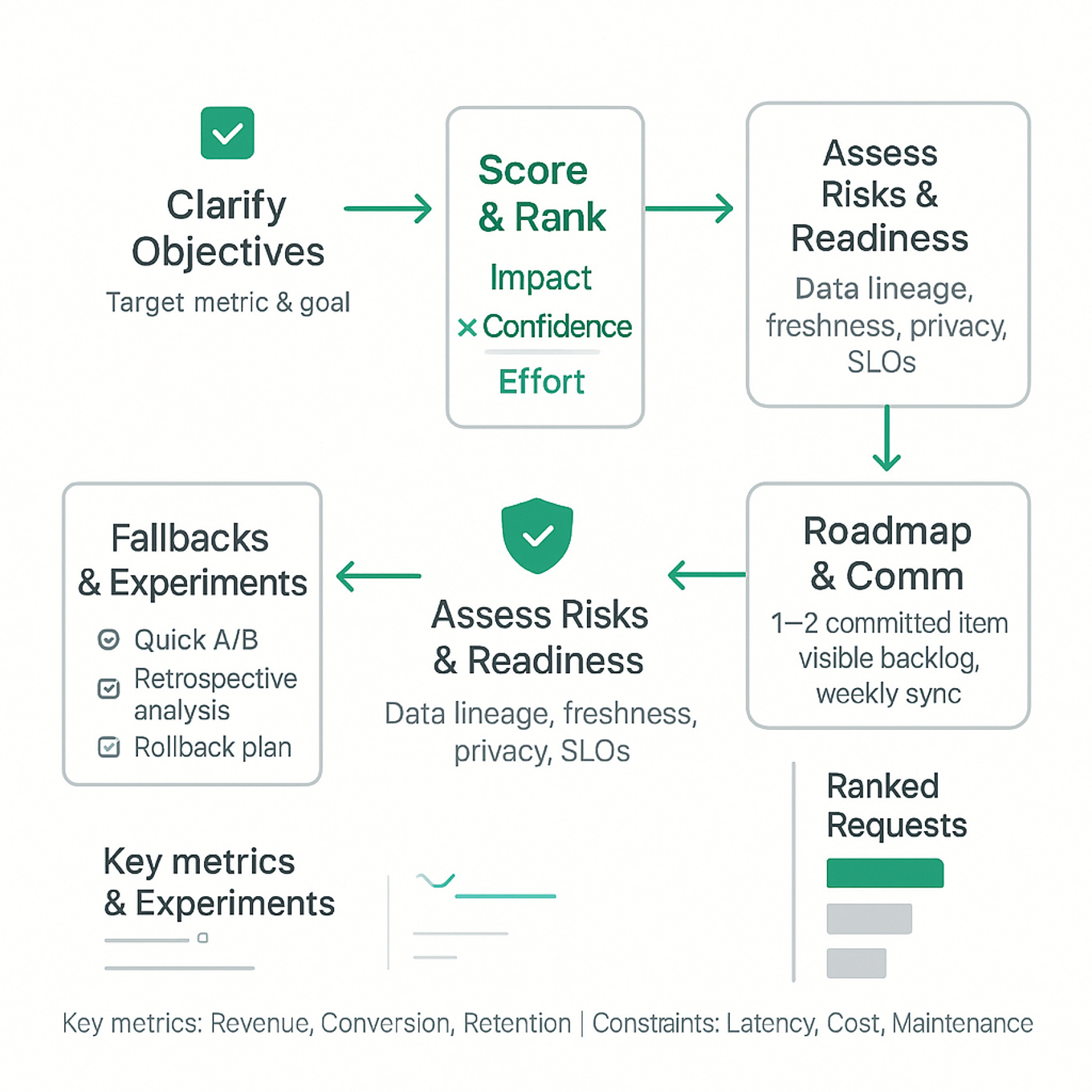
Example question: "How would you prioritize competing analytics requests from Ads, Product, and Ops with limited engineering capacity?"
Frame it by first clarifying objectives: ask which business metric each request aims to move and the expected magnitude. Define success metrics and required fidelity. Use a simple scoring rubric (impact × confidence ÷ effort) to rank requests, and surface dependencies, SLO constraints, and quick wins. Propose a short-term roadmap with 1–2 committed items, a visible backlog, and a communication cadence for tradeoff decisions.
A common pitfall
Candidates often default to “technical-first” answers (choose the most complex model or full-data pipeline) instead of business-first tradeoffs. That leads to overcommitment, unclear success criteria, and poor stakeholder buy-in. Always tie proposals to measurable impact, estimate confidence, and present fallback or experiment-based approaches.
Further reading
- Lean Analytics (Croll & Yoskovitz) — practical frameworks linking metrics to prioritization.
- John Doerr, Measure What Matters — concise guide to OKRs and outcome-focused prioritization.
Related concepts
- Behavioral Leadership, Collaboration, And AmbiguityBehavioral & Leadership
- Ownership, Prioritization, Ambiguity, and Project Deep DivesBehavioral & Leadership
- Ambiguous Project Leadership And Product ImpactBehavioral & Leadership
- Decisions Under Uncertainty and Precommitment
- Behavioral Stories: Influence, Conflict, Prioritization & Trade-offs
- Behavioral Leadership And Stakeholder ManagementBehavioral & Leadership