Real-Time Top-K And Streaming Analytics
Asked of: Software Engineer
Last updated
What's being tested
These interviews test whether you can design low-latency streaming analytics that maintain accurate or approximate rankings while events arrive continuously, out of order, and at high volume. The interviewer is probing for practical distributed-systems judgment: how you partition work, maintain state, bound memory, recover from failures, and serve fresh answers under `p99` latency targets. Amazon cares because many systems need near-real-time counters and rankings: best-selling products, ad clicks, abuse signals, log histograms, popular searches, and operational dashboards. A strong Software Engineer answer balances correctness, scalability, simplicity, and operational failure modes instead of just naming `Kafka` plus a database.
Core knowledge
-
Top-K frequency tracking usually means maintaining the K most frequent keys over a stream: product IDs, search prefixes, ad IDs, log fields, or URLs. Exact global top-K requires counting every key, which is feasible for bounded cardinality but expensive when unique keys reach millions or billions.
-
Exact counting uses a hash map from key to count plus a min-heap of size K for candidates. Updates are for the counter and when heap membership changes; memory is for N distinct keys, which may be acceptable up to ~10M keys depending on key size and retention.
-
Approximate heavy-hitter algorithms trade precision for bounded memory. Count-Min Sketch estimates frequency with error bounded by using width and depth ; Space-Saving keeps M counters and works well when you only need likely top items.
-
Window semantics are central. A tumbling window such as “top-K per minute” is simpler because events belong to one bucket; a sliding window such as “last 15 minutes updated every second” requires bucketed subwindows, incremental expiration, or time-decayed counts.
-
Event time differs from processing time. If ranking by when a click actually happened, use event timestamps and accept late arrivals up to a watermark delay, for example “finalize window after 2 minutes of lateness.” If ranking by ingestion time, results are simpler but less faithful during client buffering or retries.
-
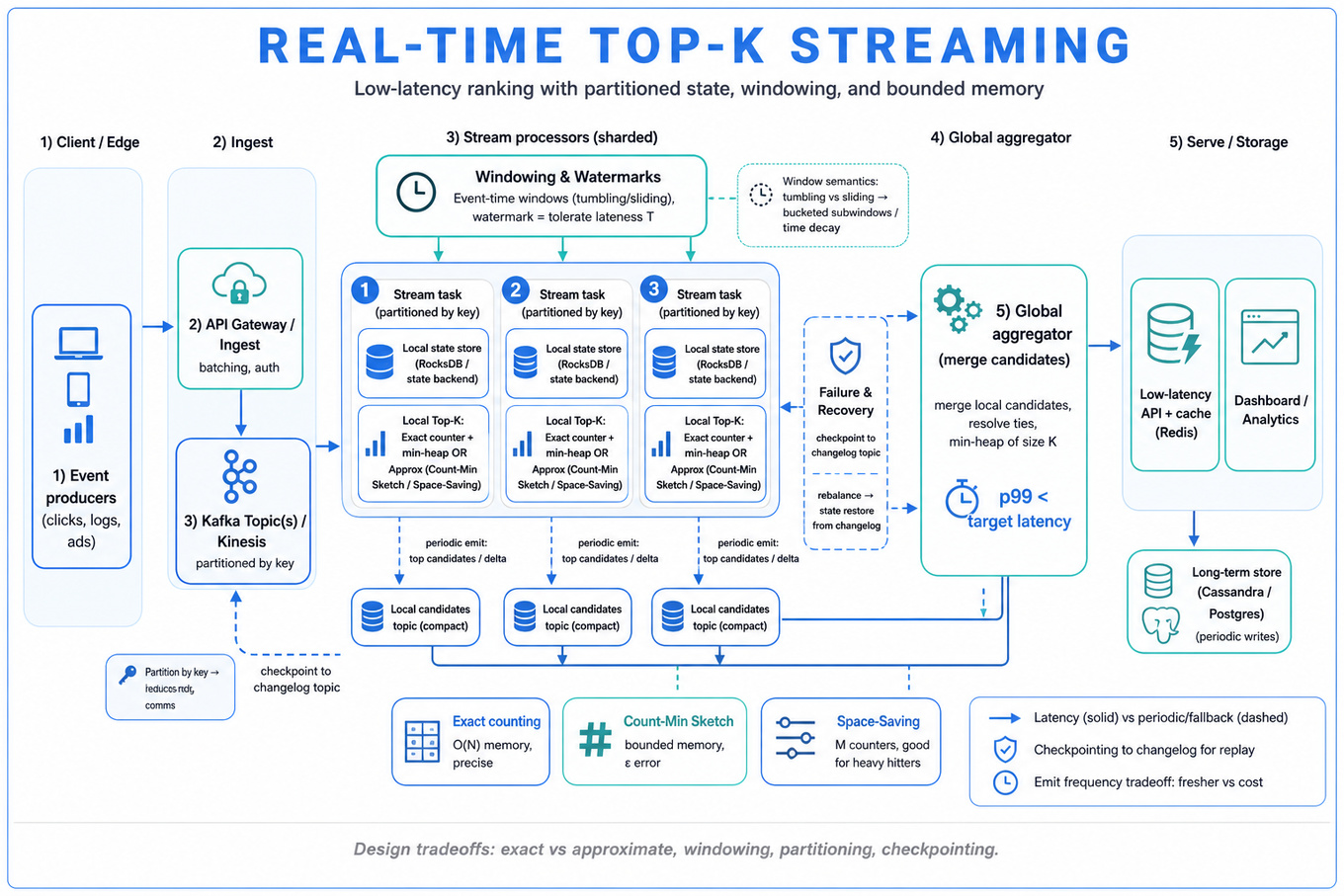
Partitioning strategy decides scalability. Hash partition by item key when aggregating counts for each key, then periodically emit local top-K candidates to a global reducer. Partitioning by user or session helps deduplication, but final top-K by item then requires a second aggregation stage.
-
Hot keys are a real failure mode. If one product, log category, or query prefix receives 30% of traffic, a single partition can overload. Mitigations include key salting, local pre-aggregation, adaptive partitioning, or separating ultra-hot keys into dedicated paths.
-
State management needs a clear recovery story. Stream processors like
`Apache Flink`,`Kafka Streams`, or`Spark Structured Streaming`keep local state backed by checkpoints or changelogs. Without checkpointing, a worker crash can reset counts or double-apply replayed events. -
Idempotency and deduplication matter for click and log systems. If producers retry, events may arrive twice; use an event ID, request ID, or composite key like
(user_id, item_id, timestamp, nonce)with bounded dedup state. Exact dedup across an infinite stream is impossible without unbounded memory. -
Serving path should be separated from computation. The streaming job writes materialized results like
(window, dimension, rank, item, count)to a low-latency store such as`Redis`,`DynamoDB`,`Cassandra`, or`OpenSearch`; read APIs should not scan raw events to answer top-K. -
Freshness versus correctness is a first-class tradeoff. For example, serving provisional top-K every second with watermark-corrected final values later may be better than waiting two minutes for perfect completeness. Make the SLA explicit: “results within 5 seconds, tolerate 0.5% error, late events included for 10 minutes.”
-
Autocomplete top-K combines streaming counts with prefix indexing. A common approach stores a trie or prefix table where each prefix maps to top suggestions; updates increment query/item counts and refresh affected prefixes. This is fast for reads but expensive for writes because one term touches prefixes.
Worked example
For Design rolling-window top-K click tracker, start by clarifying the API and SLA: “Are we returning top-K items globally or per advertiser/category? What is the window length, expected QPS, acceptable staleness, and do clicks have unique IDs?” Then declare assumptions, such as 1M clicks/sec, 15-minute sliding window, K=100, results refreshed every second, and late events accepted for 2 minutes.
A strong answer can be organized around four pillars: ingestion, aggregation, state/windowing, and serving. For ingestion, describe clients or edge services publishing click events into `Kinesis` or `Kafka`, with event ID, item ID, timestamp, and optional dimensions. For aggregation, use a stream processor such as `Flink` that partitions by item ID and maintains per-item counts in small time buckets, for example 900 one-second buckets for a 15-minute window. For top-K, each partition computes local candidates, then a second-stage reducer merges candidates and publishes the global ranked list.
The key design decision is exact versus approximate. Exact rolling counts require maintaining all active item counts and expiring old buckets, which is straightforward if active item cardinality is manageable; for very high cardinality, use Space-Saving or Count-Min Sketch to bound memory, while clearly explaining possible ranking errors near the cutoff. Serving should use a materialized store like `Redis` sorted sets or a `DynamoDB` table keyed by window and dimension, not recompute from raw clicks per request. Close by saying that with more time you would cover multi-region failover, backfill/reconciliation from durable logs, and observability metrics like ingestion lag, watermark lag, dropped duplicates, and `p99` query latency.
A second angle
For Implement autocomplete with top-K suggestions, the same core idea appears, but the read path becomes more latency-sensitive and prefix-specific. Instead of computing one global top-K, you maintain top suggestions for many prefixes, often with a trie, finite-state transducer, or prefix-to-candidates index. Updates are more expensive because a query like “headphones” affects h, he, hea, and every longer prefix, so many systems batch updates or separate real-time trending boosts from a slower offline rebuild. The tradeoff shifts from stream-window correctness to memory layout, Unicode normalization, case folding, deletion handling, and sub-10ms lookup latency.
Common pitfalls
Pitfall: Treating top-K as “just sort all events.”
Sorting raw events or scanning all counts on every query is the tempting simple answer, but it fails immediately at streaming scale. A better answer maintains incremental state: counters, heaps, sketches, or precomputed materialized rankings that make reads cheap.
Pitfall: Ignoring window and time semantics.
Saying “keep a counter per item” is incomplete if the question asks for a rolling 5-minute or 24-hour view. You need to explain how counts expire, whether timestamps use event time or processing time, and what happens to late events after a watermark.
Pitfall: Naming technologies without showing data flow.
An answer like “use `Kafka`, `Flink`, and `Redis`” sounds plausible but shallow. Interviewers want to hear what each component does, what state it owns, how data is partitioned, how failures are recovered, and where the top-K is actually computed.
Connections
Interviewers often pivot from streaming top-K into rate limiting, distributed counters, leaderboards, log analytics, or search/autocomplete indexing. They may also ask about consistency models, checkpointing, backpressure, or approximate data structures such as Bloom filters, HyperLogLog, Count-Min Sketch, and reservoir sampling.
Further reading
-
Streaming Systems by Tyler Akidau, Slava Chernyak, and Reuven Lax — the best practical treatment of event time, watermarks, windows, and triggers.
-
Count-Min Sketch paper: “An Improved Data Stream Summary” — foundational algorithm for approximate frequency estimation in large streams.
-
Space-Saving algorithm: “Efficient Computation of Frequent and Top-k Elements in Data Streams” — directly relevant to memory-bounded heavy-hitter tracking.
Featured in interview prep guides
Practice questions
- Design device telemetry pipeline for real-time and batchMicrosoft · Software Engineer · Online Assessment · medium
- Design a log filtering and analytics serviceAmazon · Software Engineer · Technical Screen · hard
- Design real-time top-K products serviceAmazon · Software Engineer · Technical Screen · hard
- Implement autocomplete with top-K suggestionsAmazon · Software Engineer · Onsite · medium
- Maintain real-time top-K products from eventsAmazon · Software Engineer · Onsite · medium
- Design rolling-window top-K click trackerAmazon · Software Engineer · Onsite · medium
- Design ad clickstream analytics pipelineAmazon · Software Engineer · Onsite · hard
Related concepts
- Top-K Queries And Streaming AggregationCoding & Algorithms
- Streaming Aggregation And Top-K SelectionCoding & Algorithms
- Heaps, Streaming Median, and Top-K SelectionCoding & Algorithms
- Top-K Frequency TrackingCoding & Algorithms
- Top-K Ranking And SelectionSystem Design
- Top-K Selection And Order StatisticsCoding & Algorithms