SQL Window Functions, Cohorts, And Retention
Asked of: Product Manager
Last updated
What's being tested
Two skills: the ability to translate product questions into cohort-based SQL analyses and to implement them using window functions and date-bucketing so you can produce accurate cohort and retention metrics. Interviewers probe whether you know the canonical SQL idioms (first-touch cohorting, deduping, time-delta joins) and can avoid common analytic mistakes that mislead product decisions.
Patterns & templates
-
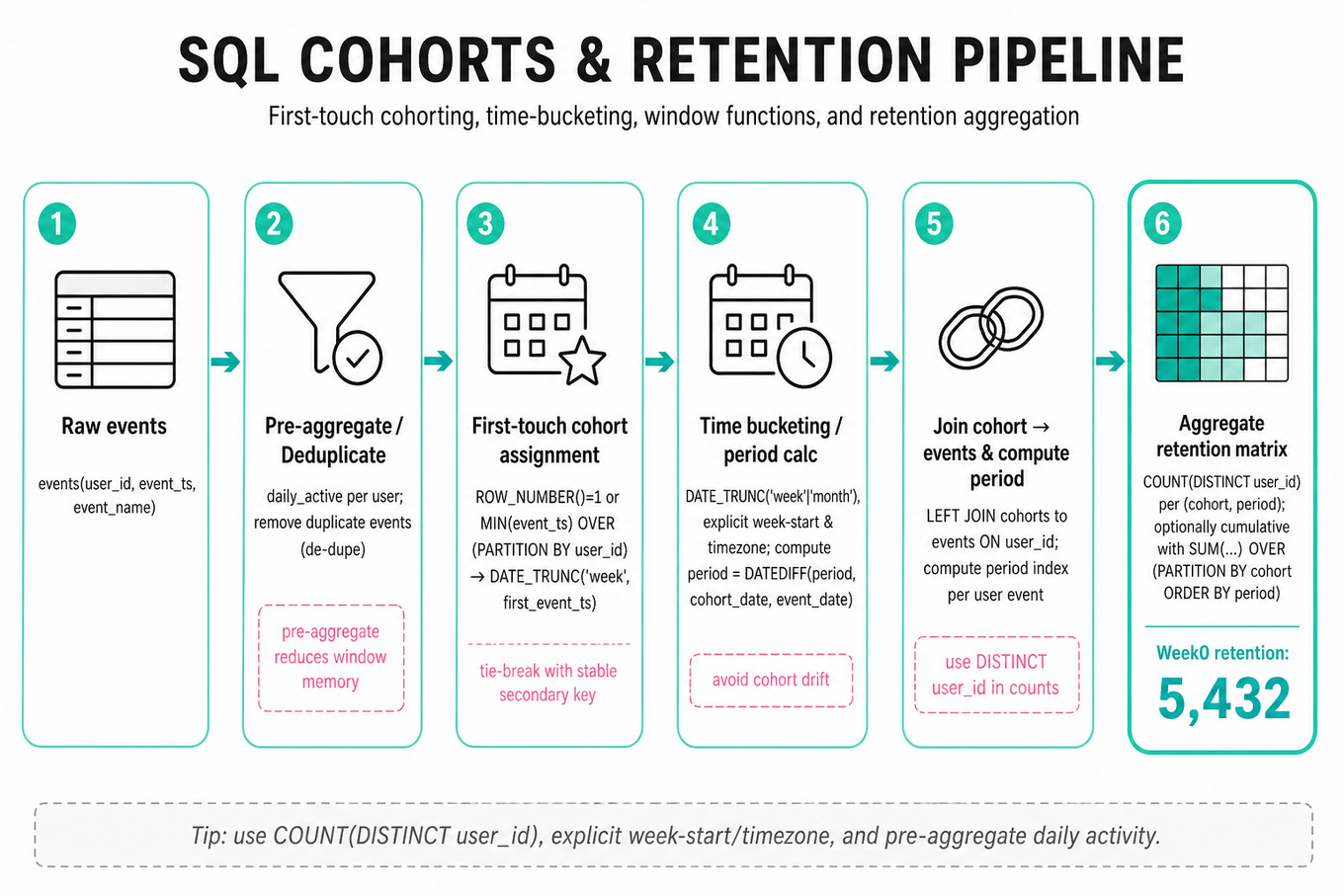
ROW_NUMBER():ROW_NUMBER() OVER (PARTITION BY user_id ORDER BY event_ts)to pick each user's first or last event; ties broken by stable secondary key. -
First-touch cohort: use
MIN(event_ts) OVER (PARTITION BY user_id)orROW_NUMBER=1thenDATE_TRUNC('week', first_event_ts)to assign cohorts. -
Retention matrix: left-join cohort users to subsequent events on
user_idand computeDATEDIFF/date_diffinto discrete periods, thenCOUNT(DISTINCT user_id)per (cohort, period). -
LAG()/LEAD(): detect returns or churn by comparing consecutive events per user;LAG(event_date) OVER (PARTITION BY user_id ORDER BY event_date). -
Cumulative vs periodic: use
SUM(active_flag) OVER (PARTITION BY cohort ORDER BY period ROWS BETWEEN UNBOUNDED PRECEDING AND CURRENT ROW)for cumulative retention. -
Time bucketing: prefer
DATE_TRUNC('day'|'week'|'month', ts)and be explicit about week-start and timezone to avoid cohort drift. -
Performance: pre-aggregate events to daily active per user before heavy window ops;
O(events)scanning but window ops can add memory pressure.
Common pitfalls
Pitfall: Counting
COUNT(*)instead ofCOUNT(DISTINCT user_id)inflates retention by double-counting multiple events per user.
Pitfall: Assigning cohorts by last event or arbitrary event instead of first-touch misattributes acquisition and retention.
Pitfall: Ignoring timezone / week-start differences yields cohort leakage across boundaries and inconsistent trends.
Practice these
The practice cards below cover the canonical variants — solve all of them and time yourself.
Related concepts
- SQL Cohort, Retention, And Churn AnalysisData Manipulation (SQL/Python)
- Cohorts And Window Functions In SQL
- SQL Window Functions And AnalyticsData Manipulation (SQL/Python)
- SQL Window Functions And Analytical QueryingData Manipulation (SQL/Python)
- Cohort, Funnel, And Retention Analysis
- Window Functions, Cohorting, and Time Series SQL