Databricks Software Engineer Interview Prep Guide
Everything Databricks actually asks Software Engineer candidates — concept walkthroughs, worked examples, and the real interview questions, drawn from candidate reports. Free to read.
Last updated
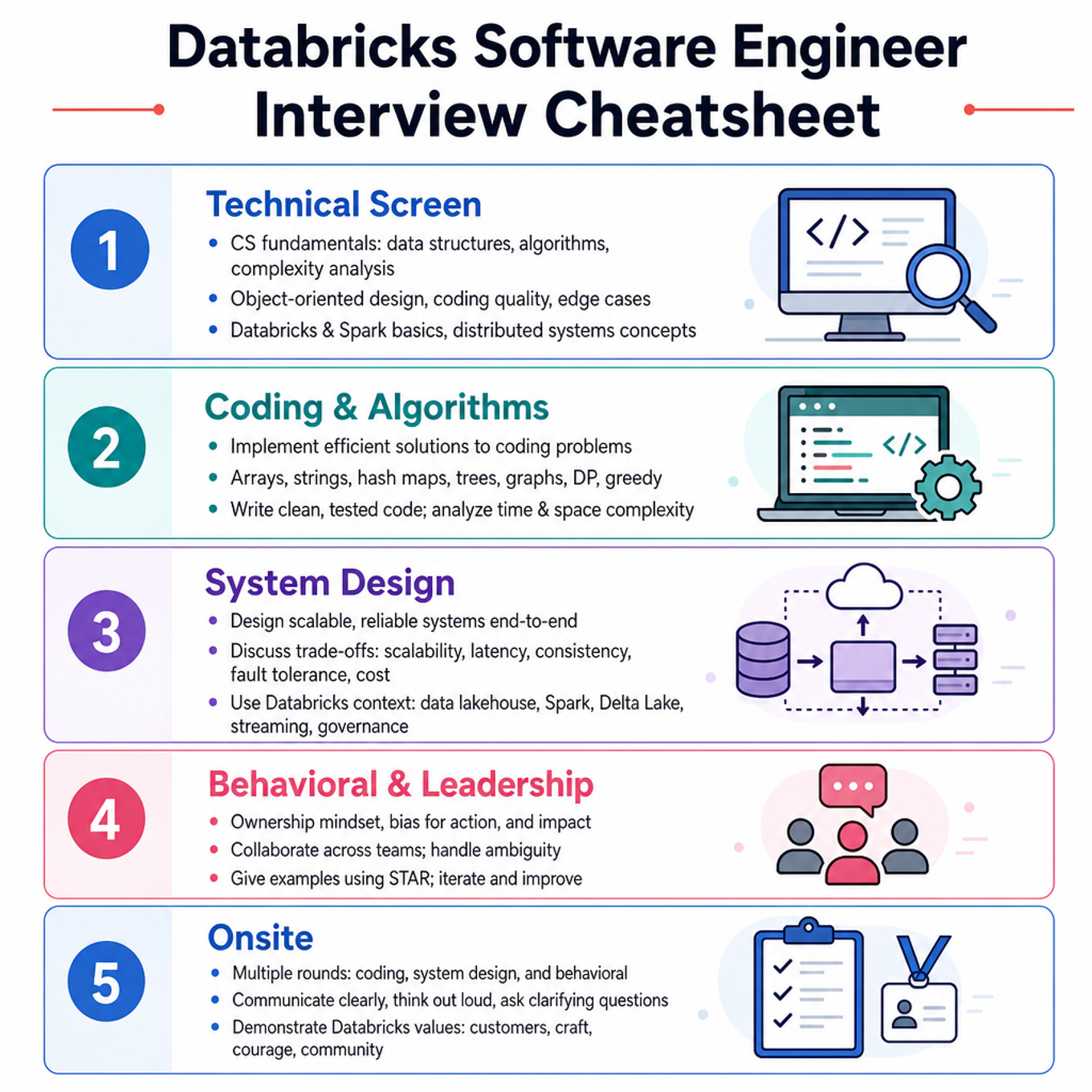
Technical Screen
Coding & Algorithms
-
IPv4 CIDR Rule Matching — covered in depth under Onsite below.
-
Sliding Window Counters And QPS — covered in depth under Onsite below.
-
Snapshotable Collections And Iterators — covered in depth under Onsite below.
What's being tested
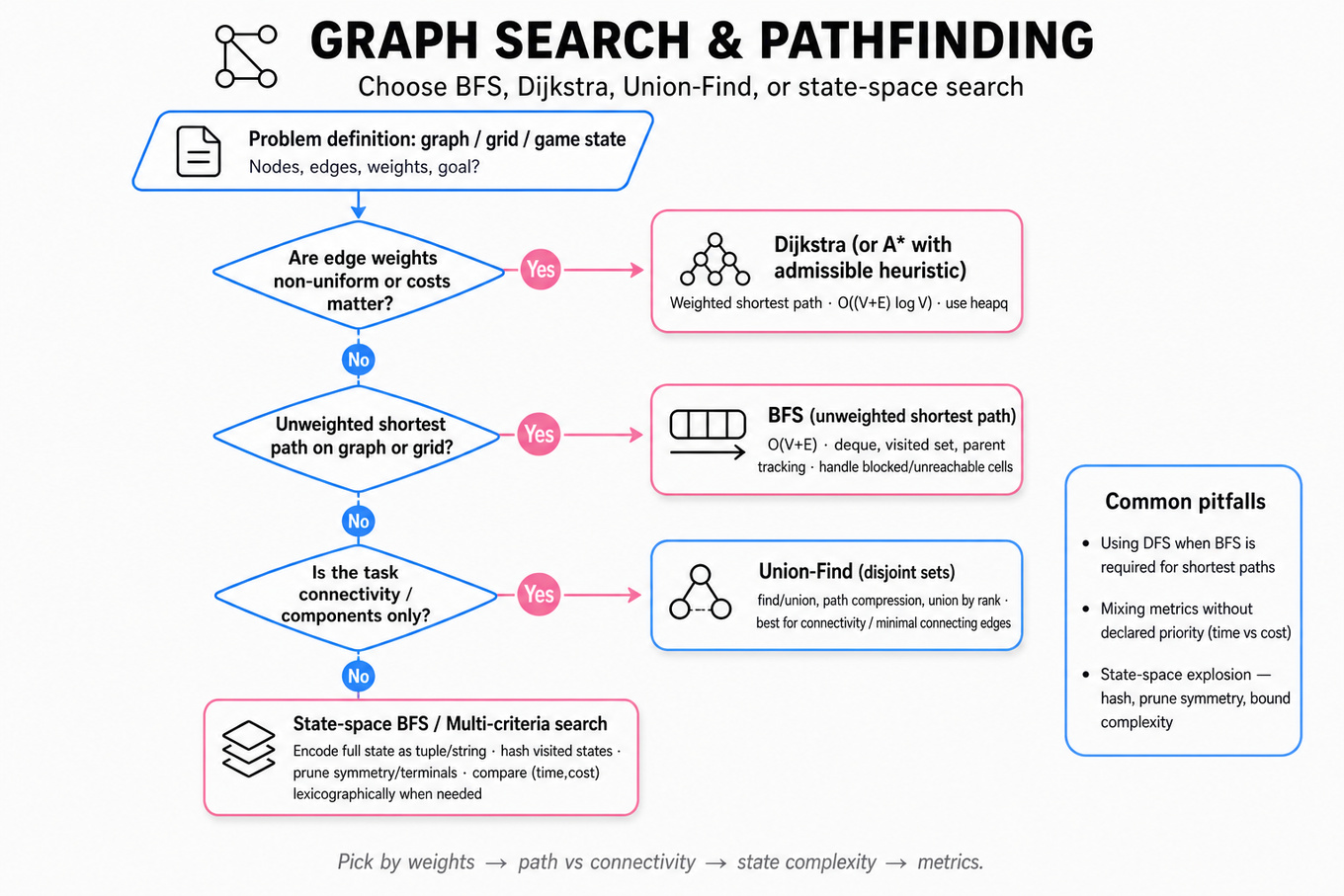
Databricks is testing graph traversal, shortest-path reasoning, and state-space search under constraints. You need to recognize when to use BFS, Dijkstra, Union-Find, randomized sampling, or dynamic programming over graph-like states, then justify complexity and edge-case behavior.
Patterns & templates
-
BFS on unweighted graphs/grids —
O(V + E)time; usedeque, visited set, parent tracking; handle blocked cells and unreachable targets. -
Dijkstra for weighted paths —
O((V + E) log V)withheapq; required when edge weights represent time, cost, or transfer penalties. -
Multi-criteria optimization — compute feasible paths per mode, compare lexicographically by
(time, cost)or declared priority; avoid mixing metrics prematurely. -
State-space BFS — encode game boards or decisions as immutable tuples/strings; hash visited states; prune terminal wins/losses early.
-
Union-Find connectivity —
find,union, path compression, union by rank; ideal for connecting components or validating minimal connecting edges. -
Grid-to-graph modeling — map
(r, c)cells to neighbors lazily; avoid materializing all edges unless repeated queries justify preprocessing. -
Random spanning connectivity — connect
kcomponents with exactlyk-1edges; sample uniformly only if every valid construction has equal probability.
Common pitfalls
Pitfall: Using DFS when shortest path in an unweighted graph is required; BFS is the correctness argument, not just an implementation choice.
Pitfall: Treating “best path” as a single scalar without clarifying whether time, cost, transfers, or mode restrictions dominate.
Pitfall: Forgetting that game-tree BFS can explode exponentially; discuss hashing, symmetry reduction, terminal-state pruning, and worst-case bounds.
Practice these
The practice cards below cover the canonical variants — solve all of them and time yourself.
Practice questions
What's being tested
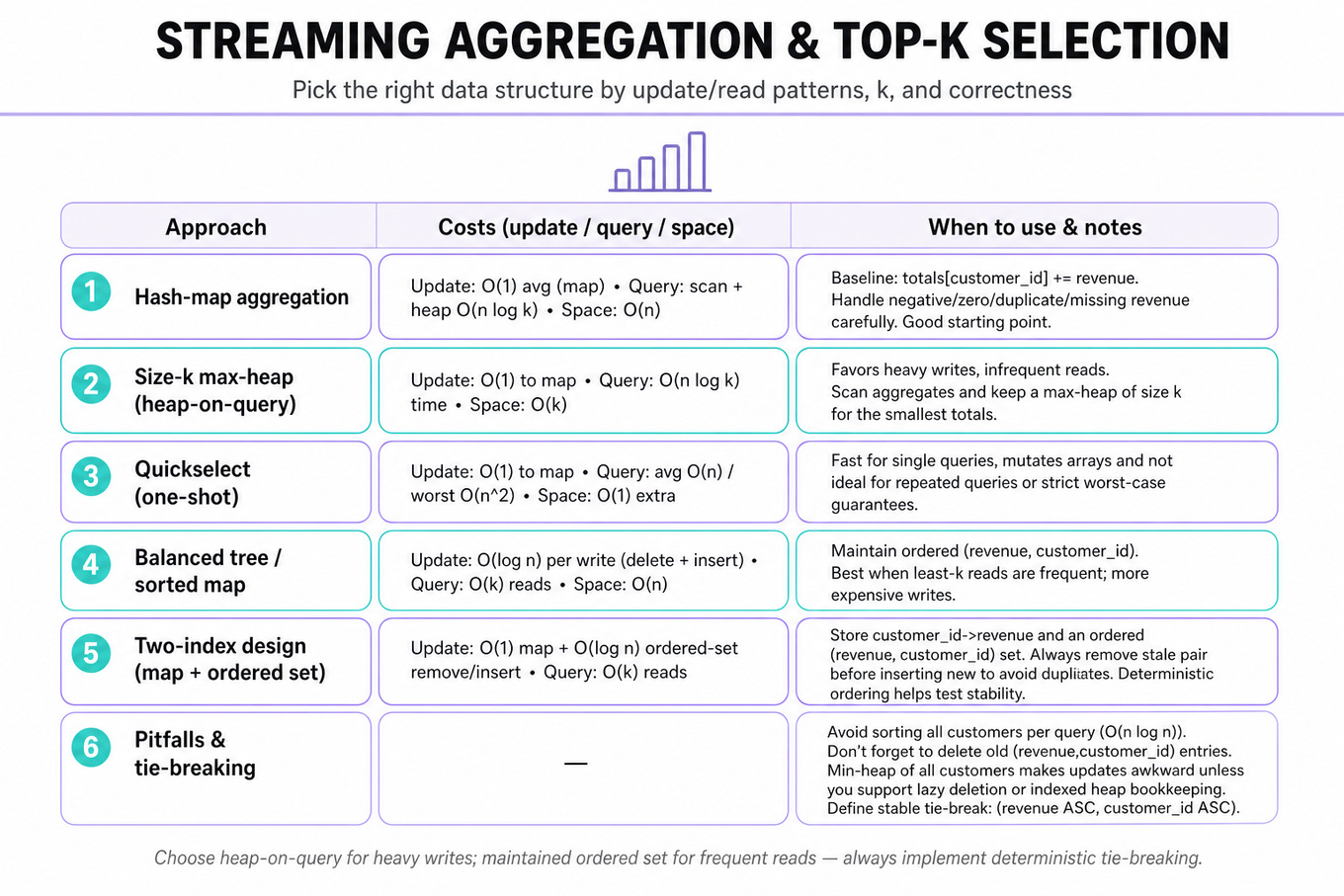
This tests streaming aggregation plus top-k selection over changing per-customer totals. You need to aggregate events into a customer_id -> revenue map, then return the k smallest totals efficiently under different read/write patterns.
Patterns & templates
-
Hash-map aggregation — maintain
totals[customer_id] += revenueinO(1)average update time; handle negative, zero, duplicate, and missing revenue carefully. -
Size-k max-heap for least-k — scan aggregates, keep heap of k largest among current smallest;
O(n log k)time,O(k)space. -
Quickselect — partition totals to find kth-smallest in average
O(n)time; useful for one-shot queries but mutates arrays and has worst-caseO(n^2). -
Balanced tree / sorted map — maintain
(revenue, customer_id)ordering with delete+insert per update;O(log n)writes,O(k)reads. -
Two-index design — store both
customer_id -> revenueand ordered(revenue, customer_id)entries; update requires removing stale pair before inserting new pair. -
Read/write tradeoff — heap-on-query favors heavy writes/light reads; maintained ordered set favors frequent least-k reads with moderate update volume.
-
Tie-breaking — define deterministic ordering, usually
(revenue ASC, customer_id ASC), to avoid flaky tests and unstable output.
Common pitfalls
Pitfall: Sorting all customers for every query is
O(n log n)and often fails when k is small or queries are frequent.
Pitfall: Updating revenue in a tree without deleting the old
(revenue, customer_id)entry leaves duplicate stale values.
Pitfall: Using a min-heap of all customers gives easy reads but awkward arbitrary updates unless you support lazy deletion or indexed heap bookkeeping.
Practice these
The practice cards below cover the canonical variants — solve all of them and time yourself.
Practice questions
System Design
-
Durable Key-Value Stores And Caches — covered in depth under Onsite below.
-
Concurrency Control And Thread Safety — covered in depth under Onsite below.
Behavioral & Leadership
- Behavioral Communication And Ownership — covered in depth under Onsite below.
Onsite
Coding & Algorithms

What's being tested
IPv4 CIDR rule matching tests bit-level reasoning, parsing, and choosing the right lookup structure for prefix/range containment. Interviewers probe whether you can implement correctness first, then scale from linear scans to prefix tries, sorted ranges, or bucketed lookups with clear rule-priority semantics.
Patterns & templates
-
IPv4 parsing via
`ip_to_int(s)`— split four octets, validate0..255, compute(a<<24)|(b<<16)|(c<<8)|d; use unsigned 32-bit logic. -
CIDR containment with masks — for
a.b.c.d/p,mask = (0xffffffff << (32-p)) & 0xffffffff; match when(ip & mask) == (base & mask). -
Range conversion — CIDR block maps to
[start, end], wherestart = base & mask,end = start | (~mask & 0xffffffff); useful for interval search. -
Linear scan baseline —
O(R)per query,O(R)space; acceptable if rule count is small or “first matching rule wins” dominates. -
Binary trie for longest-prefix match — insert 32 bits, store rule/action at nodes; query in
O(32)time, spaceO(total prefix bits). -
Priority handling — distinguish first rule wins, last rule wins, and longest prefix wins; store insertion index or best-so-far metadata explicitly.
-
Dynamic updates — trie insert/delete is
O(32); sorted interval structures need rebalancing and careful overlap handling.
Common pitfalls
Pitfall: Treating IPs as strings causes wrong ordering and containment; always normalize to a 32-bit integer before comparison.
Pitfall: Mishandling
/0and/32;/0matches everything, while/32matches exactly one address.
Pitfall: Optimizing before clarifying semantics; “first CIDR block covering IP” and “longest-prefix firewall rule” require different lookup behavior.
Practice these
The practice cards below cover the canonical variants — solve all of them and time yourself.
Practice questions

What's being tested
These problems test time-windowed aggregation: maintaining counts, rates, or averages over the last seconds without scanning all historical events. Interviewers look for clean data structure tradeoffs, correct expiry logic, and complexity analysis under monotonic timestamps, timestamp collisions, and high event volume.
Patterns & templates
-
Circular bucket array — store
(timestamp, count)per second;hit(t)andget(t)areO(1)/O(W), spaceO(W). -
Lazy bucket reset — when
t % Wis reused, reset bucket if stored timestamp differs; prevents stale counts from leaking. -
Deque of timestamps/events — append on hit, pop expired while
front <= now - W; amortizedO(1), space proportional to recent hits. -
Aggregated deque buckets — store
(bucketStart, count)for sparse streams or range queries; merge same bucket, evict old buckets. -
Running total optimization — maintain
totalalongside buckets/deque sogetCount()isO(1)after evicting expired entries. -
QPS formula — average QPS is
events_in_window / window_seconds; clarify whether denominator is fixedWor elapsed warm-up time. -
Per-key counters — use
Map<Key, Counter>for KV-store variants; evict inactive keys if memory bounds matter.
Common pitfalls
Pitfall: Forgetting timestamp collisions in modulo buckets;
t % Walone is not enough without storing the bucket’s real timestamp.
Pitfall: Off-by-one expiry errors; define whether the valid interval is
(now - W, now]or[now - W, now].
Pitfall: Claiming
O(1)queries while summing allWbuckets each time; either admitO(W)or maintain a running total.
Practice these
The practice cards below cover the canonical variants — solve all of them and time yourself.
Practice questions
What's being tested
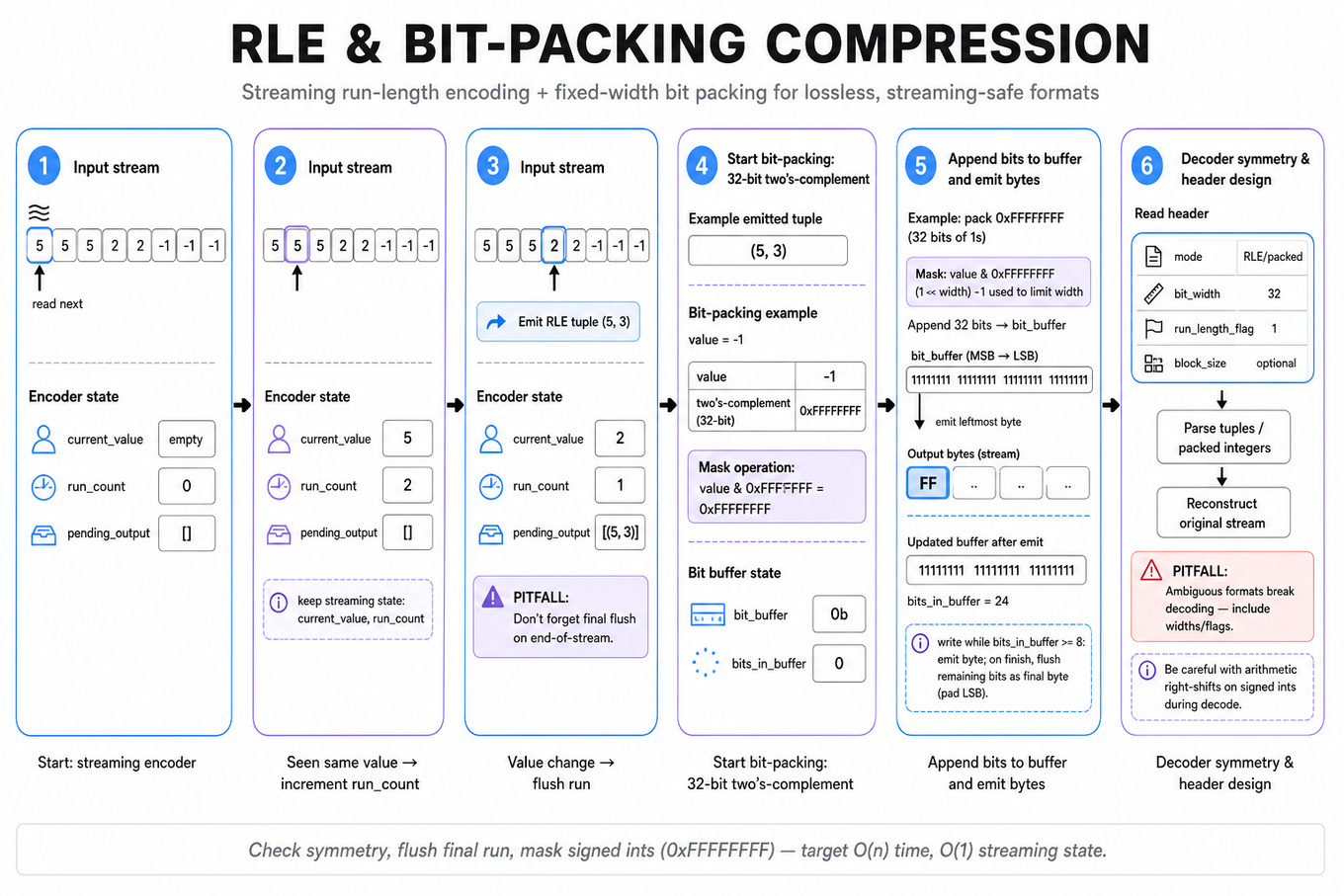
Tests lossless compression implementation with careful state management, bit manipulation, and edge-case handling. Strong answers show clean encoder/decoder symmetry, correct handling of 32-bit signed integers, and streaming-safe APIs that do not require loading all input into memory.
Patterns & templates
-
Run-length encoding groups consecutive equal values as
(value, count);encode_rleanddecode_rleareO(n)time with small state. -
Streaming RLE keeps
current_value,run_count, andpending_output; flush on value change, count limit, or end-of-stream. -
Bit packing stores fixed-width integers using
bit_buffer,bits_in_buffer, and masks like(1 << width) - 1; encode/decode areO(n). -
Signed integer handling requires preserving two’s-complement representation; mask with
0xFFFFFFFFbefore packing and reinterpret on decode. -
Header design separates metadata from payload: store mode, bit width, run length, or block size so decoder can unambiguously parse bytes.
-
Decoder symmetry matters: every encoder write path needs a corresponding read path; test round-trips with
decode(encode(x)) == x. -
Complexity target is
O(n)time andO(1)toO(block_size)auxiliary space; avoid string concatenation or per-bit arrays for large inputs.
Common pitfalls
Pitfall: Forgetting to flush the final RLE run produces correct output for mid-stream transitions but loses the last value.
Pitfall: Using arithmetic right shift or signed casts inconsistently can corrupt negative numbers during bit-packing decode.
Pitfall: Designing an ambiguous format, such as writing counts and values without delimiters, widths, or block metadata, makes decoding impossible.
Practice these
The practice cards below cover the canonical variants — solve all of them and time yourself.
Practice questions

What's being tested
Tests versioned collection design: preserving stable iterator views while the underlying set mutates. You must demonstrate clear iterator semantics, complexity tradeoffs, and an implementation that handles add/remove/re-add without leaking deleted state into active snapshots.
Patterns & templates
-
Copy-on-iterator snapshot —
`iterator()`copies current elements into an array/list;O(n)creation,O(1)next, simplest correctness story. -
Copy-on-write set — clone backing
`HashSet`before mutation when snapshots exist; good when reads dominate, costly for frequent writes. -
Operation log with versions — store
`addVersion`/`removeVersion`per element; iterator captures`snapshotVersion`, filters by visibility inO(1)orO(log k). -
Reference-counted snapshots — track active iterators; defer cleanup of tombstoned elements until all older snapshots are closed or exhausted.
-
Stable iterator contract — define whether
`hasNext()`is idempotent, whether iteration order matters, and whether mutations during iteration are visible. -
Complexity framing — compare
`add`,`remove`,`contains`,`iterator`,`next`; strong answers explicitly optimize for expected read/write ratio.
Common pitfalls
Pitfall: Returning a raw
`HashSet`iterator gives fail-fast or live-view behavior, not snapshot semantics.
Pitfall: Treating remove as physical deletion immediately breaks older iterators that still need to see the element.
Pitfall: Ignoring re-add after remove; visibility must depend on version intervals, not just current membership.
Practice these
The practice cards below cover the canonical variants — solve all of them and time yourself.
Practice questions
System Design

What's being tested
Databricks is probing whether you can design storage-backed, concurrent key-value systems with clear APIs, predictable failure behavior, and justified performance tradeoffs. A strong answer covers both the data path (get, put, delete) and the failure path: crash recovery, partial writes, fsync semantics, corruption, and concurrent mutations. Interviewers are not looking for a production clone of `RocksDB`; they want to see whether you can reason from first principles about durability, in-memory indexing, eviction, synchronization, and time-windowed counters. This matters for a Software Engineer at Databricks because many platform components depend on local metadata stores, caches, execution-state stores, and high-QPS services where correctness under concurrency is as important as throughput.
Core knowledge
-
API shape should be explicit before internals:
get(key) -> Optional<Value>,put(key, value),delete(key), optionalcompareAndSwap(key, expectedVersion, newValue),ttl,scan(prefix), andflush. Clarify whether operations are single-key atomic, whether values are bytes or generic typed objects, and whether reads after writes must be immediately visible. -
Durability usually starts with a write-ahead log: append mutation records to disk before applying them to in-memory state. On restart, rebuild the in-memory map by replaying the log in order. The key invariant is: if
put(k,v)is acknowledged, the log record must survive a crash, typically requiringfsyncor group commit. -
Crash recovery requires handling torn writes and partial records. A common record format is
[magic][length][sequence_number][op][key][value][crc32]. During recovery, stop at the first invalid checksum or incomplete length-delimited record. Sequence numbers help resolve duplicate replay and preserve last-writer-wins ordering. -
On-disk layout tradeoffs are central. An append-only log gives fast writes, but unbounded disk growth; a hash index in memory maps keys to file offsets for fast reads. Periodic compaction rewrites only the latest value for each key and drops tombstones older than any active reader.
-
LSM-tree designs, like
`LevelDB`and`RocksDB`, use a mutable memtable, immutable sorted runs, and background compaction. They optimize write throughput and range scans but introduce read amplification and compaction stalls. A simple interview design can mention LSM as an extension, not start there unless range scans or large data volumes require it. -
B-tree designs, like many database indexes, update pages in place and are good for read-heavy workloads and range queries. They require careful page-level crash safety through journaling, copy-on-write, or WAL redo/undo. For an embeddable KV store with simple point lookups, append-only plus compaction is often easier to reason about.
-
Concurrency control must identify shared mutable state: the map, log file offset, LRU list, TTL heap, hit counters, and compaction metadata. A simple design uses a
ReadWriteLock: concurrentgets acquire read locks;put/deleteacquire write locks. Higher-throughput designs use lock striping by key hash plus a separate serialized log append path. -
Race conditions often come from compound operations: “check then insert,” LRU update during
get, TTL expiration while a writer updates the same key, or computing`QPS`while requests are being recorded. The fix is to define the linearization point: forput, it might be after WAL append succeeds and before the map pointer is swapped. -
Persistent cache design combines eviction policy with durability. A typical in-memory cache has
HashMap<Key, Node>plus a doubly linked list for LRU, givingO(1)get,put, and eviction. If persistence is required, evictions and updates must also be logged or the cache may resurrect evicted entries after restart. -
TTL semantics need precision. Store
expiresAt = now + ttlusing a monotonic clock where possible for in-process comparisons, but persist wall-clock timestamps if expiration must survive restart. Lazy expiration checks ongetare simple; proactive expiration uses a min-heap or timing wheel but adds concurrency complexity. -
Sliding-window QPS can be implemented with fixed-size time buckets. For a window seconds and bucket size , keep buckets containing request counts and timestamps. Average QPS is after ignoring stale buckets. Smaller buckets improve accuracy but increase update contention and memory.
-
Serialization and versioning matter for a generic store. Use a pluggable
`Serializer<T>`interface that returns bytes and can fail explicitly. Include a schema/version byte in records so future readers can decode old values. Avoid Java/Python object serialization as a default because it is brittle across code changes and unsafe for untrusted data.
Worked example
For Design a durable key-value store, start by clarifying scope in the first 30 seconds: “Is this single-node or distributed? Are keys and values bounded in size? Do we need range scans, TTL, transactions, or only single-key atomicity? What durability guarantee is expected after put returns?” Then declare a reasonable baseline: single-node embedded store, byte-array keys and values, point reads/writes, last-writer-wins, and durability for acknowledged writes.
Organize the answer around four pillars: API and guarantees, write/read path, recovery and compaction, and concurrency/performance. The write path is: serialize record, append to WAL, fsync according to policy, then update the in-memory hash index from key to latest value location. The read path is: check the in-memory index, seek to the offset if values are only on disk, or return directly if the full value is cached in memory.
For recovery, replay valid WAL records from the beginning or from the latest snapshot, rebuild the hash index, and stop at the first partial/corrupt record using a checksum. For compaction, write a new segment containing only the latest live records, atomically install a manifest pointing to the new segment, then delete old segments after no readers depend on them. A key tradeoff to flag is latency versus durability: calling fsync on every write gives strong guarantees but high `p99`; batching fsync every few milliseconds improves throughput but can lose recent acknowledged writes unless acknowledgments wait for the batch flush. Close by saying that with more time you would add checksummed segment files, background compaction scheduling, metrics for log size and recovery time, and optional compareAndSwap for conditional updates.
A second angle
For Design a single-node persistent in-memory cache, the same storage ideas apply, but the priority shifts from durable database semantics to bounded memory and fast access. The core structure is HashMap<Key, Entry> plus an LRU list or segmented LRU policy, with a WAL recording put, delete, and eviction events so restart reconstructs the same logical cache. The tricky part is that get mutates recency state, so a supposedly read-only operation can contend on the LRU lock. A strong design might batch recency updates, use sharded LRUs, or accept approximate LRU to reduce contention. Unlike the durable store, it is acceptable to discuss weaker durability if the cache can be rebuilt, but you must state that assumption explicitly.
Common pitfalls
Pitfall: Treating “durable” as “write to a file.”
Writing bytes to a file is not enough; data can sit in OS page cache, records can be partially written, and directory metadata may not be durable after rename. A better answer distinguishes write, flush, fsync, atomic rename, checksums, and recovery behavior after crashes at different points.
Pitfall: Ignoring the linearization point under concurrency.
A tempting but weak answer says “use a mutex” without explaining what operation becomes atomic. Interviewers may push with two threads doing put(k,1) and get(k) while a WAL append is in progress; you should define whether visibility happens before or after the log is durable and ensure the map and log cannot disagree for acknowledged operations.
Pitfall: Overdesigning into a distributed database.
Do not jump to sharding, consensus, quorum reads, or `Raft` unless the prompt asks for multiple nodes. For these interviews, a precise single-node design with WAL, compaction, locking, and recovery is usually stronger than a vague distributed architecture. If you mention distributed extensions, keep them as optional follow-ups.
Connections
Interviewers may pivot from here into thread-safe data structures, LSM-tree storage engines, cache eviction algorithms, rate counters, or idempotent APIs. They may also ask how this differs from using `Redis`, `RocksDB`, `SQLite`, or an in-process `ConcurrentHashMap`, so be ready to compare guarantees rather than just features.
Further reading
-
Designing Data-Intensive Applications — Martin Kleppmann’s chapters on storage, replication, and consistency give strong mental models for logs, indexes, and crash recovery.
-
The Log-Structured Merge-Tree — the foundational paper behind many write-optimized KV stores such as
`LevelDB`and`RocksDB`. -
RocksDB Wiki — practical details on WALs, memtables, compaction, write amplification, and performance tuning in a real embedded storage engine.
Practice questions
What's being tested
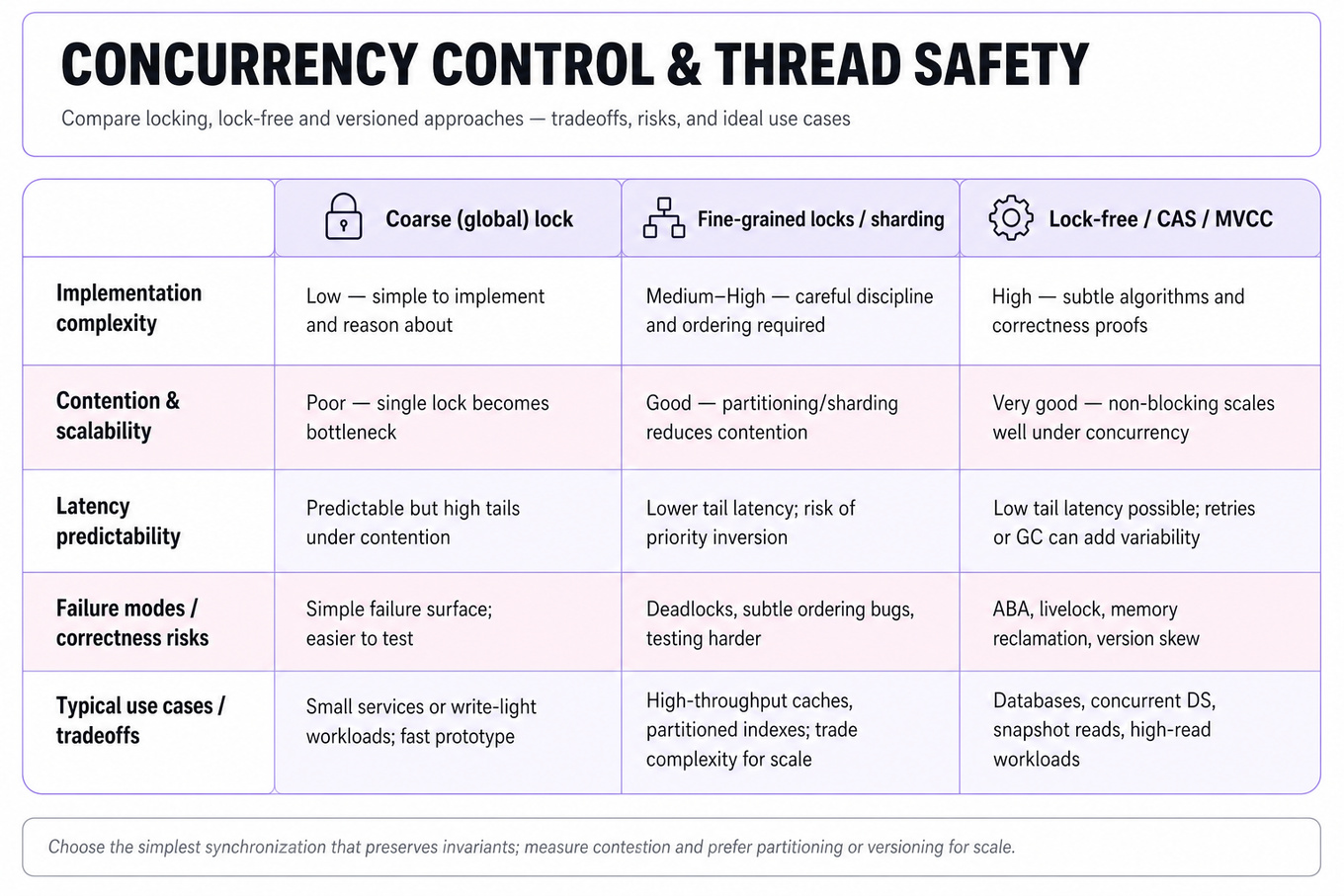
Interviewers are probing whether you can reason about shared mutable state under concurrent access without hand-waving away correctness. For Databricks, this matters because storage engines, metadata services, caching layers, and distributed execution components routinely serve many readers and writers while preserving durability, isolation, and predictable latency. A strong answer separates safety properties, like no lost updates or corrupted invariants, from liveness properties, like no deadlock, starvation, or unbounded blocking. The interviewer is usually looking for clear synchronization boundaries, explicit invariants, failure-mode analysis, and tradeoffs between coarse locking, fine-grained locking, lock-free techniques, and versioned designs.
Core knowledge
-
Thread safety means every public operation preserves the data structure’s invariants under arbitrary valid interleavings. Define the invariant first: queue size is always
0 <= size <= capacity, a key-value store index always points to a durable record, or a snapshot iterator observes a stable logical version. -
Race conditions happen when correctness depends on timing. The classic read-modify-write bug is
x = x + 1: two threads can read the same old value and lose one increment. Fixes include mutexes, atomic compare-and-swap, sharding counters, or redesigning the operation to be idempotent. -
Linearizability is the usual correctness target for concurrent in-memory APIs: every operation appears to take effect atomically at some instant between call and return. For example,
put(k, v)in a key-value store should have a clear linearization point, often the lock-protected index update or successfulCAS. -
Condition variables solve blocking coordination, not mutual exclusion by themselves. A bounded queue typically uses one mutex plus
notEmptyandnotFull; calls towait()must occur in awhileloop because of spurious wakeups and because another thread may consume the condition first. -
Backpressure is a correctness and stability tool. A bounded queue should define behavior for
enqueue: block forever, block until timeout, returnfalse, or throw. Capacity prevents unbounded memory growth, but poor wakeup policy can cause convoying or starvation under high producer/consumer contention. -
Lock granularity controls contention. A single global lock is simple and often sufficient up to moderate concurrency; striped locking hashes keys across, say, 64 or 256 locks to improve throughput. Fine-grained locks reduce contention but increase deadlock risk, complexity, and cache-coherence overhead.
-
Deadlock prevention requires a consistent lock order or avoiding nested locks. If a range cache locks chunk metadata and then an in-flight request map, every code path must acquire them in the same order. Timeouts detect symptoms but do not prove safety.
-
Read-write locks help only when reads dominate and read sections are nontrivial. They can hurt when writes are frequent, readers are short, or implementation favors readers and starves writers. For highly read-heavy maps, copy-on-write or RCU-style versioned snapshots may be cleaner.
-
MVCC and snapshot isolation let readers avoid blocking writers by reading immutable versions. A snapshotable set can store insert/delete version numbers per element, so an iterator at version
vreturns elements wherecreated <= v < deleted. This trades memory and garbage collection complexity for stable iteration. -
Write-ahead logging is the foundation of durability in a key-value store. The rule is: append the intent or record to the WAL and
fsyncas required before exposing the update in the in-memory index. Recovery replays committed log records; torn writes need checksums, lengths, and record boundaries. -
Atomicity across memory and disk is subtle. If
put(k, v)updates the in-memory index before the log is durable, a crash can expose acknowledged data that cannot be recovered. If the log is durable before the index update, recovery is safe because replay can rebuild the index. -
In-flight request deduplication is a concurrency-control pattern for caches. For a range-aware file cache, maintain a map like
(fileId, chunkId) -> Future; the first caller fetches the chunk, and later callers await the same future. On failure, remove the future so retries are possible.
Worked example
For Design a thread-safe bounded queue, a strong candidate starts by clarifying the API: enqueue(item, timeout), dequeue(timeout), size(), shutdown semantics, whether fairness is required, and whether null items are allowed. They would state assumptions early: fixed capacity, multiple producers and consumers, blocking operations with timeout, and linearizable behavior for successful operations. The answer can be organized around four pillars: internal state, synchronization strategy, blocking semantics, and edge cases.
The internal state is a circular buffer with head, tail, and count, where the invariant is 0 <= count <= capacity. The synchronization strategy is one mutex protecting all three fields, plus two condition variables: notFull for producers and notEmpty for consumers. enqueue waits in a while count == capacity loop, computes remaining timeout using a monotonic clock, inserts at tail, increments count, and signals notEmpty; dequeue mirrors this and signals notFull. The candidate should explicitly flag the tradeoff between signal() and broadcast(): signal() avoids thundering-herd wakeups, while broadcast() can be useful for shutdown or complex predicates.
A good answer also covers size(): either acquire the same mutex for exact linearizable size, or expose approximate size via an atomic counter if the API allows it. Fairness should be discussed separately from correctness; FIFO item order does not imply FIFO thread scheduling. To close, say that with more time you would add tests using randomized producer/consumer schedules, timeout boundary cases, interruption/shutdown behavior, and stress tests under tools like ThreadSanitizer or jcstress.
A second angle
For Design a durable key-value store, the same concept appears at the boundary between concurrent operations and crash recovery. Instead of only protecting an in-memory invariant like queue size, you must preserve a cross-layer invariant: acknowledged writes must survive process or machine crashes. A simple design uses a global write mutex around append WAL -> fsync policy -> update memtable/index, while concurrent readers use a read lock or immutable memtable snapshot. The key framing difference is that “thread-safe” is not enough: an update that is race-free in memory can still be incorrect if the crash happens after index mutation but before durable log persistence. The interviewer may push you toward higher throughput, where you discuss group commit, lock striping by key, immutable segments, and compaction coordination.
Common pitfalls
Pitfall: Treating
volatileor atomics as a universal replacement for locks.
Atomic visibility does not protect compound invariants like head, tail, and count moving together. A better answer says exactly which operations need mutual exclusion, which can use atomics safely, and where the linearization point is.
Pitfall: Describing a lock but not the waiting protocol.
For blocking structures, “use a mutex” is incomplete. You need to specify condition predicates, while-based waits, timeout recomputation, wakeup signaling, and what happens on shutdown, interruption, or cancellation.
Pitfall: Optimizing before proving correctness.
Jumping straight to lock-free queues, fine-grained range locks, or custom MVCC can sound sophisticated but often hides missing invariants. Start with a correct coarse-grained design, name its bottleneck, then evolve to striped locks, immutable snapshots, or in-flight future deduplication only when the workload justifies it.
Connections
Interviewers can pivot from this topic into storage engine design, especially WALs, memtables, compaction, and crash recovery. They may also move toward distributed concurrency control, including leases, optimistic concurrency, idempotency keys, and consensus-backed metadata updates. For coding-heavy follow-ups, expect implementation details around ReentrantLock, synchronized, std::mutex, Condition, Semaphore, or atomic CAS loops.
Further reading
-
The Art of Multiprocessor Programming by Herlihy and Shavit — rigorous treatment of linearizability, locks, nonblocking algorithms, and concurrent data structures.
-
Designing Data-Intensive Applications by Martin Kleppmann — excellent chapters on storage, transactions, isolation, logs, and distributed consistency tradeoffs.
-
SQLite Write-Ahead Logging documentation — practical example of WAL design, concurrent readers/writers, checkpoints, and durability tradeoffs.
Practice questions
Behavioral & Leadership
What's being tested
Interviewers are probing whether you can communicate clearly under ambiguity, take ownership of technical outcomes, and respond constructively when plans, feedback, or constraints change. For a Software Engineer at Databricks, this matters because engineers often work on complex distributed systems where correctness, performance, operability, and customer impact depend on crisp tradeoff communication. The interviewer is not just asking “are you nice to work with?”; they are testing whether you can explain technical scope, quantify impact, handle conflict without defensiveness, and make decisions when information is incomplete. Strong answers show a pattern: you clarify goals, expose assumptions, make a reasoned call, invite feedback, and own the result.
Core knowledge
-
Career narrative should be a 60–90 second technical story: domain, systems built, scale, hardest engineering problems, and measurable outcomes. A strong version sounds like: “I worked on
Goservices processing 50K requests/sec, reducedp99latency from 420ms to 180ms, and led the migration to async job execution.” -
Impact quantification is essential. Use before/after metrics: latency, throughput, availability, cost, developer velocity, incident rate, or correctness. Prefer concrete deltas: , such as “reduced cloud spend by 28%” or “cut build time from 35 minutes to 11 minutes.”
-
Ownership means taking responsibility for the full engineering outcome, not just your assigned ticket. For SWE interviews, that includes design review, implementation quality, rollout, monitoring, rollback plans, incident response, and post-launch fixes. Avoid implying that ownership means making unilateral decisions without alignment.
-
Technical communication should separate facts, assumptions, options, and recommendations. A good structure is: “The constraint is X, I see options A and B, A optimizes for latency while B reduces operational risk, so I recommend B unless correctness requires A.” This is especially important when discussing distributed systems tradeoffs.
-
Conflict resolution should be framed around shared technical goals, not personalities. If you disagreed with another engineer about
PostgresversusDynamoDB, synchronous versus asynchronous execution, or monolith versus service split, explain the evaluation criteria:p99latency, consistency model, operational complexity, team expertise, migration risk, and failure modes. -
Handling interviewer hints requires real-time alignment. If hints conflict, say what you heard, identify the contradiction, and ask which constraint to prioritize. For example: “Earlier we optimized for
O(n)time, but now the hint suggests sorting, which isO(n log n). Should I prioritize simplicity or preserve linear time?” -
Feedback receptiveness is judged by whether you changed behavior, not whether you accepted blame verbally. A strong answer includes the feedback, why it was valid, the adjustment you made, and the later result. Example: “My design docs were too implementation-heavy, so I added decision tables and failure-mode sections; review cycles dropped from three rounds to one.”
-
Project depth should include architecture and tradeoffs, not only business value. Be ready to describe data flow, APIs, storage, concurrency, retries, consistency, observability, and rollout strategy. For a
DatabricksSWE role, systems-oriented detail usually lands better than vague claims like “I improved platform reliability.” -
Ambiguity management means making progress while reducing uncertainty. Name your assumption explicitly, choose a reversible path when possible, and define a validation point. For example: “I assumed read traffic would grow 10x, so I chose horizontal sharding but delayed cross-region replication until metrics justified the added consistency complexity.”
-
Failure ownership is stronger than success-only storytelling. If a rollout caused elevated
5xxerrors or a bad migration increasedp99, describe detection, mitigation, root cause, and prevention. Use concrete mechanisms: feature flags, canary deploys,SLOalerts, dashboards, load tests, or postmortem action items. -
Leadership without authority matters for non-manager SWE candidates. Examples include driving an RFC, unblocking another team, mentoring a junior engineer through code reviews, standardizing an API contract, or coordinating an incident response. The key is influence through technical clarity, not title.
-
Databricks-specific signal comes from showing comfort with large-scale engineering environments: distributed compute, storage abstractions, multi-tenant services, developer platforms, and production reliability. You do not need to claim expertise in
Apache SparkorDelta Lake, but you should be able to discuss systems tradeoffs rigorously.
Worked example
For “How do you handle conflicting interviewer hints?”, a strong candidate first frames the situation calmly instead of treating it as a trick. In the first 30 seconds, say something like: “I want to make sure I’m incorporating your guidance correctly. I heard one hint suggesting we optimize for linear time, and another suggesting sorting; those imply different tradeoffs. Should I prioritize asymptotic efficiency, implementation simplicity, or a particular edge case?” The answer skeleton should have four pillars: acknowledge the conflict, restate the technical implications, ask a prioritization question, and proceed with a justified path.
In a coding or design setting, you might say: “If the input size is up to , O(n log n) sorting is probably acceptable and simpler; if it is or streaming, I’d preserve O(n) or incremental processing.” That shows you are not blindly following hints but reasoning about constraints. The tradeoff to flag explicitly is that interviewer hints may optimize for different evaluation dimensions: correctness, performance, simplicity, or exposing a concept they want to test. After clarifying, commit: “Given your preference for simplicity, I’ll use sorting first, then mention how I’d adapt it to linear time.” Close by saying: “If I had more time, I’d validate this against boundary cases and discuss when the alternative approach becomes necessary.”
The key behavioral signal is composure. You are showing that you can resolve ambiguity in real time without becoming defensive, ignoring feedback, or thrashing between approaches. In production engineering, the same skill appears when two reviewers, dashboards, or customer reports point in different directions.
A second angle
For “Describe project impact and critical feedback”, the same communication-and-ownership skill applies, but the emphasis shifts from real-time ambiguity to retrospective accountability. Start with the project context, your role, and the technical objective: for example, “I owned the migration of a synchronous job runner to an async queue-backed architecture using SQS, worker pools, and idempotent task execution.” Then quantify impact: “This reduced user-facing timeouts by 70% and improved p99 request latency from 2.1s to 600ms.”
The critical feedback should be specific and credible, not a disguised strength. For instance: “A senior engineer told me my initial design underestimated operational complexity around retries and duplicate execution.” Then explain the correction: idempotency keys, dead-letter queues, replay tooling, and alerting on retry exhaustion. This shows you can absorb criticism and translate it into better system design.
Common pitfalls
Pitfall: Giving a polished story with no technical substance.
A weak answer says, “I led a high-impact project that improved reliability and collaborated cross-functionally.” That sounds generic. A better answer names the system, the bottleneck, the design decision, the scale, and the metric: “I moved expensive aggregation out of the request path into an async pipeline, reducing p99 latency by 45% while keeping read-after-write behavior for critical endpoints.”
Pitfall: Treating conflict as a persuasion contest.
Do not frame disagreements as “I convinced everyone I was right.” Interviewers are looking for judgment and collaboration, not dominance. Say how you aligned on criteria, tested assumptions, or chose a reversible compromise: “We ran a load test, compared failure modes, and chose the simpler design because the added consistency guarantees were not needed for the first launch.”
Pitfall: Over-indexing on humility and losing ownership.
Some candidates describe every success as a team effort and every failure as circumstantial, which makes their personal contribution unclear. It is good to credit the team, but still state your specific actions: “I wrote the migration plan, implemented the dual-write path, added dashboards for mismatch rate, and coordinated the rollback criteria.”
Connections
Interviewers may pivot from this area into system design tradeoffs, especially if your project involved scaling, storage, APIs, or reliability. They may also ask follow-ups on debugging production incidents, code quality and review culture, or technical leadership without authority. Prepare one deep project that can support all of those directions with concrete design details and metrics.
Further reading
-
The STAR Method — Useful baseline structure for behavioral answers, but adapt it with technical metrics and tradeoffs.
-
Google SRE Book — Postmortem Culture — Strong reference for blameless ownership, incident communication, and learning from production failures.
-
Staff Engineer by Will Larson — Helpful for understanding technical leadership, influence, and ownership beyond assigned implementation tasks.
Practice questions