Two Sigma Software Engineer Interview Prep Guide
Everything Two Sigma actually asks Software Engineer candidates — concept walkthroughs, worked examples, and the real interview questions, drawn from candidate reports. Free to read.
Last updated
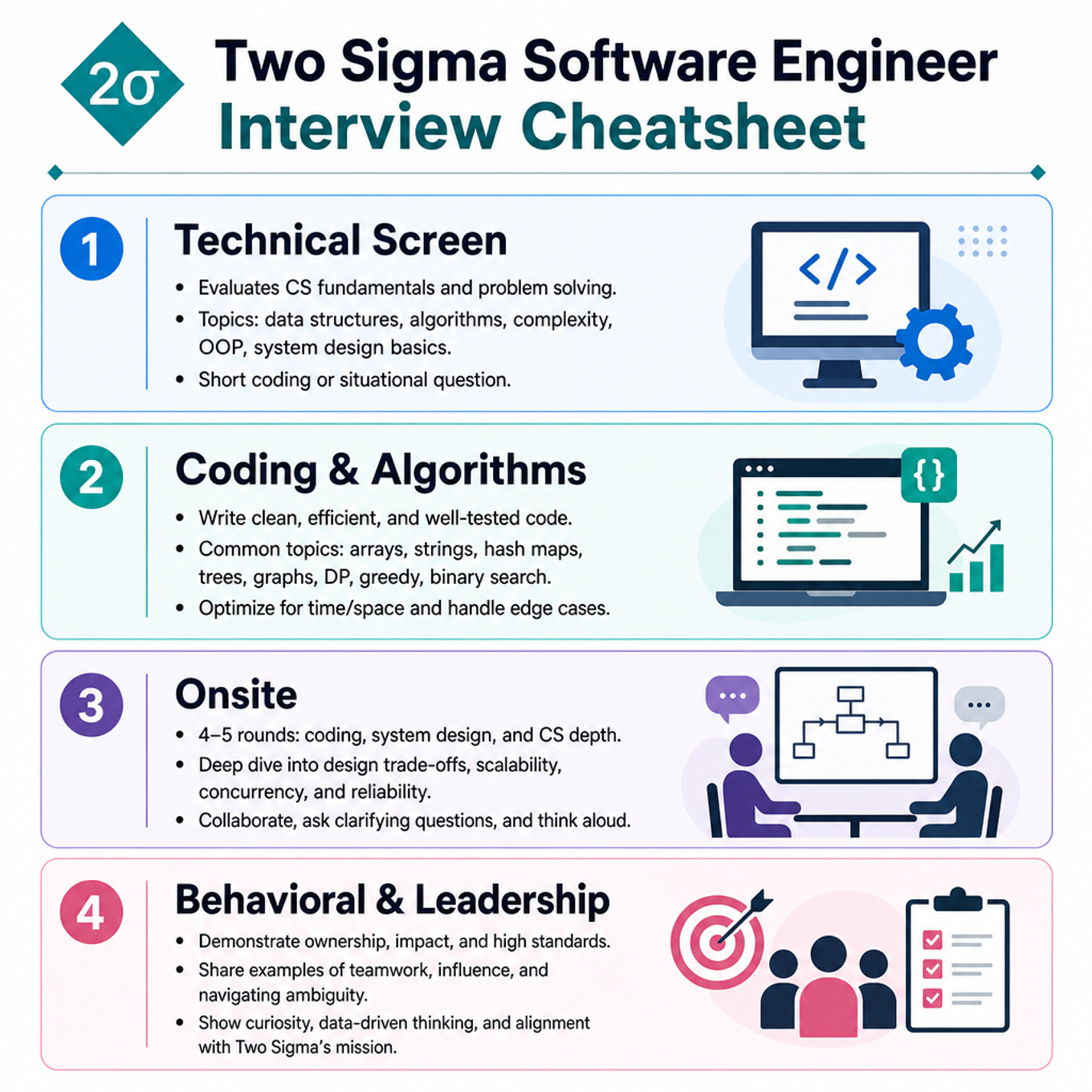
Technical Screen
Coding & Algorithms
-
Greedy Algorithms And Priority Queues — covered in depth under Onsite below.
-
Graph Search And Weighted Paths — covered in depth under Onsite below.
What's being tested
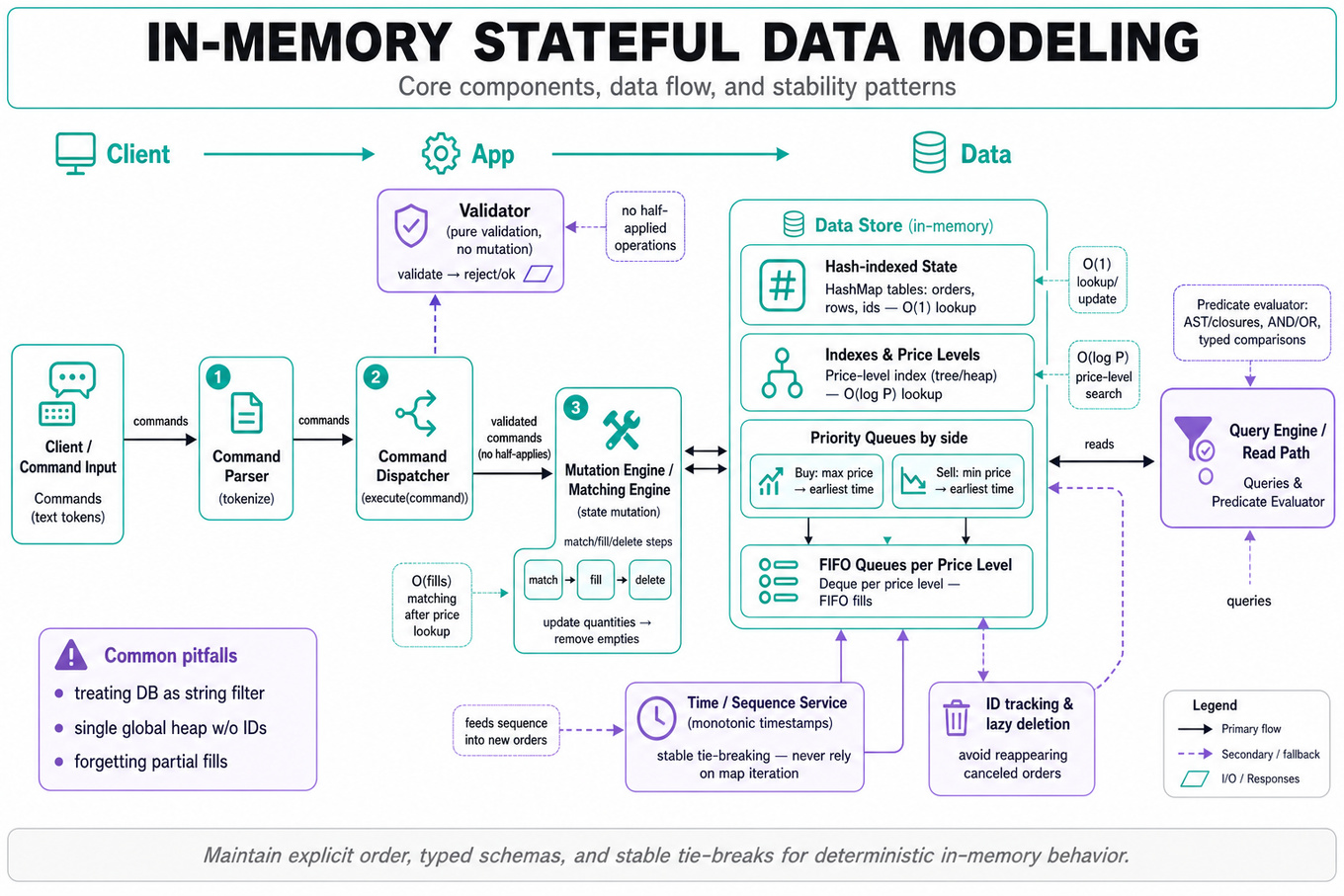
These problems test stateful in-memory modeling: maintaining mutable domain objects, applying commands in order, and returning correct query results after many updates. Interviewers are probing for clean data-structure design, deterministic tie-breaking, predicate evaluation, and careful handling of partial state changes.
Patterns & templates
-
Command dispatcher — parse tokens once, route via
execute(command), keep validation separate from mutation to avoid half-applied operations. -
Hash-indexed state — use
dict/HashMapfor tables, rows, orders, and IDs; targetO(1)lookup and update. -
Predicate evaluator — represent filters as small AST nodes or closures; support
AND/OR, comparison operators, and type-aware comparisons. -
Priority queues by side — buy book orders by max price then earliest time; sell book by min price then earliest time.
-
FIFO queues per price level — use
Dequefor price-time priority; matching isO(fills)afterO(log P)price-level lookup. -
Mutation ordering — compute match/fill/delete steps explicitly; update quantities before removing empty orders or price levels.
-
Stable tie-breaking — maintain monotonically increasing
timestamp/sequence number; never rely on unordered map iteration for deterministic output.
Common pitfalls
Pitfall: Treating an in-memory database like string filtering only; rows need schemas, typed values, missing-column behavior, and compound predicates.
Pitfall: Using one global heap for an order book without lazy deletion or ID tracking; canceled or partially filled orders can reappear incorrectly.
Pitfall: Forgetting partial fills; matching must handle buyer quantity, seller quantity, residual insertion, and exact exhaustion symmetrically.
Practice these
The practice cards below cover the canonical variants — solve all of them and time yourself.
Practice questions
What's being tested
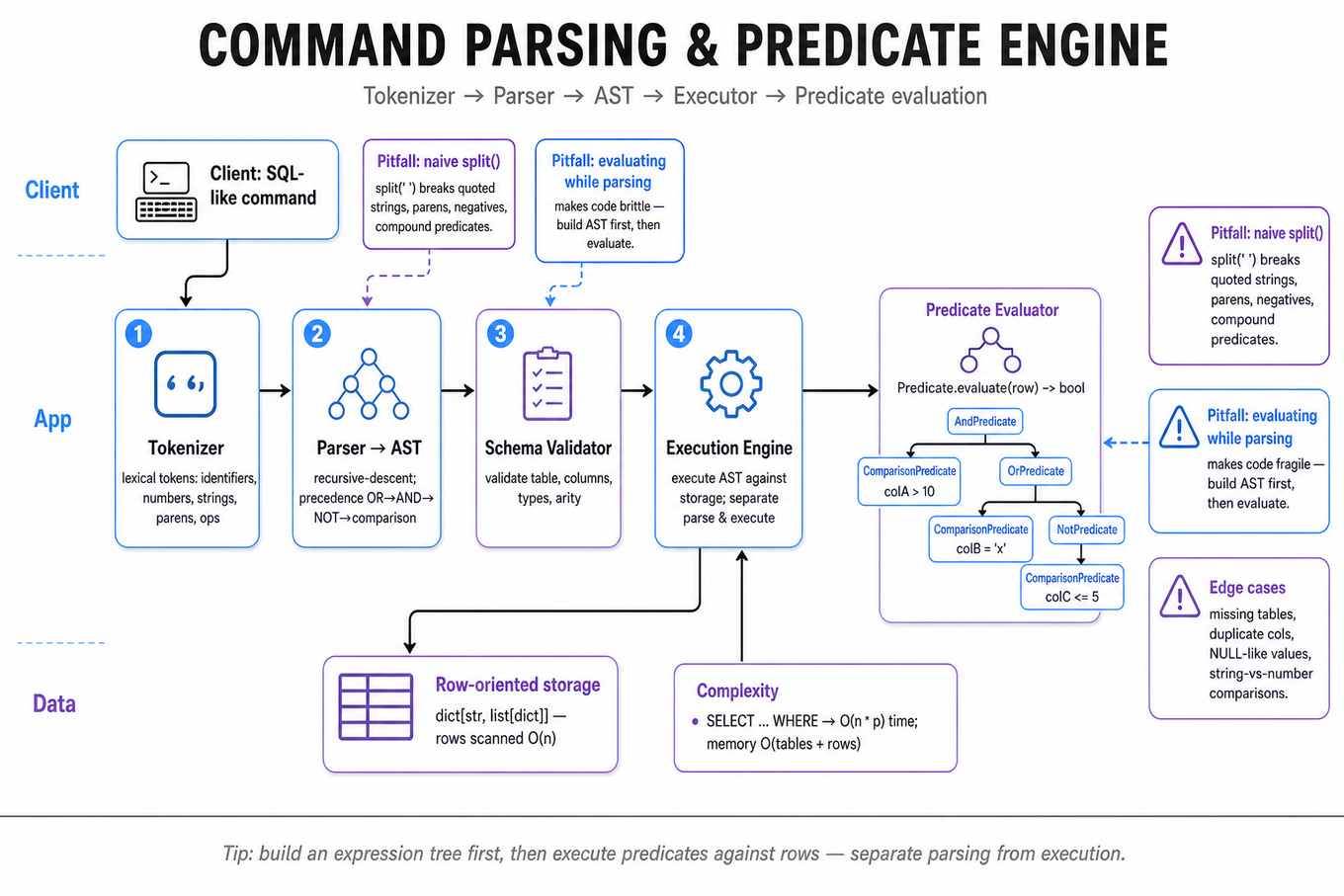
This tests command parsing, in-memory relational modeling, and predicate evaluation under clean coding constraints. The interviewer is looking for a small database engine: tokenize commands, store rows/columns efficiently, evaluate WHERE-style comparisons, and compose predicates without hard-coding one-off cases.
Patterns & templates
-
Tokenizer + parser split — separate
parse(command)fromexecute(ast); avoid mixing string handling with table mutation logic. -
Row-oriented storage — use
dict[str, list[dict[str, Any]]]for simple queries;O(rows)scans are acceptable unless indexing is requested. -
Schema validation — track column names/types per table; reject unknown columns, wrong arity, and malformed commands before execution.
-
Predicate interface — model filters as
Predicate.evaluate(row) -> bool; implementComparisonPredicate,AndPredicate,OrPredicate, andNotPredicate. -
Operator dispatch table — map strings like
=,!=,<,<=,>,>=to functions fromoperator; centralizes type and comparison behavior. -
Recursive descent parsing — for compound expressions, parse precedence as
OR -> AND -> NOT -> comparison; parentheses require a token cursor. -
Complexity accounting — simple
SELECT ... WHEREisO(n * p)fornrows andppredicate nodes; memory isO(tables + rows).
Common pitfalls
Pitfall: Treating parsing as ad hoc
split(" ")logic breaks quoted strings, parentheses, negative numbers, and compound predicates.
Pitfall: Evaluating predicates while parsing makes the code brittle; build an expression tree first, then execute it against each row.
Pitfall: Forgetting edge cases like missing tables, duplicate columns,
NULL-like values, empty result sets, and string-vs-number comparisons.
Practice these
The practice card below covers the canonical variant — solve it end-to-end, then time yourself while adding compound predicates and validation.
Practice questions
What's being tested
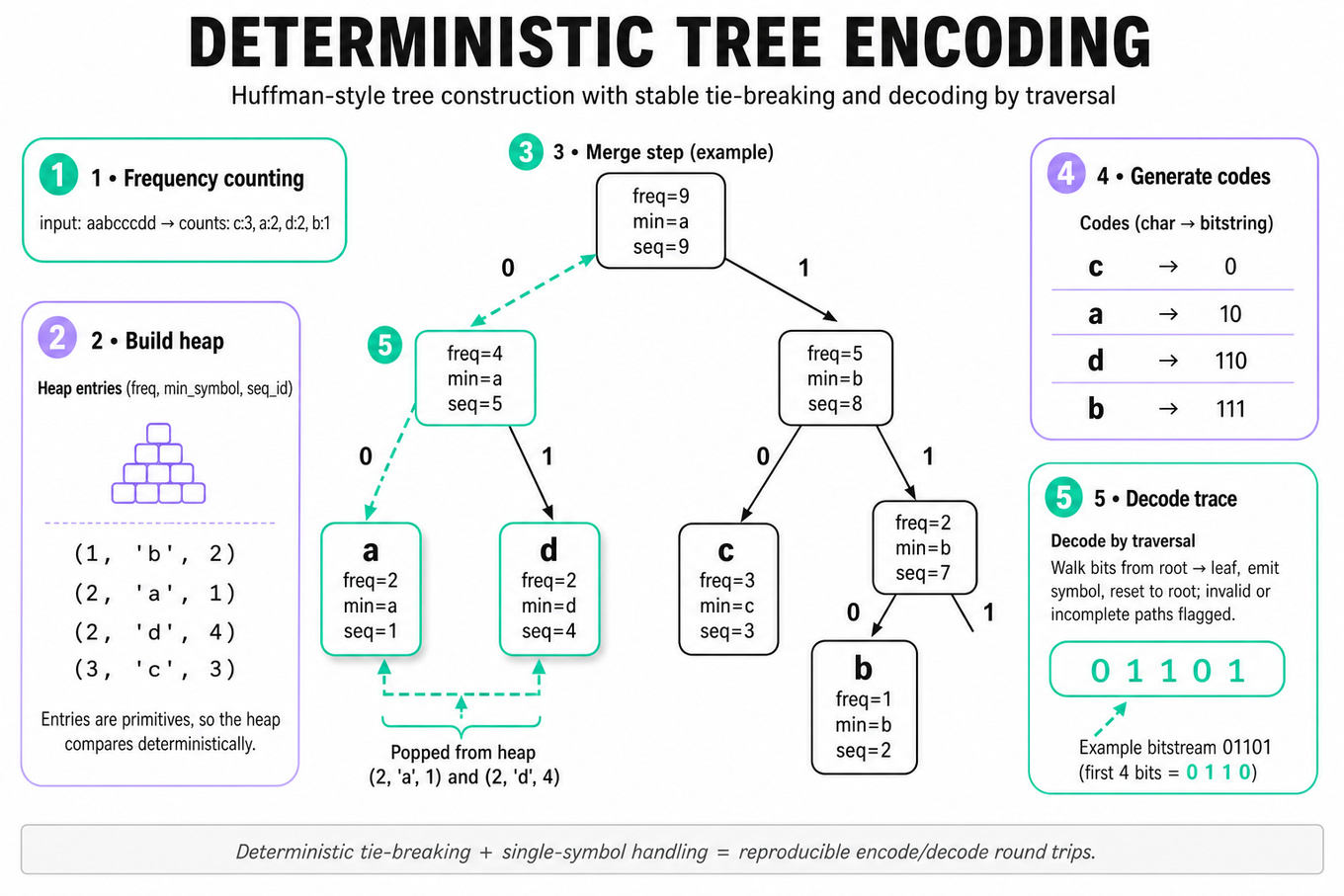
This tests deterministic Huffman-style coding: building a frequency-based binary tree, deriving prefix-free bit codes, and decoding by tree traversal. Interviewers probe whether you can implement priority-queue construction cleanly while preserving exact tie-breaking so encode/decode are reproducible.
Patterns & templates
-
Frequency counting with
dict/Counter— compute symbol weights inO(n)time; handle empty input and single-symbol alphabets explicitly. -
Min-heap tree construction using
heapq— repeatedly pop two lowest-frequency nodes, merge, and push; total cost isO(k log k)forksymbols. -
Deterministic tie-breaking — heap entries need stable fields like
(freq, min_symbol, sequence_id, node)because raw tree nodes are not comparable. -
Prefix-code generation via DFS — assign
0for left,1for right; storechar -> bitstring, with single-node trees using"0". -
Decoding by traversal — walk bits from root to leaf, emit symbol, reset to root; validate invalid bits and incomplete terminal paths.
-
Round-trip testing with
decode(encode(s)) == s— include ties, repeated characters, one unique character, empty string, and non-ASCII symbols.
Common pitfalls
-
Pitfall: Ignoring tie-breaking creates different valid Huffman trees, causing hidden tests to fail despite correct compression logic.
-
Pitfall: Forgetting the single-character case can produce an empty code, making encoded output ambiguous or undecodable.
-
Pitfall: Comparing custom
Nodeobjects directly inheapqcrashes when frequencies tie; include deterministic primitive fields before the node.
Practice these
The practice cards below cover the canonical variants — solve all of them and time yourself.
Practice questions

What's being tested
This tests stateful stream processing with priority queues / ordered maps and FIFO queues to implement a limit order book. You must preserve price-time priority, handle partial fills, and update mutable book state cleanly across a sequence of buy/sell orders.
Patterns & templates
-
Use two books: bids sorted by highest price first, asks sorted by lowest price first; each price level stores a FIFO queue.
-
Matching condition: buy crosses when
buy.price >= bestAsk; sell crosses whensell.price <= bestBid; loop until order filled or no cross. -
Store per-price orders in
dequeto preserve time priority; consume from the front and append residual incoming orders at the back. -
Use
TreeMap,SortedDict, heap plus lazy deletion, or ordered balanced BST; targetO(log P + F)per order, wherePis price levels andFfills. -
Keep mutable fields explicit:
remaining_qty,order_id,timestamp,side,price; never mutate price or time priority after insertion. -
Remove empty price levels immediately after the last order at that level is filled; stale levels cause wrong best bid/ask behavior.
-
Factor helpers like
match(order, opposite_book),add_to_book(order, same_side_book), andbest_price(book)for testable, readable code.
Common pitfalls
Pitfall: Matching by best timestamp globally instead of best price first; priority is price, then FIFO within the same price.
Pitfall: Forgetting partial fills; both the incoming order and resting order can have residual quantity after each trade.
Pitfall: Using a plain hash map for prices without an efficient best-price lookup, causing
O(P)scans per incoming order.
- Concurrency And Multithreading Fundamentals — covered in depth under Onsite below.
Onsite
Coding & Algorithms
What's being tested
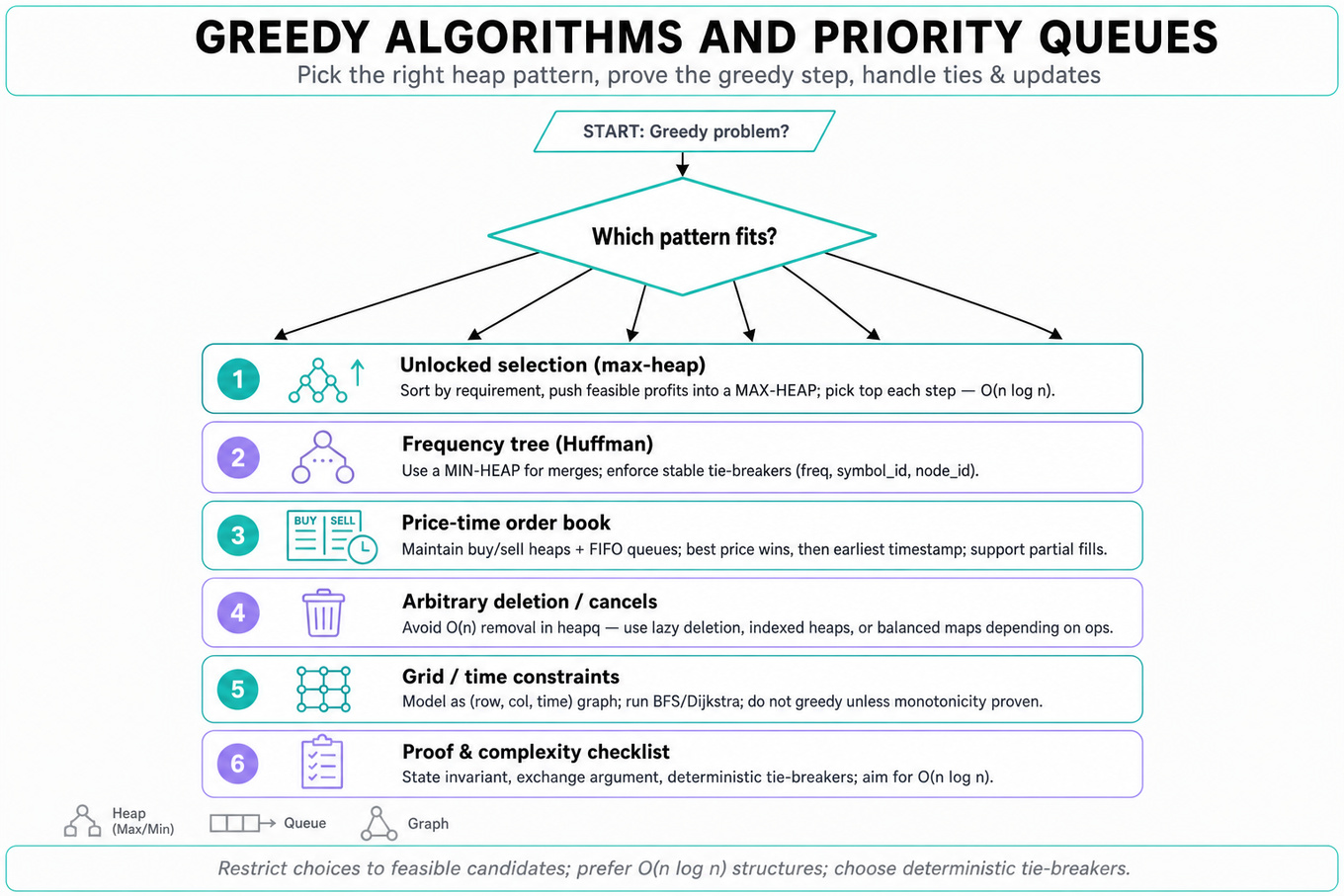
These problems test greedy choice validation, priority queue design, and stateful data-structure updates under ordering constraints. You need to show why the local choice is safe, choose the right heap/tree/map representation, and handle ties, partial updates, and edge cases deterministically.
Patterns & templates
-
Max-heap selection with unlock constraints — sort by requirement, push feasible profits into
heapq; each step picks best available inO(n log n). -
Min-heap tree construction —
Huffman-style merge by frequency; include deterministic tie-breakers like(freq, symbol_id, node_id)to avoid ambiguous encodings. -
Price-time priority matching — maintain buy/sell books using heaps plus FIFO queues; best price wins, then earliest timestamp, with partial fills preserved.
-
Greedy proof template — state invariant, prove exchange argument, then show each chosen item cannot make a better future solution impossible.
-
Heap deletion gotcha —
heapqlacks efficient arbitrary removal; use lazy deletion, indexed heaps, or balanced maps depending on update/cancel requirements. -
Grid escape with time constraints — model as shortest path/BFS/Dijkstra over
(row, col, time); avoid greedy moves unless monotonicity is proven. -
Complexity discipline — aim for
O(n log n)for selection/tree/order-book operations; explain whenO(n^2)scans will fail.
Common pitfalls
Pitfall: Picking the highest-profit project before checking capital feasibility breaks the greedy invariant; only choose among currently unlocked candidates.
Pitfall: Building a frequency tree without stable tie-breaking can produce correct-looking but non-reproducible encode/decode behavior.
Pitfall: Treating an order book as “sort all orders after every event” is usually too slow; maintain incremental priority structures instead.
Practice these
The practice cards below cover the canonical variants — solve all of them and time yourself.
Practice questions
What's being tested
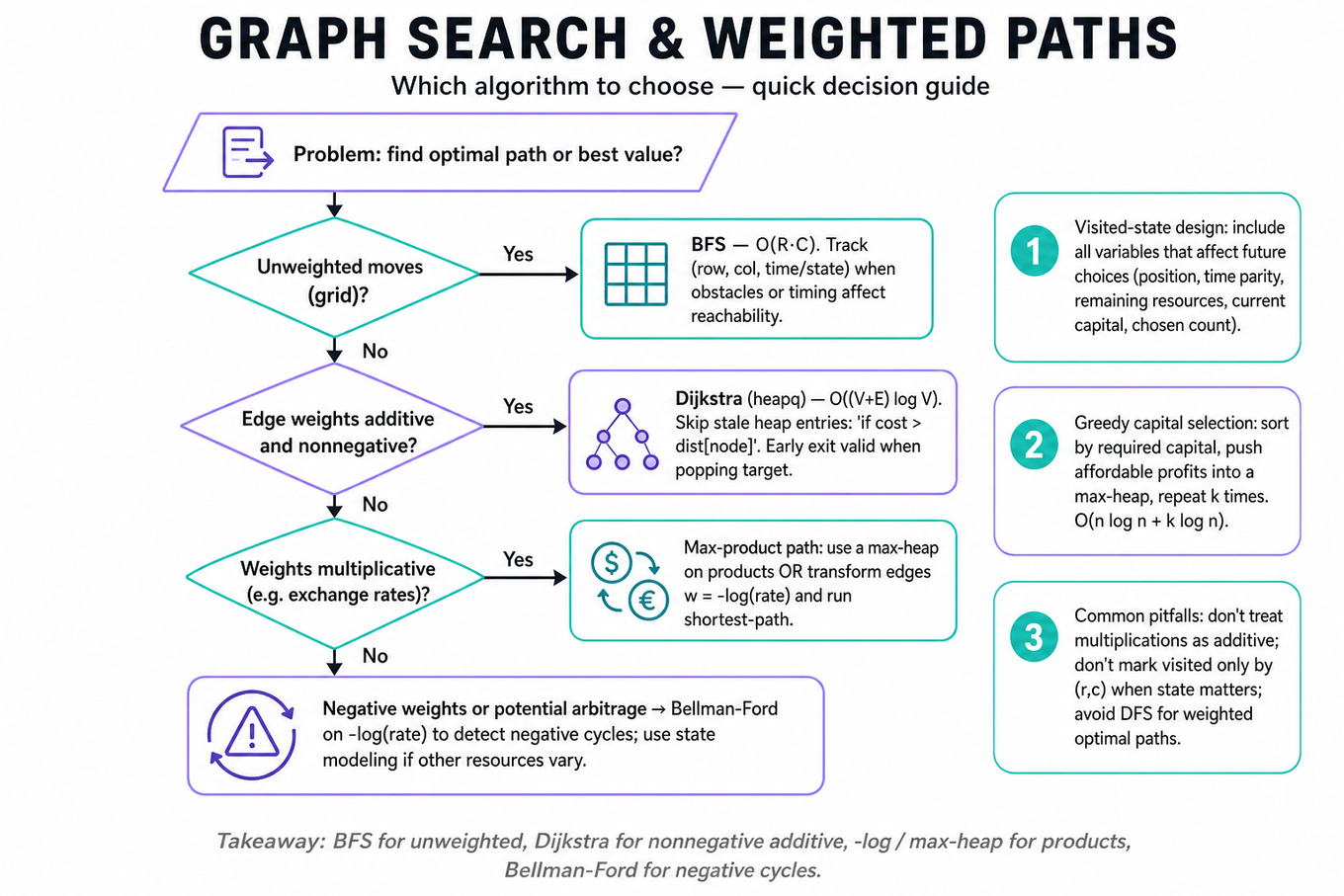
Tests graph modeling, weighted path optimization, and choosing the right search strategy under constraints. You should recognize when to use BFS, Dijkstra-style priority queues, greedy heaps, or multiplicative-to-additive transforms for paths like currency exchange.
Patterns & templates
-
BFS on grids —
O(R*C)time for unweighted moves; track(row, col, time/state)when obstacles or timing constraints change reachability. -
Dijkstra with
heapq— use for nonnegative weighted shortest paths;O((V+E) log V)and skip stale heap entries withif cost > dist[node]. -
Maximum product path — for exchange rates, maximize using a max-heap, or transform to shortest path with edge weight .
-
Bellman-Ford for arbitrage — detects negative cycles after
-log(rate)conversion; use when cycles can improve value indefinitely. -
Greedy capital selection — sort projects by required capital, push affordable profits into a max-heap, repeat
ktimes;O(n log n + k log n). -
Visited-state design — include all variables that affect future options: position, time parity, remaining resources, current capital, or chosen count.
-
Early exit carefully — valid for BFS first target and Dijkstra popped target, not for arbitrary DFS or when later cycles can improve value.
Common pitfalls
Pitfall: Treating currency exchange as normal shortest path without handling multiplication; use max-product logic or
-log(rate).
Pitfall: Marking a grid cell visited only by
(r, c)when time or resource state changes whether it is reachable.
Pitfall: Using DFS for weighted paths; it may find a path, but not the optimal path without exhaustive search or dynamic programming.

What's being tested
This tests thread-safety reasoning: recognizing shared mutable state, choosing the right synchronization primitive, and avoiding races, deadlocks, and visibility bugs. Interviewers look for whether you can write correct concurrent code, explain invariants, and reason about interleavings beyond the happy path.
Patterns & templates
-
Mutex-protected critical section — guard every read/write of shared state with
Lock/synchronized; keep locked regions small and exception-safe. -
Producer-consumer queue — use
BlockingQueue,Condition, orwait/notify; handle spurious wakeups withwhile, notif. -
Read/write separation — use
ReadWriteLockwhen reads dominate writes; beware writer starvation and upgrade deadlocks. -
Atomic counters and CAS — use
AtomicInteger,compareAndSet, orfetch_addfor simple state; avoid composing multiple atomics without a lock. -
Thread pool template — submit independent tasks to
ExecutorService; bound queue size to avoid unbounded memory growth under load. -
Deadlock prevention — acquire locks in a global order; avoid calling external/user code while holding a lock.
-
Visibility guarantees — use
volatile, locks, or atomics for happens-before ordering; do not rely on timing orsleep.
Common pitfalls
Pitfall: Treating
volatileas a replacement for a lock; it gives visibility, not atomic compound operations like check-then-act.
Pitfall: Using
ifaroundwait()/Condition.await(); spurious wakeups and stolen notifications require rechecking the predicate.
Pitfall: Over-synchronizing the whole method and accidentally serializing all work, hiding correctness bugs while failing performance expectations.
What's being tested
Distributed-systems coding interviews usually reduce to deterministic data-structure design under failures: partitioning, replication, ordering, retries, and load limits. The interviewer wants clean APIs, correct edge-case handling, and complexity reasoning, not broad architecture hand-waving.
Patterns & templates
-
Consistent hashing with sorted virtual nodes — use
bisect_leftover ring positions;O(log V)lookup,O(V)storage. -
Quorum reasoning — require
R + W > Nfor strong read-after-write visibility; handle ties, stale replicas, and unavailable nodes. -
Idempotency-key pattern — store
request_id -> result/status; retries return cached outcome, preventing double execution after timeout ambiguity. -
Token bucket / leaky bucket rate limiting — track
tokens,last_refill_ts;allow()isO(1), but time arithmetic must be monotonic. -
Logical clocks — use Lamport timestamps
(counter, node_id)for total tie-breaking; vector clocks detect concurrency atO(nodes)space. -
Leader election / heartbeat simulation — model
timeout,term, andlast_seen; avoid assuming synchronized clocks or instant failure detection. -
Replication log merge — compare
(term, index)or(timestamp, node_id); define deterministic conflict resolution before writing code.
Common pitfalls
-
Pitfall: Treating network timeout as failure certainty; in distributed systems, timeout means “unknown,” so retries must be safe.
-
Pitfall: Forgetting deterministic tie-breakers, causing different nodes to choose different winners for the same conflict.
-
Pitfall: Explaining CAP/Paxos abstractly instead of implementing the requested state transitions, invariants, and edge cases.
Behavioral & Leadership

What's being tested
Interviewers are probing whether you can explain a substantial engineering project with technical depth, clear ownership, and honest tradeoff reasoning. For a Software Engineer at Two Sigma, a strong project deep dive shows that you can build reliable systems in ambiguous, data-intensive environments where correctness, latency, maintainability, and collaboration all matter. The role-fit portion tests whether your motivations align with engineering work that supports research, trading, infrastructure, developer productivity, or platform reliability—not whether you simply “like finance.” Expect follow-ups on architecture, failure modes, debugging decisions, and why your past work predicts success in a rigorous engineering culture.
Core knowledge
-
Project narrative structure matters: use a concise arc of context, problem, constraints, design, execution, impact, and reflection. A good answer should make your role unmistakable: “I owned the service boundary and rollout plan,” not “we improved the platform.”
-
System architecture should be described at the right abstraction level: clients, APIs, storage, background jobs, caches, queues, and observability. Be ready to sketch data flow verbally using concrete components like
Postgres,Redis,gRPC,S3,Kubernetes, or internal equivalents. -
Tradeoff analysis is central. Discuss why you chose one design over another: consistency versus availability, write amplification versus read latency, batch versus streaming, normalization versus denormalization, vertical scaling versus sharding, or synchronous APIs versus async workers.
-
Correctness guarantees are especially valued in quantitative environments. Be precise about invariants: idempotency, ordering assumptions, atomicity, deduplication, retry safety, and reconciliation. If you used an idempotency key or transactional outbox pattern, explain the failure it prevented.
-
Performance reasoning should include scale and bottlenecks. Quote numbers where possible: request rate, dataset size,
p50/p95/p99latency, memory footprint, build time, or throughput. A useful framing is . -
Reliability engineering means knowing how the system fails. Mention timeouts, retries with exponential backoff, circuit breakers, health checks, degraded modes, alert thresholds, and rollback procedures. Tie incidents to prevention: “we added a
p99latency alert and synthetic canary.” -
Debugging depth separates strong candidates. Explain how you isolated the issue: logs, traces, metrics, heap profiles, flame graphs, database query plans, binary search over releases, or reproduction tests. Avoid saying “we just looked at logs” without a hypothesis-driven path.
-
Code quality is part of leadership. Discuss module boundaries, API contracts, test strategy, dependency management, readability, and migration safety. Strong answers mention unit tests, integration tests, load tests, contract tests, and property-based tests where appropriate.
-
Execution under ambiguity should show prioritization without becoming product management. For SWE, emphasize technical sequencing: reducing unknowns with prototypes, designing an incremental migration, protecting backward compatibility, and creating checkpoints for correctness and performance.
-
Collaboration should be concrete and role-aware. Say how you worked with researchers, engineers, SREs, or data consumers: clarifying requirements, negotiating interfaces, reviewing design docs, resolving incidents, or translating a research workflow into robust production code.
-
Impact metrics should be engineering-centered. Good examples: reduced
p99latency from 900 ms to 180 ms, cut job runtime from 6 hours to 45 minutes, improved deployment frequency, reduced incident rate, lowered cloud cost, or eliminated a class of data inconsistency bugs. -
Role fit should connect motivation to the work. For
Two Sigma, credible themes include rigorous engineering, data-intensive systems, high standards for correctness, collaboration with quantitative researchers, and building platforms where small reliability gains compound across many users.
Worked example
For “Explain move and recent project,” start by separating the two parts: “I’ll first give the motivation for my move, then use a recent project to show the kind of engineering problems I’m looking to do more of.” In the first 30 seconds, frame your move around engineering growth: larger-scale systems, stronger correctness requirements, and closer collaboration with technical users—not generic prestige or compensation. For the project, declare the setting: “I worked on a service that handled roughly 20K requests per second and backed a latency-sensitive internal workflow.” Organize the answer around four pillars: the problem, your ownership, the architecture, and the measurable result.
Then go one layer deeper technically: describe the request path, storage layer, cache strategy, and where the bottleneck appeared. A strong candidate might say, “The key design decision was whether to precompute results asynchronously or compute on demand; we chose precomputation because the access pattern was skewed and freshness tolerance was five minutes.” Flag one explicit tradeoff: lower read latency and predictable p99 at the cost of more complex invalidation and higher storage usage. Include a concrete debugging or rollout moment, such as discovering a hot key in Redis, adding request coalescing, or rolling out behind a feature flag. Close with reflection: “If I had more time, I would add a stronger load-test suite and formalize the service-level objective so future changes could be evaluated against the same bar.”
A second angle
For “How to prepare for a hiring manager round,” the same material becomes less of a single project monologue and more of an evidence portfolio. Prepare three stories: one technical deep dive, one collaboration or conflict story, and one failure or learning story. The hiring manager is likely testing consistency: whether your motivations, past ownership, and preferred engineering environment match the team’s needs. Instead of maximizing technical detail immediately, lead with judgment: how you choose problems, communicate risk, make tradeoffs, and raise the quality of the team. Still be ready to drill down into architecture if asked; behavioral does not mean non-technical.
Common pitfalls
Pitfall: Giving a résumé summary instead of a project deep dive.
A weak answer lists technologies: “I used Java, Kafka, Postgres, and AWS.” A stronger answer explains the design pressure: “We had bursty writes, strict replay requirements, and a downstream service that could not tolerate duplicate side effects, so we introduced idempotent writes and a reconciliation job.”
Pitfall: Claiming ownership too broadly or too vaguely.
Saying “we redesigned the platform” invites skepticism if you cannot name your specific decisions. Use precise ownership language: “I designed the API contract, implemented the cache invalidation path, wrote the migration plan, and drove the rollout across three services.”
Pitfall: Treating role fit as enthusiasm for markets rather than fit for engineering work.
“I’m interested in finance” is not enough for a Software Engineer role. Better: “I’m excited by systems where correctness, performance, and abstraction quality directly affect sophisticated technical users, and where I can work close to researchers without changing my focus from engineering.”
Connections
Interviewers may pivot from this topic into system design, incident response, code quality, or technical leadership. A project deep dive can also lead naturally into distributed systems topics such as caching, consistency, concurrency, storage design, and observability. Prepare to move smoothly from behavioral framing into concrete architecture and debugging detail.
Further reading
-
Designing Data-Intensive Applications — Martin Kleppmann’s book is the best single source for explaining storage, consistency, replication, and distributed-system tradeoffs clearly.
-
The Staff Engineer’s Path — useful for framing technical ownership, influence, and project leadership without drifting into management.
-
Google SRE Book — strong reference for reliability language:
SLOs, error budgets, monitoring, alerting, and incident response.
Practice questions