Large Models (LLMs): LangChain Overview (11)
Quick Overview
This guide covers LangChain concepts, usage patterns, and trade-offs for LLM applications, including components and chains, prompt templates and values, example selectors, retrievers and vector databases, tool integration, and output parsing strategies.
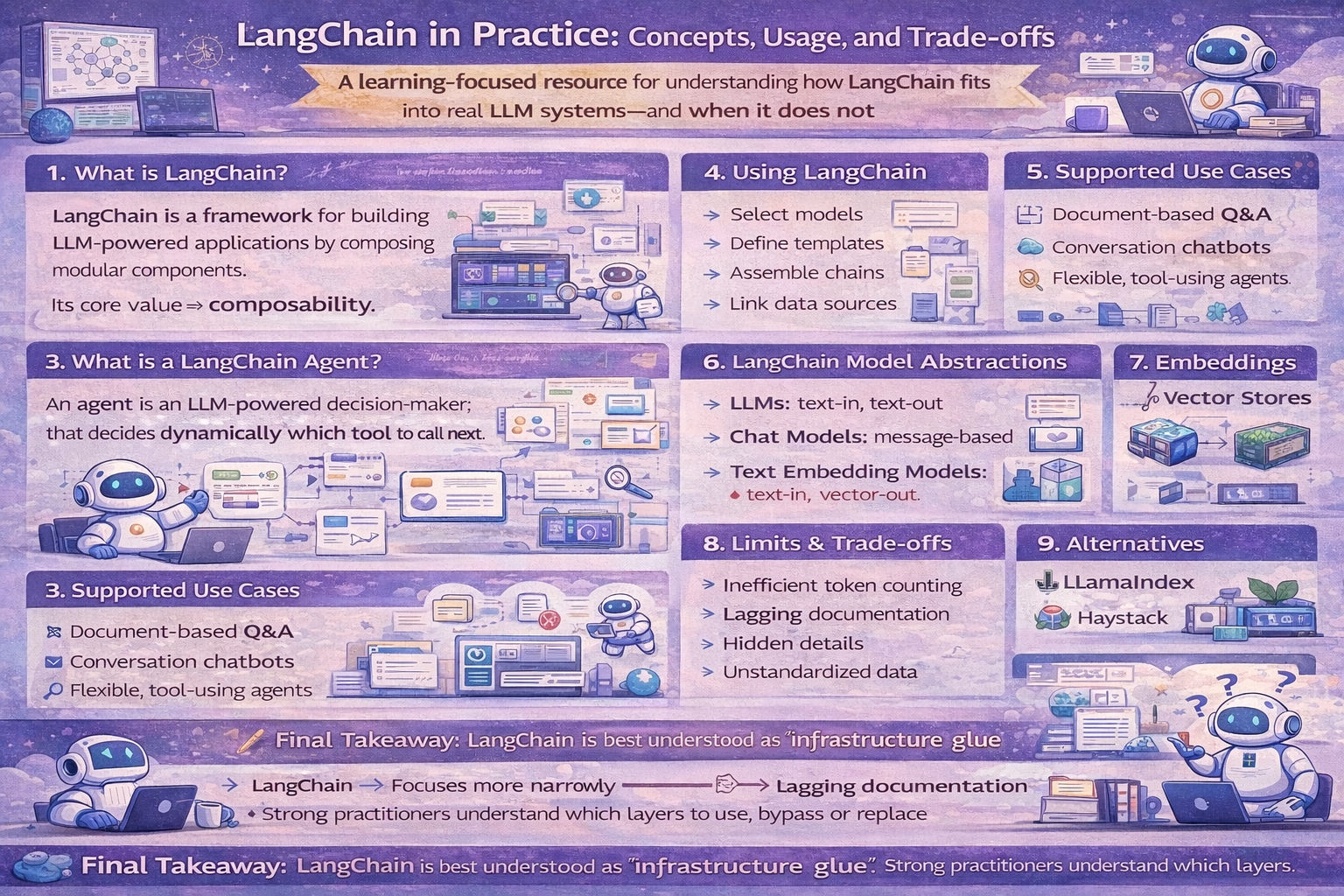
LangChain in Practice: Concepts, Usage, and Trade-offs
A learning-focused resource for understanding how LangChain fits into real LLM systems—and when it does not
Why LangChain exists
LangChain was created to solve a practical problem: LLMs alone are not applications. Real systems must call APIs, query databases, retrieve documents, remember conversation history, and coordinate multiple steps of reasoning. LangChain provides a structured way to connect language models with external tools and data, turning raw generation into controllable workflows.
You should think of LangChain not as a model framework, but as an orchestration layer sitting above LLMs.
1. What is LangChain?
LangChain is a framework for building LLM-powered applications by composing modular components. It helps manage interactions between language models and external resources such as APIs, vector databases, and custom logic.
Its core value proposition is composability: instead of writing ad-hoc glue code for every project, you assemble reusable building blocks into systems that can reason, retrieve, and act.
2. Core concepts in LangChain (how the system is structured)
Components and Chains
A Component is a single functional building block: a prompt, a model call, a retriever, or a parser. A Chain is a sequence of components wired together to complete a task.
A typical chain might:
- Format a prompt
- Call an LLM
- Parse the output into structured data
Chains allow developers to treat multi-step logic as a single callable unit, which simplifies experimentation and reuse.
Prompt Templates and Prompt Values
Prompt Templates define how user input and contextual information are transformed into model-ready inputs. Rather than concatenating strings manually, templates make prompts explicit, parameterized, and easier to audit.
Prompt Values are the resolved outputs of templates—structured representations of prompts (text or message-based) that are passed to models. This separation becomes important once you move beyond simple text prompts into multi-role chat formats.
Example Selectors
Example Selectors dynamically choose which few-shot examples to include based on the current query. This matters because context is limited, and not all examples are equally helpful for every input.
By selecting relevant examples rather than static ones, the model becomes more context-aware without blowing up token usage.
Output Parsers
LLMs generate text, but applications need structure. Output Parsers convert raw model output into usable formats such as JSON, lists, or typed objects.
There are two common strategies:
- instruct the model to produce structured output
- parse unstructured text after generation
This layer is crucial for reliability, especially when downstream systems expect machine-readable outputs.
Indexes and Retrievers
Indexes organize documents so that relevant information can be retrieved efficiently. Retrievers are the interfaces that fetch relevant documents and inject them into prompts.
This is the backbone of retrieval-augmented generation (RAG). LangChain supports vector stores, text splitters, and retrieval strategies that allow models to work with corpora far larger than their context window.
Chat Message History (Memory)
Chat Message History stores previous interactions and feeds them back into the model. This enables multi-turn dialogue and contextual continuity.
The key trade-off is scale: as history grows, token usage and latency increase. Memory management—summarization, truncation, or embedding-based recall—is an architectural decision, not just a LangChain feature toggle.
Agents and Toolkits
Agents are decision-making entities driven by LLMs. Instead of following a fixed chain, an agent decides what to do next: which tool to call, what input to provide, and when to stop.
Toolkits are curated sets of tools that agents can use. This design allows for flexible, dynamic workflows where the model reasons, acts, observes results, and iterates.
Agents shine in tasks involving uncertainty, branching logic, or multi-step reasoning—but they also introduce complexity and unpredictability.
3. What is a LangChain Agent?
A LangChain Agent is an LLM-powered controller that chooses actions dynamically. Rather than executing a predefined pipeline, it evaluates the current state and decides which tool to invoke next.
This is powerful for:
- complex question answering
- tool-augmented reasoning
- multi-step decision processes
It is also where systems become harder to debug. Agents trade determinism for flexibility.
4. How LangChain is used in practice
Using LangChain typically involves:
- selecting a model abstraction (LLM, ChatModel, or Embedding model)
- defining prompt templates
- assembling chains or agents
- connecting external data sources
- adding memory and evaluation hooks
The framework is flexible enough to support quick prototypes and moderately complex systems, but production usage requires discipline.
5. Supported use cases
LangChain is commonly used for:
- document-based question answering (RAG systems)
- conversational agents and chatbots
- tool-using agents that execute actions and reason iteratively
Its value increases as the application moves beyond “single prompt → single response.”
6. LangChain model abstractions
LangChain standardizes how models are accessed, regardless of provider.
- LLMs: text-in, text-out models for classic generation tasks
- Chat Models: message-based interfaces optimized for multi-turn dialogue
- Embedding Models: text-to-vector models used for similarity search, clustering, and retrieval
This abstraction allows developers to swap models without rewriting application logic.
7. Key feature areas
LangChain’s functionality clusters into:
- prompt management and optimization
- chain execution and workflow composition
- data-augmented generation
- agents and tool orchestration
- memory and state management
- evaluation utilities
Seen holistically, LangChain is an application framework—not a research framework.
8. Embeddings and vector stores: the practical core
Embeddings turn text into vectors so similarity can be computed efficiently. The typical pipeline is:
- split documents
- embed chunks
- store vectors
- embed queries
- retrieve nearest neighbors
LangChain supports both hosted vector databases and local stores. This is the most production-tested part of the ecosystem and underpins most real-world RAG systems.
9. Limitations and common pain points
LangChain is not without issues.
Token counting can be inefficient, and many teams prefer using lightweight tools such as tiktoken directly.
Documentation quality has historically lagged behind development speed. Source code often becomes the ultimate reference.
Abstraction layers can obscure behavior. Some helper functions simply wrap native Python logic, adding cognitive overhead without proportional benefit.
Hidden implementation details and inconsistent behavior can cause surprises. For example, some chains modify input queries in ways that are not obvious from the API.
Finally, the lack of standardized data types can make integration with other ML tooling more difficult.
10. Alternatives worth knowing
LangChain is not the only option.
LlamaIndex focuses more narrowly on data ingestion, indexing, and retrieval, offering a cleaner mental model for RAG-heavy systems.
Haystack (by deepset) is a mature framework for search and QA built on top of Hugging Face Transformers, with strong emphasis on pipelines and evaluation.
The choice depends on whether your problem is orchestration-heavy (LangChain) or data/retrieval-centric (LlamaIndex, Haystack).
Final takeaway
LangChain is best understood as infrastructure glue. It accelerates building LLM applications by standardizing common patterns—but it also introduces abstraction cost.
Strong practitioners know when to use LangChain, when to bypass parts of it, and when a simpler custom solution is better. The real skill is not memorizing APIs, but understanding which layers add value for your specific system.
Comments (0)