20 Common Meta Behavioral Interview Questions (2026)
Quick Overview
This guide presents the 20 behavioral questions most commonly asked in Meta's "Jedi" round, maps each question to Meta's six core values, and outlines a repeatable answer structure, common red flags, and a practice plan with follow-up drilling. It is aimed at software engineers and adjacent technical roles preparing for Meta behavioral interviews.
This guide is for software engineers (and adjacent technical roles) preparing for Meta's behavioral interview, commonly called the "Jedi" round. You will get the 20 questions that show up most often, mapped to Meta's six core values, plus a repeatable way to structure answers, the red flags that sink otherwise-strong candidates, and a practice plan that actually holds up under follow-up drilling.
Meta weighs behavioral fit alongside coding and system design. The bar is not "be a nice person." It is proof that you can ship fast in an ambiguous, highly autonomous environment, resolve conflict directly with data, and tie your work to measurable impact.
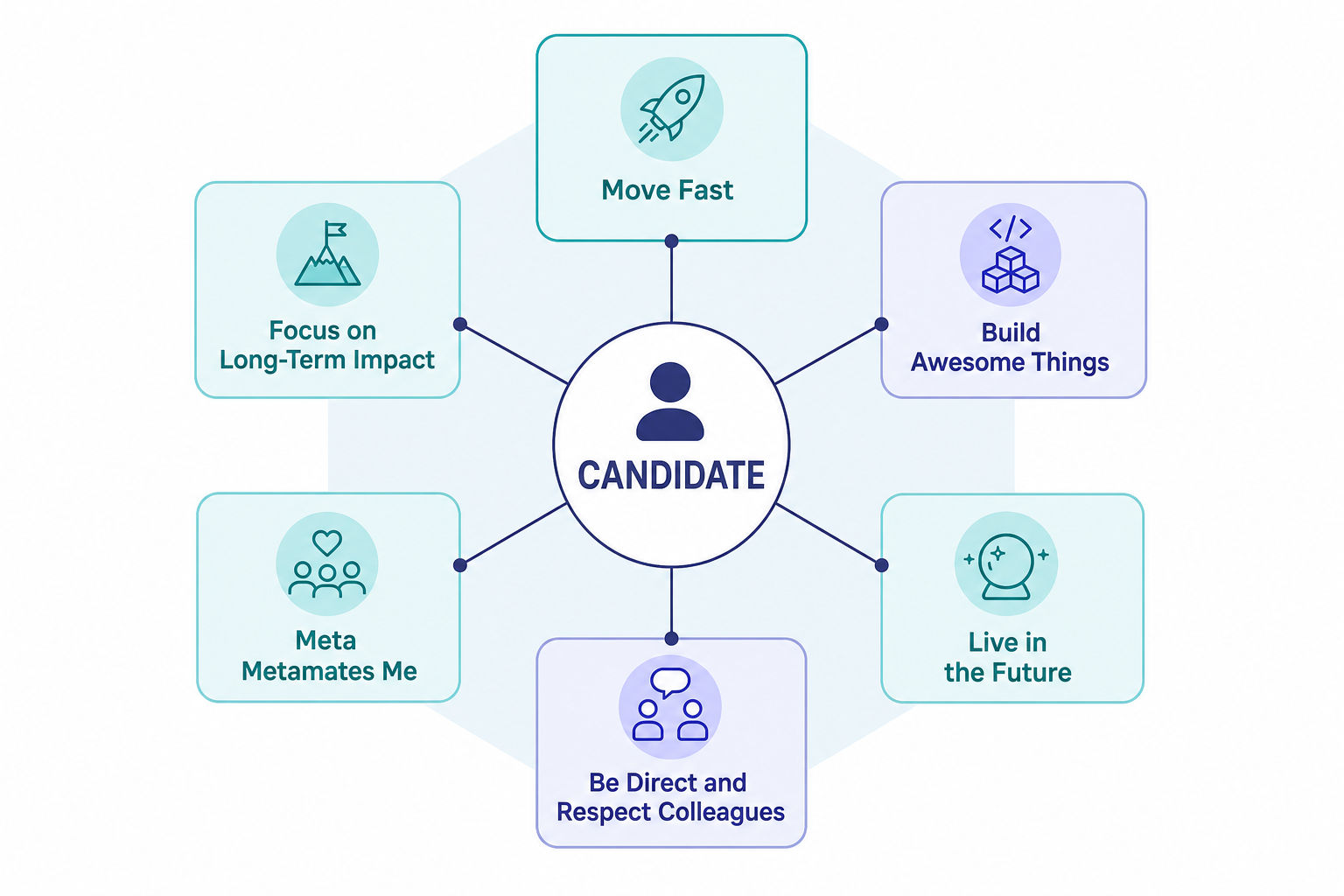
What the Jedi round actually tests
The Jedi round is Meta's dedicated behavioral interview, typically 45 minutes. It tends to be more conversational than Amazon's rigidly scripted Leadership Principles round, but it probes hard. Expect the interviewer to keep pulling on a thread until they hit the real decision you made and the real trade-off you weighed.
Three signals carry most of the weight:
- Self-awareness. Do you own your failures specifically, or do you diffuse blame onto "the team," "the org," or "bad requirements"?
- Comfort with ambiguity. Can you move a project forward when the requirements are vague or contradictory?
- Pacing and judgment. Do you ship and iterate, or do you stall on perfectionism? And do you know when speed is the wrong call?
A useful structure is STAR-L: Situation, Task, Action, Result, and Learnings. The Learnings beat matters more at Meta than at most companies, because it directly demonstrates self-awareness. Aim to keep each story to roughly two to three minutes, then let follow-ups deepen it.
Note: "Jedi" is the informal name candidates and many engineers use for this round. Treat it as the behavioral interview regardless of what your recruiter calls it.
How Meta's six core values map to questions
Meta's six core values, as stated by the company, are: Move Fast, Focus on Long-Term Impact, Build Awesome Things, Live in the Future, Be Direct and Respect Your Colleagues, and Meta, Metamates, Me. Interviewers rarely name a value out loud. Instead they ask a question that is designed to surface evidence for one of them.
| Core value | What the interviewer is really checking | A weak answer looks like |
|---|---|---|
| Move Fast | You ship an MVP and iterate on real data instead of polishing in a vacuum | "I rebuilt it the right way over six months" with no shipping milestone |
| Focus on Long-Term Impact | You prioritize by business impact, not by what was assigned | A list of tasks completed with no "so what" |
| Be Direct and Respect Your Colleagues | You give and take blunt feedback without ego | Avoiding conflict, or "winning" by seniority instead of data |
| Meta, Metamates, Me | You are a force multiplier, not a lone wolf | A solo-hero story where the team is invisible |
| Build Awesome Things | You care about the end-user experience and craft | "I just built what the ticket said" |
| Live in the Future | You think about scale, new tech, and where the product is heading | No mention of growth, scale, or what came next |
Value 1: Move Fast
Meta rewards engineers who ship a minimal, testable version and let user data guide the next iteration, rather than disappearing for months to build an unvalidated, "perfect" system. The flip side they also probe: do you understand the trade-off between speed and technical debt, and do you know when not to cut corners?
Top questions:
- Tell me about a time you had to make a technical decision with incomplete data.
- Describe a project where you cut scope to hit a hard deadline. What did you cut, and why was it safe to cut?
- Tell me about a time you chose a "hacky" or sub-optimal solution to move faster. How did you manage the resulting tech debt?
- Give an example of a time you had to pivot your technical approach mid-sprint because the goals changed.
Example answer (skeleton for question 3): "We were a week from a launch when our caching layer failed load testing. Action: I shipped a coarse in-memory cache as a stopgap, filed the proper Redis migration as a tracked follow-up with an owner and a date, and flagged the debt openly in the launch review. Result: we hit the date; the proper fix landed two sprints later. Learning: I now write the follow-up ticket before I ship the shortcut, so the debt is never invisible."
Value 2: Focus on Long-Term Impact
Moving fast is not an excuse to build things that do not matter. This value checks whether you can reason about the business levers behind your code and prioritize accordingly.
Top questions:
- Tell me about a time you pushed back on a roadmap because you believed a feature wouldn't drive meaningful impact.
- Describe a project you led that you're most proud of. What was the measurable impact?
- How do you decide what to work on when you have several high-priority tasks at once?
- Tell me about a time you noticed an inefficient internal process and fixed it without being asked.
For question 6, be ready with a number you actually owned or can defend (latency, retention, revenue, cost, engineering hours saved). If you don't have a hard metric, describe the impact qualitatively and honestly rather than inventing a percentage you can't back up under follow-up.
Value 3: Be Direct and Respect Your Colleagues
This is where many strong technical candidates stumble. Meta's culture leans on candid, continuous feedback. Sidestepping conflict, or holding back a real disagreement to keep the peace, reads as a culture miss, not as politeness.
The assessment: can you separate your ego from your code, and resolve disagreements with evidence instead of emotion or rank?
Top questions:
- Tell me about a time you fundamentally disagreed with a senior engineer or tech lead on a design. How did you break the deadlock?
- Describe a time you got harsh, critical feedback in a code review. How did you respond?
- Give an example of giving difficult feedback to a peer.
- Tell me about two teams (e.g., Engineering and Design) with competing goals. How did you broker a compromise?
A common pitfall on question 9: telling a story where you "won" because you were more senior or louder. The signal Meta wants is that you converted the disagreement into a testable question, brought data or a prototype, and committed fully to the decision even when it went against you.
Value 4: Meta, Metamates, Me
This value places the company's mission first, your teammates second, and yourself last. It is the lone-wolf detector.
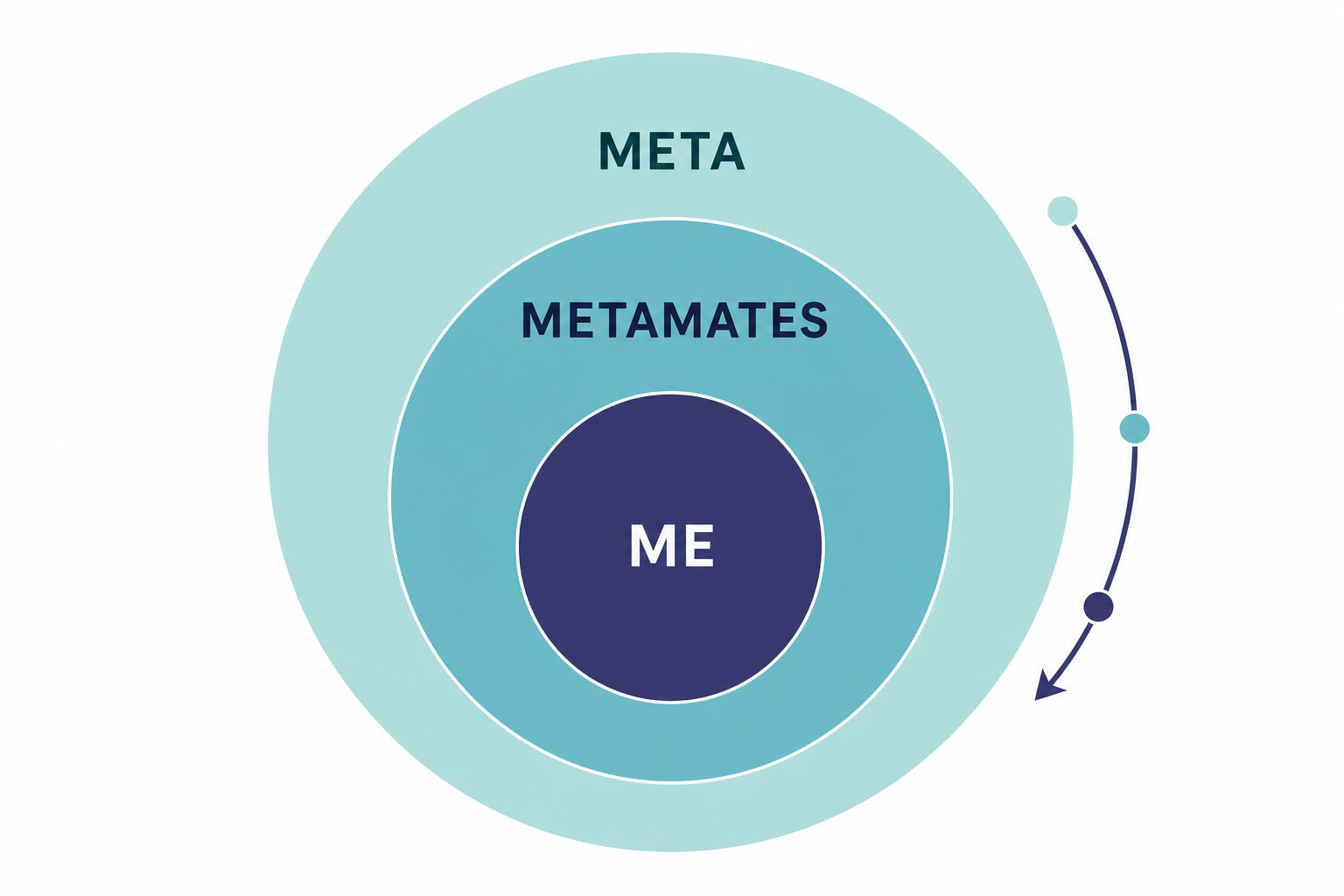
The assessment: are you a force multiplier for the team, or someone who optimizes for personal credit?
Top questions:
- Tell me about a time you sacrificed your own velocity to unblock a struggling teammate.
- Describe a serious technical mistake you made that broke production. How did you communicate it?
- Tell me about working with a difficult colleague to get something shipped.
- Give an example of a time the team succeeded but you felt you personally fell short.
Question 14 is a favorite. The trap is downplaying the failure or quietly fixing it. The strong version: you raised the alarm immediately, communicated clearly to the people affected, drove the fix, and then closed the loop with a postmortem and a concrete safeguard so it couldn't recur.
Values 5 & 6: Build Awesome Things / Live in the Future
These two are about craft and foresight: caring about the end-user experience, and thinking about where the product and the technology are heading (scale, new platforms, emerging tech).
The assessment: do you just write code, or do you care about product quality and what the system needs to become?
Top questions:
- Tell me about a time you advocated for the user when the business wanted a shortcut.
- Describe a complex problem that forced you to learn a new technology or stack quickly.
- Tell me about a time data changed the direction of a product feature.
- Give an example of a system you built that had to scale well beyond its original design.
For question 18, you don't need to claim you learned an entire stack "over a weekend." A more credible and persuasive answer shows how you ramped fast, where you leaned on documentation or teammates, and what you shipped as a result.
A practice plan that survives follow-ups
You cannot bluff this round. A rehearsed, generic answer (the classic "my weakness is that I'm a perfectionist") invites the interviewer to drill until the story collapses. Depth beats breadth.
| Do | Don't |
|---|---|
| Prepare 5–6 deep, real stories you can tell from memory | Memorize 20 separate canned answers |
| Make each story reusable across several values | Tie a story to exactly one question |
| Lead with your specific action and decision | Narrate the whole project history first |
| Quantify impact when you genuinely can | Invent metrics you can't defend |
| Rehearse out loud with a partner | Only rehearse silently in your head |
The core move: prepare a small set of rich stories, each containing moments of moving fast, resolving conflict, and measurable impact. One strong story about, say, a botched database migration can answer the production-failure question, the tech-debt question, and the disagreement question depending on which angle you emphasize. Then practice delivery with a mock partner so you can hear where you ramble or where a follow-up exposes a gap.
When you're ready to drill the technical side of the loop in parallel, work through the PracHub question bank, browse Meta-tagged questions, or filter by software engineer questions. For broader prep across the whole interview, see the interview guides.
How to Use This Page as a Prep Plan
Do not treat this as passive reading. Convert the ideas in this page into a short weekly loop: learn one idea, practice it under interview conditions, then write down what changed. That is the fastest way to turn advice into visible interview behavior.
| Prep area | What you need to prove | Practice artifact |
|---|---|---|
| Story choice | Pick a real moment with stakes. | One sentence context and why it mattered. |
| Action detail | Show judgment, not just activity. | Three actions you personally owned. |
| Result | Make the outcome verifiable. | Metric, decision, lesson, or follow-up. |
| Reflection | Prove the story changed your behavior. | What you do differently now. |
For 20 Common Meta Behavioral Interview Questions (2026), the strongest candidates usually do three things well: they make their assumptions explicit, they use concrete examples instead of vague claims, and they review mistakes quickly enough that the next practice rep is better than the last one.
Video Walkthrough
This verified YouTube video gives a second pass on the same preparation area. Use it after reading the guide, then come back and turn the advice into a practice artifact.
FAQ
What are Meta's six core values?
Meta states its six core values as: Move Fast, Focus on Long-Term Impact, Build Awesome Things, Live in the Future, Be Direct and Respect Your Colleagues, and Meta, Metamates, Me. They shape how Meta expects employees to build, give feedback, and prioritize.
What is the "Jedi" interview at Meta?
"Jedi" is the informal name many candidates and engineers use for Meta's behavioral interview round. It pressure-tests how well your past experience lines up with Meta's core values, focusing on how you handle ambiguity, cross-functional conflict, and failure. Whatever your recruiter calls it, treat it as the behavioral round.
How long is the Meta behavioral interview?
It is usually scheduled for about 45 minutes. That is enough time for roughly four to six questions, so keep each story tight (two to three minutes) and let the interviewer's follow-ups go deeper rather than filling the time yourself.
What framework should I use to answer?
STAR-L works well: Situation, Task, Action, Result, and Learnings. The Learnings step is especially valuable at Meta because it shows the self-awareness interviewers are looking for. Spend most of your words on Action and Result, the parts that show what you actually did and what it changed.
How many stories should I prepare?
Prepare a small set of deep, real stories (around five or six) rather than one scripted answer per question. Each strong story can be reframed to address several different values, which is far more durable under follow-up questioning than memorized scripts.
What are the most common red flags?
Blaming others for failures, "winning" disagreements by seniority instead of evidence, lone-wolf stories where the team is invisible, vague impact with no "so what," and avoiding conflict where the role clearly called for directness. Each one undercuts a specific core value, so check your stories against the value map above before your loop.
Comments (0)