Behavioral Interview Questions: STAR Method Guide with Examples (2026)
Quick Overview
This guide covers behavioral interview objectives and the STAR answer structure, including a bank of recurring questions, an Amazon-specific playbook, common mistakes that cost offers, and a practice framework for turning stories into rehearsable responses.
Behavioral interviews are the round most engineers under-prepare, and it shows. This guide is for software engineers and other tech candidates who can pass the coding rounds but freeze when asked "tell me about a time you disagreed with your manager." You'll get a working model of what these interviews actually test, the STAR structure for answering, a bank of the questions that come up over and over, an Amazon-specific playbook, and the mistakes that quietly cost people offers.
What behavioral interviews actually test
Every behavioral question is a proxy for one underlying question the interviewer is trying to answer: what will this person be like to work with when things get hard?
They are not grading your storytelling. They are looking for evidence - concrete examples from your past - that you can handle the situations that actually define a job: conflict, ambiguity, failure, tight deadlines, and getting things done through other people. A polished story with no substance scores worse than a rough story with real specifics.
This is also why generic answers fail. "I'm a great team player" is a claim. "When two services my team owned started conflicting, I drafted a shared interface contract and got the three owners aligned in one meeting" is evidence. Interviewers are trained to discount the first and reward the second.
The STAR method
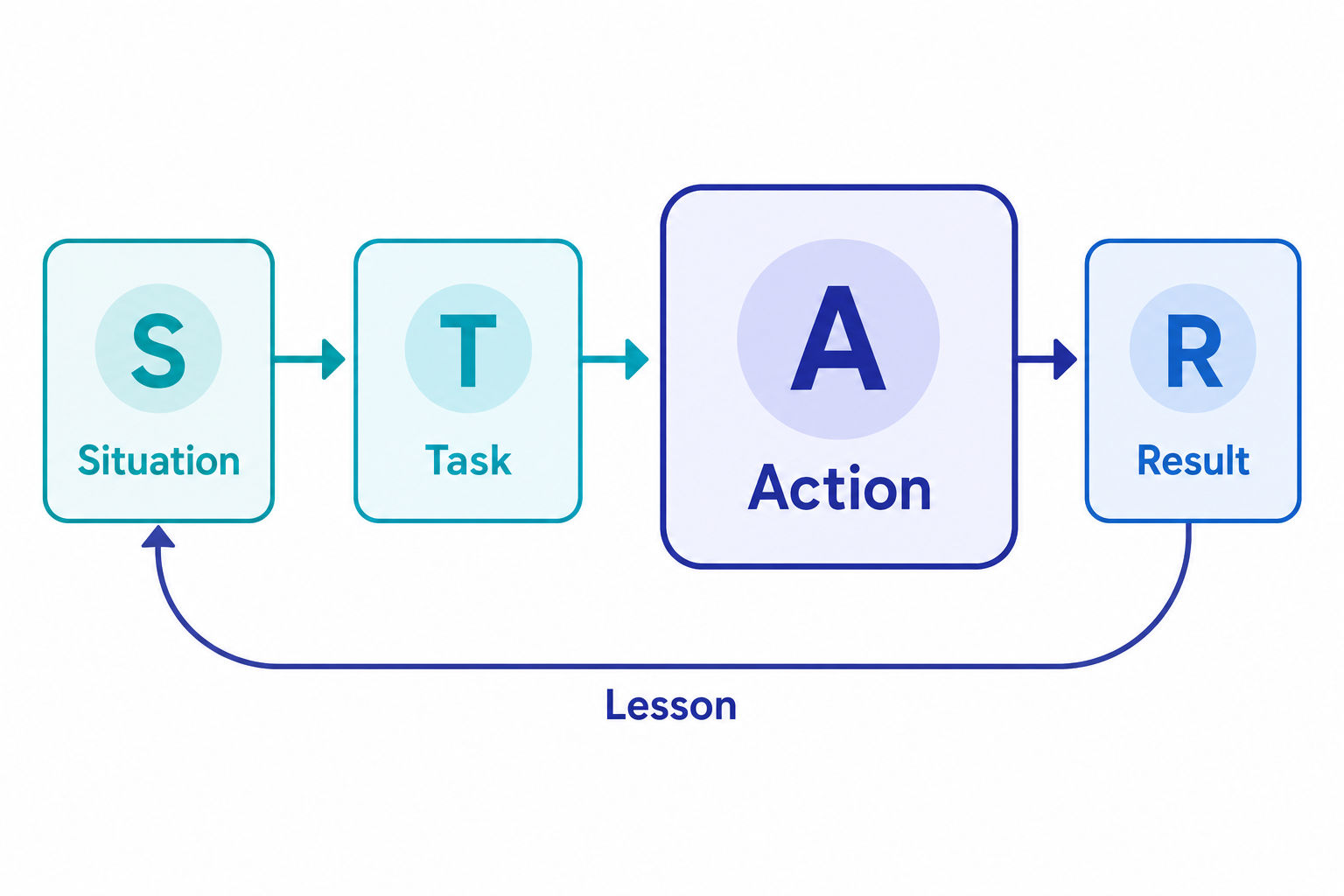
STAR stands for Situation, Task, Action, Result. Treat it as a structure for organizing your answer, not a script to recite. The interviewer should never hear you say "the situation was…" - the structure should be invisible.
Situation - set the scene fast
Two to three sentences. When was this, what team, what was the stakes? Just enough context for the rest of the answer to make sense. The most common mistake here is spending ninety seconds on backstory before getting to anything you did.
Task - your responsibility, not the team's
State your specific responsibility, not the team's goal. "We needed to ship the migration" is the team's task. "I owned the data-backfill step and the rollback plan" is yours. Interviewers are evaluating you, so the answer has to be about you.
Action - the heart of the answer
This is the longest part - aim for roughly half your airtime. Be concrete and use "I," not "we."
- Vague: "I held a meeting and we sorted it out."
- Concrete: "I scheduled a 30-minute sync with the three engineers who owned the conflicting services, proposed a shared interface contract, and wrote the first draft myself so we had something to react to."
The second version shows judgment, initiative, and follow-through. The first shows nothing.
Result - close the loop
What happened, ideally with a number you actually know to be true (a timeline, a defect-rate change, an adoption figure). If the result was mixed or you fell short, say so and add what you learned - a thoughtful "here's what I'd do differently" often scores higher than a tidy win with no reflection.
STAR at a glance
| Step | Length | Focus | Strong signal | Weak signal |
|---|---|---|---|---|
| Situation | 2-3 sentences | Context and stakes | Just enough to follow | Long backstory, irrelevant detail |
| Task | 1-2 sentences | Your responsibility | "I owned X" | "We were supposed to…" |
| Action | ~half the answer | What you did | Specific steps, judgment calls | "We figured it out," passive voice |
| Result | 2-4 sentences | Outcome + learning | Concrete impact, honest reflection | "It worked out fine," no detail |
The most common behavioral questions
These come up repeatedly across companies and roles. If you can answer all of them well, you can improvise the rest.
- Tell me about a time you disagreed with your manager or a teammate.
- Tell me about a project that failed. What did you learn?
- Describe a time you had to make a decision with incomplete information.
- Tell me about a time you went above and beyond.
- Describe a situation where you had to influence someone without authority.
- Tell me about a time you received tough feedback.
- Describe a time you had to prioritize competing deadlines.
- Tell me about a time you worked with a difficult colleague.
- Describe a project you are most proud of.
- Tell me about a time you identified a problem nobody else saw.
You can browse hundreds more, tagged by company and round, in the PracHub question bank, and filter to behavioral questions for a specific employer from its company page.
Example answer (walked through STAR)
Here is one of these questions answered in structure. This is an illustrative example, not a real quote - use it as a template, then fill in your own story.
Question: Tell me about a time you disagreed with a teammate.
Situation (example): "On my last team, a senior engineer wanted to rewrite our payments service in a new framework right before a major launch."
Task (example): "I owned the launch checklist, so I was responsible for flagging anything that put the date at risk."
Action (example): "Instead of just saying no, I wrote a one-page comparison of the rewrite's benefits against the launch risk, proposed we ship on the existing stack and schedule the rewrite for the next quarter, and walked the senior engineer through it one-on-one before the team meeting so it wasn't a public confrontation."
Result (example): "We launched on time, and the rewrite happened the following quarter with a proper plan. The senior engineer later told me the written comparison made the trade-off obvious. I learned that disagreeing in writing, early and privately, lands far better than arguing in the room."
Notice the answer is honest about a disagreement, shows the candidate's specific actions, and ends with a lesson - not a humblebrag.
Amazon's Leadership Principles
Amazon is the most behavioral-heavy interviewer in tech. Nearly every round, including the technical ones, includes at least one behavioral question tied to its Leadership Principles, and "Bar Raiser" interviewers are specifically there to probe them.
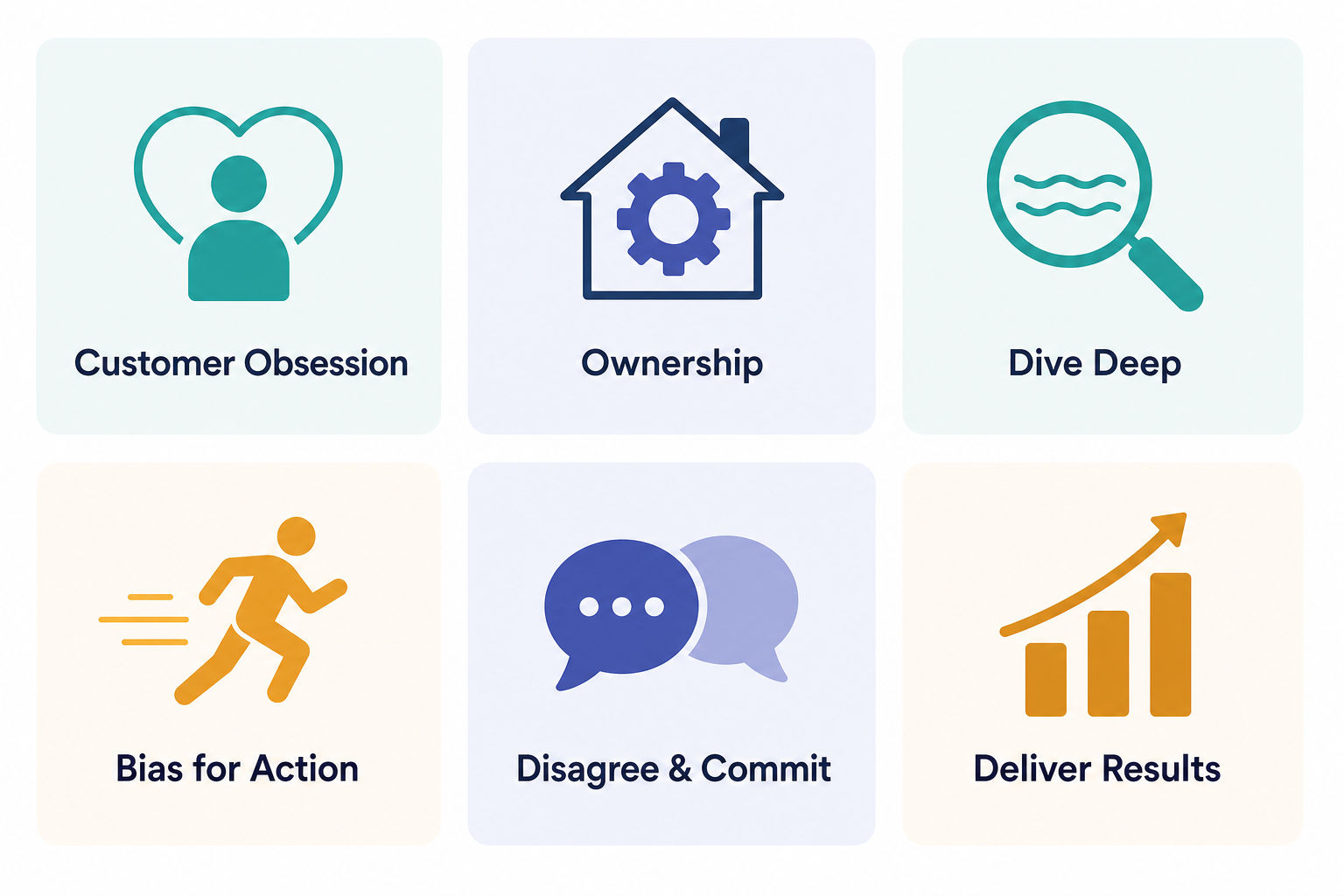
The principles that tend to dominate interview questions:
- Customer Obsession - Start with the customer and work backward.
- Ownership - Act on behalf of the whole company, think long-term, never say "that's not my job."
- Dive Deep - Know the details; be willing to audit and get into the data.
- Bias for Action - Speed matters, and many decisions are reversible.
- Disagree and Commit - Challenge a decision respectfully, then back it fully once it's made.
- Deliver Results - Focus on the key inputs and ship with the right quality.
Practical prep for Amazon: have at least two stories ready per principle you expect to be tested, and make sure each story is clearly yours. Bar Raisers follow up hard - "what was your role specifically?", "what would you do differently?" - so a story you can only narrate at the team level falls apart under questioning. You can study real reported Amazon behavioral questions, grouped by the principle they target, on Amazon's company page.
How many stories do you need?
A focused set of eight to ten well-prepared stories can cover almost any behavioral question. The trick is to pick versatile stories: a good conflict story often doubles as an "influence without authority" story and a "received tough feedback" story.
Build a small matrix of your stories against the question themes so you know your coverage and never go blank.
| Story | Conflict | Failure | Influence | Ambiguity | Leadership |
|---|---|---|---|---|---|
| Payments launch disagreement | ✓ | ✓ | |||
| Failed migration | ✓ | ✓ | |||
| Mentored a struggling teammate | ✓ | ✓ | |||
| Shipped under a shifting spec | ✓ | ✓ |
Each story should have a clear challenge (nobody wants to hear about a time everything went smoothly), your specific actions rather than the team's, a concrete outcome, and - especially for mixed results - a lesson learned.
Mistakes that quietly cost people offers
Being too vague. "We worked together and figured it out" tells the interviewer nothing. They need to know what you did.
Only telling success stories. Failure questions are not traps. The interviewer is checking for self-awareness and growth. Dodging a failure question reads far worse than owning a real mistake.
Spending too long on the Situation. Two sentences of setup, then move. If you're still scene-setting after thirty seconds, you've lost the room.
Hiding behind "we." Passive, team-level narration ("the team decided," "it got done") makes it impossible to score you. Use "I" for your contributions.
Not preparing or rehearsing. Winging it leads to rambling and circular answers. Prepare your stories and practice them out loud - the gap between a story in your head and a story you can tell cleanly under pressure is larger than most people expect.
| Don't | Do |
|---|---|
| "We solved it as a team." | "I proposed X, then drove it by doing Y." |
| Recite STAR labels aloud | Let the structure stay invisible |
| Only bring polished wins | Bring an honest failure with a lesson |
| Memorize one rigid script per question | Keep ~10 flexible stories you can re-aim |
| Pad the Situation | Get to the Action fast |
How to Use This Page as a Prep Plan
Do not treat this as passive reading. Convert the ideas in this page into a short weekly loop: learn one idea, practice it under interview conditions, then write down what changed. That is the fastest way to turn advice into visible interview behavior.
| Prep area | What you need to prove | Practice artifact |
|---|---|---|
| Story choice | Pick a real moment with stakes. | One sentence context and why it mattered. |
| Action detail | Show judgment, not just activity. | Three actions you personally owned. |
| Result | Make the outcome verifiable. | Metric, decision, lesson, or follow-up. |
| Reflection | Prove the story changed your behavior. | What you do differently now. |
For Behavioral Interview Questions: STAR Method Guide with Examples (2026), the strongest candidates usually do three things well: they make their assumptions explicit, they use concrete examples instead of vague claims, and they review mistakes quickly enough that the next practice rep is better than the last one.
Video Walkthrough
This verified YouTube video gives a second pass on the same preparation area. Use it after reading the guide, then come back and turn the advice into a practice artifact.
FAQ
What is the STAR method in an interview?
STAR is a four-part structure for answering behavioral questions: Situation (brief context), Task (your specific responsibility), Action (what you personally did, the bulk of the answer), and Result (the outcome plus what you learned). It keeps answers concrete and focused on your contribution instead of vague team narration.
How long should a STAR answer be?
Aim for roughly two minutes. Keep the Situation and Task to a few sentences each, spend about half the answer on the Action, and close with a clear Result. If you're running past three minutes, you're probably over-explaining the setup.
How many stories should I prepare for a behavioral interview?
Around eight to ten versatile stories is usually enough to cover the full range of behavioral questions. Choose stories that can be re-aimed at multiple themes (conflict, influence, failure, ambiguity) so you're not trying to memorize a unique answer for every possible prompt.
What is the most common behavioral interview question?
Variations of "tell me about a time you faced a conflict or disagreement" and "tell me about a project that failed and what you learned" show up across almost every company. Preparing strong answers to those two covers a large share of what you'll actually be asked.
Are behavioral interviews really that important for engineers?
Yes. A strong technical performance can still be derailed by a weak behavioral round, and at companies like Amazon the behavioral signal is weighted as heavily as the technical one. It's often the cheapest place to gain an edge, because most candidates under-prepare it.
How do I answer a behavioral question about failure?
Pick a real failure where you had genuine responsibility, describe what went wrong without blaming others, and spend most of the answer on what you did about it and what you changed afterward. The point of the question is growth and self-awareness, not whether you've ever made a mistake.
Ready to practice? Browse real reported behavioral and leadership questions, tagged by company and interview round, in the PracHub question bank, explore role-specific prep for software engineers, or dig into more prep articles in PracHub resources.
Comments (0)