Googleyness & Google Behavioral Interview Questions (2026)
Quick Overview
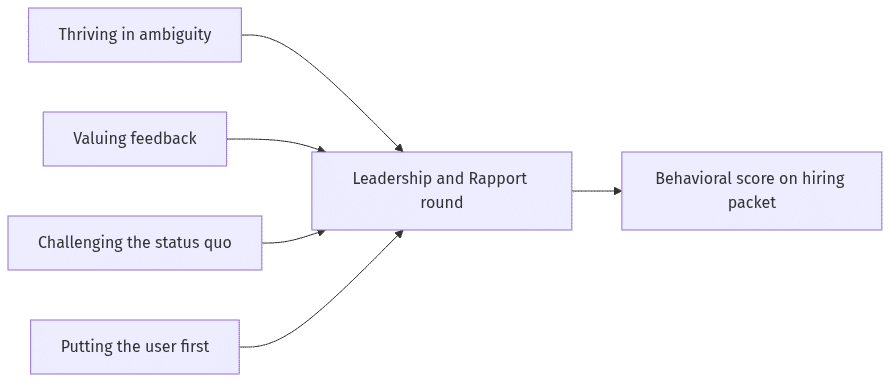
This guide explains "Googleyness" as a behavioral rubric for Google interviews, detailing the four evaluation pillars (thriving in ambiguity, valuing feedback, challenging the status quo, and putting the user first), recurring behavioral questions, the STAR-L answer structure with worked weak-versus-strong examples, and a seven-day prep plan.
"Googleyness" is the set of behavioral traits Google uses to evaluate cultural fit during interviews — how you handle ambiguity, absorb feedback, fix broken systems, and protect the user. This guide is for software engineers and adjacent candidates preparing for a Google loop, and it turns a fuzzy culture word into a rubric you can actually prepare against. You will get the four pillars interviewers grade, the positive and negative signals behind each, an answer structure with a worked weak-versus-strong example, the questions that recur, and a seven-day prep plan. Work it in order: understand the rubric, learn the structure, then build and rehearse your story set.
Key Takeaways
- Googleyness is a behavioral rubric, not a personality test. It scores four things: thriving in ambiguity, valuing feedback, challenging the status quo, and putting the user first.
- The round is usually its own scored interview, often called Leadership and Rapport. Strong coding rounds do not compensate for clear behavioral red flags.
- Use STAR-L (Situation, Task, Action, Result, Learnings). Google interviewers probe the Action hardest, so every claim in it needs specifics behind it.
- Prepare 6 to 8 deep, reusable stories rather than 20 shallow ones, and map each story to more than one pillar so you can adapt on the fly.
- Say "I" for your actions and "we" for team outcomes. Vague ownership is one of the most common reasons a technically strong candidate scores poorly here.
What Googleyness Actually Measures
Before drilling questions, it helps to know what the word is standing in for, because the popular reading of it is wrong.
Googleyness is not about being quirky, extroverted, or socially similar to the team. It is shorthand for a set of working behaviors: how you move when a problem has no defined shape, how you react when a peer tears apart your design doc, whether you fix things nobody assigned you, and whose interests you weigh when a deadline collides with quality. Candidates also spell it "Googliness" or "Googlyness" when searching, and recruiters use the terms interchangeably.
Two structural facts shape how you should prepare:
- It is usually scored on its own. The behavioral interview typically produces a signal that goes into your packet alongside coding and design. It is not a friendly chat at the end.
- It leaks into every other round. How you take a hint from a coding interviewer, how you respond when someone questions your data model, and how you treat the recruiter are all observable behavior. Treat the whole loop as part of the read.
A quick reframe that helps: the interviewer is not asking "is this person nice?" They are asking "what happens to my team's velocity and quality if this person joins?" Every story you tell should answer that second question.
Example mini-scenario: two candidates give the same project update — "the migration is basically done, just a few edge cases left." Candidate A stops there and moves on. Candidate B adds, "the edge cases are three legacy accounts with malformed IDs; I've filed a ticket and flagged the two teams whose dashboards will break if we cut over before it's fixed." Both come across as pleasant in the room. Only Candidate B reads as Googley, because the second version answers "what happens to my team's velocity and quality," not just "am I likable."
The Four Pillars of Googleyness
With the framing set, here is the rubric itself, pillar by pillar, including the mistake candidates most often make on each.
1. Thriving in Ambiguity
What it is: The ability to make forward progress on a problem that arrives without a spec, an owner, or a clear definition of done.
Why interviewers care: At Google's scale, most valuable problems do not come pre-scoped. An engineer who stalls without instructions costs a team more than one who occasionally builds the wrong thing quickly and corrects.
How to show it: Describe the structure you imposed on a mess. Who did you talk to, what data did you pull, what was the smallest thing you could ship to learn something, and how did you handle the requirements shifting mid-flight?
Common mistake: Spending most of the answer on how badly scoped the project was. Complaints about the ambiguity read as discomfort with it.
Example answer opening: "We were told to reduce checkout latency for users on slow networks, with no target and no owner. I started by pulling a week of client-side timing data segmented by connection type, which showed the p90 was dominated by a single blocking config fetch rather than by payload size. That gave me a concrete target to argue about."
2. Valuing Feedback (Intellectual Humility)
What it is: Separating your identity from your output, so criticism of a design reads as information rather than an attack.
Why interviewers care: Google's engineering culture runs on code review and openly debated design docs. A defensive engineer makes every review cycle slower and quietly discourages people from flagging real problems.
How to show it: Tell a story where someone changed your mind, and be specific about what they said and what you changed. Bonus points if the feedback was uncomfortable or came from someone junior to you.
Common mistake: Choosing feedback you disagreed with and then proved wrong. That is a story about being right, not about humility.
Example answer fragment: "A new grad on the team pointed out that my caching layer would serve stale permissions for up to five minutes after a revocation. My first reaction was that the window was acceptable. I sat with it, realized I had been reasoning about performance and not about the security case, and added explicit invalidation on permission writes."
3. Challenging the Status Quo
What it is: Noticing that something is broken or slow, and fixing it without being told to, including when it sits outside your assigned area.
Why interviewers care: This is the ownership signal. It separates engineers who complete tickets from engineers who raise the floor for everyone around them.
How to show it: Pick a concrete inefficiency you removed, and quantify what it cost before you touched it. Cross-team coordination makes the story stronger, because pushing for higher standards outside your own reporting line is the hard version.
Common mistake: Framing it as rebellion. "The old system was stupid" reads badly. Show that you understood why the status quo existed before you argued against it.
Example answer fragment: "Our integration suite took long enough that people batched merges to the end of the day, which made failures hard to attribute. Nobody owned it. I profiled the suite, found that a handful of tests were re-seeding the full fixture set, and rewrote them to share a transaction-scoped fixture. Merges went back to being continuous."
4. Doing the Right Thing (Putting the User First)
What it is: Weighing long-term user trust, accessibility, privacy, and safety against short-term delivery pressure, and speaking up when the two conflict.
Why interviewers care: Products at Google scale carry consequences that a single team cannot see from inside a sprint. They want engineers who raise the concern rather than assume someone else will.
How to show it: Find a moment where a business goal collided with the user's interest and you made the cost of ignoring the user concrete. "I argued it was wrong" is weak. "I showed that the flow failed entirely for screen reader users, which was N% of our signups" is strong — swap in your real number when you tell it.
Common mistake: Picking an example with no real tension. If nobody disagreed with you, you did not advocate for anything.
Example answer fragment: "We planned to default a new sharing setting to on because it lifted engagement in the experiment. I flagged that the setting exposed data users had previously entered under a private-by-default assumption. We shipped it off by default with a prompt instead, and I wrote the migration note so existing users were never silently opted in."
Positive vs. Negative Behavioral Signals
Those four pillars get graded through a consistent set of tells. Here is the split between what reads as a strong hire and what reads as a reject.
| Attribute | "Googly" signal (strong hire) | "Non-Googly" signal (reject) |
|---|---|---|
| Collaboration | Shares credit; uses "I" for actions and "we" for team wins; makes room for other voices | Lone-wolf framing; blames teammates for failures; claims sole credit for group work |
| Problem solving | Breaks ambiguous problems into steps; validates assumptions against data | Stalls without direction; leans on gut feeling where evidence was available |
| Response to failure | Owns the mistake plainly; focuses on root cause and prevention | Deflects to other teams, tools, or circumstances; shows no change afterward |
| Communication | Explains complex work to non-technical stakeholders without condescension | Hides behind jargon; gets visibly frustrated when others do not follow |
| Decision making | States the trade-offs weighed and why; commits once the call is made | Presents one option as the only option; relitigates settled decisions |
| Feedback | Cites feedback that changed the work, including uncomfortable feedback | Cites only feedback that validated the original plan |
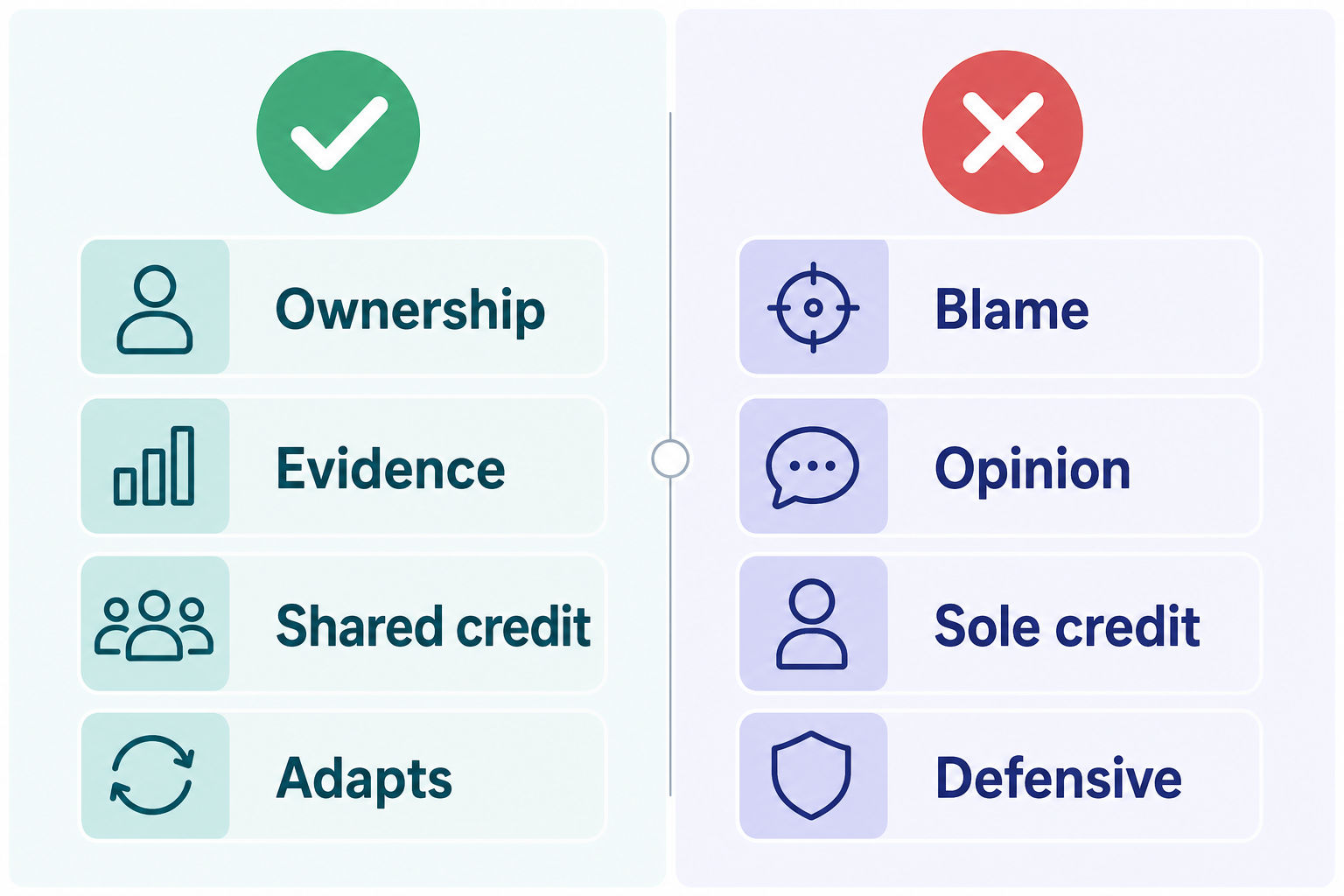
The pattern is consistent. Ownership, evidence, and shared credit read as Googly. Blame, ego, and opinion-over-data read as red flags.
How to Answer Google Behavioral Questions
Knowing the signals is not enough if your delivery buries them, so the next step is a structure that surfaces them automatically.
The structure to use is STAR-L: Situation, Task, Action, Result, and Learnings. The added L matters at Google, because interviewers want evidence that an experience changed how you work, not just that it happened. If you want a refresher on the base method first, see PracHub's STAR method guide with FAANG examples.

Budget your time deliberately:
| Section | Share of the answer | What it must contain |
|---|---|---|
| Situation / Task | Short setup | Only the context needed to make the stakes legible |
| Action | The bulk of it | Specific decisions you personally made, in "I" voice |
| Result | Brief | A number, a decision, or a concrete state change |
| Learnings | One or two sentences | A durable change in how you work now |
Aim to deliver the whole story in under three minutes before follow-ups. Expect the interviewer to dig hardest into the Action. If you say "I convinced the PM to change the roadmap," the next question is almost certainly "what data did you present, and what was their counter-argument?" Vague stories collapse under that pressure; specific ones get stronger.
Google's recruiting team has published video guidance on how they coach candidates for the leadership and behavioral round:
Worked example: the same story, weak and strong
Both versions below describe the same incident. Only the second one scores.
Weak version (example answer): "Our service kept going down, so I rewrote the retry logic and it got better. The team was happy."
Strong version (example answer): "Situation: Our payments service was paging on-call about twice a week from a downstream timeout cascade, and nobody owned the alert. Task: I picked it up even though it sat outside my immediate area. Action: I pulled a month of trace data and found one retry path with no backoff that was amplifying load during partial outages. I wrote a short design doc proposing exponential backoff with jitter. A senior engineer pushed back that this might mask the real upstream problem, which was fair, so I added a dashboard that surfaced the upstream failures separately instead of hiding them. I shipped behind a flag and rolled out gradually. Result: Pages from that cascade stopped, and the new dashboard caught two upstream regressions in the following weeks. Learnings: I now reach for observability before I reach for a code change, because that feedback reframed 'fix the symptom' into 'make the failure visible.'"
Notice what the strong version does without ever naming a pillar. It takes an unowned problem (challenging the status quo), absorbs a critique and changes the design (valuing feedback), uses trace data instead of instinct (problem solving), and ends with a real shift in approach (learnings). That is Googleyness demonstrated rather than claimed.
Top Googleyness Interview Questions
With the structure in place, here are the question types that recur in Google behavioral loops, each mapped to the pillars it tests. For broader cross-company drilling, PracHub's question bank lets you rehearse the same patterns against other rubrics.
Questions 7 through 12 below come from Google candidates' own interview reports on PracHub, submitted after onsite and technical screen loops. They map onto the same four pillars, but the wording is closer to what interviewers actually said in the room. You can browse all reported Google behavioral questions for more.
1. "Tell me about a time you solved a problem with completely unclear requirements."
Tests: Thriving in ambiguity.
How to answer: Lead with the structure you imposed, not the chaos you found. Identify stakeholders, name the missing data you went and got, propose the smallest useful slice, then iterate.
Example angle: a migration where the success criteria were undefined until you proposed and got agreement on three measurable ones.
2. "Tell me about a significant mistake that impacted production or your team."
Tests: Intellectual humility, valuing feedback.
How to answer: Pick a real mistake with real consequences, not a disguised humblebrag. Spend a little time on the mistake and most of the answer on root cause, the blameless post-mortem, and the specific safeguard that removes the class of failure rather than the one instance.
Example angle: a config change that took down a region, where the fix was not "be more careful" but a validation gate in the deploy pipeline.
3. "Describe a time you strongly disagreed with a tech lead or manager."
Tests: Challenging the status quo, collaboration.
How to answer: Show the disagreement was grounded in evidence and delivered respectfully, then show what happened after the decision. Committing fully to a call that went against you is the part most candidates skip, and it is the part that separates a green flag from a red one.
Example angle: you argued for a different storage engine, lost, then wrote the benchmark harness that made the chosen option safe to run.
4. "Tell me about an inefficient process outside your scope that you improved."
Tests: Challenging the status quo, ownership.
How to answer: Name what it cost the org before you fixed it. Internal tooling, missing documentation, a flaky test suite, and an onboarding process that took weeks all work, as long as you can describe the before state concretely.
Example angle: a runbook nobody trusted, which you rewrote after shadowing two on-call rotations.
5. "Describe a time you pushed back on a feature because it wasn't right for the user."
Tests: Doing the right thing, user first.
How to answer: Find genuine tension between a business goal and the user's interest, then show how you made the long-term cost concrete enough that others could weigh it.
Example angle: an onboarding step that lifted a conversion metric while stranding users who declined a permission.
6. "Tell me about a time you had to onboard or mentor someone."
Tests: Collaboration, emergent leadership.
How to answer: Measure success by their independence, not your output. Describe how you adapted your explanation when the first version did not land, which is the detail that shows real mentorship rather than task delegation.
Example angle: a teammate who shipped their first solo design doc six weeks in, and what you deliberately stopped doing to get there.
7. "Tell me about a time you led a project when the requirements were still ambiguous."
Tests: Thriving in ambiguity, emergent leadership.
How to answer: This one is about the people, not your own note-taking. Show how you gave a team something to move toward before the answer existed: a written hypothesis, a decision owner per open question, a date by which you would either confirm or drop each assumption. Say what you deliberately left undecided so the team was not blocked.
Example angle: a project where you shipped a narrow v0 against your best guess, then let real usage settle the two requirements the team had been arguing about — reported by a Google candidate on PracHub: see the question.
8. "Describe a time you received difficult feedback. How did you respond?"
Tests: Valuing feedback, intellectual humility.
How to answer: Resist the urge to make the feedback sound fair in hindsight. Give the actual words, your first reaction, and then the gap between that reaction and what you did next. The signal is whether you went back to the person to check you had understood them, and what specifically changed in your behavior afterward.
Example angle: a review comment about how you handled disagreement in design meetings, which you initially disputed and later verified by asking two other teammates — reported by a Google candidate on PracHub: see the question.
9. "Tell me about a significant failure and what you changed because of it."
Tests: Intellectual humility, doing the right thing.
How to answer: Pick a failure you actually owned, not one caused by someone else's decision. Name the call you got wrong and why it looked right at the time. Then spend most of your answer on the durable change, a checklist, a rollback policy, a different escalation habit, and whether it held up on a later project.
Example angle: a launch you approved without a rollback path, which turned into a standing pre-launch review you still run — reported by a Google candidate on PracHub: see the question.
10. "How have you worked with a colleague you found difficult?"
Tests: Collaboration, doing the right thing.
How to answer: Do not make the colleague a villain, and do not claim you had no problem with them. Describe the concrete friction, missed handoffs, contradictory reviews, and what you changed on your side first. Then show the mechanism that fixed it: a shared doc, a standing sync, a clearer boundary. Judge the outcome by the work, not the relationship.
Example angle: a reviewer whose blocking comments were slowing you down until you asked for their constraints up front and restructured the pull requests around them — reported by a Google candidate on PracHub: see the question.
11. "Walk me through the trade-offs in a project you built, and defend them."
Tests: Challenging the status quo, technical judgment under pressure.
How to answer: State the constraint that made the trade-off real: deadline, cost ceiling, team size, existing system. Give the option you rejected and the specific cost you accepted in exchange. Expect pushback and treat it as the actual question. Hold your position where the reasoning still stands, and concede clearly where new information would change it.
Example angle: choosing a denormalized read path you knew would cost you write complexity, because query latency was the thing users complained about — reported by a Google candidate on PracHub: see the question.
12. "What did you do when you found another team building the same thing you were?"
Tests: Doing the right thing, emergent leadership across teams.
How to answer: The failure mode is defending your own version. Show that you went and read their work before arguing, then framed the choice around which system should survive rather than whose it was. Say who you brought in to decide, and be honest if the answer was that your team stopped and adopted theirs.
Example angle: discovering a parallel internal tool, comparing both against the use cases neither team had written down, and merging into the one with the better data model — reported by a Google candidate on PracHub: see the question.
How Google Evaluates Leadership (Even for ICs)
Several of those questions probe leadership even when the role manages nobody, which surprises candidates on the individual contributor track.
Google assesses emergent leadership: what happens when a team hits a crisis, a pivot, or a technical deadlock and someone steps up without the title to do so. The through-line is influence without authority. You move the group because of how you think and communicate, not because of where you sit on the org chart.
Ways to demonstrate it as an IC:
- Mentoring less experienced engineers, and being specific about what changed for them.
- Acting as the technical connective tissue between teams that were talking past each other.
- Breaking a deadlock between senior peers by brokering a compromise the data supports.
- Volunteering to own the unglamorous shared thing (the flaky pipeline, the stale runbook) that everyone routes around.
Example mini-scenario: two teams each assumed the other owned schema validation for a shared event stream, so bad events flowed to both. Neither lead wanted to absorb the work. An IC who writes a one-page proposal, gets both leads in a room for twenty minutes, and leaves with a named owner has demonstrated emergent leadership more convincingly than any claim about being a natural leader.
If you are targeting a management track, the bar shifts once you are formally accountable for a team. PracHub's engineering manager behavioral guide covers that difference.
Common Mistakes That Sink Strong Engineers
Before building your story set, it is worth knowing the failure modes, because most of them are avoidable in editing rather than in the room.
| Mistake | Why it scores badly | The fix |
|---|---|---|
| All "we," no "I" | The interviewer cannot score a contribution they cannot identify | "We" for outcomes, "I" for every action you took |
| The humblebrag failure | "I care too much" reads as evasion, not self-awareness | Pick a mistake with a real consequence you can name |
| No data in the Action | "I convinced them" is a claim, not evidence | "I showed the p99 regression graph" survives follow-ups |
| Relitigating a lost argument | Refusing to commit signals friction on a real team | Show disagree-and-commit explicitly |
| Skipping the Learnings | Without it, a great story reads as a one-off | One sentence on what you do differently now |
| One story for everything | Forcing a single project to cover ambiguity, conflict, and user advocacy reads as a thin track record | Spread examples across projects and time periods |
| Over-rehearsed delivery | Word-perfect recitation kills the rapport half of the round | Rehearse the beats, not the script |
Example of the fix in one line: replace "we improved reliability a lot" with "I cut the retry amplification path, and the weekly page count from that alert went to zero." Same event, scoreable version.
A 7-Day Prep Plan
Knowing all of the above changes nothing until you have rehearsed it out loud, so here is the schedule that turns the rubric into delivery.
| Day | Focus | Output |
|---|---|---|
| 1-2 | Inventory your experiences | A raw list of 12 to 15 candidate stories: conflicts, failures, ambiguous projects, user advocacy, mentoring |
| 3 | Draft in STAR-L | 6 to 8 stories written out, each with a real Result and an honest Learning |
| 4 | Map to pillars | A grid showing which pillar each story covers, so you can see your gaps |
| 5 | Rehearse out loud | Every story delivered in under three minutes, timed |
| 6 | Mock the follow-ups | Prepared answers to "what data?" and "what was the counter-argument?" for each Action |
| 7 | Record and review | A recording of yourself; mark filler, vagueness, and missing numbers, then patch |
Three rules make the plan work:
- Depth over breadth. Six to eight stories you can defend under three rounds of follow-ups beat twenty you can only summarize.
- Map before you rehearse. A story that covers two pillars is worth twice as much in a round of at least 45 minutes where you cannot control which questions come.
- Record yourself. Hearing your own answer surfaces filler and missing evidence faster than reading it ever will.
Mock interviews close the loop. Rehearsing against real reported prompts tells you whether your stories hold up before you are in the room, and pressure-testing the same set against other FAANG behavioral loops keeps them useful regardless of which company calls back first.
FAQ
Common questions candidates ask once they start prepping this round.
What does "Googleyness" mean in an interview?
It is the behavioral profile Google evaluates: thriving in ambiguity, intellectual humility, valuing feedback, challenging the status quo to improve systems, and putting the user first. It is assessed in a dedicated behavioral interview, often called the Leadership and Rapport round, and it is scored alongside your technical results.
What's the best way to prepare for the Leadership and Rapport interview?
Build a small set of deep stories rather than a long list of shallow ones: inventory 12 to 15 candidate experiences, write 6 to 8 of them out in STAR-L, map each to more than one pillar, then rehearse them out loud against likely follow-ups. The 7-day plan above walks through that sequence day by day.
Can you fail a Google interview if you lack Googleyness?
Yes. The behavioral signal carries real weight in the packet. Some candidates report passing coding and system design rounds and still being turned down when the behavioral round surfaces red flags such as blaming teammates, defensiveness about feedback, or an inability to structure an ambiguous problem.
How is Googleyness different from Amazon's Leadership Principles?
Both evaluate behavior, but the emphasis differs. Amazon's Leadership Principles are an explicit published list tied tightly to ownership and execution speed, and interviewers often map answers to a named principle. Googleyness is less codified and leans toward curiosity, collaborative problem solving, and how you make a team function. In practice: Amazon weights how decisively you execute; Google weights how well you work with others on hard, unclear problems.
How many behavioral stories should I actually prepare?
Six to eight is usually enough, provided each is detailed enough to survive follow-ups and each maps to more than one pillar. Interviewers probe depth, not inventory size, so a story you can defend for ten minutes beats three you can only introduce.
Does Google still ask brainteaser questions?
Google publicly moved away from classic brainteasers such as estimating how many golf balls fit in a school bus, after concluding they did not predict on-the-job performance. Behavioral rounds now focus on real past experiences. Some roles still include open-ended estimation, but it is scored on your reasoning and assumptions, not on hitting a trick answer.
Is Googleyness scored separately or folded into the technical rounds?
It is typically its own scored interview, but interviewers in technical rounds can also record behavioral observations: how you take a hint, how you handle a challenge to your approach, how you communicate under time pressure. Treat every interaction in the loop as part of the behavioral read.
Can I use the same story for two different questions?
Yes, and you should design for it. A story that involves an ambiguous problem, a piece of hard feedback, and a user-facing trade-off can answer three different prompts with a different emphasis each time. Avoid using the identical story twice with the same interviewer, and never reuse one within a single round.
Practice with real Google behavioral questions
The fastest way to make any of this concrete is to rehearse against prompts Google actually asks. Browse the real Google behavioral and leadership interview questions reported by recent candidates, check the wider Google question bank for the rest of the loop, and pressure-test your STAR-L stories one at a time until each one survives three follow-ups.
Comments (0)