LLMs Practical Lancchain RAG Question (13)
Quick Overview
This project-based tutorial covers building a Retrieval-Augmented Generation (RAG) system with LangChain, including data ingestion and Document abstraction, chunking and splitting trade-offs, embedding-based semantic search, retrieval strategies, prompt control, and conversational memory.
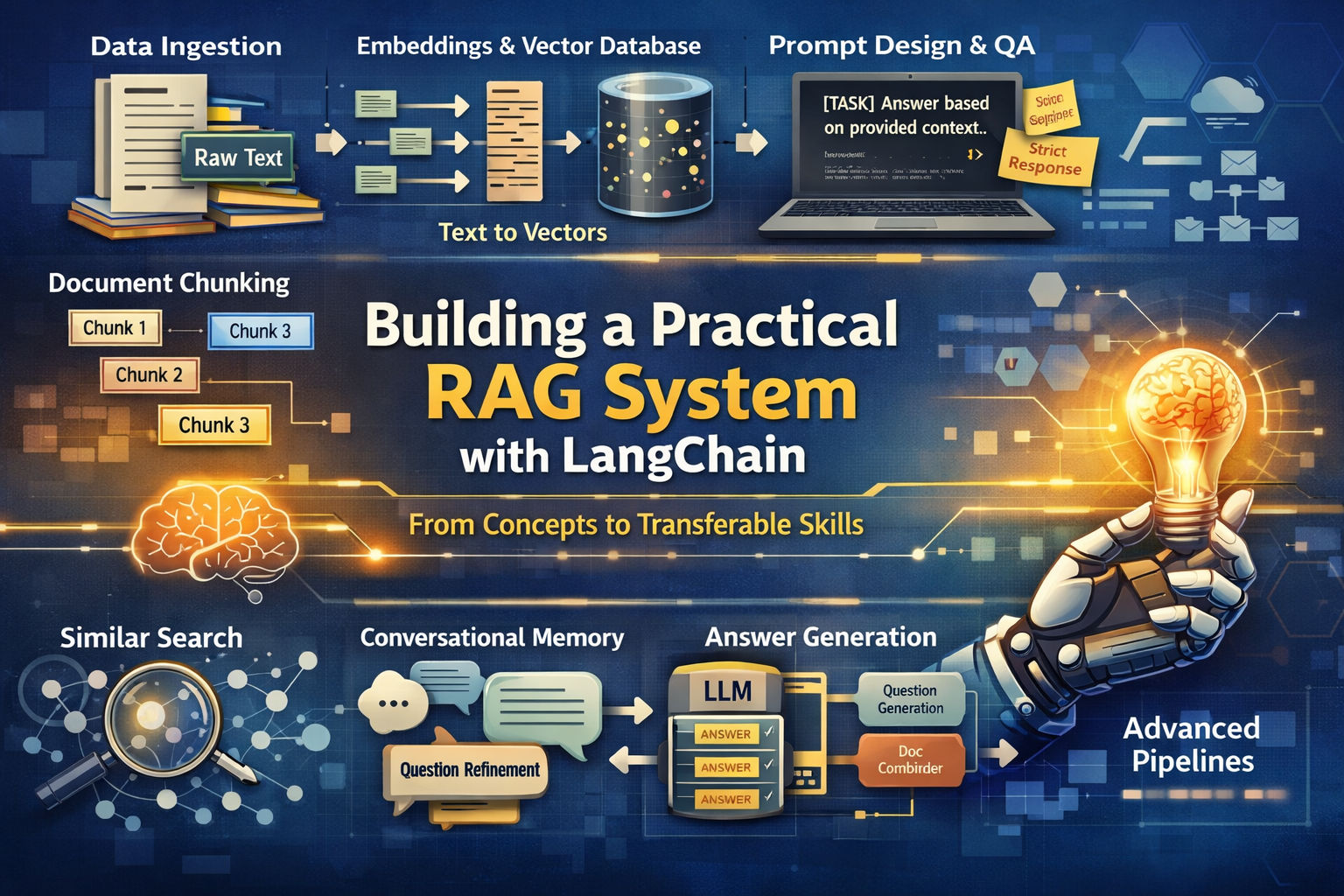
Building a Practical RAG System with LangChain: From Concepts to Transferable Skills
Why This Project Matters
Retrieval-Augmented Generation (RAG) is no longer an academic idea—it is a production pattern used in search engines, enterprise assistants, internal knowledge bots, and AI copilots. This project, based on a simple encyclopedia-style Quinoa dataset, is valuable not because of the domain itself, but because it exposes the entire cognitive pipeline behind modern LLM applications: data grounding, retrieval, prompt control, and conversational memory.
If you can fully understand this example, you are already thinking like an applied AI engineer rather than a prompt-only user.
Core RAG Mental Model (What You’re Really Learning)
At a high level, RAG solves one fundamental problem:
LLMs do not “know” your data unless you explicitly retrieve and inject it.
This project demonstrates the canonical RAG loop:
- Ingest knowledge (raw text → structured documents)
- Chunk knowledge (optimize recall vs. precision)
- Embed knowledge (semantic representation)
- Retrieve relevant context (similarity search)
- Constrain generation (prompt + retrieved context)
- Maintain dialogue state (conversation memory)
Once this loop is clear, the domain (Quinoa, finance, medical notes, legal docs) becomes interchangeable.
Data Preparation: Why “Plain Text” Is Enough
Using a Baike article saved as .txt may look simplistic, but that is intentional. Most enterprise data starts as unstructured text: PDFs, internal docs, emails, wikis.
The key learning here is document abstraction. LangChain wraps raw text into a Document object, separating:
page_content: the actual knowledgemetadata: provenance, source tracking, compliance hooks
This abstraction later enables source citation, filtering, and trust scoring—critical in real systems.
Document Splitting: The First Hidden Bottleneck
Chunking is not a cosmetic step; it directly determines retrieval quality.
A fixed chunk_size=128 characters demonstrates a trade-off:
- Smaller chunks → higher recall, noisier context
- Larger chunks → lower recall, richer context
In practice, chunk size should be driven by:
- Embedding model context window
- Average sentence density
- Query granularity
This is the same problem you’ll face when indexing:
- Financial reports
- Research papers
- Customer support tickets
Chunking is retrieval engineering, not preprocessing trivia.
Embeddings: Why Semantic Search Changes Everything
Using m3e-base converts text into normalized vectors, allowing meaning-based retrieval instead of keyword matching.
This unlocks:
- Paraphrase tolerance (“How to prevent pests?” vs “pest control methods”)
- Cross-lingual or low-resource scenarios
- Robustness to user phrasing errors
The embedding + vector store combination (Chroma here) is reusable across:
- Recommendation systems
- Similar document detection
- Resume–job matching
- Knowledge deduplication
If you understand embeddings, you understand the backbone of modern AI systems.
Prompt Design: Turning LLMs into Deterministic Systems
The prompt explicitly forbids hallucination and forces grounding:
“You must strictly answer based on the background knowledge provided.”
This transforms the LLM from a creative generator into a controlled reasoning engine.
In real-world deployments, this pattern is essential for:
- Compliance-heavy domains (finance, healthcare, law)
- Enterprise QA systems
- Internal policy assistants
Prompt design here is not about “nice wording”—it is about risk containment.
Conversational Retrieval: Memory Is a System Feature, Not Magic
ConversationalRetrievalChain introduces a critical idea:
conversation history must be actively managed, not blindly appended.
The system:
- Condenses prior turns into a standalone question
- Uses that refined query for retrieval
- Generates answers only from retrieved context
This pattern prevents:
- Context window explosion
- Irrelevant retrieval
- Answer drift over long conversations
This same design is used in:
- AI customer support agents
- Internal chatbots
- Coding assistants with session memory
Advanced Chains: Why Modularity Matters
Separating:
- Question generation
- Document combination
- Answer synthesis
is not overengineering—it is what allows:
- Better traceability
- Custom retrievers per question type
- Model swaps without pipeline rewrites
This modular thinking maps directly to production ML systems, where observability and control matter more than demos.
Transferable Skills You Gain from This Project
By mastering this example, you are indirectly learning:
- Search system design (semantic retrieval)
- LLM safety and grounding (hallucination control)
- Data engineering for AI (chunking, metadata, storage)
- System-level thinking (pipelines, memory, modular chains)
These skills apply far beyond LangChain:
- OpenAI Assistants API
- LlamaIndex
- Custom in-house RAG stacks
- Search + LLM hybrids
How to Extend This Further (Real Learning Starts Here)
To deepen understanding, consider:
- Swapping Chroma for FAISS or Milvus
- Comparing different embedding models
- Introducing hybrid search (BM25 + vectors)
- Adding source citation enforcement
- Evaluating retrieval quality with test queries
Each extension mirrors a real industry problem.
Final Perspective
This is not a “Quinoa QA demo.”
It is a compressed blueprint of how modern AI applications reason over knowledge.
If you can explain why each component exists—not just how to run it—you are already operating at an applied AI engineer level.
Comments (0)