Machine Learning Interview Questions: Complete 2026 Guide
Quick Overview
This guide covers applied machine learning interview topics in 2026, including coding problems, ML theory such as bias–variance and evaluation metrics, diagnosing and shipping degrading models in production, common question patterns, and differences in emphasis across companies like Amazon, Meta, and Google.
Machine learning interviews reward applied judgment as much as textbook recall. If you can explain the bias-variance tradeoff but freeze when asked how you'd ship a model that's quietly degrading in production, you'll struggle. This guide breaks down what ML interviews actually test in 2026, how the emphasis shifts between companies like Amazon, Meta, and Google, the questions that come up again and again, and a concrete way to prepare for each round.
It's written for candidates targeting Machine Learning Engineer roles and adjacent applied-ML positions. By the end you'll know where to spend your prep time instead of spreading it evenly across topics that aren't equally weighted.
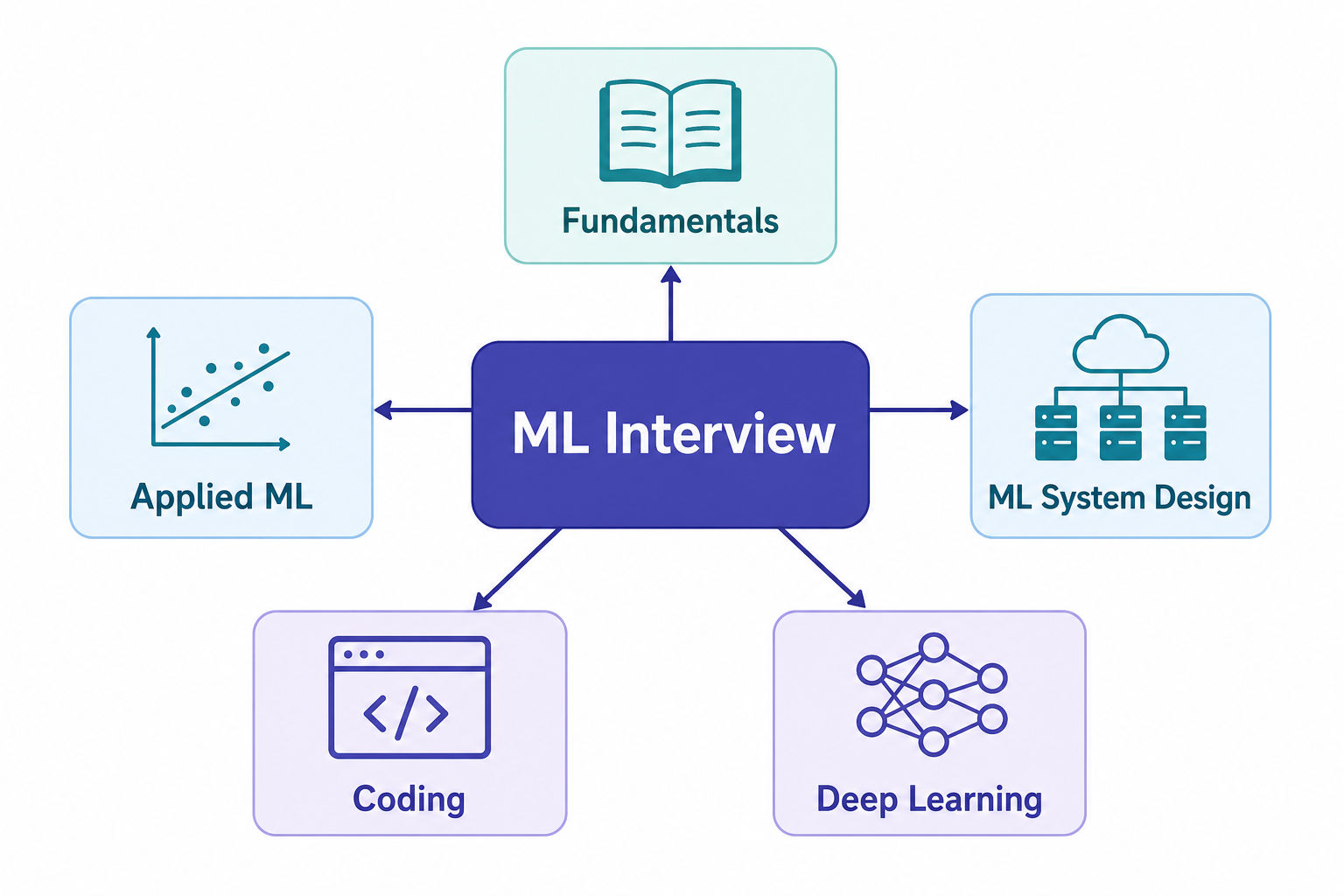
What ML interviews cover
ML interview questions cluster into five areas. They overlap heavily - a single open-ended prompt can pull in fundamentals, applied judgment, and system design at once - so treat these as lenses, not buckets. Most loops weight fundamentals and applied ML the most, with system design as the round that often separates strong candidates from average ones.
Fundamentals
The conceptual core. Expect to explain, not just define. Interviewers push with follow-ups, so a memorized one-liner rarely survives the second question.
- Bias-variance tradeoff and how to diagnose which one a model suffers from
- Overfitting and regularization (L1 vs L2)
- Cross-validation strategies and when each is appropriate
- Evaluation metrics (precision, recall, F1, AUC-ROC) and when each misleads
- Gradient descent and optimization basics
Applied ML
Open-ended problems where you reason about a real modeling decision end to end. This is where genuine project experience shows.
- Feature engineering for a specific problem
- Model selection: choosing the right tool for the constraints
- Handling imbalanced data
- Missing-data strategies
- A/B testing an ML model in production
ML system design
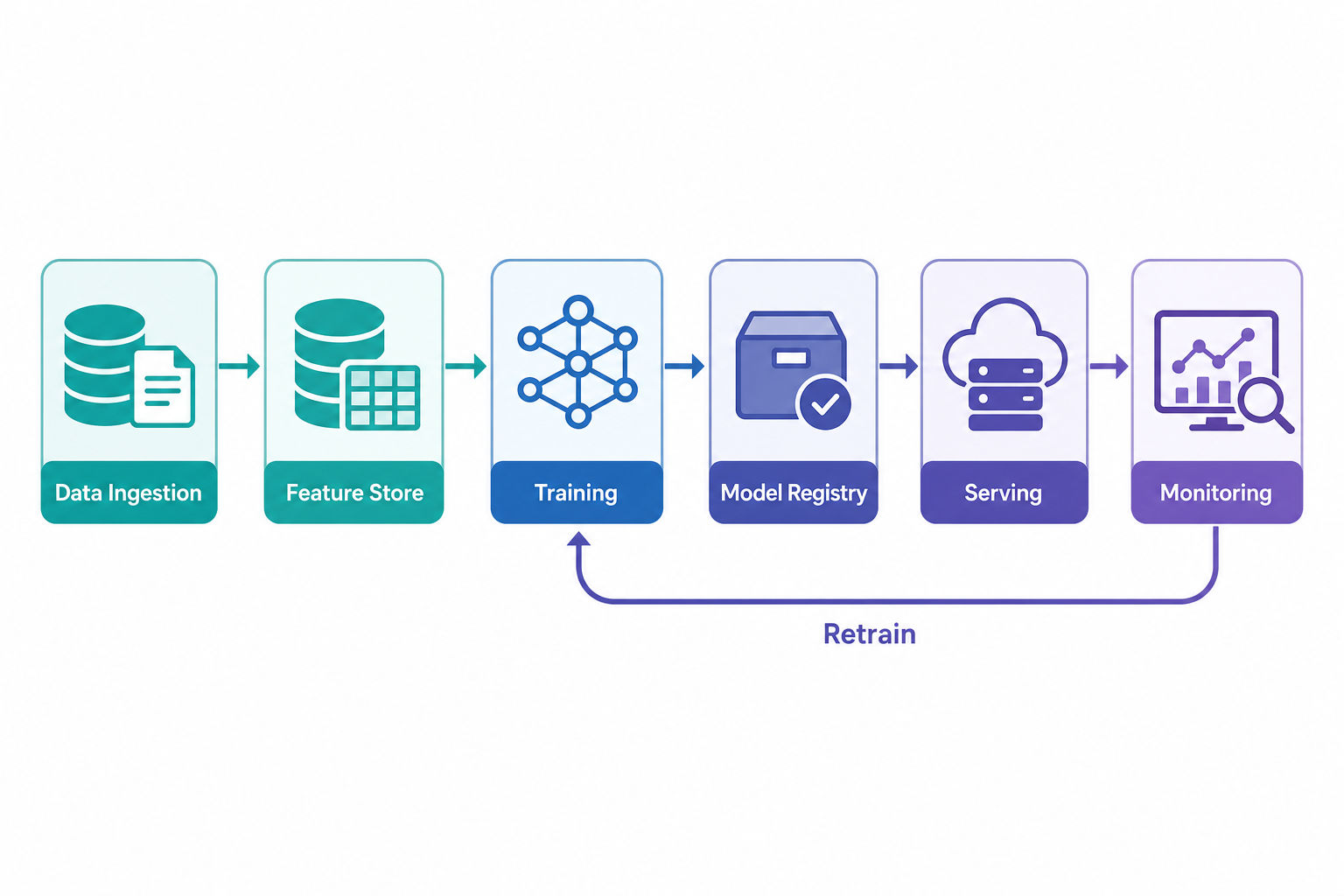
Whiteboard a full ML pipeline, from raw data to serving and monitoring. Strong practice material is scarce here, which is exactly why it tends to be the differentiator.
- Design a recommendation system
- Design a fraud detection pipeline
- Design a search ranking system
- Design an ad click-prediction system
- Model serving, monitoring, and retraining
Coding
Lighter than a standard algorithms round, but you still need fluent tooling. The bar is competence, not LeetCode-hard puzzles.
- Implement a simple model from scratch (logistic regression, k-means)
- Data manipulation with pandas / NumPy
- Write a clean training loop
- Feature-processing code
Deep learning
Increasingly prominent, especially anything LLM-adjacent.
- Transformers and attention mechanisms
- CNNs vs RNNs vs Transformers, and where each still fits
- Transfer learning and fine-tuning
- LLM-related questions (notably more common in 2026)
You can browse real, company-tagged versions of all of these in the PracHub question bank.
How the focus shifts by company
The same fundamentals show up everywhere, but each company leans on a different round and frames problems around its own products. The table below is a directional rubric, not a guarantee - interviewers vary, and any given loop can break the pattern.
| Company | Primary emphasis | What to prepare | Example framing you might see |
|---|---|---|---|
| Amazon | Applied, business-oriented | Tie modeling choices to business outcomes; Leadership Principles | "Build a recommender for product pages" |
| Meta | Ranking, ads ML, integrity/safety | Feed ranking, content classification at scale, engagement vs well-being tradeoffs | "Detect harmful content across billions of posts" |
| Theory and infrastructure | Derivations, why an algorithm works, model serving | "Derive the update rule" or "explain the math" |
Amazon
Heavily applied and business-oriented. Questions tend to be grounded in Amazon's own products - recommendation systems for product pages, detecting fraudulent reviews, optimizing logistics. Be ready to connect every modeling choice to a measurable business outcome, and expect behavioral questions woven in.
Meta
Centered on content ranking, ads ML, and integrity/safety models. Be ready to discuss how a ranking system might surface relevant content, how to detect harmful content at scale, and how to design a model that balances engagement against user well-being.
More theoretical than Amazon or Meta on average. You may be asked to derive results, explain why an algorithm works, and reason about the math underneath. Google also probes ML infrastructure and serving more than most.
Questions that keep showing up
These questions - or close variants - appear across many companies. Practice saying your answers out loud, because the follow-up is where interviews are won or lost.
- Explain the bias-variance tradeoff. How do you diagnose which one your model suffers from?
- When would you use logistic regression over a random forest?
- Your model has high AUC-ROC but low precision. What's going on, and what do you do about it?
- How would you handle a dataset where only 1% of examples are positive?
- Design a recommendation system for a given product. Walk through the full pipeline.
- How do you decide which features to include in a model?
- Explain L1 vs L2 regularization. When would you use each?
- Your model performs well offline but poorly in production. What could cause this?
- How do you A/B test a machine learning model?
- Explain how a transformer works. Why has it replaced RNNs for most NLP tasks?
Worked example: high AUC-ROC, low precision
Here's how a strong answer to question 3 might sound. Example answer: "AUC-ROC measures ranking quality across all thresholds and is insensitive to class imbalance, so a high AUC just means positives tend to score above negatives. Low precision at my operating threshold means that among the items I flag as positive, too many are actually negative - usually because positives are rare and even a small false-positive rate produces many false alarms in absolute terms. I'd first look at the precision-recall curve instead of ROC, since PR is more informative under imbalance. Then I'd consider moving the decision threshold, re-weighting the loss, or whether precision or recall matters more for the actual product before optimizing for either."
Notice that the example doesn't just define terms - it connects the metric to the business decision. That framing is what interviewers reward.
How to prepare
Each round rewards a different kind of practice. Spend your time in proportion to where you're weakest, not evenly.
| Round | What good preparation looks like | Common pitfall |
|---|---|---|
| Fundamentals | Explain concepts without a script; understand why, not just what | Reciting definitions that collapse on the first follow-up |
| Applied ML | Run full case studies end to end, out loud | Jumping to a model before clarifying the problem and metric |
| System design | Draw the full pipeline under time pressure; name the components | Designing the model but ignoring data, serving, and monitoring |
| Coding | Sharpen pandas / NumPy and simple from-scratch models | Over-preparing for hard algorithms that rarely appear |
Fundamentals
Be able to explain core concepts without a script. The interviewer will push, and a memorized definition won't survive the second question. Aim to understand why a method works. For instance, don't just say "L1 induces sparsity" - be ready to explain that the L1 penalty's constant gradient can drive weights exactly to zero, while L2's shrinking gradient pulls them toward, but rarely onto, zero.
Applied ML
Practice full case studies. Given a business problem, walk the whole arc: problem formulation, data collection, feature engineering, model selection, evaluation, deployment, and monitoring. Start every case by clarifying the objective and the metric before you reach for a model.
ML system design
Similar to general system design, but centered on ML pipelines. Know the components - data ingestion, feature store, training pipeline, model registry, serving infrastructure, monitoring, and retraining - and practice drawing them under time pressure. A common failure is designing a great model while saying nothing about how data arrives, how predictions are served at latency, or how you'd notice the model decaying.
Coding
Don't expect LeetCode-hard problems. The bar is fluent data manipulation, simple model implementations, and feature processing. Make sure your pandas and NumPy are sharp enough that you're thinking about the problem, not the syntax.
Common mistakes to avoid
- Memorizing instead of understanding. Definitions break under follow-ups; mental models don't.
- Skipping problem framing. In applied and design rounds, clarify the objective and success metric before modeling.
- Ignoring the production half. Many candidates can train a model but go quiet on serving, drift, and monitoring - which is where senior signal lives.
- Treating every metric as equivalent. Know when accuracy lies, when AUC misleads under imbalance, and when precision or recall is what the business actually cares about.
- Over-indexing on deep learning. It matters, but most loops still gate on fundamentals and applied judgment first.
Takeaways
- ML interviews have shifted toward applied, end-to-end judgment - but fundamentals still gate every round.
- Tailor prep to the company: applied and business framing for Amazon, ranking and integrity for Meta, theory and infrastructure for Google.
- The system design round is often the differentiator, because strong, structured practice is hard to find elsewhere.
PracHub maintains a large, company-tagged set of ML interview questions across fundamentals, applied ML, system design, coding, and deep learning. Browse them in the question bank, filter by Machine Learning Engineer, or explore more prep material in the resource library.
How to Use This Page as a Prep Plan
Do not treat this as passive reading. Convert the ideas in this page into a short weekly loop: learn one idea, practice it under interview conditions, then write down what changed. That is the fastest way to turn advice into visible interview behavior.
| Prep area | What you need to prove | Practice artifact |
|---|---|---|
| Coding fluency | Explain the brute force path, then optimize aloud. | Two timed problems plus a written postmortem. |
| ML fundamentals | Connect concepts to concrete model behavior. | One concept note with examples and failure cases. |
| System design | Discuss data, training, serving, monitoring, and cost. | One diagram with bottlenecks and tradeoffs. |
| Interview execution | Stay calm while clarifying, testing, and revising. | One mock interview and a short feedback log. |
For Machine Learning Interview Questions: Complete 2026 Guide, the strongest candidates usually do three things well: they make their assumptions explicit, they use concrete examples instead of vague claims, and they review mistakes quickly enough that the next practice rep is better than the last one.
Video Walkthrough
This verified YouTube video gives a second pass on the same preparation area. Use it after reading the guide, then come back and turn the advice into a practice artifact.
FAQ
What topics do machine learning interviews focus on most?
Most loops weight fundamentals (bias-variance, regularization, evaluation metrics) and applied ML (feature engineering, model selection, handling imbalance) the most. System design, coding, and deep learning round out the rest, with deep learning and LLM questions becoming more common in 2026.
How are ML interviews different from software engineering interviews?
The coding bar is lower and centered on data manipulation and simple model implementations rather than hard algorithms. In exchange, you face applied modeling discussions and an ML-specific system design round covering data pipelines, feature stores, serving, and monitoring.
How long should I prepare for an ML interview?
It depends on your starting point, but a focused plan that cycles through fundamentals, applied case studies, system design, and coding over several weeks tends to work better than cramming. Prioritize the round you're weakest in rather than spreading time evenly.
Do ML interviews require knowing deep learning and LLMs?
It varies by role and company, but deep learning and LLM-adjacent questions have grown more common. For most applied ML roles, solid fundamentals and applied judgment still carry more weight than cutting-edge deep learning trivia - but be ready to speak to transformers and fine-tuning at a conceptual level.
What's the best way to practice ML system design?
Pick concrete prompts (recommendation, fraud detection, search ranking) and draw the full pipeline end to end under time pressure, naming each component and the tradeoffs. Reviewing real, company-tagged ML system design questions helps you see the variety of framings interviewers use.
How important is the bias-variance tradeoff in interviews?
Very - it's one of the most reliably asked fundamentals. Beyond defining it, be ready to diagnose whether a specific model is underfitting or overfitting from its train/validation gap, and to name the levers (more data, regularization, model complexity) you'd pull for each case.
Related Articles
Shopify Machine Learning Engineer Interview Guide 2026
This guide details Shopify's 2026 Machine Learning Engineer interview process and study map, covering stages such as recruiter screens, the Life Story......
Snapchat Machine Learning Engineer Interview Guide 2026
This guide covers the Snapchat Machine Learning Engineer interview process in 2026, including recruiter and technical screens, virtual onsite loops......
Microsoft Machine Learning Engineer Interview Guide 2026
This guide covers interview expectations and practical topics for Microsoft Machine Learning Engineer roles, including coding (data structures and......
Google Machine Learning Engineer Interview Guide 2026
This 2026 guide covers the Google Machine Learning Engineer interview loop with round-by-round expectations for coding, ML theory, ML system design......
Comments (0)