Message Queue Interview Questions: Ordering, Retries, Delivery Semantics, and DLQs
Quick Overview
Learn a practical message queue interview framework for ordering guarantees, retries, acknowledgements, delivery semantics, idempotency, DLQs, and failure recovery.
A message queue looks simple on a whiteboard: a producer sends a message, a broker stores it, and a consumer processes it. The difficult interview questions begin when one of those arrows fails halfway through.
Imagine that a payment consumer charges a card successfully and then crashes before acknowledging the message. The broker delivers it again. Do you charge the customer twice, lose the payment, or prove that the second attempt is a duplicate? That single failure window connects ordering, acknowledgements, retries, delivery semantics, idempotency, and dead-letter queues.
Use PracHub's Backend Engineer interview questions to practice the company and role context around these decisions. This guide gives you a reusable framework for explaining the failure path instead of reciting Kafka, RabbitMQ, or SQS vocabulary.
Quick answer: use an eight-step message queue framework
A strong answer moves from business correctness to broker mechanics. Use this sequence before naming a product:
- Define the event and source of truth. State what the message means, who owns its state, and whether an outbox is needed to avoid a database-and-publish dual write.
- Choose the ordering scope. Decide whether events must be ordered globally, per account, per order, or not at all.
- Define producer acceptance. Explain when the producer considers a publish durable and how it handles an uncertain broker response.
- Choose delivery semantics. Say whether loss, duplicates, or coordination cost is the most acceptable failure.
- Place the acknowledgement boundary. Identify exactly when the consumer acknowledges and what durable work has completed first.
- Make side effects idempotent. Give each business operation a stable key and store the result or processed state durably.
- Classify retries. Separate transient failures from permanent failures, then bound attempts with backoff and jitter.
- Operate the failure path. Cover backlog age, redeliveries, poison messages, DLQ alerts, replay, and backpressure.
This order prevents a common mistake: promising exactly-once delivery before defining what "once" means for an external database, payment API, email provider, or search index.
What message queue interviewers are actually evaluating
Message queue interviews test whether you can reason about partial failure. A producer may time out even though the broker stored its message. A consumer may finish the side effect even though the acknowledgement never reaches the broker. A retry may arrive after a newer event.
Interviewers listen for explicit boundaries. What is durable? What can be repeated? Which component owns the retry? How long may processing take? What happens when one key is hot? How will an operator distinguish a temporary dependency outage from a malformed message that will never succeed?
Ordering is a scoped business requirement
Do not say "the queue preserves order" without naming the scope. Many systems preserve order only within a partition, shard, or ordering key. An order's events may need to remain in sequence while two unrelated orders can be processed concurrently.
Choose a key from the business invariant, such as order_id, account_id, or device_id. Events sharing the key route through the same ordered lane. This preserves local sequence and keeps parallelism across independent entities.
Global ordering is expensive and usually unnecessary
A single global sequence reduces concurrency and creates a coordination bottleneck. Before proposing it, ask what failure global order prevents. If the answer only concerns one account or workflow, per-key ordering is more scalable and easier to recover.
Ordering keys also create a hot-key risk. One very active customer can dominate a partition while other partitions remain idle. A good answer mentions key distribution, per-key backlog, and whether the business operation can be split safely.
Retries can break the order users observe
Suppose event 41 fails and event 42 succeeds. If the consumer retries 41 later, the side effects appear out of order even if the broker originally delivered them correctly. You can pause that key until 41 succeeds, reject or buffer later versions, or make handlers validate an entity version before applying an update.
Delivery semantics are trade-offs, not labels
| Semantic | Typical acknowledgement choice | What can happen | Best fit |
|---|---|---|---|
| At-most-once | Acknowledge before or immediately upon delivery | A crash can lose work, but the broker does not intentionally redeliver it | Telemetry or replaceable updates where duplicates are worse than loss |
| At-least-once | Acknowledge after the durable side effect | The same message can be processed more than once | Business workflows where loss is unacceptable and consumers are idempotent |
| Effectively once | At-least-once transport plus idempotent or transactional application logic | Duplicates may arrive, but repeated handling produces one business result | Payments, orders, provisioning, and other durable workflows |
| Scoped exactly once | Broker or stream transaction within a defined boundary | Guarantee may stop at an external database or API | Stream processing where all participating reads and writes share the supported transaction model |
At-most-once accepts possible loss. At-least-once accepts possible duplicates. So-called exactly-once behavior requires you to define the boundary: one broker log, one transactional data store, or the entire business operation.
In many backend systems, the practical answer is at-least-once delivery with effectively-once side effects. The consumer expects redelivery and uses a stable idempotency key, a unique database constraint, or a processed-message record to prevent duplicate business outcomes.
Place acknowledgements after durable work
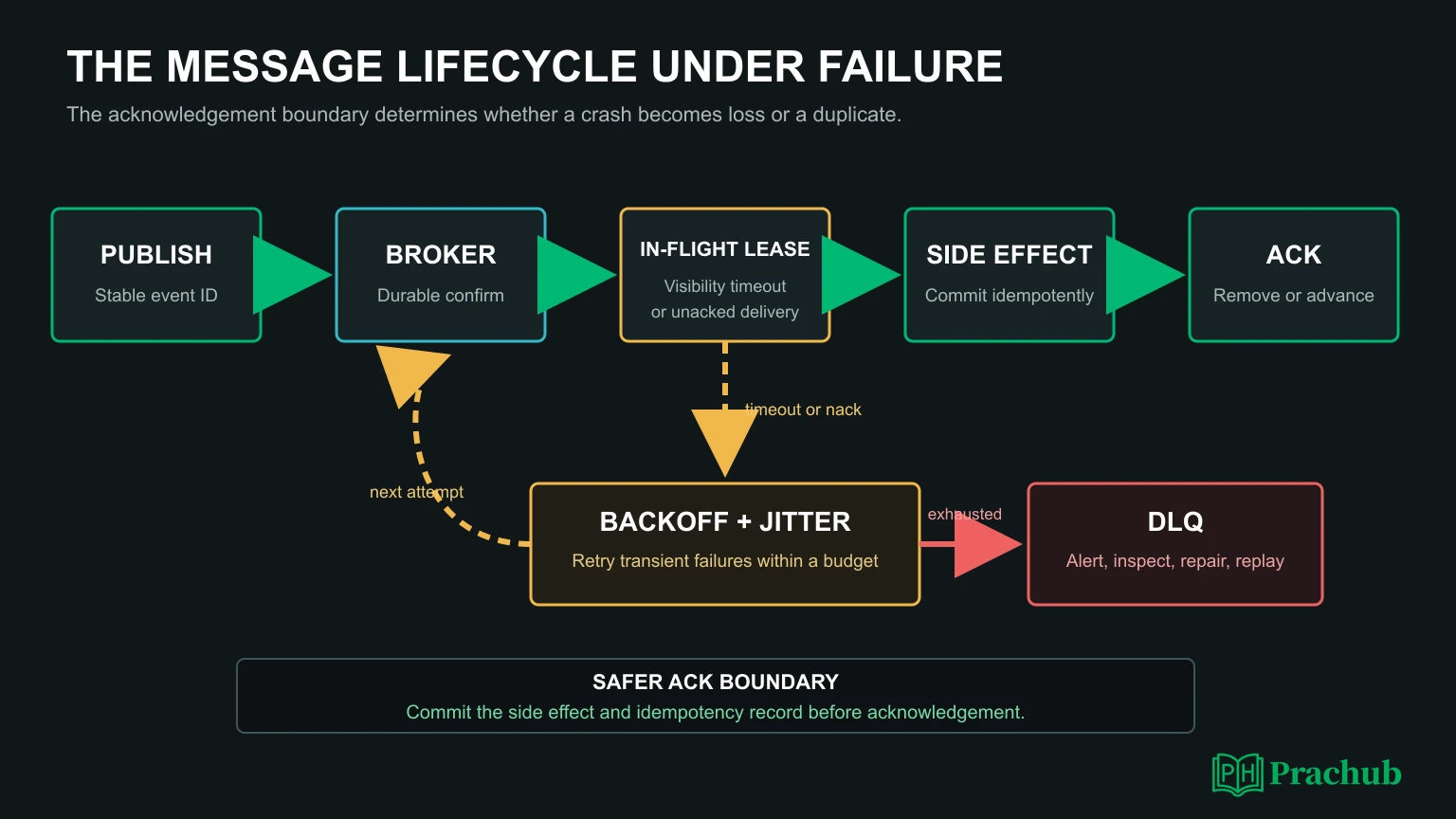
The acknowledgement boundary determines whether a crash produces loss or a duplicate. If the consumer acknowledges first and crashes before writing the database, the broker believes the message is complete and the work may disappear.
If the consumer commits the database change first and then acknowledges, a crash between those steps causes redelivery. That is safer when loss is unacceptable, but only if the second attempt recognizes that the business operation already succeeded.
Publisher confirms and consumer acknowledgements solve different problems
A publisher confirmation tells the producer that the broker accepted responsibility for a message. A consumer acknowledgement tells the broker that delivery-side processing reached the chosen completion boundary. They are independent; one does not replace the other.
A producer timeout is therefore ambiguous. The broker may have stored the message even though the confirmation was lost. Retrying the publish can create a duplicate, so the message should carry a stable event or command ID that downstream consumers can deduplicate.
Visibility timeouts are processing leases
Queue services may hide a received message for a visibility period rather than deleting it. If the consumer does not finish and delete or acknowledge it before that lease expires, another consumer can receive it.
Set the lease above normal processing time and extend it with a heartbeat for genuinely long jobs. An excessively short lease creates concurrent duplicates; an excessively long lease delays recovery after a dead worker. Monitor lease extensions and processing percentiles instead of choosing a timeout by instinct.
Design retries as a bounded recovery policy
Retries are useful for temporary conditions such as timeouts, rate limits, dependency overload, or a lost connection. They do not fix invalid schemas, missing required fields, revoked permissions, or deterministic business-rule failures.
Classify the error before scheduling another attempt. Use exponential backoff with random jitter so thousands of consumers do not retry at the same instant. Apply a maximum attempt count or elapsed-time budget, then route exhausted or non-retryable messages to a failure workflow.
Avoid immediate requeue loops
An immediate nack-and-requeue can return the same poison message to a ready consumer repeatedly. That burns CPU, floods logs, and can starve healthy work. A delayed retry queue, scheduled visibility change, or retry topic separates the next attempt from the hot delivery path.
Backpressure belongs in the design too. Bound consumer concurrency, limit in-flight work, and reduce intake when a dependency is unhealthy. Without those controls, adding consumers can amplify an outage rather than recover from it.
A dead-letter queue is a safety valve, not a graveyard
A DLQ isolates messages that cannot complete after the allowed retry policy. It protects the main queue from poison-message loops and gives operators a place to inspect failures without silently deleting the work.
Store enough context to investigate: the original payload or a secure reference, message ID, ordering key, schema version, error class, attempt count, first and last failure times, and a trace or correlation ID. Apply the same privacy and retention controls used for the source data.
Replay is part of the design
Define who owns the DLQ, which alert opens an incident, how a fix is verified, and how messages return to processing. Replay should preserve the original idempotency key and be rate-limited so a large recovery batch does not overwhelm the dependency that just recovered.
Do not assume a DLQ preserves the original order. Moving one event out of its ordered lane may allow later events to proceed. If sequence matters, block that key, quarantine the affected entity, or run reconciliation before replay.
Worked scenario: an order payment event
Assume an order service must publish PaymentRequested when an order is confirmed. Writing the order and publishing the event as two independent operations creates a dual-write gap: the database can commit while the publish fails.
Use a transactional outbox. The order row and an outbox row with a stable event_id commit in one database transaction. A relay publishes the outbox event and marks it sent after broker confirmation. If the relay times out, it may publish again, but the event ID remains the same.
Key the message by order_id so state transitions for one order stay together. The payment consumer receives the event under an at-least-once model. In one local database transaction, it inserts the idempotency key under a unique constraint and records the intended payment result or ledger change. It acknowledges only after that transaction commits.
If the process crashes after the commit but before the acknowledgement, the broker redelivers the event. The unique idempotency key shows that the work already completed, so the consumer returns the stored result and acknowledges without charging again.
A temporary payment-provider timeout receives delayed retries with backoff and jitter. A malformed account identifier is non-retryable and goes to the DLQ with context. A later shipment event checks the order version so it cannot ship an order whose payment state is unresolved.
Measure publish-confirm latency, outbox age, queue age, consumer lag, processing and acknowledgement latency, redelivery rate, attempts per message, hot-key backlog, DLQ ingress, replay success, and the downstream error rate. Those metrics reveal whether failure recovery is working before customers report duplicates or delays.
Practice message queue questions on PracHub
These prompts exercise delivery guarantees, queue architecture, delayed retries, backpressure, and operational recovery. Use the stored question as practice context; it is not a prediction of an exact future interview.
| PracHub question | Practice focus | Why it helps |
|---|---|---|
| Design At-Least-Once Notification Delivery | Idempotency, retries, and duplicate windows | Forces you to place the acknowledgement boundary and prove repeated delivery is safe. |
| Design a Distributed Message Queue Service | Partitions, durability, and consumer progress | Connects ordering and throughput requirements to broker architecture and recovery. |
| Design a Delayed Job Scheduler (LLD) | Retry timing, leases, and worker failure | Builds a concrete model for delayed attempts, claiming work, and expired ownership. |
| Design a High-Throughput Event Subscription System | Backpressure, webhook failures, and DLQs | Tests fan-out reliability, subscriber isolation, retry budgets, and observability. |
A seven-day message queue interview plan
| Day and focus | What to do |
|---|---|
| Day 1: Failure timeline | Draw producer, broker, consumer, side effect, and ack; mark every crash window. |
| Day 2: Ordering | Choose business ordering keys for orders, accounts, and devices; explain hot-key trade-offs. |
| Day 3: Delivery semantics | Compare loss, duplicates, and scoped exactly-once behavior using one payment example. |
| Day 4: Idempotency | Design a unique-key or processed-message table and trace a crash after commit. |
| Day 5: Retries and DLQs | Classify transient and permanent failures; set backoff, attempt budgets, alerts, and replay. |
| Day 6: Operations | Choose lag, queue age, redelivery, lease, hot-key, and DLQ metrics with thresholds. |
| Day 7: Mock design | Deliver the eight-step framework on an order, notification, or webhook system. |
Frequently asked questions
Does a message queue guarantee ordering?
Usually only within a defined scope such as one partition or ordering key. State the business entity that requires sequence and allow unrelated keys to run in parallel.
What is the difference between at-least-once and exactly-once?
At-least-once may redeliver, so consumers must tolerate duplicates. Exactly-once is meaningful only inside a named boundary. An external API or database may still require idempotency even when the broker offers transactional processing.
When should a consumer acknowledge a message?
Acknowledge after the durable business side effect when loss is unacceptable. Because a crash can occur after the side effect but before the ack, store a stable idempotency key or processed result.
How should message retries work?
Retry transient failures with exponential backoff, jitter, and a bounded attempt or time budget. Send permanent or exhausted failures to an owned investigation workflow rather than immediately requeueing forever.
What belongs in a dead-letter queue?
Include the original message or secure reference, IDs and ordering key, schema version, failure class, attempt count, timestamps, and trace context. Define alerting, ownership, retention, repair, and controlled replay.
How do you prevent duplicate side effects?
Give the business operation a stable idempotency key. Enforce it with a unique constraint, processed-message record, or transactional write so a redelivery returns the existing result instead of repeating the effect.
Final takeaway
A strong message queue answer is a failure-state-machine answer. Define the ordering scope, separate producer confirmation from consumer acknowledgement, expect duplicate delivery, make side effects idempotent, bound retries, and make the DLQ observable and replayable.
Practice the framework with PracHub's Backend Engineer question bank. For every prompt, draw the exact crash window, state which outcome you prefer, and defend the mechanism that turns a retry into recovery rather than a second incident.
Sources and Further Reading
- Apache Kafka Documentation
- RabbitMQ: Consumer Acknowledgements and Publisher Confirms
- Amazon SQS: Visibility Timeout
- Amazon SQS: Queue Types
- Amazon SQS: Dead-Letter Queues
- Google Cloud Pub/Sub: Ordering Messages
- Google Cloud Pub/Sub: Dead-Letter Topics
Research note: This guide was checked on August 22, 2026. Broker guarantees, acknowledgement APIs, retry behavior, and ordering features vary by product and configuration.
Related Articles
小林coding 够用吗?后端八股到真实面试实战的差距
小林coding准备后端面试够用吗?本文分析图解八股的优势、真实面试中的Coding与系统设计差距,并给出7天实战训练路线。
Distributed Lock Interview Questions: Leases, Fencing Tokens, and Failure Modes
Prepare for distributed lock interviews with leases, fencing tokens, stale-writer protection, Redis and etcd trade-offs, and failure walkthroughs.
Microservices Interview Questions: Boundaries, Failure Handling, and Data Ownership
Prepare for microservices interviews with service boundaries, failure handling, data ownership, sagas, outbox patterns, and a worked checkout design.
Caching Interview Questions for Backend Engineers: Eviction, Stampedes, and Consistency
Prepare for backend caching interviews with eviction policies, stampede defenses, consistency trade-offs, failure modes, and worked scenarios.
Comments (0)