Meta's AI-Enabled Coding Interview: What to Expect in 2026
Quick Overview
A detailed breakdown of Meta's AI-enabled coding interview, rolled out in October 2025. Covers who gets it, the three-panel CoderPad environment and model choice, why the AI often feels weaker than in practice, the three phases (bug fixing, core implementation, optimization), the known problem pool, and Meta's four evaluation competencies. Links to real Meta AI coding interview questions on PracHub.
In October 2025, Meta began rolling out a new interview type it calls AI-enabled coding. An internal description framed it as a coding interview where candidates have access to an AI assistant, on the grounds that it better reflects how Meta's engineers actually work — and that it makes LLM-based cheating less useful, since you're allowed to use the model anyway.
Since then, candidates from E5 up through E7 and M2 have shared what the round is like. The experiences vary a lot: one finished all three phases in forty minutes, while an E7 spent the round watching the model hallucinate on a maze problem. This guide pulls together what's consistent across those reports.
If you want to practice, PracHub has Meta AI-enabled coding interview questions reported from actual loops, and a broader AI coding interview guide that covers the format across companies. Most content is free to read.
Who gets this interview
Meta uses the AI-enabled format for software engineering and engineering management roles, as part of the onsite loop, up through E7 and M2. You'll still get a traditional coding round alongside it: one classic, AI-free algorithm problem and one AI-enabled round. Your recruiter will tell you which is which ahead of time.
The environment
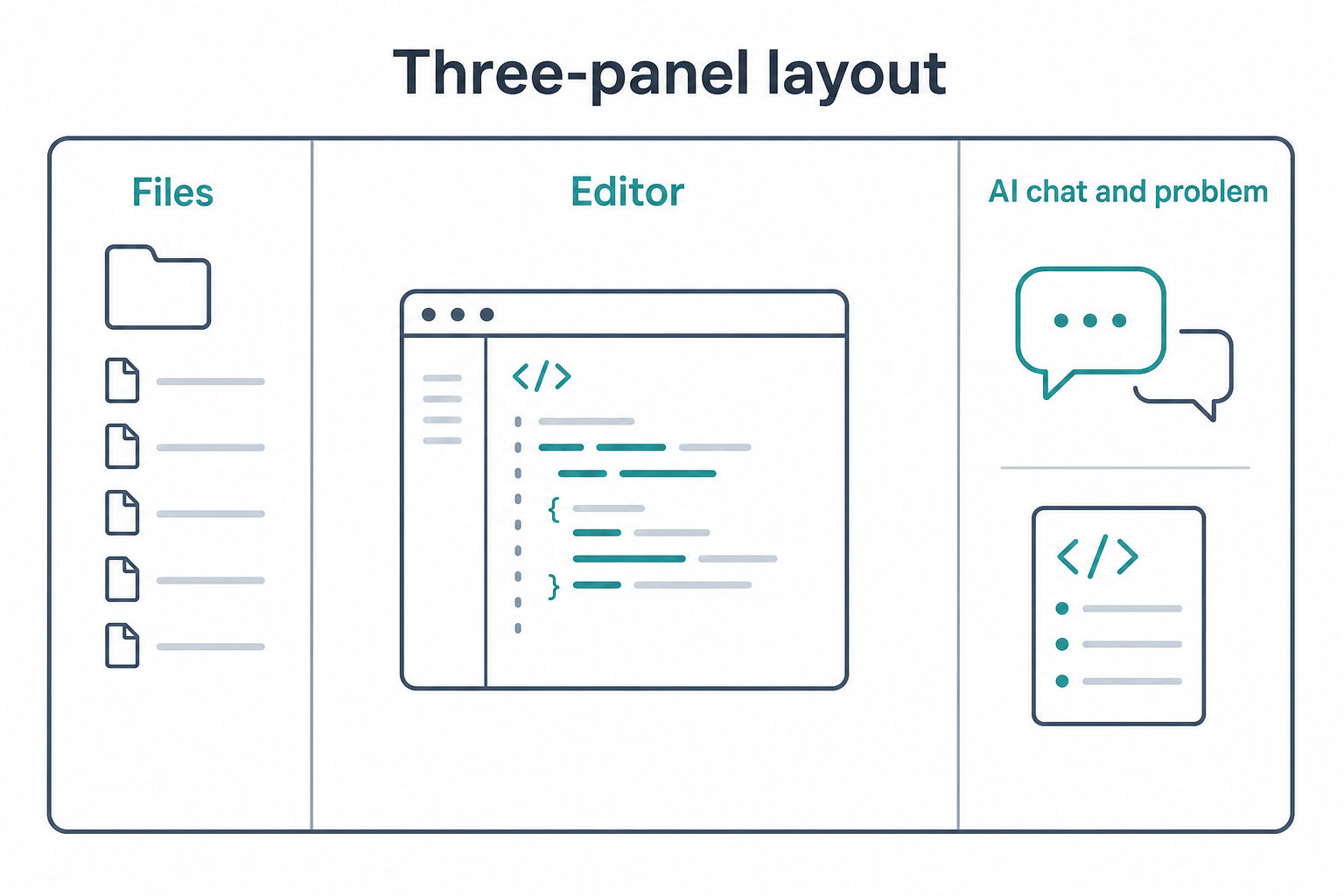
You work inside a three-panel CoderPad layout: a file explorer on the left, the editor in the middle, and the AI assistant plus the problem instructions on the right. The assistant can see the project files but can only respond in the chat panel — it can't edit your files directly, so you still write or paste every line yourself. The project is multi-file, with classes, data models, and logic already written that you didn't write and need to understand quickly.
Meta lets you switch between several models during the round — candidates have reported options including GPT-5, Claude Sonnet and Haiku, Claude Opus, Gemini, and Llama. Pick the most capable one available; some report GPT-5 running slowly under interview conditions, so a strong Claude model is a reasonable default. Supported languages typically include Python, Java, C++, C#, Kotlin, and TypeScript — confirm with your recruiter if you have a preference.
A few small things candidates flag: code reruns when you save, the test-versus-main selector stays on your last choice, and the output panel doesn't clear between runs. Meta also provides a practice environment with a sample problem (often called "the puzzle"). Use it. Getting comfortable with the layout, the chat panel, and the test runner before the interview is one of the most useful things you can do, because nothing about the UI surprises you on the day.
A note on the AI being weaker than expected
This comes up often enough to plan for: several candidates report the in-interview assistant being noticeably less helpful than the same model is in their own tools. One E7 said Claude Sonnet worked brilliantly in practice and then repeatedly produced wrong logic during the round. Another asked it to describe the codebase and got a plain description with none of the bugs it had surfaced in a personal environment.
Not everyone sees this, but the pattern is consistent enough that you shouldn't build your strategy around the AI bailing you out. The leading theory is that Meta shapes the assistant's behavior through a system prompt so it won't hand you bugs or complete solutions unprompted. Treat it as useful for boilerplate, known data structures, and syntax — not for the core insight. As one candidate put it, if you can't solve the problem yourself, it's hard to use the AI to solve it for you.
The three phases
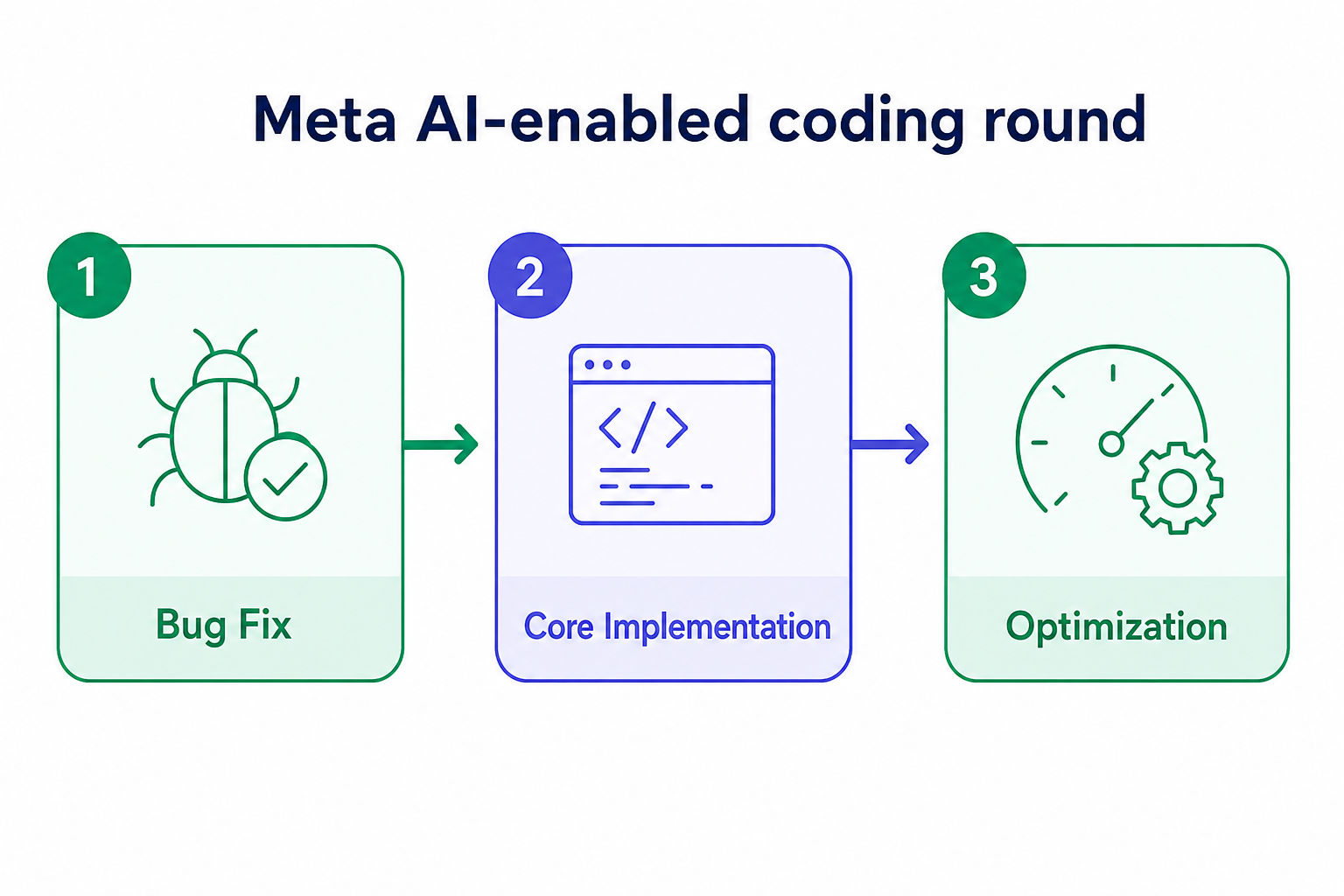
Every Meta AI-enabled round follows the same structure: three progressive phases built around one extended problem. The interviewer spends the first five or six minutes orienting you to the platform, then the phases begin.
| Phase | What you do | AI use |
|---|---|---|
| 1 - Bug fixing | Find and fix a bug in the existing codebase | Often off, or your call; many solve it by hand |
| 2 - Core implementation | Implement the main algorithm or feature (100+ lines) | Expected; guide it with your own approach |
| 3 - Optimization | Make it handle larger inputs that break phase 2 | Useful for implementing and benchmarking |
Phase 1: Bug fixing
The codebase ships with a bug. Your job is to find it and fix it. AI rules here are inconsistent — some interviewers say no AI for this part, others leave it to you. Even when it's allowed, many strong candidates debug phase 1 by hand, because solving it independently gives the interviewer early confidence.
The bugs are usually not algorithmic: a type cast that breaks an assumption elsewhere, an off-by-one, a wrong conditional, a missing visited-set causing an infinite loop. The biggest regret candidates report is skipping the reading step. Even if the interviewer says "let's just run it," take a few minutes to read the data models and control flow first. Five minutes of reading saves fifteen of debugging. Be ready to explain what the tests do and to give the time and space complexity of the existing code.
Phase 2: Core implementation
This is the main event, and where AI use is expected. You implement the primary algorithm or feature, and it's substantial — candidates describe it as harder than a medium LeetCode problem, often a hundred-plus lines. Reported problems include BFS through a maze with directional gates and maximizing unique characters across a set of words.
Prompt granularity is what separates strong runs here. The candidates who do well guide the model with their own approach instead of asking it for a wholesale solution. If you already know the algorithm — BFS, DFS, backtracking, a trie — say so, tell the interviewer your plan, and use the AI to implement the parts you've already reasoned through. One candidate who recognized a problem as DFS plus backtracking explained that up front, used the AI only for the trie, and finished all three phases in forty minutes.
Phase 3: Optimization
The final phase introduces larger inputs that break your phase 2 solution. Meta's test files are designed to expose specific weaknesses — one data file might favor a trie while another favors a greedy approach. Sometimes the fix is switching algorithms entirely; sometimes it's a bitmask or memoization. You need enough algorithmic knowledge to recognize which optimization the data is asking for, even if you lean on the AI to implement it. You can also have the model benchmark two approaches against different input profiles, which tends to impress.
Not finishing phase 3 is fine. Multiple candidates who ran out of time on it still got offers. Meta cares more about your approach, your reasoning, and clean AI usage than about completion.
The known problem pool
Candidates report Meta working from a small pool — an internal source put it around nine problems. Frequently mentioned ones include a maze solver with path printing, maximizing unique characters from a word list, a card game finding three cards that sum to fifteen, a friend-recommendation system, and maze pathfinding. The practice "puzzle" is often harder than the real problems, so if you can handle it, the interview tends to feel more manageable. Meta will rotate these over time, so treat the list as a guide to the format, not a set of answers to memorize.
How Meta evaluates you
The criteria are the same four competencies Meta uses for its traditional coding interviews:
- Problem solving. Do you understand the problem deeply, break it into steps, reason about edge cases, and pick an appropriate algorithm?
- Code quality. Is the code clean and efficient, and — more importantly — do you understand what the AI generated? Candidates have been marked down specifically for leaning on the AI in a way that hurt their solution's quality.
- Verification. Do you run code often, check the AI's output before moving on, and test edge cases? This is one of the clearest positive signals you can send.
- Communication. Are you narrating your process, explaining decisions, and talking through what the AI gave you? Several candidates said keeping this dialogue going while working with the AI was the hardest part of the round.
An internal summary of the bar: you should use the AI, but you need to show you understand the code, explain the output, and test before you rely on it — and you can't prompt your way out of not knowing the answer.
How to prepare
Ask your recruiter for the practice environment and actually use it. On the algorithm side, focus on the families that keep showing up: backtracking, BFS and DFS, greedy, tries, dynamic programming basics, and bitmask optimization — and keep solving hard problems without AI so your own judgment stays sharp. Drill reading unfamiliar code, since the whole interview revolves around a codebase you didn't write. And practice narrating while you work, because the dual conversation is genuinely hard under time pressure.
Treat the AI as an assistant, not the driver. You lead the solution at every step. Over-communicate, watch the input data closely (the optimization catch is often hidden there rather than in the algorithm), and if you know the optimal approach but run low on time, explain it anyway — interviewers give credit for understanding even when the clock beats you.
Practice
The most useful prep is reps on the real thing. Work through Meta's AI-enabled coding interview questions reported from actual loops, and read the broader AI coding interview guide for the cross-company rubric. As the format evolves, always confirm the current details with your recruiter.
Frequently asked questions
What is Meta's AI-enabled coding interview?
It's a coding round Meta rolled out in October 2025 where you're given an AI assistant inside a three-panel CoderPad environment. You work through one extended, multi-file problem in three phases — bug fixing, core implementation, and optimization — and you're evaluated on how you direct and verify the AI.
Does Meta still have a traditional coding round?
Yes. The AI-enabled round is paired with a classic, AI-free algorithm interview. Your recruiter tells you which is which ahead of time.
Which AI model should I pick in the Meta interview?
Pick the most capable one offered. Candidates report a choice between models including GPT-5, Claude Sonnet/Haiku/Opus, Gemini, and Llama. Some find GPT-5 slow under interview conditions, so a strong Claude model is a common default.
Is the AI assistant weaker during the real Meta interview?
Several candidates report it being less helpful than the same model is in their own tools, likely because Meta shapes its behavior through a system prompt so it won't hand you bugs or full solutions. Plan to carry the core problem-solving yourself.
What are the three phases of the Meta AI coding round?
Phase 1 is fixing a bug in an existing codebase, phase 2 is implementing the core algorithm or feature (where AI use is expected), and phase 3 is optimizing for larger inputs that break the phase 2 solution. Not finishing phase 3 is fine and candidates still get offers.
What does Meta evaluate in the AI coding interview?
The same four competencies as its traditional rounds: problem solving, code quality (including whether you understand the AI's output), verification, and communication. You're expected to use the AI but stay in control and be able to explain every line.
Comments (0)