Softmax, Argmax, and Cross Entropy
Quick Overview
This tutorial explains argmax, softmax, and cross-entropy, covering mathematical definitions, gradient and numerical stability considerations, and their roles in classification models and loss computation.
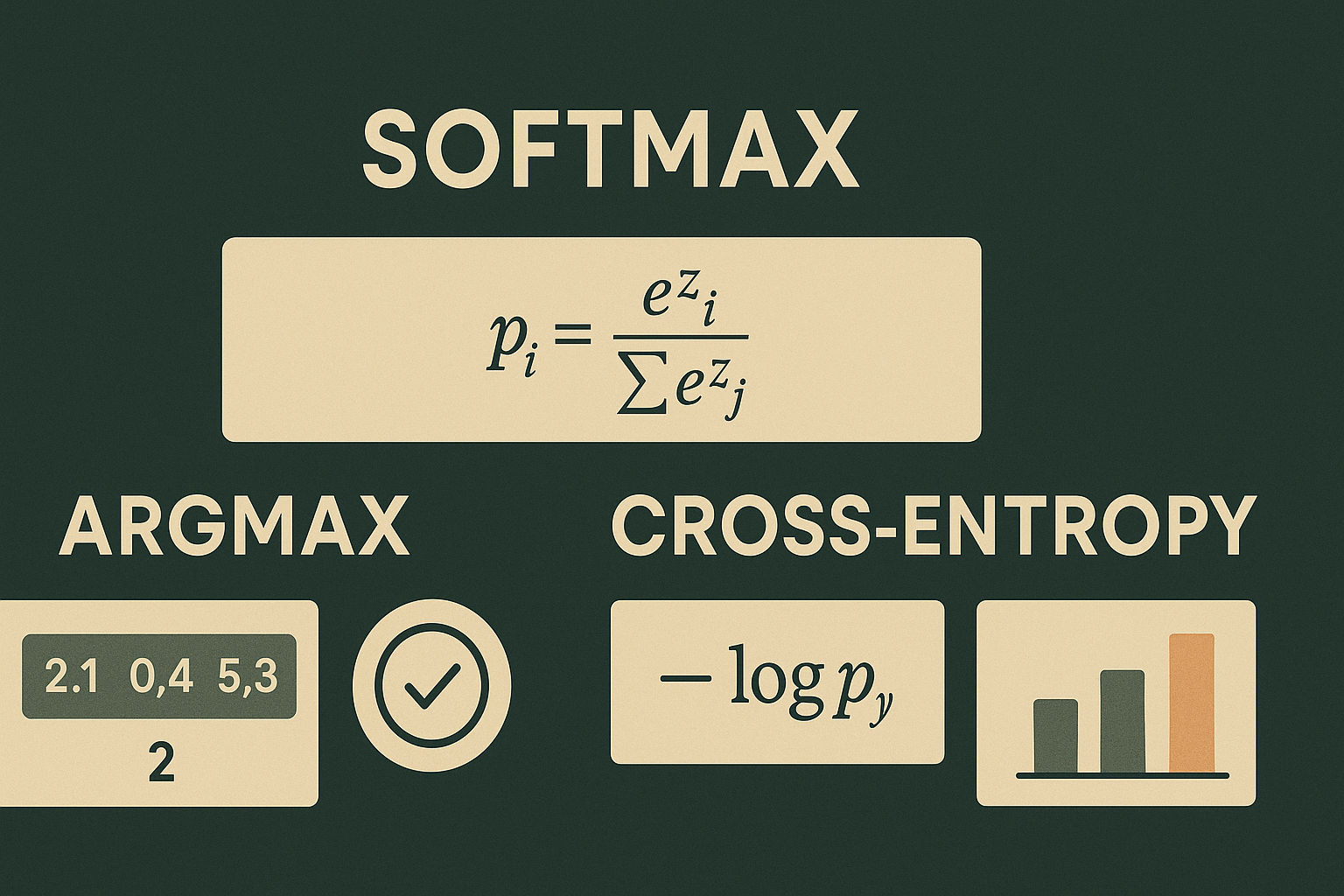
Here’s a clean, intuitive explanation of argmax, softmax, and cross-entropy
1. Argmax
Argmax = “which class has the highest score?”
If your model outputs something like:
scores = [2.1, 0.4, 5.3]
Then:
argmax(scores) = 2 # because 5.3 is the largest
- It does NOT give the value (5.3)
- It gives the index of the maximum value
Used in:
- Classification prediction
- Q-learning (choose best action = argmax(Q-values))
- Choosing best probability class after softmax
2. Softmax
Softmax turns raw model scores (logits) into probabilities:
pᵢ = e^(zᵢ) / Σⱼ e^(zⱼ)
Properties:
- All probabilities are between 0 and 1
- Sum to 1
- Larger scores → larger probability (exponentially)
Example:
Scores:
z = [2, 1, 0]
Softmax:
e^2 = 7.389
e^1 = 2.718
e^0 = 1

sum = 11.107

softmax = [7.389/11.107, 2.718/11.107, 1/11.107]
 ≈ [0.665, 0.245, 0.090]
So the model thinks class 0 is most likely.
✅ 3. Cross-Entropy Loss
Cross-entropy measures how good the predicted probability distribution is.
For classification, if the true class is class ( y ):
- If the model gives the true class high probability, loss is small.
- If the model gives the true class low probability, loss is huge.
Examples:
If true class = 0
Model predicts:
p = [0.8, 0.1, 0.1]
Loss = -log(0.8) = 0.223 (very good)
Bad prediction:
p = [0.2, 0.3, 0.5]
Loss = -log(0.2) = 1.609 (bad)
Cross-entropy punishes wrong, confident predictions the most.
🎯 How these three work together
In neural networks:
- Model outputs scores (logits), e.g.
[2.1, 0.4, 5.3]
- Softmax converts to probabilities
[0.03, 0.01, 0.96]
-
Cross-entropy checks how good the probability for the correct class is e.g. if true class = 2 → loss = −log(0.96)
-
At prediction time, use argmax to pick the most likely class.
🔥 Concrete Numerical Example (Everything together)
Suppose:
- Model outputs logits
z = [1.0, 3.0, 2.0]
- True label = class 1
Step 1 - Softmax
e^1 = 2.718
e^3 = 20.085
e^2 = 7.389

sum = 30.192

probabilities =
[2.718/30.192, 20.085/30.192, 7.389/30.192]
≈ [0.09, 0.66, 0.24]
Step 2 - Cross-entropy
True class = 1 → p_y = 0.66
Loss:
CE = -log(0.66) ≈ 0.415
Step 3 - Prediction (argmax)
argmax(z) = 1 because "3.0" is the largest logit.
→ model predicts class 1.
Summary Table
| Concept | What it does | Formula | Example |
|---|---|---|---|
| Argmax | Picks largest score | argmax(z) | [1,5,3] → 1 |
| Softmax | Converts logits → probabilities | ( \frac{e^{z_i}}{\sum e^{z_j}} ) | [2,1,0] → [0.66,0.24,0.09] |
| Cross-Entropy | Measures how wrong the predicted probability is | −log(p_y) | true=1, p=0.66 → loss=0.415 |
How to Use This Page as a Prep Plan
Do not treat this as passive reading. Convert the ideas in this page into a short weekly loop: learn one idea, practice it under interview conditions, then write down what changed. That is the fastest way to turn advice into visible interview behavior.
| Prep area | What you need to prove | Practice artifact |
|---|---|---|
| Understand | Turn the prompt into a concrete goal. | Clarifying questions and success criteria. |
| Practice | Use realistic constraints and timed reps. | Worked examples with edge cases. |
| Explain | Make reasoning visible. | Tradeoffs, assumptions, and test strategy. |
| Improve | Review misses quickly. | A short feedback log and next action. |
For Softmax, Argmax, and Cross Entropy, the strongest candidates usually do three things well: they make their assumptions explicit, they use concrete examples instead of vague claims, and they review mistakes quickly enough that the next practice rep is better than the last one.
Video Walkthrough
This verified YouTube video gives a second pass on the same preparation area. Use it after reading the guide, then come back and turn the advice into a practice artifact.
FAQ
How should I use this guide?
Read it once for the structure, then turn each section into a practice task with a visible artifact.
What should I do if I am short on time?
Prioritize the skills most likely to be tested, then do one mock or timed drill to expose the largest gap.
How do I know I am ready?
You can explain your approach clearly, recover from hints, and name tradeoffs without relying on memorized wording.
Related Articles
Machine Learning Interview Questions: Complete 2026 Guide
This guide covers applied machine learning interview topics in 2026, including coding problems, ML theory such as bias–variance and evaluation......
Machine Learning Engineering Interview Guide (MLOps & AI 2026)
This guide covers MLOps and ML system design for 2026 interviews, including model deployment and production maintenance, CI/CD for models, data......
Shopify Machine Learning Engineer Interview Guide 2026
This guide details Shopify's 2026 Machine Learning Engineer interview process and study map, covering stages such as recruiter screens, the Life Story......
Snapchat Machine Learning Engineer Interview Guide 2026
This guide covers the Snapchat Machine Learning Engineer interview process in 2026, including recruiter and technical screens, virtual onsite loops......
Comments (0)