System Design Interview Questions at FAANG Companies (2026)
Quick Overview
This guide covers system design interview workflows at FAANG companies, detailing how to scope vague prompts, make reasonable assumptions, sketch architectures, model data and APIs, consider storage and constraints, and defend trade-offs within a 45–60 minute interview.
System design interviews at FAANG companies run 45-60 minutes and start from a deliberately vague prompt like "Design Instagram." You are expected to scope the problem, make reasonable assumptions, sketch an architecture, and defend your tradeoffs out loud. The interviewer is grading how you reason through an open-ended problem, not whether you can recite a memorized diagram.
This guide is for software engineers preparing for system design rounds at Google, Meta, Amazon, Microsoft, Netflix, and similar companies. It covers the questions that recur most often, how the round actually unfolds minute by minute, what each company tends to push on, and a concrete prep plan you can start today.
The question categories that actually repeat
Across the system design questions on PracHub, a handful of categories come up again and again. If you can confidently design one strong example from each category below, you will be ready for most prompts you encounter. The wording changes by interviewer; the underlying problem rarely does.
Distributed storage and databases
- Design a key-value store
- Design a distributed file system
- Design a time-series database
- Design a caching layer (Redis or Memcached style)
Real-time systems
- Design a chat / messaging system (WhatsApp style)
- Design a notification system
- Design a real-time collaborative editor (Google Docs style)
- Design a live video streaming system
Feed and timeline
- Design a news feed (Facebook or Instagram style)
- Design a timeline (Twitter / X style)
- Design a recommendation system
Search and discovery
- Design a web search engine
- Design an autocomplete / typeahead system
- Design "nearby places" / proximity search
Infrastructure primitives
- Design a URL shortener (bit.ly style)
- Design a rate limiter
- Design a distributed task scheduler
- Design a logging and monitoring system
Each prompt forces a different core skill: partitioning and replication, fan-out tradeoffs, ranking, indexing, or throttling. That is why they recur. Cover one design per category and you have covered the underlying skills, not just the surface prompts.
What each category is really testing
A useful way to study is to map each prompt to the one or two concepts the interviewer expects you to surface unprompted. If you can name the central tension before you start drawing, you are already ahead of most candidates.
| Category | Canonical prompt | The concept it really tests |
|---|---|---|
| Distributed storage | Design a key-value store | Partitioning, replication, consistency vs. availability |
| Real-time | Design a chat system | Connection management, message ordering, delivery guarantees |
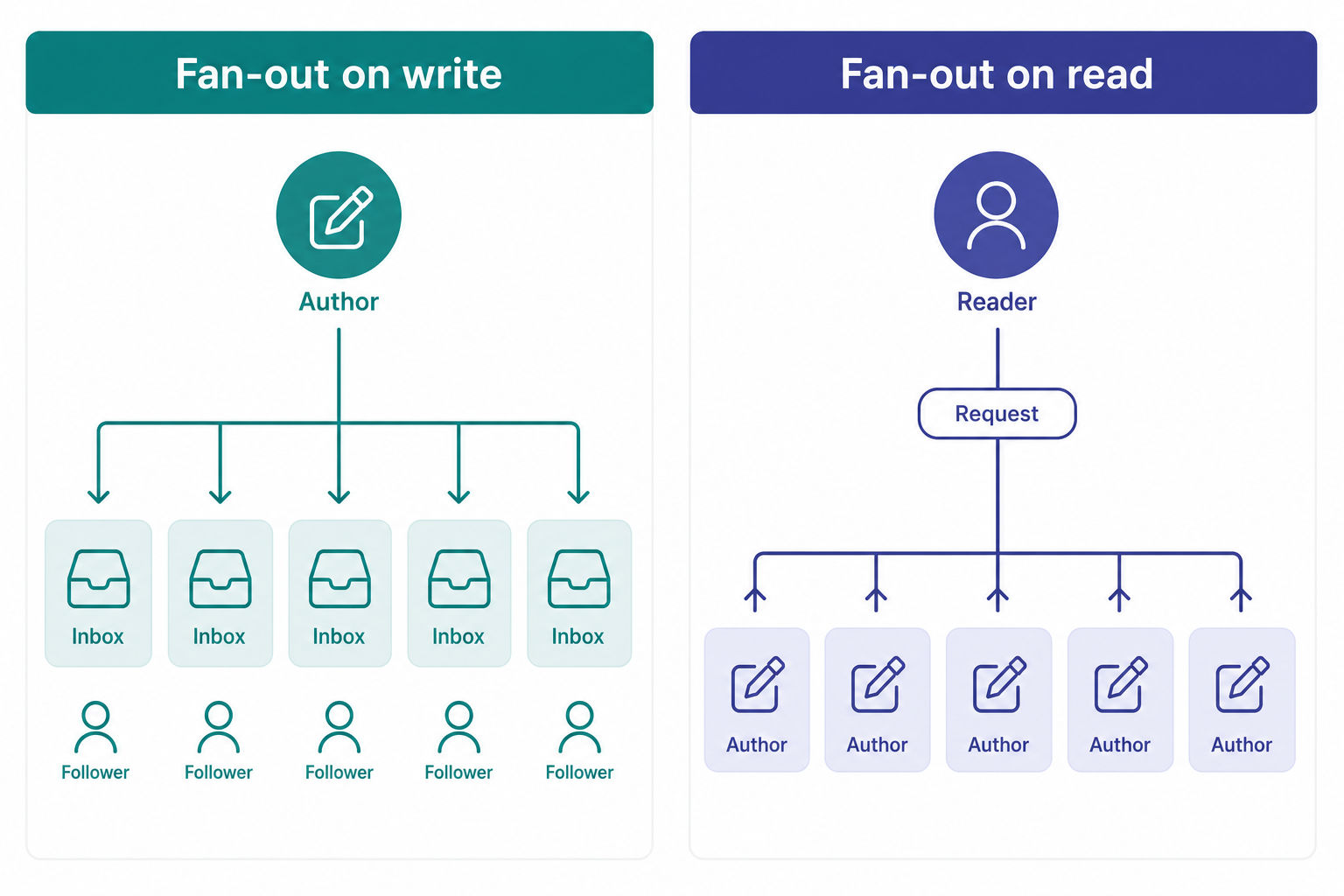
| Feed / timeline | Design a news feed | Fan-out-on-write vs. fan-out-on-read, ranking, caching |
| Search | Design autocomplete | Inverted indexes / tries, prefix lookups, ranking by frequency |
| Infrastructure | Design a rate limiter | Counters, token bucket vs. sliding window, distributed state |
You do not need to memorize a "correct" architecture for each row. You need to be able to walk into the deep-dive section and say, for instance, "the interesting decision in a news feed is fan-out: precompute each user's feed on write, or assemble it on read - and the right answer depends on the follower distribution," then defend the choice you make.
How the round actually works
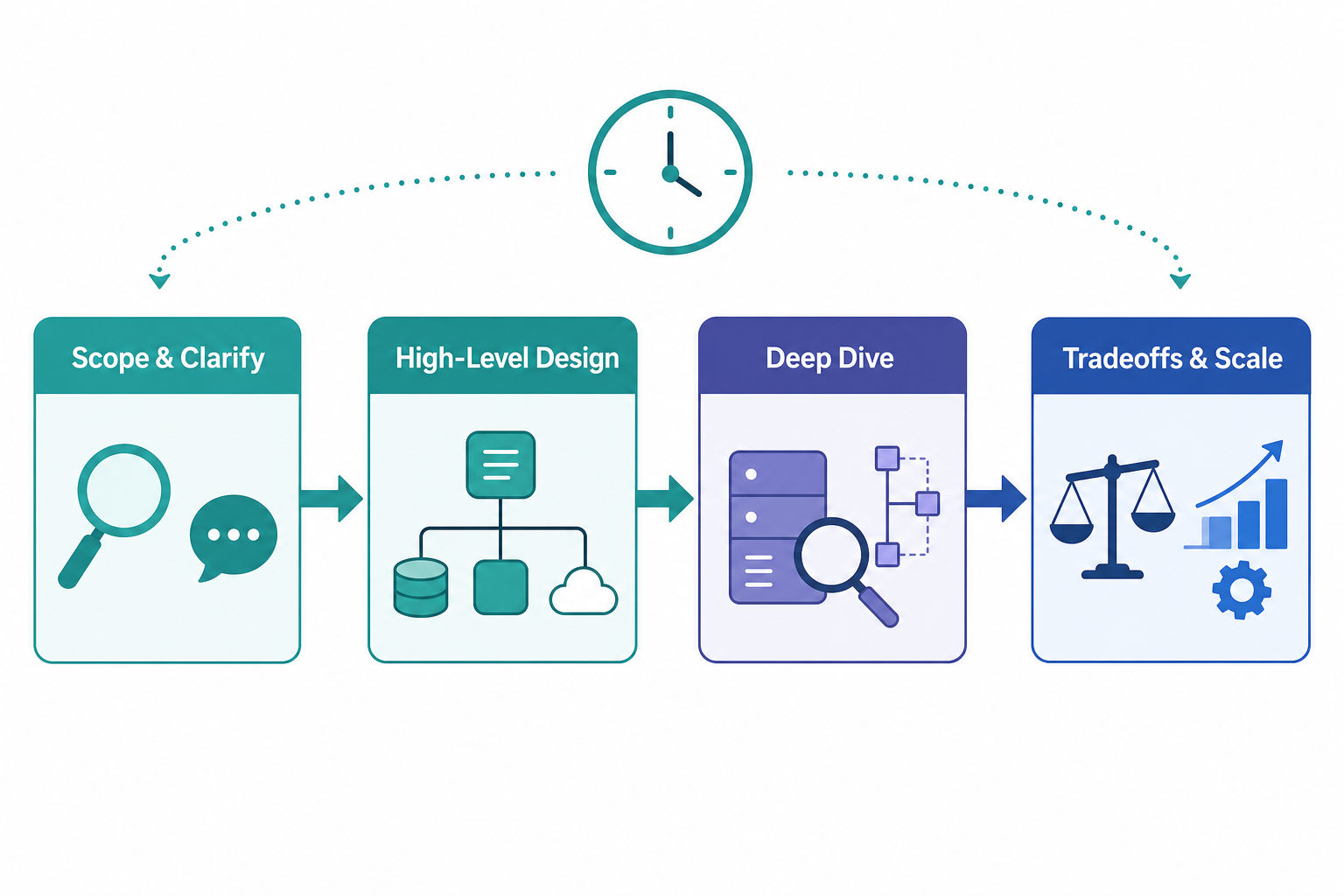
The prompt is intentionally underspecified, and your first job is to narrow it. Spend the opening minutes asking clarifying questions before you draw a single box.
Strong clarifying questions:
- Scope. Which features are in play? For "Design Instagram," is it just photo upload and the feed, or also Stories and direct messaging? Pin this down - designing the wrong thing well still fails the round.
- Scale. Roughly how many users, requests per second, and how much data? You are negotiating the numbers you will reason with, not guessing the company's real figures.
- Priorities. What matters most here: latency, consistency, or availability? The answer reshapes most downstream decisions.
Once scope is agreed, the round typically flows like this:
- High-level design (about 5-10 minutes). Sketch the major components and how a request moves through them. Breadth before depth.
- Deep dive. Go deep on the hardest parts, usually the data model, the main read and write paths, and the scaling bottleneck. The interviewer will steer you here if you do not pick a meaty area yourself.
- Tradeoffs and follow-ups. Defend your choices and respond to "what if we 10x the traffic?" or "what happens when this component dies?" prompts.
The most common failure mode is skipping the scoping step and immediately designing a system nobody asked for. The second most common is going deep too early - sketching a perfect database schema before the interviewer knows what the system even does. Slow down at the start, then earn the right to go deep.
Company-specific tendencies
Every company shares the same core rubric, but each tends to push harder on a different dimension. Treat these as where to weight your practice, not as a guarantee of what you will be asked.
| Company | Tends to emphasize | What to over-prepare |
|---|---|---|
| Distributed systems internals | Consensus, partitioning, replication, consistency models | |
| Meta | Social features at scale | Feeds, messaging, caching, fan-out tradeoffs |
| Amazon | Service-oriented design and operations | Failure modes, retries, idempotency, monitoring and alerting |
| Netflix | Streaming, recommendations, data pipelines | Availability over strict consistency, graceful degradation |
| Microsoft | Broad range, including OO design | Object-oriented prompts (parking lot, elevator, library system) |
A few notes on reading this table:
- Google interviewers often want to see you reason about when to choose strong consistency over availability, not just that you know the difference.
- Meta loves the news feed and messaging family because they map directly to its core products; fan-out-on-write vs. fan-out-on-read comes up constantly.
- Amazon weaves its operational culture into the round - expect "how would you detect this is failing?" follow-ups, tied to its bias toward ownership.
- Microsoft is the one place where a classic object-oriented design prompt ("design an elevator system") is genuinely common alongside distributed-systems questions.
Any interviewer can ask anything. Use the patterns to bias your practice, not to skip whole categories.
A prep plan that actually works
- Practice out loud, not just by reading. You must talk through a design in real time. Reading architecture write-ups builds recognition; only speaking practice builds the ability to produce a design under pressure. Record yourself or rope in a peer.
- Master the building blocks. Load balancers, CDNs, message queues, SQL vs. NoSQL stores, caching layers, and consistent hashing are the vocabulary of every answer. If you cannot explain when a queue beats a synchronous call, drill that first.
- Get comfortable with back-of-the-envelope math. "How much storage for a billion photos?" is a common warm-up. A quick, sane estimate signals competence; freezing on arithmetic does the opposite. Memorize a few anchors (a day is ~86,400 seconds; one million requests/day is ~12 per second).
- Rehearse tradeoff discussions explicitly. There is rarely one right answer. The scored behavior is: state the options, pick one, and explain why. Practice saying "Option A gives us lower latency but weaker consistency; I'll take A here because the prompt prioritized speed."
- Build a reusable skeleton. Walk into every prompt with the same opening sequence - clarify, estimate scale, sketch high level, pick a deep-dive area, discuss tradeoffs. A consistent structure frees your attention for the hard parts.
A worked micro-example
For instance, take "Design a URL shortener." A strong candidate would not start drawing immediately. They would say something like:
Example opening: "Before I design, let me scope it. Are we just mapping long URLs to short ones and redirecting, or do we also need analytics, custom aliases, and expiry? Let's assume reads heavily outnumber writes - most short links are clicked far more than they're created - so I'll optimize the read path and treat the write path as the simpler problem."
That single move - scoping the read/write ratio out loud before touching the whiteboard - demonstrates the exact instinct interviewers are scoring.
Where to practice next
- Browse the full system design question bank and filter by the category you are weakest in.
- Targeting a specific employer? See company-tagged questions at /companies/meta, /companies/google, and /companies/amazon.
- Preparing the broader loop? The software engineer role hub collects coding, behavioral, and design questions in one place.
- For more structured prep walkthroughs, see the PracHub interview guides and the resource library.
Key takeaways
- Scope first, design second; the vague prompt is part of the test.
- Know one solid design per category (storage, real-time, feed, search, infrastructure).
- Lead with tradeoffs; a defended decision beats a "perfect" diagram with no reasoning.
- Use company tendencies to focus practice, but prepare across all categories.
How to Use This Page as a Prep Plan
Do not treat this as passive reading. Convert the ideas in this page into a short weekly loop: learn one idea, practice it under interview conditions, then write down what changed. That is the fastest way to turn advice into visible interview behavior.
| Prep area | What you need to prove | Practice artifact |
|---|---|---|
| Requirements | Clarify the problem before drawing boxes. | Functional and non-functional checklist. |
| Architecture | Map data flow before naming technologies. | One end-to-end diagram. |
| Tradeoffs | Explain why the design fits the constraints. | Latency, consistency, cost, and operability notes. |
| Failure handling | Show how the system behaves under stress. | Backpressure, retries, monitoring, and rollback plan. |
For System Design Interview Questions at FAANG Companies (2026), the strongest candidates usually do three things well: they make their assumptions explicit, they use concrete examples instead of vague claims, and they review mistakes quickly enough that the next practice rep is better than the last one.
FAQ
How long is a FAANG system design interview?
Most run 45 to 60 minutes. Budget the first several minutes for scoping and clarifying questions, roughly 5-10 minutes for the high-level design, the bulk of the remaining time for one or two deep dives, and the last few minutes for tradeoff and scaling follow-ups.
Do I need to know real production architectures of Instagram or Twitter?
No. Interviewers are not checking your recall of any company's actual internal system. They want to see you derive a reasonable design from first principles, scope it sensibly, and defend your tradeoffs. Knowing common patterns helps, but a memorized "correct" diagram with no reasoning behind it scores poorly.
What is the single most common mistake candidates make?
Skipping the scoping step and immediately designing something the interviewer never asked for. A close second is diving into deep implementation detail before establishing the high-level picture. Both are fixed by the same habit: clarify and sketch breadth first, then go deep.
How should I handle the "estimate the scale" part if I freeze on the math?
Anchor on a few memorized numbers and round aggressively. A day has about 86,400 seconds (round to ~100,000 for quick division), and one million requests per day is roughly 12 per second. Interviewers care that your estimate is in the right order of magnitude and that you can explain it, not that it is exact.
Are object-oriented design questions (like "design a parking lot") system design questions?
They are a related but distinct category. They test class modeling, encapsulation, and clean interfaces rather than distributed-systems tradeoffs. Microsoft asks them more often than the others, so if you are interviewing there, practice a couple of OO design prompts alongside the distributed ones.
How many system design questions should I practice before an interview?
Quality over raw count. Aim to work through at least one strong design per category (storage, real-time, feed, search, infrastructure) until you can talk through each without notes, then drill the categories your target company emphasizes. A handful of designs you can defend deeply beats dozens you only skimmed.
Related Articles
Tech Interview Statistics 2026: What Gets Asked Most
This analysis examines 8,479 real interview questions from 452 companies and covers category breakdowns, company-level topic weightings......
Meta Data Scientist Interview Guide: Updated 2025 Preparation
This guide covers Meta Data Scientist interview topics including the hiring and application process, interview structure and rounds, SQL and product......
The AI Coding Interview: A Complete 2026 Guide
AI-enabled coding interviews explained: what interviewers evaluate and how to prepare, with real AI coding interview questions from Meta, Shopify and Rippling.
LeetCode vs Real Interview Questions: What Actually Gets Asked (2026)
This comparison examines LeetCode-style algorithm and data structure practice versus real interview questions, covering topic selection, common blind......
Comments (0)