Ads, Revenue, And Monetization Analytics
Asked of: Data Scientist
Last updated
What's being tested
Meta is probing whether you can reason about monetization as a marketplace problem, not just compute revenue metrics. A strong Data Scientist must connect product changes to advertiser value, user experience, auction dynamics, and long-term platform health. Interviewers are usually testing whether you can choose the right success metric under business constraints, diagnose revenue movement into interpretable drivers, and design causal measurement when ads systems have interference, budgets, pacing, and delayed conversions. The bar is not “knows CTR and CPM”; it is “can explain why revenue went up, whether that increase is sustainable, and who may have been harmed.”
Core knowledge
-
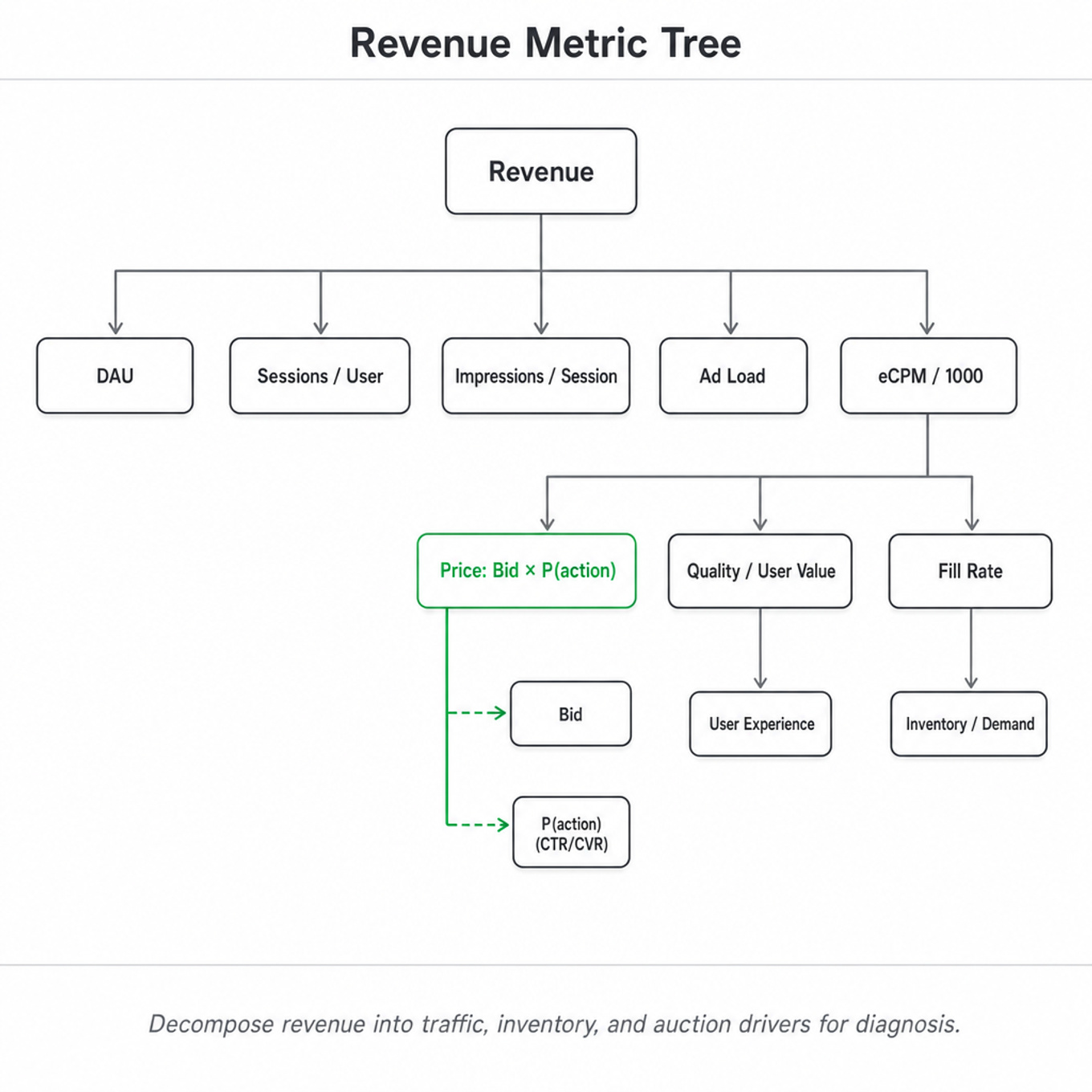
Ads revenue decomposes into supply, load, price, and engagement:
This decomposition is the fastest way to diagnose whether a revenue move came from traffic, inventory, auction pressure, or ad quality. -
Core marketplace metrics include revenue, RPM/eCPM, impressions, fill rate, ad load, CTR, CVR, CPA, ROAS, advertiser spend, advertiser retention, and user guardrails. Meta cares about both sides: short-term revenue can rise while advertiser ROI or user engagement deteriorates.
-
In auction-based ads, ranking often optimizes expected total value:
The action may be click, conversion, app install, purchase, or value-based conversion depending on campaign objective. -
Pricing is typically second-price or VCG-like rather than pure first-price. The winning advertiser may pay the minimum needed to beat the next-best ad, adjusted for estimated action rates and quality. This creates non-obvious effects: improving prediction can change both allocation and clearing prices.
-
Advertiser objectives differ. A brand advertiser may optimize reach, frequency, and video views; a direct-response advertiser may optimize CPA, ROAS, or purchase value. Do not evaluate all ads changes with CTR alone; higher CTR can attract low-intent clicks and hurt conversion quality.
-
Delayed conversion measurement matters. Clicks are immediate, but purchases may arrive hours or days later. Use attribution windows such as 1-day click, 7-day click, or 1-day view, and distinguish observed conversions from modeled conversions when privacy constraints limit tracking.
-
Budget and pacing create interference. If treatment improves delivery efficiency, advertisers may exhaust budgets earlier, shifting impressions across time and auctions. User-level randomization can contaminate advertiser budgets; advertiser-level or geo-level experiments may be cleaner but require larger samples.
-
Incrementality is different from attribution. Attributed conversions answer “what was credited to ads?”; incremental lift asks “what would not have happened without ads?” Use randomized conversion lift tests, holdouts, ghost ads, geo experiments, or synthetic controls when causal ROI is the question.
-
Experiment metrics should separate primary, secondary, and guardrail outcomes. A ranking change might target long-term value or revenue, with guardrails on hides, reports, session time, retention, advertiser CPA, auction coverage, latency, and demographic/geographic fairness.
-
Sample size depends on variance, baseline rate, and minimum detectable effect:
Revenue metrics are heavy-tailed, so winsorization, CUPED, stratification, or user-level aggregation often improves sensitivity. -
Segment analysis is mandatory but dangerous. Break down by country, placement, advertiser vertical, campaign objective, new vs mature advertisers, iOS vs Android, and budget size. Avoid post-hoc cherry-picking; pre-register key segments or adjust for multiple testing when many cuts are examined.
-
Common monetization tradeoff: more ads or more aggressive ranking may raise near-term revenue but reduce user engagement, ad trust, or future inventory. A strong answer explicitly discusses long-term LTV:
Worked example
For a prompt like “How would you evaluate a change to the ads ranking model?”, start by clarifying the surface, objective, and mechanism: is the model changing pCTR, pCVR, value prediction, ad quality, or final auction ranking? State that you would evaluate it as a marketplace intervention, not just a prediction-model upgrade. The answer should be organized around four pillars: offline model validation, online experiment design, marketplace metrics, and long-term/heterogeneous effects. Offline, you would check calibration, AUC/PR-AUC, log loss, bias by segment, and whether predicted value maps to actual advertiser outcomes such as CPA or ROAS. Online, you would run an A/B test with user-level randomization if budget interference is acceptable, or advertiser/geo-level randomization if the change materially affects budget allocation and auction competition. The primary metric might be total ads revenue or value-weighted conversions, but you would pair it with advertiser ROI metrics and user guardrails like hide/report rate, session depth, and retention. One tradeoff to flag explicitly is that a model can increase revenue by favoring high-bid ads while worsening relevance; that may look good in a short test but damage user trust and future inventory. You would also examine segments by campaign objective, placement, country, and advertiser size because ranking changes often help sophisticated high-budget advertisers while hurting small advertisers. Close by saying that, with more time, you would estimate long-term effects through holdouts, advertiser retention cohorts, and repeated-exposure user metrics rather than relying only on a two-week revenue lift.
A second angle
For a prompt like “Ads revenue dropped 10%; how would you investigate?”, the same concepts apply, but the framing shifts from causal evaluation to diagnosis. Start with the revenue decomposition: users, sessions, impressions, ad load, fill rate, CTR/CVR, bids, eCPM, and budget availability. Then isolate whether the issue is demand-side, such as fewer active advertisers, lower bids, budget exhaustion, or broken conversion tracking, versus supply-side, such as reduced feed sessions, lower ad load, ranking latency, or policy changes limiting eligible ads. You would compare against seasonality, country and platform cuts, campaign objectives, and recent launches. Unlike an experiment question, the key is building a decision tree quickly and ruling out logging or instrumentation errors before offering product explanations.
Common pitfalls
A common analytical mistake is optimizing for CTR as if it were revenue or advertiser value. The tempting answer is “choose the model with higher CTR,” but better reasoning asks whether those clicks convert, whether advertisers achieve lower CPA or higher ROAS, and whether the auction price or ad quality changed.
A common communication mistake is giving a metric list without a hierarchy. Saying “I’d look at revenue, CTR, CVR, retention, ROAS, CPM, and engagement” sounds comprehensive but unfocused. A stronger answer names one primary metric, two to four guardrails, and explains why each maps to user, advertiser, or Meta value.
A common depth mistake is ignoring marketplace interference. In ads, one advertiser’s treatment can change auction prices, budget pacing, and inventory available to others. If you propose a simple user-level A/B test, also acknowledge when advertiser-level, campaign-level, or geo-level randomization would be more appropriate.
Connections
Interviewers may pivot from monetization analytics into experimentation under interference, causal inference for incrementality, marketplace design, or machine-learning evaluation for ranking systems. Be ready to discuss conversion lift, attribution bias, heterogeneous treatment effects, budget pacing, and long-term user-retention guardrails.
Further reading
- Facebook Ads Auction documentation — Useful overview of bid, estimated action rate, and ad quality components in Meta’s ad delivery system.
- Lewis and Rao, “The Unfavorable Economics of Measuring the Returns to Advertising” — Seminal paper on why ad incrementality is difficult to estimate precisely.
- Kohavi, Tang, and Xu, Trustworthy Online Controlled Experiments — Practical reference for experimentation design, guardrails, variance reduction, and metric interpretation.
Related concepts
- Ads, Revenue, And Marketplace Analytics
- Revenue, Marketplace, And Monetization Analytics
- Ads Ranking And Monetization AnalyticsAnalytics & Experimentation
- Ads Revenue, Auction, And Business TradeoffsAnalytics & Experimentation
- Ads, Revenue, And Marketplace Tradeoffs
- Shop Ads And Social Commerce Analytics