Structuring Ambiguous and Curveball Product Questions
Asked of: Product Manager
Last updated
What's being tested
Interviewers are assessing your ability to structure ambiguous, open-ended product problems into a clear decision-making process under uncertainty. They want to see prioritized tradeoffs, high-quality clarifying questions, measurable success criteria, and a defensible recommendation that a PM (not engineering or data infra) would own. At DoorDash, this maps to making fast, customer-facing choices that balance marketplace health, unit economics, and operational constraints.
Core knowledge
-
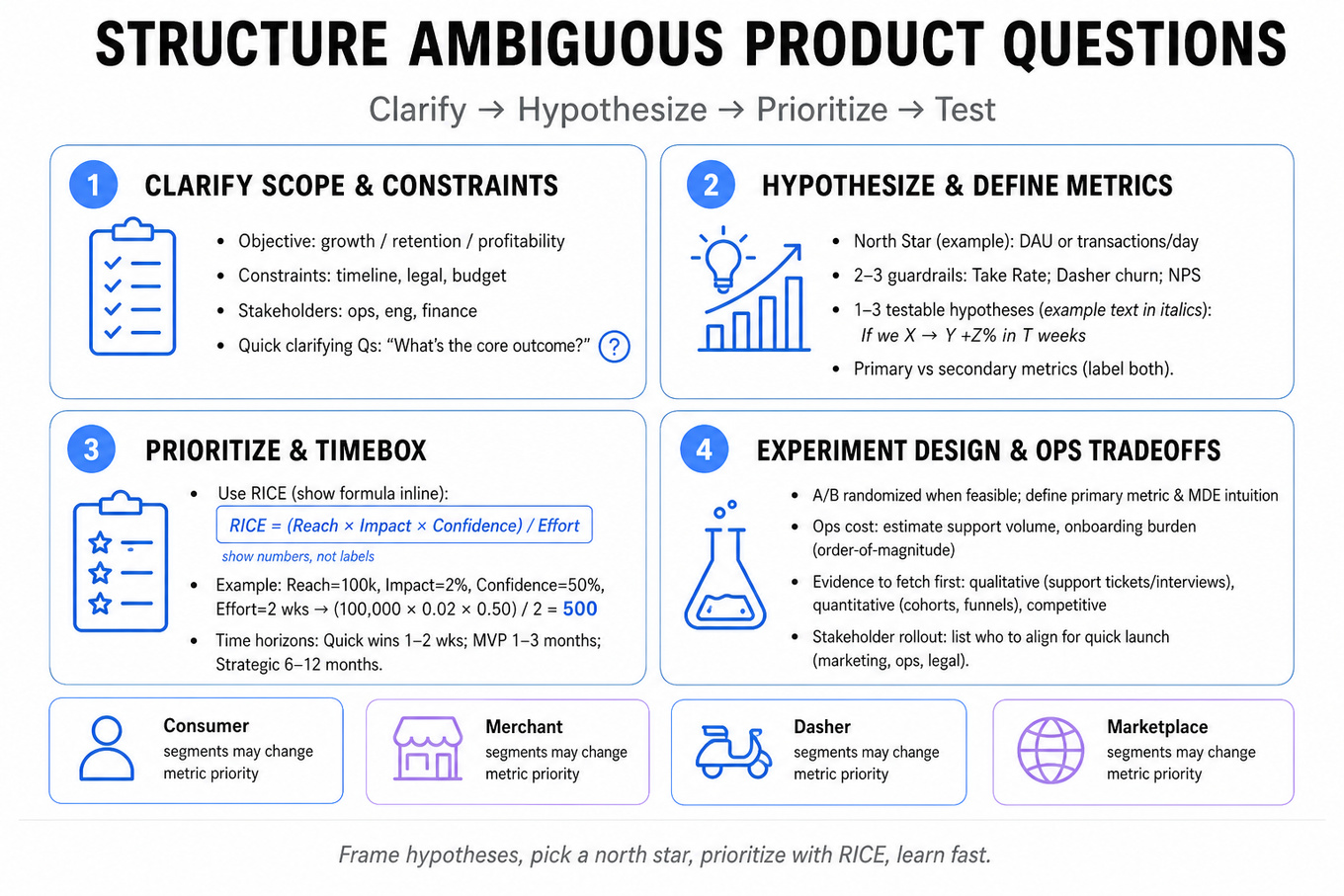
Clarifying questions — Ask about objective (growth, retention, profitability), constraints (legal, timeline, budget), and stakeholders (ops, engineering, finance). Clear scope prevents chasing irrelevant solutions.
-
User segments & personas — Always split impact by consumer, merchant, Dasher, and marketplace; different segments can reverse prioritization and metric choice.
-
North Star & guardrails — Define one North Star metric (e.g.,
DAU, transactions/day) and 2–3 guardrails (e.g.,Take Rate,Dasher churn, customerNPS) to prevent local optimization. -
Hypothesis-first framing — Convert the ask into 1–3 testable hypotheses: "If we X, then Y metric will change by Z% in T weeks." This drives experiments and success metrics.
-
Prioritization frameworks — Use RICE (Reach×Impact×Confidence / Effort), ICE, or opportunity-scoring; show numeric thought experiments rather than vague labels.
- RICE formula:
-
Time-boxed solutions — Differentiate quick wins (1–2 weeks), MVPs (1–3 months) and strategic bets (6–12 months); recommend earliest learnings-first.
-
Experiment design basics — Propose randomized
A/Bwhere feasible, define primary/secondary metrics, minimum detectable effect (MDE) intuition, and ramping plan; avoid false-positive traps from many comparisons. -
Cost & ops tradeoffs — Quantify operational burden (e.g., added customer support volume, new onboarding flows) and impact on unit economics; estimate order-of-magnitude costs.
-
Data & evidence types — Use qualitative signals (support tickets, interviews), quantitative signals (cohort retention, conversion funnels), and competitive benchmarking; declare which you’d fetch first.
-
Communication & stakeholder plan — Outline who needs to be aligned for quick rollout (marketing, ops, legal), what artifacts they need (PRD, rollout checklist, rollback criteria), and cadence of check-ins.
-
Signal decay & downstream effects — Consider time-lagged metrics (lifetime value change), seasonality, and potential gaming; call out how to detect and mitigate.
-
Decision criteria — Be explicit: “Ship if primary metric improves ≥X% with no guardrail breach within Y weeks,” otherwise iterate or rollback.
Worked example — "Reduce Dasher cancellations on high-distance deliveries"
Start by clarifying: what counts as a cancellation (Dasher-initiated vs merchant), target reduction %, and acceptable tradeoffs on delivery time or cost. Frame 3 pillars: Diagnose (data + user interviews), Short-term fixes, Long-term product changes. Diagnosis: quantify cancellation rate by distance, time-of-day, payout; run qualitative interviews with cancelled Dashers. Short-term fixes: change acceptance UI (show clearer payout/time), conditional bonuses for long trips; propose an A/B test with primary metric cancellations_per_order and guardrail on-time rate. Long-term: redesign Dasher routing / batching or change pricing algorithm. Flag tradeoff: raising payouts reduces cancellations but harms unit economics; recommend testing targeted payouts for top 20% problematic routes first. Close with next steps: run a 2-week experiment, monitor guardrails, and—if positive—scale with stratified rollout; if inconclusive, run deeper segmentation by Dasher lifetime.
A second angle — "Respond to an unexpected regulatory ban on surge pricing"
This is still an ambiguous, urgent product question but with a hard constraint: no surge. Clarifying Qs: scope (city vs state), timeline, and permitted alternate levers (peak windows, guaranteed pay). Pillars: stabilize supply (Dasher incentives), manage demand (dynamic messaging, capped wait times), and PR/merchant communication. Propose short-term operational incentives (time-limited guaranteed pay), medium-term product changes (predictive ETAs to set expectations), and longer-term pricing alternatives (subscription or demand-weighted fees). Tradeoffs differ: you must be conservative about experimentation speed because regulatory noncompliance is non-negotiable; measurement focuses on supply elasticity and fulfillment windows rather than revenue per order.
Common pitfalls
Pitfall: Overfitting to one metric — optimizing a single KPI (e.g., gross orders) without guardrails often degrades marketplace health; always include guardrail metrics and segment-level analysis.
Pitfall: No clear success criteria — proposing features without concrete, numeric targets (e.g., reduce cancellations by X% in Y weeks) leaves execution vague and decisions subjective.
Pitfall: Deep technical solutions too early — jumping to engineering-heavy fixes without validating user pain or operational feasibility wastes time; prefer experiments and quick learning when uncertain.
Connections
Interviewers may pivot to experiment design & metrics (A/B testing, MDE), analytics (cohort and funnel analysis), or go-to-market and ops (rollout plans, incident playbooks). Be ready to translate your structured recommendation into an experiment and a launch checklist.
Further reading
-
Decode and Conquer — Lewis C. Lin — practical frameworks for structuring PM interview answers.
-
Inspired — Marty Cagan — product decision frameworks and evidence-driven roadmaps.