Structuring Ambiguous and Curveball Product Questions
Asked of: Product Manager
Last updated
What's being tested
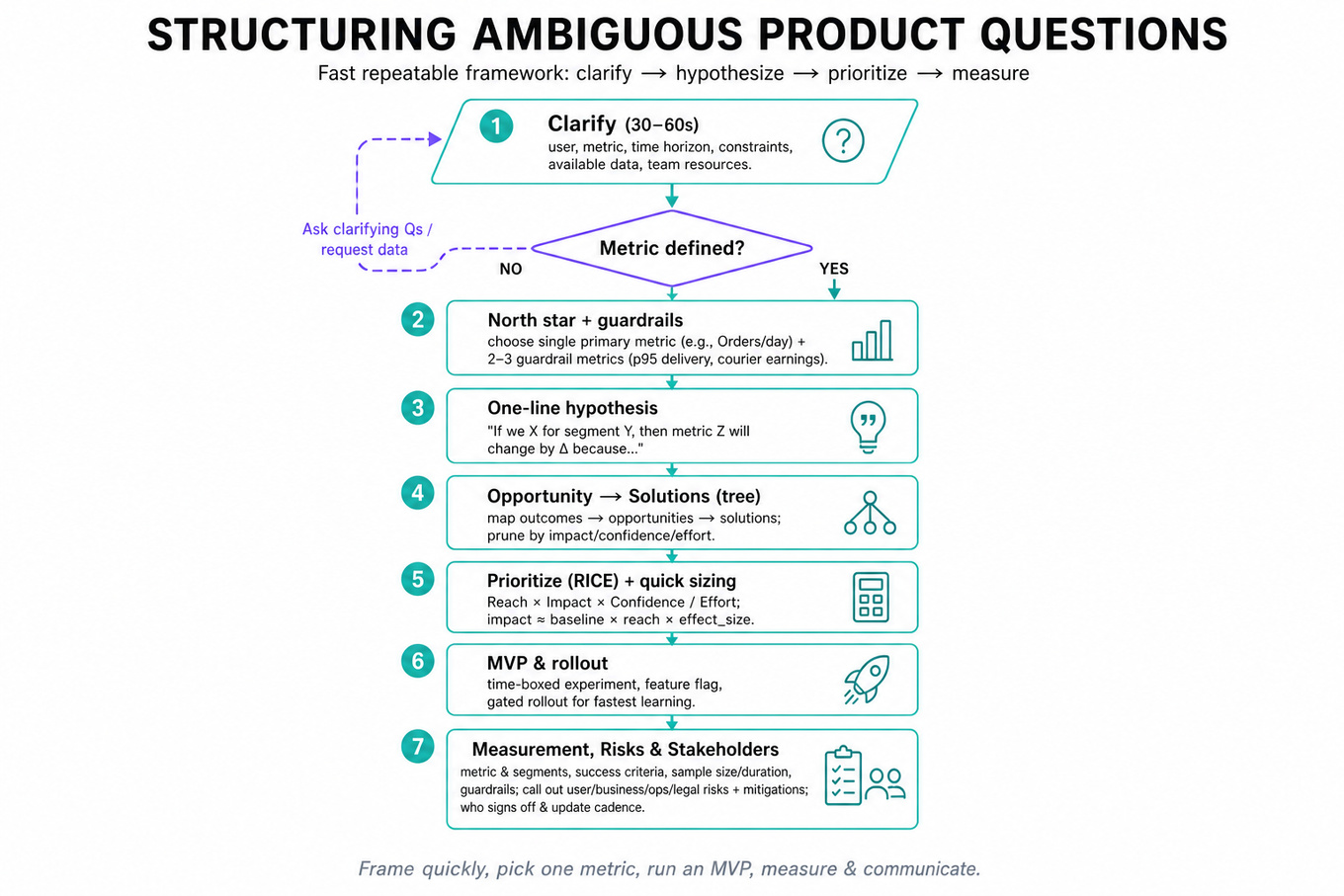
Interviewers are probing your ability to structure ambiguous, open-ended product problems quickly and repeatably: clarify scope, pick the right metrics, generate prioritized solutions, and produce a measurable launch plan. DoorDash cares because PMs must make high-impact tradeoffs with limited data and time, communicate decisions to cross-functional partners, and convert fuzzy inputs into experiments and delivery. The interviewer is checking for disciplined framing, defensible assumptions, stakeholder awareness, and how you surface risks and guardrails.
Core knowledge
-
Clarifying questions — first 30–60s: confirm user, metric, time horizon, constraints, and success definition; always ask for available data and team resources.
-
North Star / success metric — choose a single primary metric (e.g.,
Orders/day,Conversion rate) and 2–3 guardrail metrics (e.g.,p95delivery time, courier earnings) to avoid optimization regressions. -
Hypothesis-driven framing — write a one-line hypothesis: “If we X for segment Y, then metric Z will change by Δ because …”; this forces causal thinking and testability.
-
Opportunity–Solution Tree — map outcomes → opportunities → solutions; prune by impact, confidence, and effort. Use it to show breadth before committing to one solution.
-
Prioritization (RICE) — score ideas with Reach × Impact × Confidence / Effort; quantify Reach and Impact with back-of-envelope math (estimated users × expected % change).
-
Quick sizing math — estimate impact: Impact ≈ baseline_metric × reach × effect_size; use this for rough ROI and sample-size feasibility checks.
-
Time-boxing & MVP — propose an MVP for fastest learning (e.g., gated rollout, feature flag) and a longer roadmap for scalability/quality improvements.
-
Measurement plan — define experiment design: metric, segments, success criteria, necessary sample size, duration, and guardrail checks; plan observational fallbacks if randomization impossible.
-
Risks & mitigations — call out user, business, operational, and legal risks with concrete mitigations (e.g., telemetry gaps, courier incentives).
-
Stakeholder alignment — identify who must sign off (analytics, ops, legal) and the minimum asks from each: data slice, enforcement, budget, timeline.
-
Communication cadence — describe when you’ll update stakeholders: quick sync after clarifying, decision memo with RICE, weekly checkpoints post-launch.
-
Behavioral signals — be explicit about assumptions and how you’ll validate them (surveys, qualitative interviews, cohort analysis); don’t hide uncertainty.
Worked example
Question: “Reduce checkout drop-off for first-time customers on the app.” Frame instantly: clarify timeframe, current baseline checkout conversion and instrumented steps, whether we can A/B test, and the acceptable business tradeoff (e.g., revenue vs. onboarding cost). Skeleton answer pillars: (1) Diagnose — split funnel by step, segment by device/source, and run quick qualitative sessions for pain points; (2) Solutions — low-effort hacks (pre-filled address, simplified payment flow), medium-effort (one-tap guest checkout), long-term (unified account recovery); (3) Prioritize — RICE score each using baseline conversion and estimated effect sizes; (4) Measurement & rollout — plan an A/B test with primary metric checkout conversion and guardrails average order value and fraud rate. Flag the tradeoff: a one-tap guest checkout may raise fraud risk — require fraud-team signoff and monitor chargeback rate as a guardrail. Close by saying, “If I had more time I’d run quick usability tests and a payback calculation for incentives to convert first orders.”
A second angle
Question: “A major competitor promises 10-minute delivery in a new city — how do we respond?” The same structuring applies but shifts emphasis: clarify which metric the company cares about (market share, retention, margin), constraints (fleet size, coverage), and timeframe for response. Map opportunities: improve speed, differentiate on reliability/selection, or highlight cost. Prioritize by impact and feasibility: a quick marketing campaign emphasizing reliability may win immediate share without operational overhaul. Measurement would use local market order volume, repeat rate, and customer satisfaction (NPS) with a short A/B test on messaging. The key transfer: identical hypothesis framing, RICE prioritization, and guardrail planning, but different success metrics and stakeholder urgency change recommended levers.
Common pitfalls
Pitfall: Jumping straight to a solution.
Rushing into feature suggestions without clarifying the target metric, constraints, or available data makes your answer sound unstructured. Always spend the first 30–60 seconds framing and asking one or two critical clarifying questions.
Pitfall: Using vague estimates as facts.
Giving numeric recommendations without stating assumptions (user base size, baseline rates) looks confident but unscientific. Always label back-of-envelope numbers and show how they change your RICE ranking.
Pitfall: Ignoring guardrails and stakeholders.
Proposing growth hacks without calling out negative side effects (cost, fraud, courier experience) or necessary approvals undermines feasibility. Explicitly name the stakeholders and the minimal gating criteria.
Connections
Interviewers often pivot to experimentation design, metric instrumentation, or go-to-market tradeoffs after a structuring question — be ready to convert your hypothesis into an A/B test plan or a phased rollout that ties into analytics and ops.
Further reading
-
ProductTalk / Teresa Torres — Opportunity Solution Tree — practical technique to show branching from outcome to experiments.
-
[Inspired, Marty Cagan] — book on product leadership and decision frameworks; useful for PM judgment and tradeoffs.
Related concepts
- Structuring Ambiguous and Curveball Product Questions
- Structuring Ambiguous and Curveball Growth PM Cases
- DoorDash Ambiguity & Curveball Product Framing
- Ambiguity and Curveball PM Case Framework
- Data-Driven Product DecisionsProduct / Decision Making
- Ambiguous Project Leadership And Product ImpactBehavioral & Leadership