Backend System Design For Fintech Platforms
Asked of: Software Engineer
Last updated
What's being tested
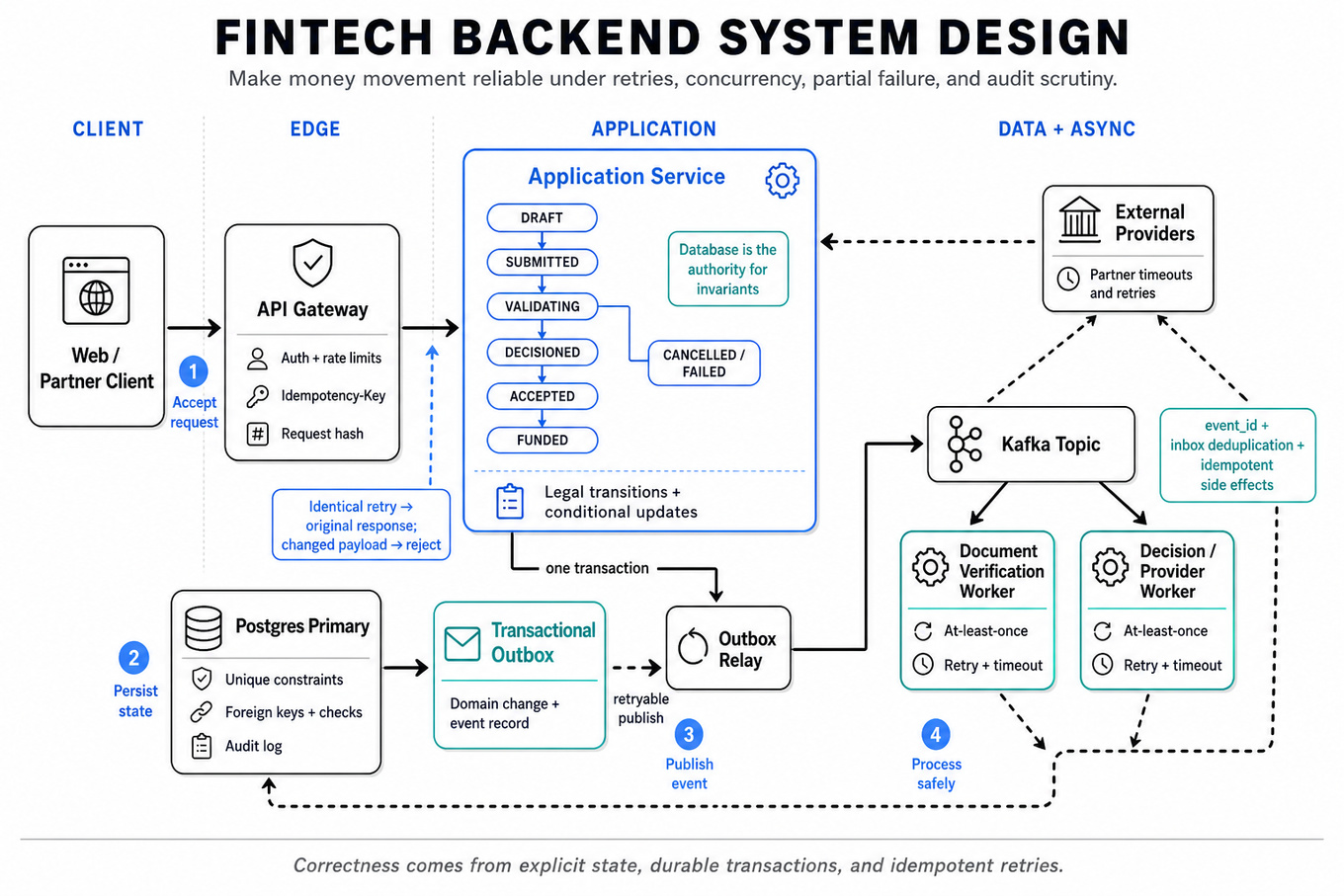
Backend fintech design probes whether you can build reliable services around money, identity, applications, and decisions while handling retries, concurrency, partial failure, and strict audit requirements. A strong Software Engineer decomposes the system into APIs, state transitions, durable storage, asynchronous workflows, and operational safeguards rather than jumping directly to databases or cloud products. Upstart cares because a loan platform must remain correct and explainable under high request volume, partner timeouts, duplicate submissions, and regulatory scrutiny.
Core knowledge
-
Requirements clarification separates functional requirements—submit an application, retrieve status, update documents—from nonfunctional requirements such as availability, latency, durability, consistency, auditability, and recovery objectives. Ask for traffic, payload size, retention, and acceptable staleness before choosing architecture.
-
Model the domain with an explicit state machine:
DRAFT → SUBMITTED → VALIDATING → DECISIONED → ACCEPTED → FUNDED, with terminal failure or cancellation states. Define legal transitions, who may trigger them, whether transitions are reversible, and how duplicate events are handled. -
Use idempotency keys for client retries on mutating endpoints. Persist
(client_id, idempotency_key, request_hash, response, status)under a unique constraint; return the original response for an identical retry and reject the key if the payload differs. -
Treat the database as the authority for transactional invariants. In
Postgres, combine unique constraints, foreign keys, check constraints, and transactions; use conditional updates such asUPDATE ... WHERE status = 'SUBMITTED'to prevent illegal concurrent transitions. -
Distinguish synchronous request/response work from asynchronous work. Validate and persist the application synchronously; enqueue document verification or external-provider calls asynchronously when they may exceed the API timeout or require retries.
-
A durable transactional outbox prevents the “database commit succeeded but message publish failed” gap. Write the domain change and outbox record in one transaction, then publish outbox records to
Kafkaor a queue with a relay that is itself retryable. -
Assume at-least-once delivery. Consumers need event IDs, inbox or deduplication records, and idempotent side effects; “exactly once” is generally an end-to-end application property, not a guarantee obtained merely by selecting a broker option.
-
Choose consistency deliberately. Application status and eligibility constraints typically require strong consistency, while search indexes, notifications, and dashboards can be eventually consistent. State the user-visible behavior when a read replica or projection lags.
-
Design external integrations with timeouts, bounded retries, exponential backoff, jitter, and circuit breakers. Retry only transient failures; avoid retry storms and duplicate provider submissions by sending a stable request ID and recording provider responses.
-
Secure sensitive financial data using least privilege, encrypted transport and storage, secret rotation, tokenized or redacted logs, and strict access controls. Keep immutable audit records containing actor, timestamp, request ID, prior state, new state, and reason without logging unnecessary personal data.
-
Make observability part of the design: propagate a correlation ID, emit structured logs, measure request rate, error rate, saturation, and
p50/p95/p99latency, and trace asynchronous work. Alert on stuck state transitions, outbox backlog, consumer lag, and provider failure rates. -
Plan recovery with reconciliation jobs, replayable events, dead-letter queues, and backups. A reconciliation process should compare internal records with provider results and repair projections without inventing state; define RPO/RTO and test restoration rather than assuming backups work.
Worked example
Representative scenario: Design an idempotent loan-application API. In the first 30 seconds, clarify whether one applicant may submit multiple applications, the expected write/read QPS, latency target, retention period, permitted status staleness, and whether external verification is synchronous. I would organize the answer around the API and idempotency contract, the application state machine and Postgres schema, asynchronous verification with an outbox, and security/observability/recovery. POST /applications would require an idempotency key, validate the request, and transactionally insert the application plus an outbox event under a uniqueness constraint. A worker would consume the event, call verification providers with a stable provider request ID, and conditionally advance the state only if the current state permits it. The explicit tradeoff is strong consistency for the application’s canonical status versus eventual consistency for a read-optimized status projection; the latter improves read scale but may briefly show an older state. I would also explain how provider timeouts, duplicate Kafka deliveries, and client retries produce no duplicate application or verification side effect. I would close by saying that, with more time, I would specify partitioning and retention, failure-injection tests, key rotation, reconciliation behavior, and a rollout plan.
A second angle
A funding-disbursement service uses the same principles but has a stricter financial correctness boundary than an application-submission API. The design should use an immutable ledger or double-entry records, unique transfer identifiers, and conditional state transitions so a retry cannot create two payouts. External bank calls remain asynchronous and may be at-least-once, so reconciliation against bank statements is essential. Availability may be sacrificed briefly when account or balance invariants cannot be verified, because returning “funded” incorrectly is worse than returning a temporary error. This framing shifts emphasis from flexible workflow progress to atomic money movement, auditability, and recovery.
Common pitfalls
Pitfall: Treating an idempotency key as a cache key without persisting the request fingerprint. A client can reuse the same key with a different payload, so store and compare a canonical request hash and define the conflict response.
Pitfall: Listing
Kafka,Redis, and microservices without explaining the correctness model. State which database is authoritative, which operations are transactional, what can be eventually consistent, and how duplicate messages or stale reads affect users.
Pitfall: Claiming “exactly-once processing” or infinite retries as the solution to provider failures. A stronger answer uses bounded retries, idempotent consumers and provider calls, dead-letter handling, circuit breaking, and reconciliation for cases that remain ambiguous.
Connections
The interviewer may pivot to distributed transactions, outbox/inbox messaging, event sourcing versus CRUD, or database isolation levels. They may also test API versioning, rate limiting, disaster recovery, and how to debug a stuck asynchronous workflow.
Further reading
-
Designing Data-Intensive Applications — Martin Kleppmann’s treatment of replication, consistency, transactions, streams, and fault tolerance.
-
Stripe: Idempotent Requests — a concrete production pattern for safely retrying financial API mutations.
-
Microservices Patterns — practical explanations of transactional outbox, sagas, and reliable messaging.
Related concepts
- Transactional Banking System DesignSystem Design
- Scalable Backend Architecture And Data ModelingSystem Design
- Distributed System Design For Ledgers And CountersSystem Design
- Payment Processing And Ledger SystemsSystem Design
- Scalable Distributed System ArchitectureSystem Design
- Fault-Tolerant Backend System DesignSystem Design