Behavioral Ownership, Communication, And Tradeoffs
Asked of: Software Engineer
Last updated
What's being tested
These conversations test technical ownership: whether you can take a software system from ambiguous requirements through design, implementation, operation, and improvement. They probe whether you can explain architecture clearly, make explicit tradeoffs, debug incidents, and communicate decisions to engineers and stakeholders without hiding uncertainty. LinkedIn cares because production systems are cross-team, long-lived, and user-facing; strong Software Engineers reduce operational risk while helping others make sound technical decisions.
Core knowledge
-
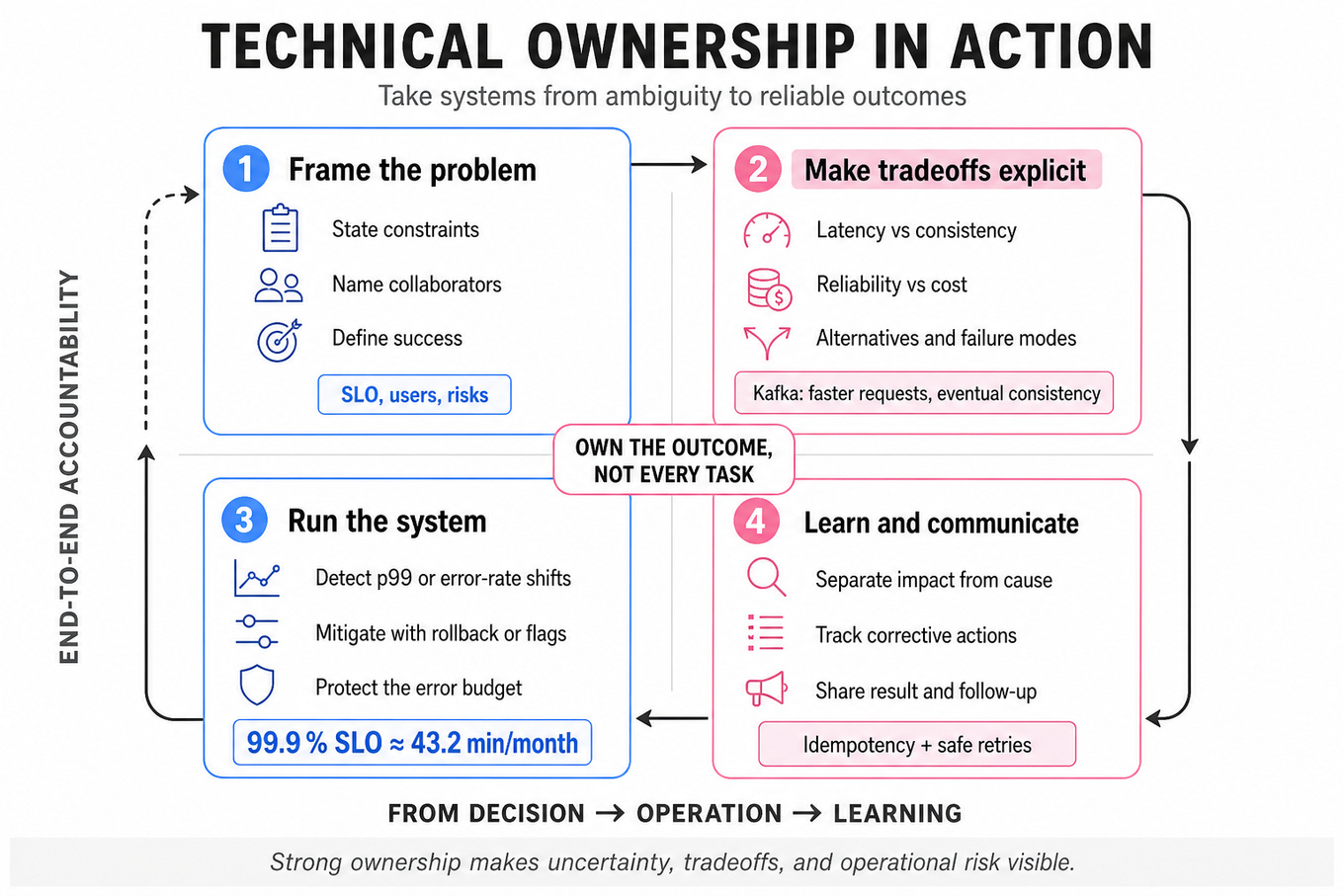
Ownership means being accountable for the outcome, not personally implementing every task. State the problem, constraints, decision-maker, collaborators, risks, rollout plan, and measurable result; distinguish what you directly changed from what the team achieved.
-
Use a STAR structure—situation, task, action, result—but make the action technically specific. Explain the system boundary, your contribution, alternatives considered, failure modes, and follow-up work instead of saying “we improved scalability.”
-
For system decisions, compare latency, throughput, availability, consistency, operational complexity, and cost. For example, asynchronous work through
`Kafka`improves request latency and resilience but introduces eventual consistency, retries, duplicate delivery, and harder user-visible status handling. -
Make reliability quantitative with an SLO and error budget. A 99.9% monthly availability target permits roughly 43.2 minutes of unavailability; if a release consumes the budget rapidly, pause feature work, investigate, and prioritize remediation.
-
Describe incident management as a controlled loop: detect through
`p99`latency or error-rate alerts, mitigate with rollback or feature flags, establish a timeline, identify the contributing factors, and track corrective actions. Separate customer impact from root cause and avoid blame. -
Explain idempotency whenever retries can repeat writes. An idempotency key stored with the operation result prevents duplicate effects; a timeout does not prove failure, so clients and workers must safely retry. Consider key expiration, concurrent requests, and partial failures.
-
For backward compatibility, prefer additive API or schema changes: deploy readers before writers, support old and new fields during migration, and remove deprecated paths only after usage reaches zero. Explicitly address rolling deployments, old binaries, and rollback behavior.
-
When debugging, narrow the search using observability: structured logs for request IDs, metrics for rates and percentiles, and distributed traces for cross-service timing. Correlate the first bad deployment or dependency change, then reproduce with the smallest realistic input.
-
Discuss rollout safety using canaries, dark launches, feature flags, and automated rollback thresholds. A canary should compare error rate, saturation, latency, and correctness—not merely whether the process remains alive.
-
Knowledge transfer is an engineering control, not just onboarding courtesy. Provide an architecture diagram, request and failure-flow walkthrough, local setup instructions, runbook, ownership boundaries, and a small scoped change; verify learning by having the teammate explain or modify the system.
-
Handle disagreement with written decision records such as an ADR: state the context, requirements, options, decision, rejected alternatives, and revisit conditions. Escalate only when the disagreement affects safety, availability, compliance, or an agreed delivery constraint.
-
Measure outcomes with engineering signals such as
`p95`/`p99`latency, availability, deployment frequency, change-failure rate, recovery time, queue depth, and support incidents. Attribute results carefully: “`p99`fell from 900 ms to 350 ms after caching” is stronger than “performance improved.”
Worked example: Discuss Projects and Tradeoffs
For “Discuss Projects and Tradeoffs,” a strong candidate first asks which project, the scale and reliability requirements, their personal scope, and whether the interviewer wants architecture depth or leadership context. They might declare assumptions such as millions of daily requests, a 300 ms `p99` target, and an existing multi-service deployment, then organize the answer around problem and constraints, architecture, key tradeoffs, execution, and measurable outcome. They should describe the request path, storage choices, asynchronous boundaries, failure handling, observability, and rollout strategy rather than listing technologies. One explicit tradeoff could be choosing asynchronous event processing through `Kafka`: it reduces synchronous latency and isolates failures, but requires idempotent consumers, replay handling, and a strategy for eventual consistency. The candidate should explain one disagreement, how they used measurements or a prototype to resolve it, and how they kept partner teams informed. They should quantify the result with latency, availability, cost, or incident-rate changes and clarify which part they personally owned. A strong close is: “If I had more time, I would validate the assumptions under load, test regional failure, and document the migration and rollback plan.”
A second angle
For “Handle Issues and Onboard Teammates,” the same ownership principle is applied to operational ambiguity and team resilience rather than a single project narrative. Frame the issue by separating immediate mitigation from the longer-term fix, then explain how you communicated impact, assigned ownership, and recorded decisions. When onboarding, avoid giving an unstructured code tour; use a production request path, failure scenarios, runbook, and a small change to test understanding. The key constraint is safe delegation: give the teammate enough context to act independently while retaining review, monitoring, and rollback safeguards. Close with how the process reduced repeated questions, shortened incident response, or improved bus-factor risk.
Common pitfalls
Pitfall: Saying “we chose microservices for scalability” is an analytical non-answer. Name the actual bottleneck, compare a modular monolith or a single service, and explain why the selected boundary improved a measured constraint while adding deployment and debugging cost.
A communication mistake is presenting a polished success story that hides disagreement or failure. “Everyone agreed and the launch went smoothly” gives no evidence of leadership; instead, explain the competing concerns, how you made the decision legible, and what you changed after an unexpected result.
A depth mistake is naming `Kafka`, Kubernetes, or caching without explaining behavior under retries, overload, rollback, or dependency failure. The interviewer is not testing brand familiarity; be ready to trace one request, identify a failure mode, and state the mitigation and monitoring signal.
Connections
The interviewer may pivot to system design, distributed-systems failure modes, incident response, API and schema evolution, or observability. They may also ask how you prioritize reliability work when the error budget is limited or how you validate a design before committing implementation effort.
Further reading
-
Site Reliability Engineering — Google’s treatment of SLOs, error budgets, incident response, and sustainable operations.
-
Designing Data-Intensive Applications — practical analysis of consistency, replication, streaming, storage, and distributed-system tradeoffs.
-
Accelerate — research-backed engineering delivery and reliability metrics, including deployment frequency and change-failure rate.
Practice questions
- Handle Issues and Onboard TeammatesLinkedIn · Software Engineer · Onsite · easy
- Discuss Projects and TradeoffsLinkedIn · Software Engineer · Onsite · medium
- How do you win project buy-in?LinkedIn · Software Engineer · Technical Screen · medium
- Explain a past project and critique a prior teamLinkedIn · Software Engineer · Technical Screen · medium
- Explain your most impactful project clearlyLinkedIn · Software Engineer · Onsite · medium
- Explain a project and handle ambiguityLinkedIn · Software Engineer · Onsite · hard
- Introduce yourself and discuss challengesLinkedIn · Software Engineer · HR Screen · medium
- Describe leading an infrastructure initiativeLinkedIn · Software Engineer · Onsite · medium
- Describe challenging teamwork and feedback handlingLinkedIn · Software Engineer · Onsite · medium
Related concepts
- Technical Leadership, Project Ownership, And Stakeholder CommunicationBehavioral & Leadership
- Behavioral Ownership, Communication, And LeadershipBehavioral & Leadership
- Behavioral Communication And OwnershipBehavioral & Leadership
- Behavioral Leadership, Motivation, And TradeoffsBehavioral & Leadership
- Behavioral Leadership And Stakeholder ManagementBehavioral & Leadership
- Behavioral Ownership, Metrics, And Product JudgmentBehavioral & Leadership