Behavioral Ownership, Impact, And Leadership
Asked of: Software Engineer
Last updated
What's being tested
These prompts test whether you can show ownership from ambiguous problem discovery through implementation, rollout, and measurable outcome—not merely describe tasks assigned to you. The interviewer is probing technical judgment, debugging discipline, communication under disagreement, and influence without requiring formal management authority. Walmart Labs cares because production software operates at large scale: a seemingly small change can affect checkout reliability, inventory accuracy, latency, cost, and millions of customers. Strong answers connect your individual engineering decisions to system behavior and business-relevant outcomes while being candid about trade-offs and mistakes.
Core knowledge
-
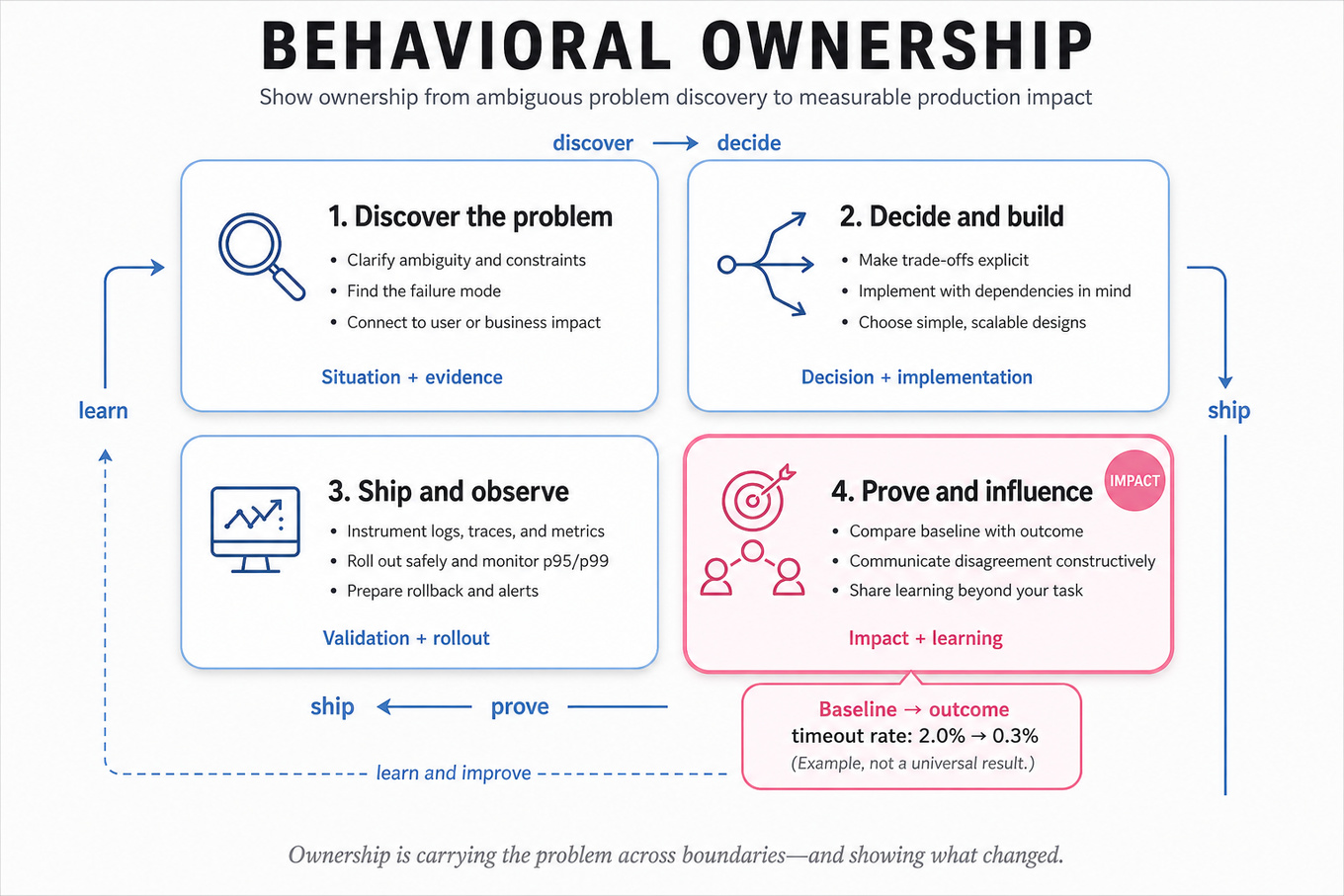
STAR is useful, but the strongest behavioral answer is technically causal: situation and constraints, your specific decision, implementation details, validation, measurable result, and what you learned. Spend most time on decisions and evidence rather than team background.
-
Ownership means carrying a problem across boundaries: clarifying requirements, identifying dependencies, writing or reviewing code, instrumenting behavior, deploying safely, monitoring
p95/p99latency and error rate, and following through after release. Do not equate ownership with doing every task yourself. -
Quantify impact with a baseline and comparison: “timeout rate fell from 2.0% to 0.3%” is stronger than “performance improved.” For reliability, discuss availability,
MTTR, deployment frequency, rollback rate, saturation, and error-budget consumption; distinguish correlation from causation. -
For a hard technical problem, explain the failure mode before the fix. Examples include a thundering herd after cache expiry, duplicate writes caused by retries, stale reads from replica lag, an
N+1query pattern, or a race condition around shared state. -
Make trade-offs explicit: synchronous versus asynchronous processing, strong versus eventual consistency, relational transactions versus distributed coordination, caching versus freshness, or a simple local fix versus a reusable platform abstraction. State why the chosen option fit the scale and failure tolerance.
-
Observability turns ownership into evidence. Mention structured logs with request or trace IDs, actionable metrics, distributed traces, dashboards, and alerts tied to user impact. A deploy is not complete until you can detect regressions and identify the failing dependency.
-
Safe delivery demonstrates engineering judgment: feature flags, canary releases, backward-compatible schema changes, automated tests, staged rollout, rollback criteria, and idempotent handlers. For a high-risk change, define “stop” conditions before deployment rather than improvising during an incident.
-
Influence without authority relies on artifacts and experiments: a short design document, reproducible benchmark, failure analysis, API contract, or test demonstrating the concern. Invite critique, separate people from technical claims, and escalate only after attempting direct resolution.
-
In conflict, distinguish facts, constraints, preferences, and decision rights. Compare alternatives using measurable criteria such as correctness, operational complexity, latency, cost, security, and reversibility; record the decision and commit once the decision owner chooses.
-
Mentoring and code quality are engineering leverage, not merely interpersonal activities. Use focused code reviews, pairing, test-design guidance, static analysis, API conventions, and runbooks to raise the team’s ability to ship safely without becoming a single point of failure.
-
Integrity matters when pressure conflicts with correctness or compliance. Do not hide a failing test, silently weaken authorization, manipulate a metric, or ship known data-loss risk; state the risk, propose a safe alternative, document the decision, and escalate through the appropriate channel.
-
A credible failure story includes a concrete correction. Examples are adding a
UNIQUEconstraint after duplicate records, introducing an idempotency key after retry-induced double processing, or adding contract tests after a breaking downstream API change. Explain how the process changed afterward.
Worked example: “Describe a Hard Technical Problem You Solved and a Coworker Conflict You Resolved”
In the first 30 seconds, I would clarify the system context, my exact responsibility, the severity of the technical issue, the disagreement’s subject, and the measurable outcome expected. I would state assumptions such as: “This was a backend service in production, and I owned the change and rollout, while the coworker owned the dependent client.” I would organize the answer around four pillars: diagnosing the failure with logs, metrics, and traces; comparing the competing designs; resolving the disagreement respectfully; and deploying and validating the fix. A concrete technical decision might be choosing an idempotent asynchronous workflow over a synchronous retry loop because retries were amplifying load and creating duplicate writes. I would explain the trade-off: asynchronous processing improved resilience but introduced eventual consistency, so I added status visibility and clear retry semantics. For the conflict, I would describe a one-on-one conversation, restate the coworker’s reliability concern, and use a reproducible load test rather than treating disagreement as resistance. I would close with the result—such as lower duplicate-write rate, improved p99, and no regression during a canary—and the lesson that design assumptions should be tested early. If I had more time, I would also describe the monitoring, rollback threshold, and follow-up documentation that prevented the same class of incident.
A second angle
For “Handle conflict and motivate engineering teams,” the core concept shifts from one technical incident to sustaining execution across several engineers. I would frame my role as creating clarity and reducing friction, not acting as the team’s manager: define the technical goal, split work by ownership boundaries, surface risks, and make progress visible through a lightweight plan. Motivation should be grounded in engineering autonomy, achievable milestones, useful feedback, and recognition of specific contributions—not generic encouragement. I would include how I handled a missed commitment or design disagreement while protecting code quality and the delivery date.
Common pitfalls
Pitfall: Saying “I improved performance” without a baseline, workload, or measurement makes the claim unverifiable. State the tested traffic shape, the bottleneck, the before-and-after metric, and whether the result held in production.
A communication mistake is presenting a coworker as incompetent or describing conflict as something you “won.” That signals poor collaboration; instead, explain the legitimate concern on each side, the evidence used, how the decision was made, and how you preserved the working relationship.
A depth mistake is naming tools—Kafka, caching, microservices, or Kubernetes—without explaining the failure mode or trade-off. “We added retries” is incomplete unless you discuss timeout budgets, backoff, jitter, idempotency, retry limits, and how you prevented a retry storm.
Connections
An interviewer may pivot from these stories to incident response, distributed-systems consistency, observability and SLOs, or code-review and testing strategy. Be ready to connect behavioral evidence to a concrete design artifact, algorithmic choice, debugging method, or production safeguard.
Further reading
-
The Site Reliability Workbook — practical guidance on SLOs, error budgets, incident response, and safe operational ownership.
-
[Debugging Teams](https://pragprog.com/titles/ate disputing/debugging-teams/) — techniques for diagnosing collaboration and communication failures with the same discipline used for technical failures.
-
Staff Engineer: Leadership beyond the management track by Will Larson — useful frameworks for technical influence, scope, and leading without formal authority.
Practice questions
- Describe a Hard Technical Problem You Solved and a Coworker Conflict You ResolvedWalmart Labs · Software Engineer · Onsite · easy
- Answer leadership scenarios about influence and integrityWalmart Labs · Software Engineer · Technical Screen · medium
- Handle conflict and motivate engineering teamsWalmart Labs · Software Engineer · Onsite · easy
- Describe past projects and impactWalmart Labs · Software Engineer · Technical Screen · medium
- Provide self introduction, achievements, automation challenges, code quality, mentoringWalmart Labs · Software Engineer · Technical Screen · medium
Related concepts
- Behavioral Ownership, Communication, And LeadershipBehavioral & Leadership
- Behavioral Ownership, Metrics, And Product JudgmentBehavioral & Leadership
- Behavioral Ownership, Conflict, Ambiguity, And GrowthBehavioral & Leadership
- Behavioral Ownership And Stakeholder InfluenceBehavioral & Leadership
- Behavioral Leadership And Stakeholder ManagementBehavioral & Leadership
- Behavioral Leadership, Ownership, And ComplianceBehavioral & Leadership