Coding Fundamentals and Complexity for DS
Asked of: Data Scientist
Last updated
-
What it is This is the practical toolkit of data structures, algorithms, and Big-O analysis you use to reason about runtime and memory. It helps you choose implementations that stay fast as data grows and to spot when code will blow up at scale.
-
Why interviewers ask about it Teams shipping ranking, ads, or integrity systems care whether your solution still works on tens of millions of rows. They’re probing if you can turn a correct idea into something that’s efficient in Python and common ML/data libraries, and if you can explain performance trade-offs clearly.
-
Core ideas to know
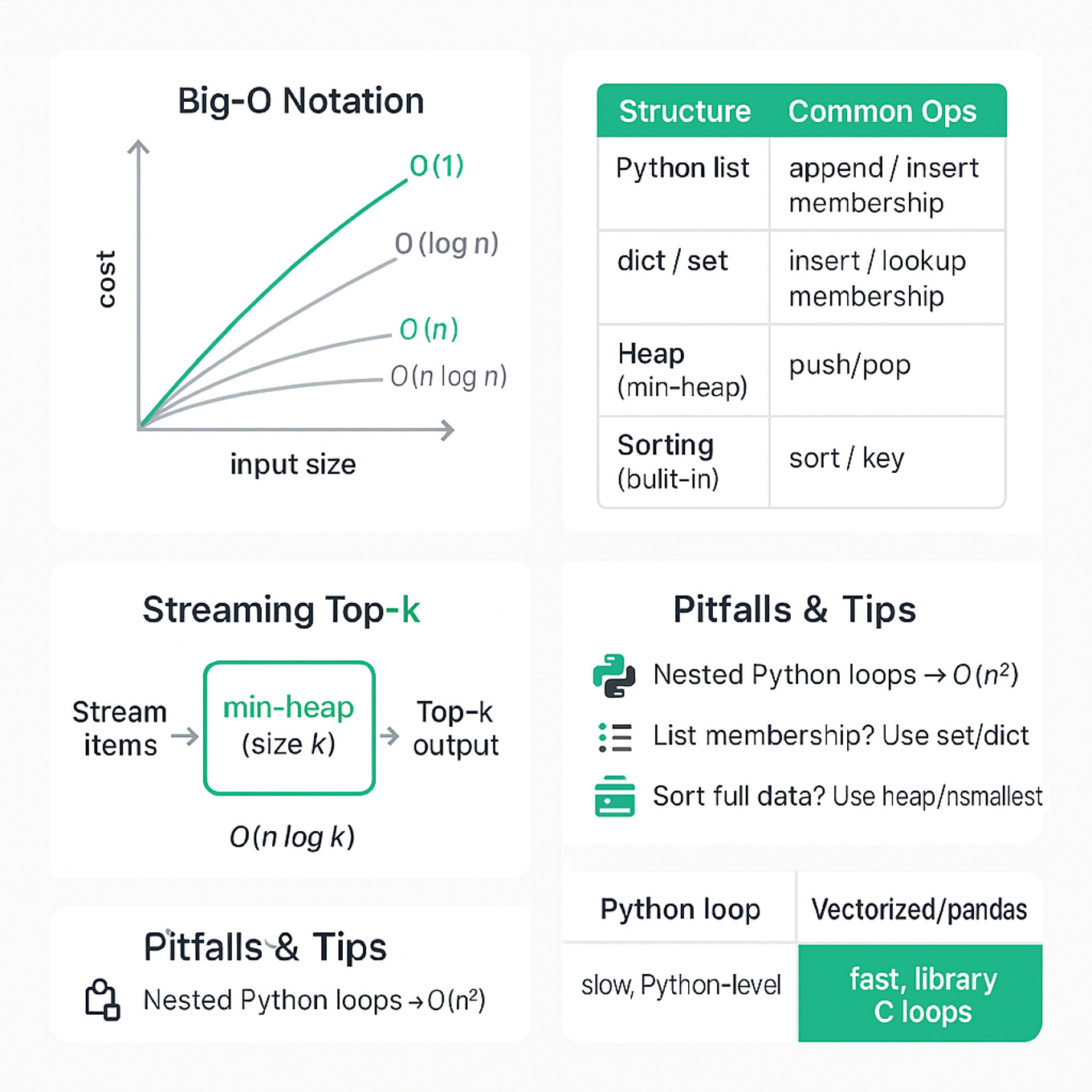
- Big-O captures how runtime/space grow with input; know O(1), O(log n), O(n), O(n log n), O(n^2).
- Python lists: append amortized O(1); insert/delete in middle O(n); membership tests O(n).
- dict/set: average O(1) inserts/lookups; worst-case O(n) with poor hashing; ideal for membership, dedup, joins.
- Sorting: built-ins are stable; typical O(n log n). Supplying a key function can reduce comparison overhead.
- Heaps solve streaming top-k: maintain a size-k heap, overall O(n log k).
- Prefer vectorized NumPy/pandas and library ops; avoid Python loops that add large constant factors.
-
A common pitfall Candidates recite Big-O but ignore real Python and data stack behavior. They write nested Python loops for pairwise operations (O(n^2)) that crawl on 10M rows instead of using vectorized operations, groupby/merge, or a heap-based top-k. Others use list membership in joins instead of sets/dicts, or sort full datasets when a heap or nsmallest would do. Interviewers notice when you can replace slow constructs with the right data structure and explain the resulting complexity.
-
Further reading
- MIT OCW: Big-Oh and Big-Theta — clean, formal intro with examples you can adapt in interviews. (ocw.mit.edu)
- Python Wiki: TimeComplexity — authoritative cheat sheet for list, dict, and set operations in CPython. (wiki.python.org)
- scikit-learn: Computational Performance — how estimator training/prediction scale and practical tips for avoiding bottlenecks. (scikit-learn.org)
Related concepts
- Coding Fundamentals For Data Scientists
- Numerical Coding And Algorithmic Data ProcessingCoding & Algorithms
- Coding, Data Structures, And Parsing
- Core Data Structures, Algorithms, And ComplexityCoding & Algorithms
- Core Data Structures, Sorting, And ComplexityCoding & Algorithms
- Arrays, Strings, Hash Maps, And Frequency CountingCoding & Algorithms