Combinatorial Search With Exact Arithmetic
Asked of: Software Engineer
Last updated
What's being tested
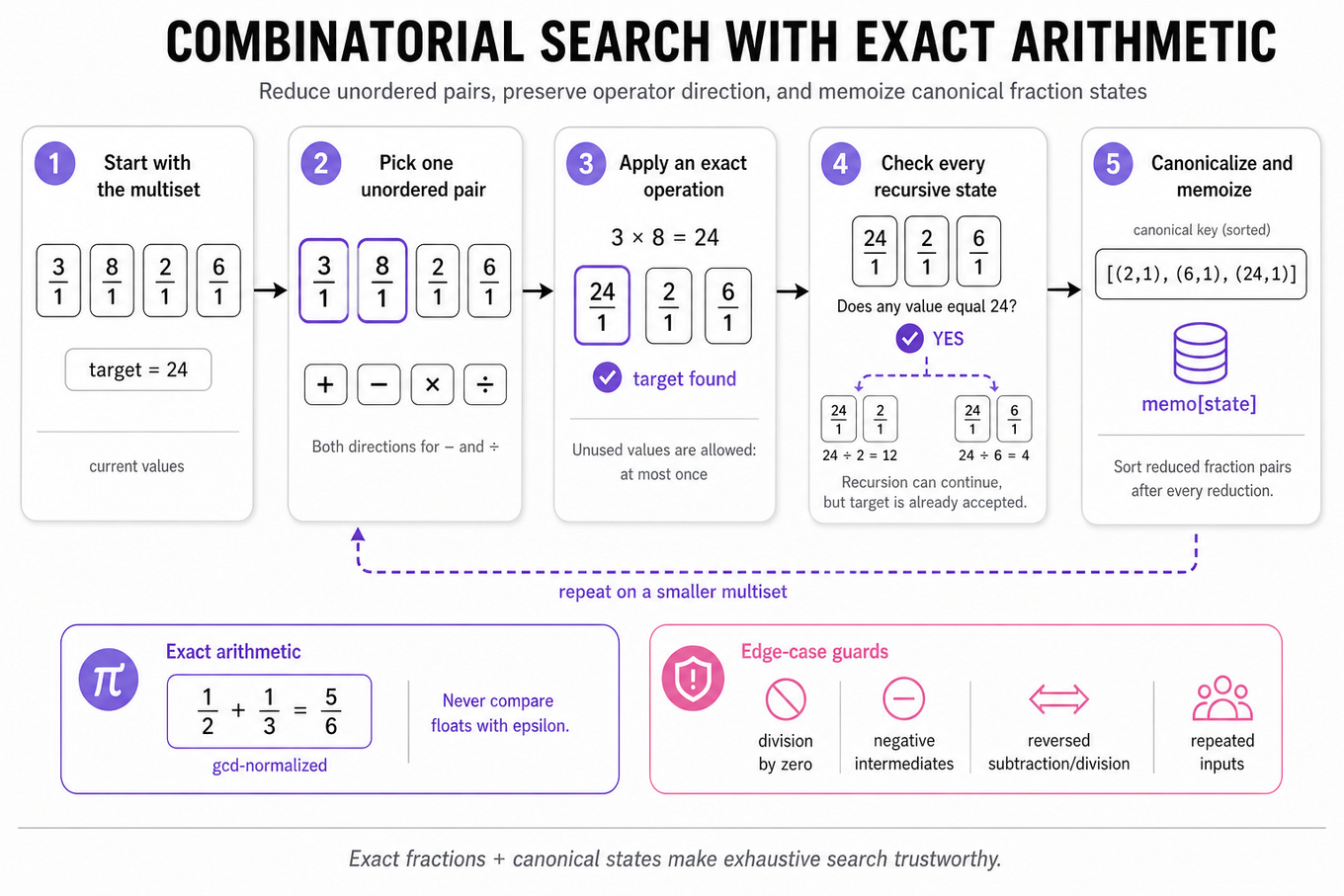
This tests combinatorial search over subsets of numbers, with recursive operator composition and parenthesization. You must control duplicate states, handle division and subtraction correctly, and use exact rational arithmetic rather than floating-point comparisons.
Patterns & templates
-
Enumerate unordered pairs of current values, apply each operator, then recurse on the reduced multiset; this naturally explores every parenthesization.
-
Represent values as reduced fractions, such as
(numerator, denominator), usinggcd; test equality with cross-multiplication or canonical pairs. -
Preserve subtraction and division direction: for values
a,b, consider botha-bandb-a, plusa/bandb/awhen denominators are nonzero. -
Memoize canonical multiset states, sorting fraction pairs after each reduction; this removes duplicate work caused by operand order and repeated inputs.
-
Decide whether numbers may be skipped: “at most once” permits unused values, so check the target at every recursive state or add a subset dimension.
-
With
nnumbers, pair-reduction search is exponential; memoization helps substantially, while unrestricted expression enumeration remains infeasible for largen. -
Guard arithmetic edge cases explicitly: division by zero, negative intermediates, zero targets, repeated numbers, and fractions that must be normalized after every operation.
Common pitfalls
Pitfall: Using
floatand checkingabs(x - target) < epsiloncan accept incorrect expressions or reject exact results.
Pitfall: Exploring only
a-banda/bmisses valid expressions because those operators are not commutative.
Pitfall: Assuming every number must be used changes “at most once” into “exactly once”; clarify this before choosing the recursion state.
Practice these
The practice cards below cover the canonical variants — solve all of them and time yourself.
Practice questions
Related concepts
- Dynamic Programming, Backtracking, And Combinatorial SearchCoding & Algorithms
- Sliding Window, Binary Search, and Prefix ReasoningCoding & Algorithms
- Dynamic Programming, Backtracking, and State-Space SearchCoding & Algorithms
- Binary Search On AnswerCoding & Algorithms
- Binary Search, Partitioning, And Convex SearchCoding & Algorithms
- Recursion, Backtracking, And CombinatoricsCoding & Algorithms