Cycle Detection
Asked of: Software Engineer
Last updated
What's being tested
These problems test cycle detection in a dynamic dependency graph (cells referencing cells) plus related techniques: expression parsing, incremental evaluation, and state management for updates. Interviewers probe correctness (no false-negatives/positives for cycles), performance (incremental vs full recompute), and clear API/state reasoning.
Patterns & templates
-
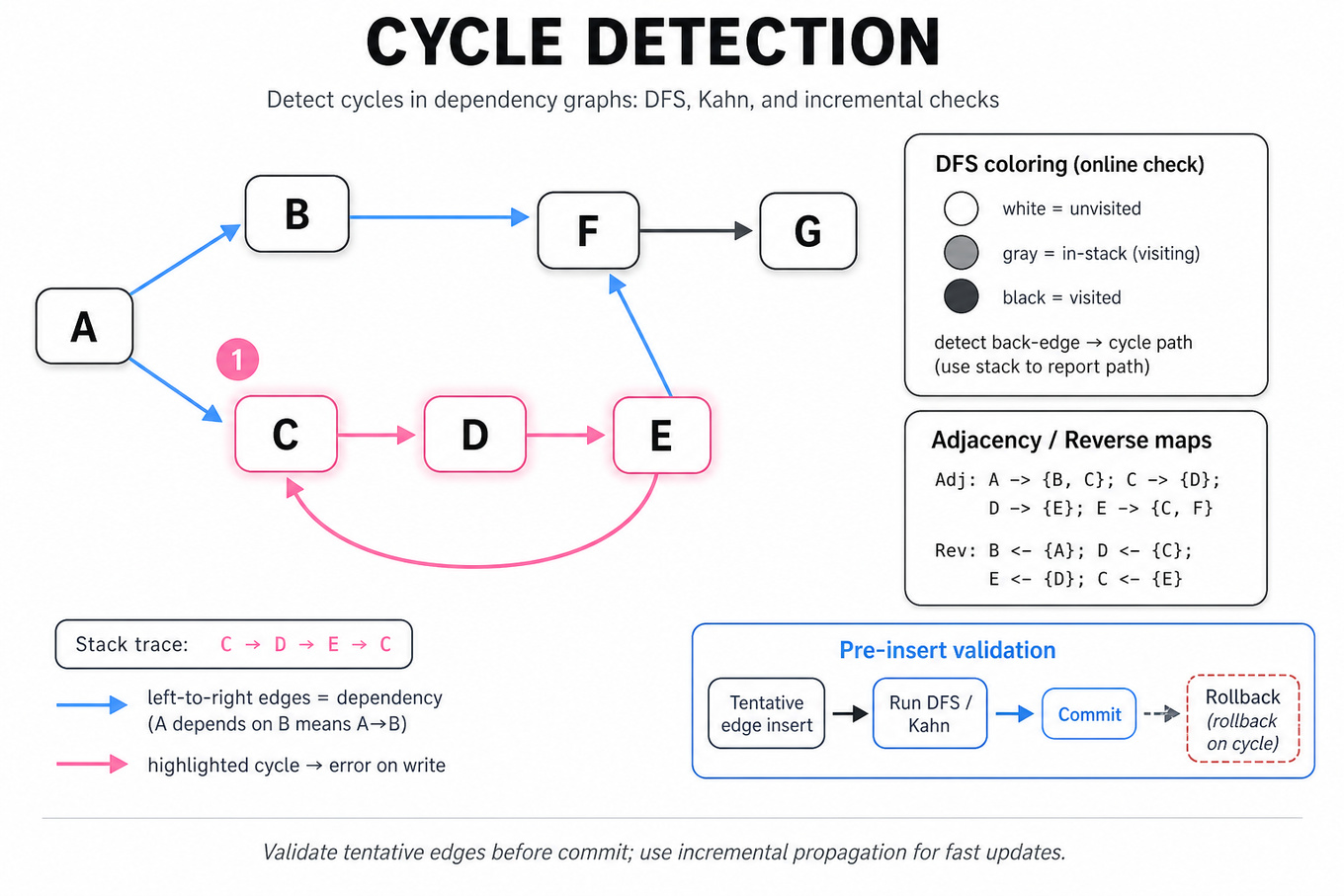
DFS with coloring (white/gray/black) for online cycle detection —
O(V+E)time, stack traces give cycle path for error messages. -
Kahn's algorithm / topological sort to compute evaluation order for acyclic graphs; detect leftover nodes as cycles.
-
Adjacency list graph representation: map cell -> set(dependents) and reverse map cell -> set(dependees) for update propagation.
-
Incremental evaluation via change propagation: BFS/queue from changed node through dependents, memoize values to avoid re-eval.
-
Expression parsing + AST: tokenize formulas, build AST with node types (literal, ref, op), evaluate AST using resolved references. Use
parseExpressionthenevalAST. -
Cycle prevention strategies: pre-insert tentative edge, run DFS/Kahn to validate before committing; rollback on failure.
-
Complexity framing: initial parse/build
O(F)per formula; full sheet recomputeO(V+E); incremental updates average proportional to affected subgraph size.
Common pitfalls
Pitfall: Failing to update reverse dependency map causes stale propagation or missed re-evaluations.
Pitfall: Detecting cycles only at evaluation time (not on update) lets invalid state be visible; validate on write.
Pitfall: Using recursion without recursion-depth safeguards crashes on deep chains — prefer iterative DFS or explicit stack.
Practice these
The practice cards below cover canonical variants — solve all of them and time yourself.
Practice questions
Related concepts
- Dependency Graphs and Cycle HandlingSoftware Engineering Fundamentals
- Topological Sort And Cycle DetectionCoding & Algorithms
- Topological Sorting And Cycle DetectionCoding & Algorithms
- Depth-First Search, Connected Components, And CyclesCoding & Algorithms
- Graph Algorithms, Dependency Resolution And ConnectivityCoding & Algorithms
- Graph, Grid, And Connectivity AlgorithmsCoding & Algorithms