Distributed Systems Consistency And Low-Latency Design
Asked of: Software Engineer
Last updated
What's being tested
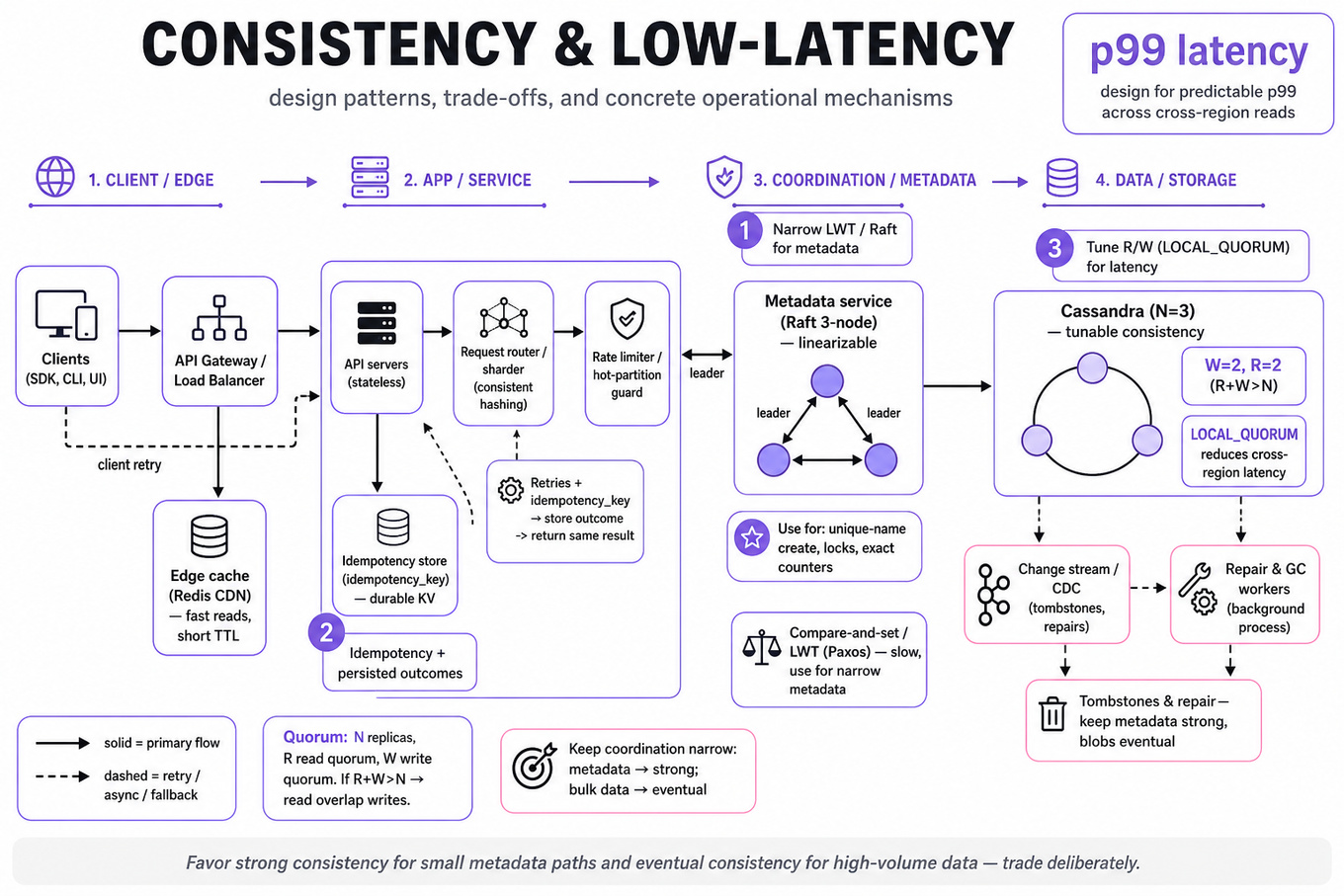
Interviewers are probing whether you can design distributed services that make explicit tradeoffs between consistency, availability, latency, and operational simplicity. The shared skill is not drawing boxes; it is choosing where correctness must be strong, where eventual convergence is acceptable, and how retries, failures, and concurrency affect real users. NVIDIA cares because many software systems around GPU clusters, artifact management, model serving, telemetry, and control planes need predictable p99 latency while operating across many nodes. Expect the interviewer to push on concrete mechanisms: idempotency keys, quorum reads/writes, leader election, compare-and-set, tombstones, hot partitions, and failure-mode behavior.
Core knowledge
-
CAP theorem is a design constraint, not an excuse. Under network partition, a replicated system must choose between availability and linearizable consistency; most production designs choose strong consistency for small metadata paths and eventual consistency for high-volume data paths.
-
Linearizability means every operation appears to occur atomically at one point between request and response. It is usually required for unique-name creation, account debits, distributed locks, and exact counters, but it costs coordination through
Raft,Paxos, database transactions, or conditional writes. -
Quorum replication uses read quorum and write quorum over replicas. If , reads overlap writes and can observe the latest committed value, assuming correct conflict resolution; common settings are .
-
Cassandra consistency is tunable, but not magically transactional.
QUORUMreads/writes improve freshness;LOCAL_QUORUMlimits cross-region latency; lightweight transactions usingPaxosprovide compare-and-set semantics but are much slower and should be reserved for narrow metadata operations. -
Idempotency is mandatory when clients retry after timeout. Use a client-generated
idempotency_key, persist request outcome, and return the same result for duplicate submissions; do not rely on “the client probably won’t retry” for creates, deletes, payments, or counter increments. -
Compare-and-set is the standard primitive for concurrent creation. For an artifact named
foo, write a row keyed by normalized name with conditionIF NOT EXISTS; if it fails, return conflict. Avoid read-then-write because two clients can both observe absence. -
Soft deletes preserve correctness for races and auditability. A deleted artifact can be represented with
deleted_at,version, and optionalttl; hard deletion in stores likeCassandracreates tombstones that can harm read latency if overused or queried through wide partitions. -
Counters are deceptively hard. An exact global counter requires serialization through a leader, shard ownership protocol, or consensus; an eventually consistent counter can use CRDT structures such as a G-counter or PN-counter, trading exact real-time reads for mergeability.
-
Low-latency design starts with a budget. For a
50msservice-level objective, allocate roughly:5msingress,5–10msfeature/cache reads,10–20mscompute or model call,5msdownstream decision write, and leave headroom for network jitter and garbage collection. -
Tail latency dominates user experience. If a request fans out to independent services with each dependency at
p99 = 20ms, the overallp99is worse than any single dependency. Reduce fanout, use request hedging carefully, cache hot data, and enforce deadlines. -
Backpressure protects latency under overload. Use bounded queues, admission control, token buckets, circuit breakers, and graceful degradation. A low-latency fraud service should return a conservative fallback decision before its deadline rather than timing out every caller.
-
Observability must separate correctness from performance. Track
p50,p95,p99, timeout rate, retry rate, duplicate-idempotency hits, conditional-write conflicts, stale-read rate, tombstone scan warnings, leader changes, and replication lag.
Worked example
For Design an artifact store on K8s and Cassandra, a strong candidate would first frame the problem by asking: are artifact names globally unique or namespace-scoped, are artifacts immutable after upload, what object sizes are expected, and what consistency is required after create/delete? A reasonable assumption is that binary blobs live in object storage such as S3, GCS, or an internal blob store, while Cassandra stores metadata: name, owner, version, content hash, state, timestamps, and blob pointer.
The answer can be organized around four pillars: API semantics, metadata schema, consistency model, and failure handling. For API semantics, define CreateArtifact(name, idempotency_key, metadata), GetArtifact(name), DeleteArtifact(name), and possibly ListArtifacts(namespace). For metadata, avoid a single giant partition; partition by namespace or tenant, and maintain a uniqueness row keyed by canonical artifact name if uniqueness must be enforced. For consistency, use Cassandra lightweight transactions only on the uniqueness row: INSERT ... IF NOT EXISTS, then write the metadata row and blob pointer with an idempotent workflow.
The important tradeoff to call out is that using LWT for every metadata update gives simpler semantics but poor throughput and higher tail latency; using it only for create-name reservation keeps the critical invariant strong while allowing normal reads and writes to use LOCAL_QUORUM. Deletes should be modeled as state transitions: ACTIVE -> DELETING -> DELETED, with soft-delete markers and asynchronous blob cleanup, because a crash between metadata delete and blob delete can otherwise create leaks or broken references. The close should mention: “If I had more time, I’d discuss compaction strategy, tombstone pressure, multi-region reads, and a reconciliation job that scans for orphaned blobs or dangling metadata.”
A second angle
For Design real-time fraud detection under 50ms, the same consistency-and-latency reasoning applies, but the correctness boundary shifts. The service usually does not need linearizable global state for every request; it needs a reliable decision within a deadline. Strong consistency may be necessary for idempotent transaction decisions, recent account-block state, or velocity counters that prevent obvious abuse, while many features can be eventually consistent or cached. The design should emphasize an in-memory feature cache such as Redis or local process cache, precomputed aggregates, strict deadlines, and fallback policies. The key difference is that stale data may be acceptable if the decision engine returns within 50ms, whereas an artifact uniqueness violation is usually not acceptable even if latency is lower.
Common pitfalls
Pitfall: Treating “distributed” as “put it behind a load balancer.”
A tempting but weak answer is to say Kubernetes replicas plus Cassandra replication solve reliability. That misses the real issue: concurrent clients can create the same name, retry the same operation, or observe stale deletes unless you define conditional writes, idempotency, and read consistency.
Pitfall: Optimizing average latency instead of tail latency.
Saying “the model call is only 10ms on average” is not enough for a 50ms decisioning service. Interviewers want to hear deadline propagation, bounded fanout, p99 measurement, cache hit rate, timeout budgets, and what the system returns when dependencies are slow.
Pitfall: Overusing strong consistency everywhere.
A common depth mistake is proposing consensus for every request, every counter update, or every artifact read. A better answer isolates the invariant: use strong coordination for unique names, exact balance-like updates, or idempotency records; use eventual consistency, caching, batching, or CRDT-style merging where exact immediate reads are not required.
Connections
Interviewers may pivot from here into leader election, distributed locking, cache invalidation, rate limiting, or database indexing and partitioning. They may also ask how your design changes across regions, where LOCAL_QUORUM, asynchronous replication, failover policy, and stale-read tolerance become central.
Further reading
-
Designing Data-Intensive Applications — Martin Kleppmann — Best practical foundation for replication, partitioning, consistency, transactions, and stream processing tradeoffs.
-
Dynamo: Amazon’s Highly Available Key-value Store — Seminal paper on quorum, vector clocks, sloppy replication, and eventually consistent storage.
-
Spanner: Google’s Globally-Distributed Database — Useful contrast for globally consistent transactions and the latency cost of stronger guarantees.
Featured in interview prep guides
Practice questions
Related concepts
- Low-Latency Consistency and ConcurrencySystem Design
- Distributed Systems Correctness And IdempotencySystem Design
- Distributed Storage, Replication, and ConsistencySystem Design
- Distributed Systems Consistency, Reliability, And ObservabilitySystem Design
- Distributed Systems Reliability And StorageSystem Design
- Distributed Systems Reliability For Rippling Services