Distributed Training And LLM Fine-Tuning Platforms
Asked of: ML Engineer
Last updated
What's being tested
Interviewers are probing practical mastery of distributed training and production LLM fine‑tuning platforms: orchestration, resource isolation, cost/reproducibility tradeoffs, and runtime correctness. Expect to show you can design cloud-native pipelines on AWS (compute, storage, networking), pick and configure distributed-training primitives (all-reduce, sharding), and explain how synchronization primitives like torch.distributed.barrier affect correctness and performance. OpenAI cares because reliable, cost‑efficient fine‑tuning at scale requires engineers who bridge ML training practices with robust infra and observability.
Core knowledge
-
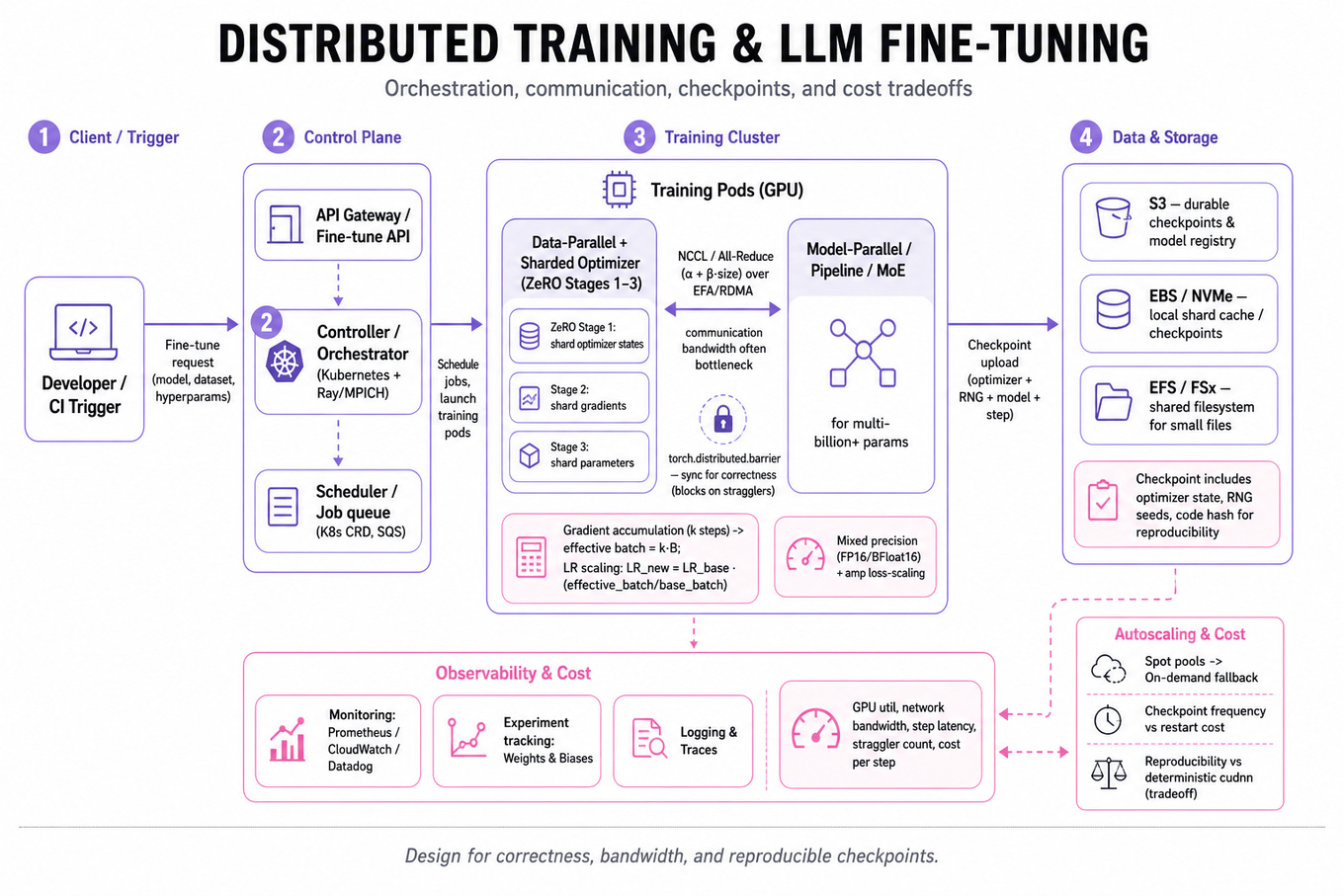
Distributed data-parallel vs model-parallel — Data-parallel duplicates parameters on each device and shards batches; model-parallel shards parameters across devices. Choose data-parallel (with sharded optimizer) up to ~100s GPUs; prefer model-parallel/pipe/MoE for multi‑billion+ parameter models.
-
ZeRO optimizer stages — ZeRO Stage 1 shards optimizer states; Stage 2 additionally shards gradients; Stage 3 shards parameters themselves. Memory per GPU roughly reduces from O(N) to O(N/P) as you increase stage and devices.
-
All‑reduce / communication complexity — Collective time ~α + β·size per step; tree or ring all‑reduce gives ~O(size·(P−1)/P) bandwidth. Network (RDMA/EFA) is often the bottleneck; plan for high bandwidth and low latency.
-
Synchronous vs asynchronous SGD — Synchronous ensures stable convergence but stalls on stragglers; asynchronous reduces stalls but complicates convergence analysis and reproducibility. Most LLM fine‑tuning uses synchronous with gradient accumulation to emulate large batch sizes.
-
Gradient accumulation & learning‑rate scaling — Accumulate k steps to emulate batch size k·B; apply linear scaling rule: LR_new = LR_base · (effective_batch / base_batch), with warmup to avoid instability.
-
Mixed precision & stability — Use FP16/BFloat16 with loss-scaling (automatic with
torch.cuda.amp) to cut memory and increase throughput; watch for under/overflow and layernorm/norm stability for some checkpoints. -
Checkpointing & reproducibility — Checkpoint optimizer + RNG states + model params + training step. For deterministic reproduce: set
torch.manual_seed,torch.backends.cudnn.deterministic=True, but expect throughput tradeoffs. -
Storage design on
AWS— UseS3for durable checkpoints and artifacts,EBS/FSx/EFSfor worker-local I/O tradeoffs; avoid shared POSIX for large broadcasts — prefer staging via local SSD + parallel multipartS3operations. -
Multi‑tenant isolation & security — Enforce IAM roles per job, VPC isolation, per‑job encryption keys, and quota/cost controls. Containerize with
KubernetesorSageMakerto isolate file system and network namespaces. -
Observability & SLOs — Instrument step time, samples/sec, GPU utilization, memory headroom, network throughput, and validation metrics; export to
Prometheus/Grafana. Define SLOs for job throughput and checkpointing frequency. -
Cost controls & autoscaling — Use spot instances for non‑urgent jobs with checkpointing; design fast preemption recovery and adaptive batch-sizing. Estimate cost: GPU-hour * price and factor in data transfer and storage costs.
-
Training correctness primitives — Understand
torch.distributedcollectives, barrier synchronization, and rendezvous behaviors to ensure parameter synchronization and proper shutdown ordering.
Tip: When describing a design, always quantify capacity (GPUs, TB of params), expected latency for checkpoint saves, and recovery time objective.
Worked example — Design an AWS fine-tuning platform for LLMs
First 30 seconds: clarify workload shapes (model sizes: 1B/10B/100B params), tenant model diversity, expected concurrency, checkpoint RPO/RTO, and spot vs on‑demand tolerance. Skeleton pillars: (1) Compute orchestration (job scheduler, per-job IAM, Kubernetes or SageMaker), (2) Distributed training runtime (choose DeepSpeed/FairScale/torch.distributed with ZeRO stage selection), (3) Storage & checkpointing (S3 durable checkpoints + local NVMe for fast IO), (4) Observability & cost controls (metrics, quotas, spot handling), (5) Security & multi‑tenant isolation (separate VPCs, KMS keys). Flag tradeoff: using spot instances lowers cost but requires more frequent and consistent checkpointing and fast restore logic—this increases storage and scheduler complexity. Close by saying: if more time, I'd sketch the job lifecycle diagram, failure modes (network partition, OOM), and a migration plan for moving models between ZeRO stages as scale grows.
A second angle — Explain what torch.distributed.barrier does
torch.distributed.barrier is a synchronization primitive that blocks calling processes until all participating ranks reach the barrier, ensuring global ordering for events like checkpoint writes or reversing collective operations. In practice, use barriers to coordinate lifecycle events (e.g., all ranks finished gradient step before a single rank writes a checkpoint), but avoid placing barriers on the hot path each step because they induce global synchronization and can amplify straggler effects. For troubleshooting, confirm correct world size and process group initialization; a missing rank or misconfigured backend (nccl vs gloo) will hang. The concept applies to platform design: choose minimal necessary barriers and rely on collective semantics where possible.
Common pitfalls
Pitfall: Designing for single large model only. Engineers often optimize infra for one model size; multi‑tenant platforms must support scaling both up (model parallelism) and out (more smaller jobs), so include flexible scheduler and runtime config.
Pitfall: Overusing global barriers. People add
torch.distributed.barrierfor safety in training loops—this prevents overlap of computation and communication and magnifies stragglers; prefer rendezvous-only coordination and barrier only for infrequent lifecycle events.
Pitfall: Ignoring checkpoint/restore latency. A tempting answer is "save every N steps"; interviewers expect you to quantify checkpoint time, storage cost, and recovery RTO, and to propose incremental or sharded checkpoints for large models.
Connections
Interviewers may pivot to CI/CD for models (automated validation, canary fine‑tuning), online serving constraints (latency and model size tradeoffs), or deeper distributed systems topics like straggler mitigation, RDMA/EFA networking, and scheduler design (kube-batch, gang scheduling).
Further reading
-
ZeRO: Memory Optimization Towards Training A Trillion Parameter Models (Microsoft) — core paper explaining optimizer/parameter sharding and tradeoffs.
-
DeepSpeed documentation — practical runtime features for ZeRO, checkpointing, and sparse attention optimizations.
-
PyTorch Distributed Overview — authoritative reference for
torch.distributedcollectives andbarriersemantics.
Practice questions
Related concepts
- LLM Architecture, Tuning, And EvaluationMachine Learning
- Distributed Training Parallelism And CollectivesML System Design
- Distributed GPU Computation And Parallel MLML System Design
- LLM Evaluation, Safety Monitoring, and Guardrails
- Transformer Architecture And LLM LifecycleMachine Learning
- LLM Chat Applications, RAG, And ML EvaluationML System Design