Distributed Training Parallelism And Collectives
Asked of: Machine Learning Engineer
Last updated
What's being tested
Interviewers are probing whether you can reason about distributed training as an end-to-end ML engineering problem: how model computation, memory, communication, and convergence interact when scaling beyond one accelerator or one host. You should be able to explain data parallelism, tensor/model parallelism, pipeline parallelism, expert parallelism, and the collective communication primitives that make them work. Amazon cares because large-scale training systems directly affect GPU utilization, cost per experiment, training reliability, and iteration speed for production ML systems. A strong answer connects algorithms to systems metrics: throughput, memory footprint, communication volume, straggler sensitivity, and model quality.
Core knowledge
-
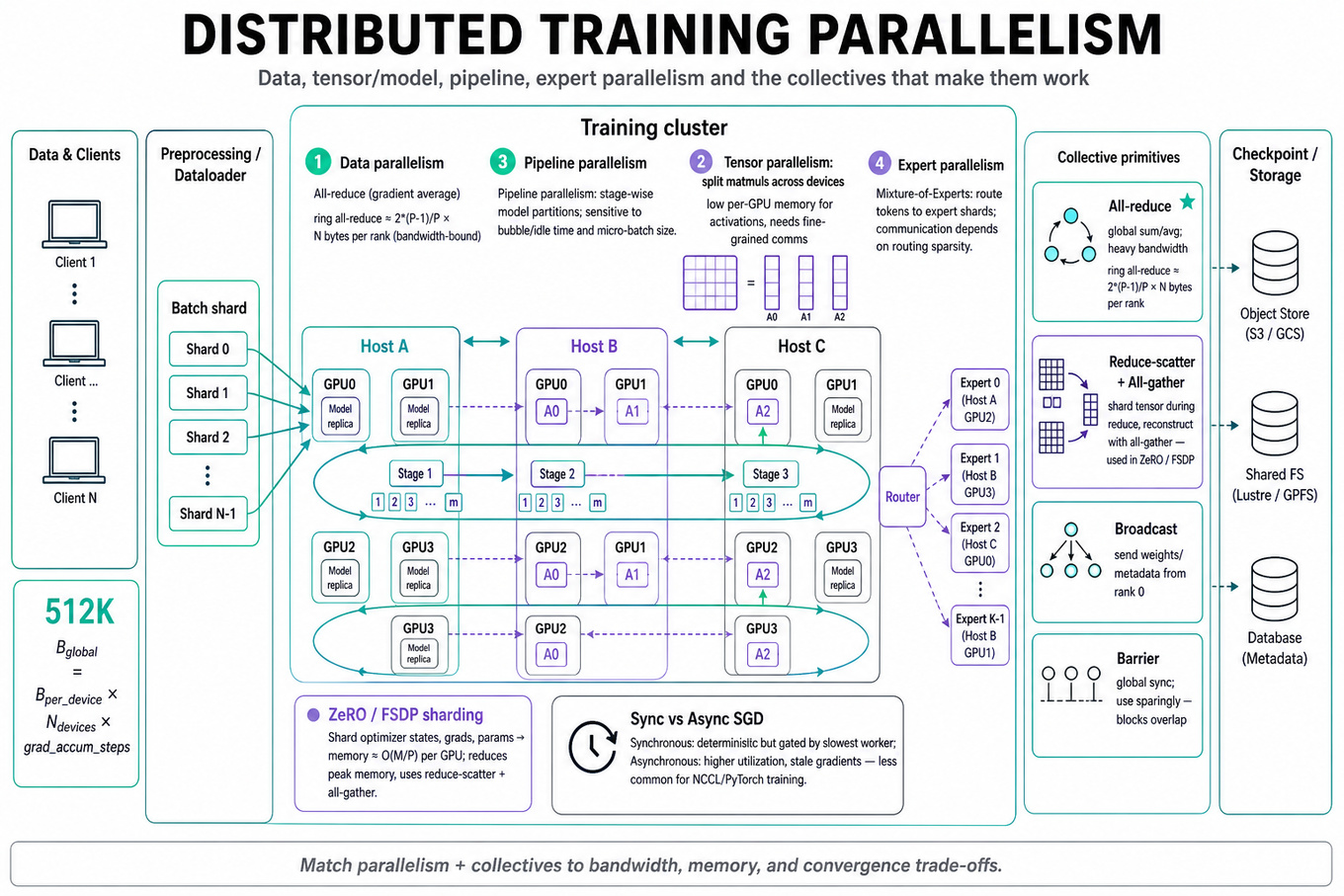
Data parallelism replicates the model on each worker, shards the batch, computes local gradients, then synchronizes gradients with all-reduce. Effective global batch size is , which can require learning-rate scaling and warmup.
-
Synchronous SGD gives deterministic step boundaries and simpler convergence reasoning, but the slowest worker gates every iteration. Asynchronous training can improve hardware utilization but introduces stale gradients; it is less common for large
PyTorch/NCCLdeep learning training where convergence stability matters. -
All-reduce combines values across ranks and returns the result to every rank, commonly used for gradient averaging. Ring all-reduce moves roughly bytes per rank for workers and tensor size , making bandwidth the dominant bottleneck for large gradients.
-
Reduce-scatter partitions a reduced tensor across ranks, while all-gather reconstructs the full tensor from shards.
DeepSpeed ZeROandPyTorch FSDPexploit this: shard optimizer states, gradients, and parameters to reduce memory from roughly per GPU toward for model state size . -
Broadcast sends data from one rank to all others, often used to initialize model weights or distribute metadata. Barrier synchronizes ranks but should be used sparingly; unnecessary barriers can hide performance bugs and reduce overlap between compute and communication.
-
Tensor parallelism splits individual matrix operations across devices, common in Transformer MLP and attention projections. It reduces per-device memory and compute, but introduces collectives such as all-reduce or all-gather inside every layer, so it is sensitive to fast intra-node links like
NVLink. -
Pipeline parallelism partitions layers across devices and sends activations forward and gradients backward. It improves model-size scalability but creates pipeline bubbles; schedules like 1F1B reduce idle time, while microbatch count controls the tradeoff between utilization and activation memory.
-
Expert parallelism in Mixture-of-Experts models routes tokens to different expert networks. It usually requires all-to-all communication: tokens are exchanged by expert assignment, processed locally, then returned. Load imbalance is a core issue, so routing capacity factors and auxiliary load-balancing losses matter.
-
Hybrid parallelism combines data, tensor, pipeline, and expert parallelism. A practical design maps high-traffic collectives to fastest links: tensor parallel inside a node, pipeline across nodes, and data parallel across replicas. Poor placement can make the network, not the GPU, the training bottleneck.
-
Gradient accumulation simulates larger batches without synchronizing every microbatch. In
PyTorch DistributedDataParallel,no_sync()avoids intermediate all-reduces, reducing communication frequency, but increases optimizer-step latency and may affect convergence if the effective batch becomes too large. -
XGBoost parallelism differs from neural training: histogram-based split finding builds feature histograms over row shards, then merges histograms across workers. Sparse-aware split finding skips missing entries and uses default directions; performance depends on cache-friendly column blocks, quantile sketching, and communication of compact histograms rather than dense gradients.
-
Performance debugging should separate compute, memory, and communication. Track GPU utilization, step time, tokens/sec or samples/sec, network throughput, collective time, and variance across ranks. Tools include
NVIDIA Nsight Systems,PyTorch Profiler,NCCL_DEBUG,DeepSpeedlogs, and rank-level timing.
Worked example
For Explain parallelism and collectives in training, a strong candidate would start by clarifying the target setting: “Are we training a Transformer-like dense model, how many GPUs and nodes are available, and is the limiting factor memory, throughput, or time-to-convergence?” Then they would declare assumptions, such as using PyTorch, NCCL, homogeneous GPUs, and synchronous training.
The answer skeleton should have four pillars: first, describe data parallelism as the default scaling strategy and explain gradient all-reduce; second, introduce model/tensor parallelism when the model or activations do not fit on one GPU; third, discuss pipeline parallelism for very deep models and the bubble/utilization tradeoff; fourth, name core collectives and map them to training operations. The candidate should explicitly call out that collectives are not interchangeable: all-reduce is natural for replicated-gradient averaging, all-gather/reduce-scatter are natural for sharded parameters and optimizer states, and all-to-all is central for MoE token routing.
A concrete tradeoff to flag is memory versus communication. FSDP or ZeRO-3 can enable larger models by sharding parameters, gradients, and optimizer state, but may increase all-gather frequency around layer execution; this can hurt throughput if network bandwidth is weak. The candidate should also mention overlapping communication with backpropagation using gradient buckets, because practical training performance depends on hiding all-reduce latency behind compute.
A good close would be: “If I had more time, I’d propose a parallelism layout based on model size and cluster topology, then validate it with per-rank profiling: step time breakdown, collective duration, GPU utilization, and scaling efficiency.”
A second angle
For Explain Transformers and MoE in LLMs, the same distributed-systems concepts appear, but the framing shifts from generic training to architecture-specific scaling. Dense Transformer layers often use tensor parallelism for attention and MLP projections, where all-reduce or all-gather appears inside each block. MoE adds expert parallelism: tokens are dynamically routed to experts, which makes all-to-all communication and load balancing first-class design constraints. The key difference is that MoE increases parameter count without activating every parameter for every token, so the MLE must reason about capacity factor, dropped tokens, expert imbalance, and communication overhead rather than only gradient synchronization.
Common pitfalls
Pitfall: Treating “distributed training” as just data parallel all-reduce.
That answer is incomplete for modern large models. Data parallelism is the simplest baseline, but the interviewer expects you to know when memory forces sharding, tensor parallelism, pipeline parallelism, or hybrid layouts. A better answer starts with data parallelism, then explains the failure modes that motivate other strategies.
Pitfall: Naming collectives without explaining what data moves.
Saying “use NCCL all-reduce” is not enough. You should identify whether the tensor being moved is gradients, parameters, activations, token embeddings, histograms, or optimizer state. This distinction shows you understand both correctness and performance.
Pitfall: Ignoring convergence and ML quality when optimizing systems throughput.
A tempting but weak answer maximizes samples/sec by increasing global batch size indefinitely. A stronger MLE answer notes that larger batches can require learning-rate scaling, warmup, gradient clipping, and validation monitoring; throughput gains are only useful if time-to-quality improves.
Connections
Interviewers may pivot from this topic into training pipeline design, model checkpointing, fault tolerance, GPU memory optimization, or serving-time model parallelism. They may also connect it to feature engineering and distributed tree training through XGBoost, where the same communication-versus-computation tradeoff appears but with histograms and split statistics instead of neural gradients.
Further reading
-
“Megatron-LM: Training Multi-Billion Parameter Language Models Using Model Parallelism” — foundational paper on tensor and pipeline parallelism for large Transformer training.
-
“ZeRO: Memory Optimizations Toward Training Trillion Parameter Models” — explains optimizer, gradient, and parameter sharding tradeoffs used by
DeepSpeed. -
“XGBoost: A Scalable Tree Boosting System” — covers histogram/quantile-based tree training, sparsity handling, and systems optimizations behind distributed
XGBoost.
Featured in interview prep guides
Practice questions
Related concepts
- Distributed GPU Computation And Parallel MLML System Design
- Distributed Training And LLM Fine-Tuning PlatformsML System Design
- ML Frameworks, Model Compilation, And ParallelismML System Design
- Distributed Training and GPU Efficiency for Autonomy Models
- Distributed Training Infrastructure And Checkpointing
- High-Throughput Streams, Jobs, And ObservabilitySystem Design