Dynamic Programming And Combinatorial Counting
Asked of: Software Engineer
Last updated
What's being tested
These problems test dynamic programming state design, combinatorial counting, and recognizing when a faster mathematical or search-based formulation replaces naive DP. Microsoft interviewers are probing whether you can derive recurrences, prove correctness, handle large constraints, and explain O(...) tradeoffs clearly.
Patterns & templates
-
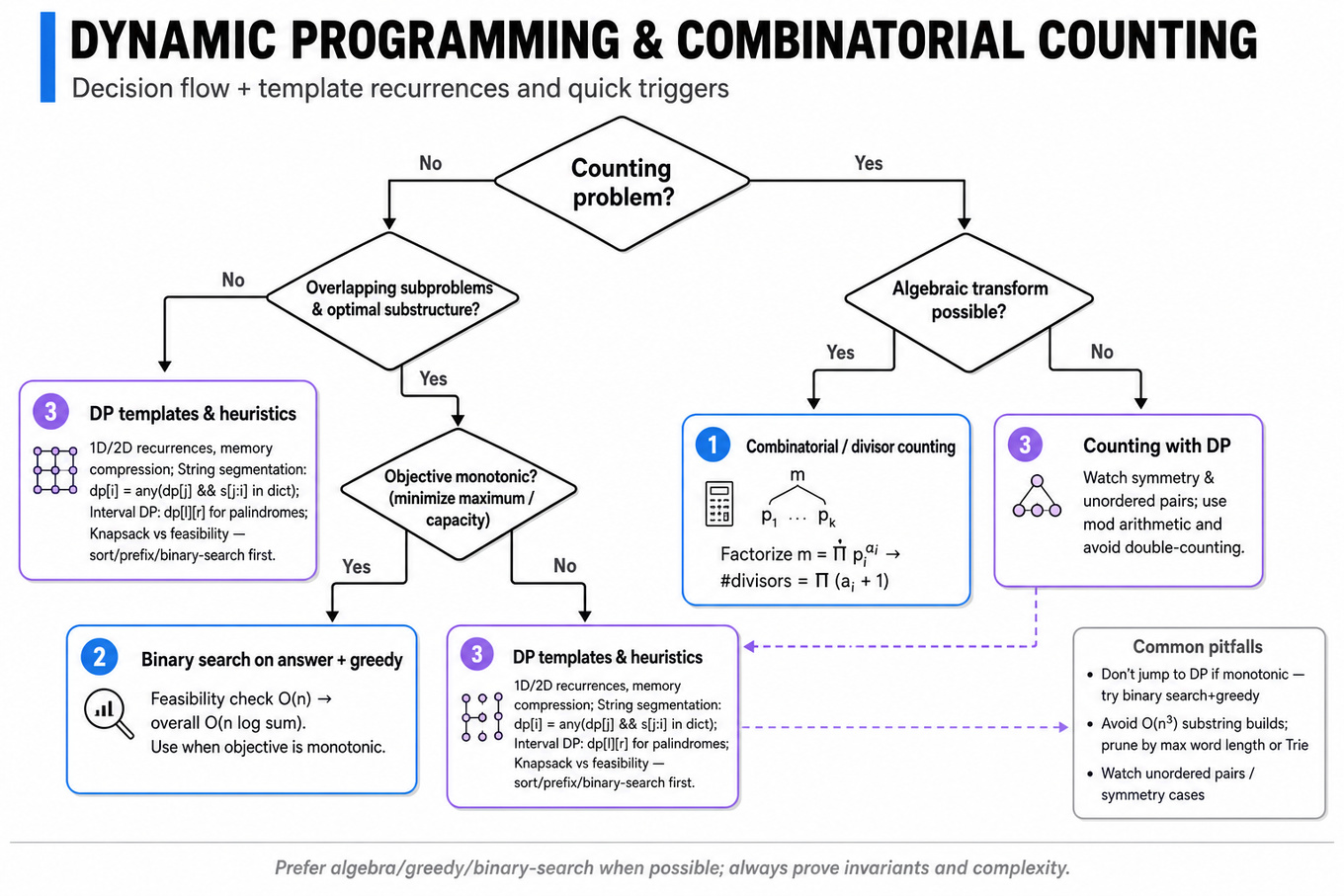
1D/2D DP recurrence design — define
dp[i]ordp[i][j], base cases, transition order, and memory compression when only prior states matter. -
String segmentation DP —
dp[i] = any(dp[j] && s[j:i] in dict); optimize with Trie, rolling hash, or max-word-length pruning. -
Interval DP for palindromes — longest palindromic subsequence uses
dp[l][r]; fill by increasing substring length,O(n^2)time and space. -
Binary search on answer — for load balancing or capacity minimization, test feasibility greedily in
O(n), givingO(n log sum)instead of exponential partitioning. -
Combinatorial divisor counting — transform equations algebraically, factorize
N, then count divisors using prime exponents: if , divisors are . -
Knapsack-style feasibility — distinguish true 0/1 knapsack DP from monotonic feasibility problems where sorting, prefix sums, or binary search is enough.
-
Correctness proof template — state invariant, show base case, prove transition/greedy feasibility, then bound time and memory before coding.
Common pitfalls
Pitfall: Jumping to DP without checking monotonicity; many “minimize maximum load” problems are cleaner with binary search plus greedy feasibility.
Pitfall: Counting ordered pairs when the problem asks unordered pairs, or missing symmetry cases like
x == y.
Pitfall: Building
s[j:i]substrings inside nested loops in languages where slicing copies; this can silently turnO(n^2)intoO(n^3).
Practice these
The practice cards below cover the canonical variants — solve all of them and time yourself.
Featured in interview prep guides
Practice questions
- Solve binary-tree reverse printing and LPSMicrosoft · Software Engineer · Technical Screen · easy
- Solve four classic algorithm problemsMicrosoft · Software Engineer · Technical Screen · easy
- Count integer pairs satisfying 1/x + 1/y = 1/NMicrosoft · Software Engineer · Online Assessment · medium
- Solve load balancing and perfect pairsMicrosoft · Software Engineer · Online Assessment · medium
- Count non-decreasing arrays by digit sumsMicrosoft · Software Engineer · Technical Screen · medium
- Count k for consecutive-sum generatorMicrosoft · Software Engineer · Technical Screen · medium
- Determine dictionary-based string segmentationMicrosoft · Software Engineer · Onsite · medium
- Solve binary-search knapsack & graph shortest pathMicrosoft · Software Engineer · Online Assessment · medium
Related concepts
- Dynamic Programming, Backtracking, And Combinatorial SearchCoding & Algorithms
- Dynamic Programming, Scheduling, And Set CoverCoding & Algorithms
- Dynamic Programming And MemoizationCoding & Algorithms
- Dynamic Programming and State-Space OptimizationCoding & Algorithms
- Dynamic Programming, Backtracking, and State-Space SearchCoding & Algorithms
- Dynamic Programming And Mutable Range QueriesCoding & Algorithms