Embedded-to-Cloud Backend Integration
Asked of: Software Engineer
Last updated
What's being tested
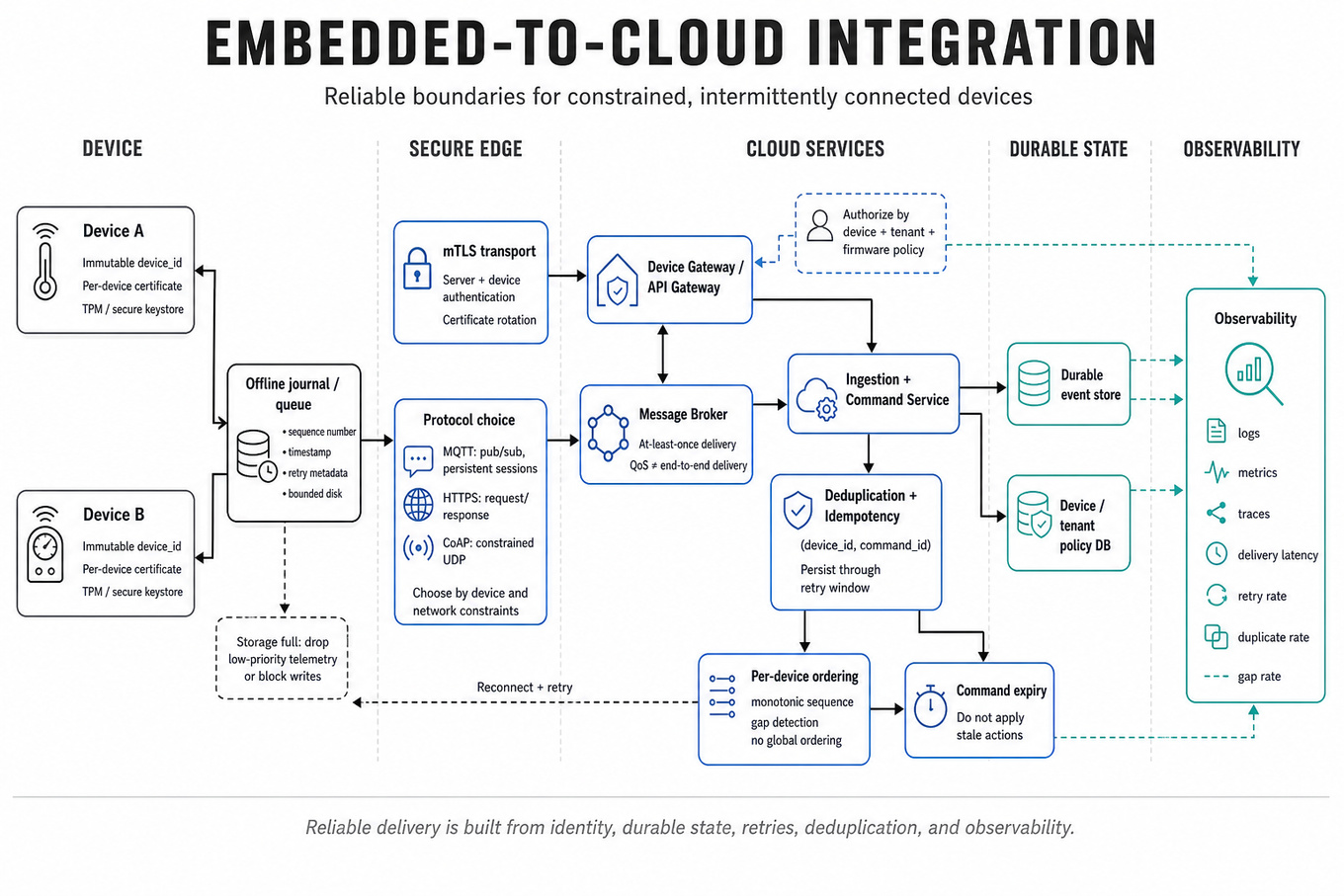
This topic tests whether you can design a reliable distributed boundary between constrained, intermittently connected embedded devices and elastic cloud services. The interviewer is probing your ability to reason about device identity, protocol selection, asynchronous communication, retries, ordering, offline behavior, security, and observability as one system rather than isolated components. Google cares because failures at this boundary are common, expensive, and difficult to reproduce: devices may have limited CPU, storage, power, and connectivity while the backend must serve millions of heterogeneous clients safely.
Core knowledge
-
Device identity and authentication must be separate concepts: assign each device a stable immutable identifier, authenticate it with a per-device credential or certificate, and authorize its operations using device, tenant, and firmware policy. Avoid shared fleet-wide secrets.
-
Mutual TLS (mTLS) is a strong default for device-to-cloud connections because the device authenticates the server and the server authenticates the device. Use certificate rotation, short-lived credentials where practical, revocation strategy, and secure key storage such as a
TPMor hardware-backed keystore. -
Protocol selection follows constraints.
MQTTprovides lightweight publish/subscribe, persistent sessions, QoS levels, and retained messages;HTTPSis simpler for request/response and broad infrastructure compatibility;CoAPsuits constrained networks, often overUDP. Do not claim protocol QoS guarantees end-to-end application delivery. -
At-least-once delivery is usually the practical choice over unreliable networks. Retries create duplicates, so every mutating operation needs an idempotency key, such as
(device_id, command_id), persisted long enough to cover the retry window. “Exactly once” is generally an application-level illusion built from deduplication and durable state. -
Offline-first behavior requires a local queue or journal with bounded disk usage, sequence numbers, timestamps, and retry metadata. Define what happens when storage fills: drop oldest telemetry, drop lowest-priority records, or block writes. Commands should have expiration times so stale actions are not applied after reconnection.
-
Ordering is scoped, not global. A per-device monotonic sequence number can detect gaps and duplicates, but reconnects and multiple backend workers complicate ordering. If commands must be serialized, partition processing by
device_idor use a per-device state machine; do not impose a single global ordering across the fleet. -
The ingestion path should separate connection handling from durable processing: gateway or broker accepts traffic, durable buffering absorbs bursts, consumers validate and persist events, and downstream workers perform side effects. Use bounded queues, backpressure, admission control, and dead-letter handling rather than unbounded memory.
-
State modeling should distinguish desired state, reported state, and command execution state. A device may report version 7 while the cloud desires version 9; reconciliation compares versions and issues a new operation rather than assuming a synchronous request succeeded.
-
Concurrency control prevents stale updates from overwriting newer state. Use device sequence numbers, version checks, compare-and-set semantics, or a per-device actor. A last-write-wins timestamp is unsafe when clocks are skewed or messages arrive out of order.
-
Reliability targets should be explicit: connection success rate, command acceptance rate, command completion latency, telemetry freshness, duplicate rate, and error rate by firmware version and network type. Track
p50,p95, andp99; averages hide tail failures concentrated in poor connectivity regions. -
Fleet-scale rollout needs staged deployment, compatibility checks, resumability, and rollback. Firmware or configuration updates should be chunked, cryptographically verified, power-loss safe, and protected against bricking; the backend should enforce rollout limits and stop conditions.
-
Observability and debugging require a correlation ID spanning device logs, gateway records, broker messages, and backend processing. Use structured logs, metrics, and traces where feasible, and a device-side diagnostic ring buffer. Redact secrets and avoid assuming clocks are synchronized.
Worked example
Design an embedded-to-cloud backend for remote device commands and telemetry. In the first 30 seconds, clarify device count and growth, connectivity patterns, command latency requirements, telemetry volume, offline duration, security requirements, and whether commands may be duplicated or delayed. I would state an assumption such as one million devices, intermittent connectivity, at-least-once delivery, and commands that must not execute after a defined expiration time. I would organize the design around device authentication and protocol termination, durable ingestion and command delivery, device-side offline queues, and per-device state plus observability. I would use MQTT for long-lived bidirectional sessions, a broker or gateway layer for connection management, and durable cloud storage or streaming infrastructure behind it rather than having application workers hold device connections. The explicit tradeoff is choosing at-least-once delivery with idempotent command processing instead of pursuing end-to-end exactly-once semantics, which would add complexity without preventing every physical-world duplicate effect. I would explain reconnect behavior, bounded queues, sequence numbers, dead-letter handling, and certificate rotation before discussing capacity estimates. If I had more time, I would add failure-injection tests for broker outages, power loss during updates, clock skew, certificate expiry, and a staged firmware rollout.
A second angle
Design a cloud service that maintains desired configuration for intermittently connected devices. The framing shifts from high-throughput telemetry ingestion to reconciliation of durable state under disconnection and conflicting updates. Model desired configuration, reported configuration, and operation status separately, with version numbers and a clear authority rule for device-local versus cloud-managed changes. A reconnecting device should fetch the latest desired version, apply it transactionally if possible, report success or failure, and remain safe if the same configuration is delivered repeatedly. The key constraint is not merely message delivery; it is convergence, compatibility across firmware versions, and preventing an old device response from overwriting newer reported state.
Common pitfalls
Pitfall: Saying “
MQTTQoS 2 guarantees exactly-once execution.” It only defines protocol-level delivery behavior between participants; the application still needs durable deduplication and idempotent physical actions.
Pitfall: Presenting a synchronous
RESTrequest from the cloud to the device as if the device were always reachable. Stronger answers model commands as durable, expiring jobs whose acceptance and execution are separate states.
Pitfall: Discussing encryption without explaining key provisioning, rotation, revocation, or recovery after credential compromise. Name the trust anchor, certificate lifecycle, authorization boundary, and fleet-level containment plan.
Connections
An interviewer may pivot to distributed-systems consistency, event-driven architecture, backpressure, zero-trust security, or firmware update safety. Be ready to connect per-device ordering and idempotency to stream partitioning, transactional state transitions, and failure recovery.
Further reading
-
Google SRE Book — “Handling Overload” — practical treatment of backpressure, overload control, and graceful degradation.
-
MQTT Version 5.0 Specification — authoritative details on sessions, QoS, retained messages, and delivery semantics.
-
Designing Data-Intensive Applications by Martin Kleppmann — strong foundations for logs, replication, streams, consistency, and distributed failure modes.
Related concepts
- API Integration And External Service DesignSystem Design
- Scalable Backend Architecture And Data ModelingSystem Design
- Caching, CDNs, and Edge Delivery at Google Scale
- Cloud Networking, CIDR, And Secure InfrastructureSystem Design
- Resilient APIs And External Dependency IntegrationSystem Design
- Storage, Indexing, APIs, And Secure ExecutionSystem Design