File Deduplication and Content Hashing
Asked of: Software Engineer
Last updated
What's being tested
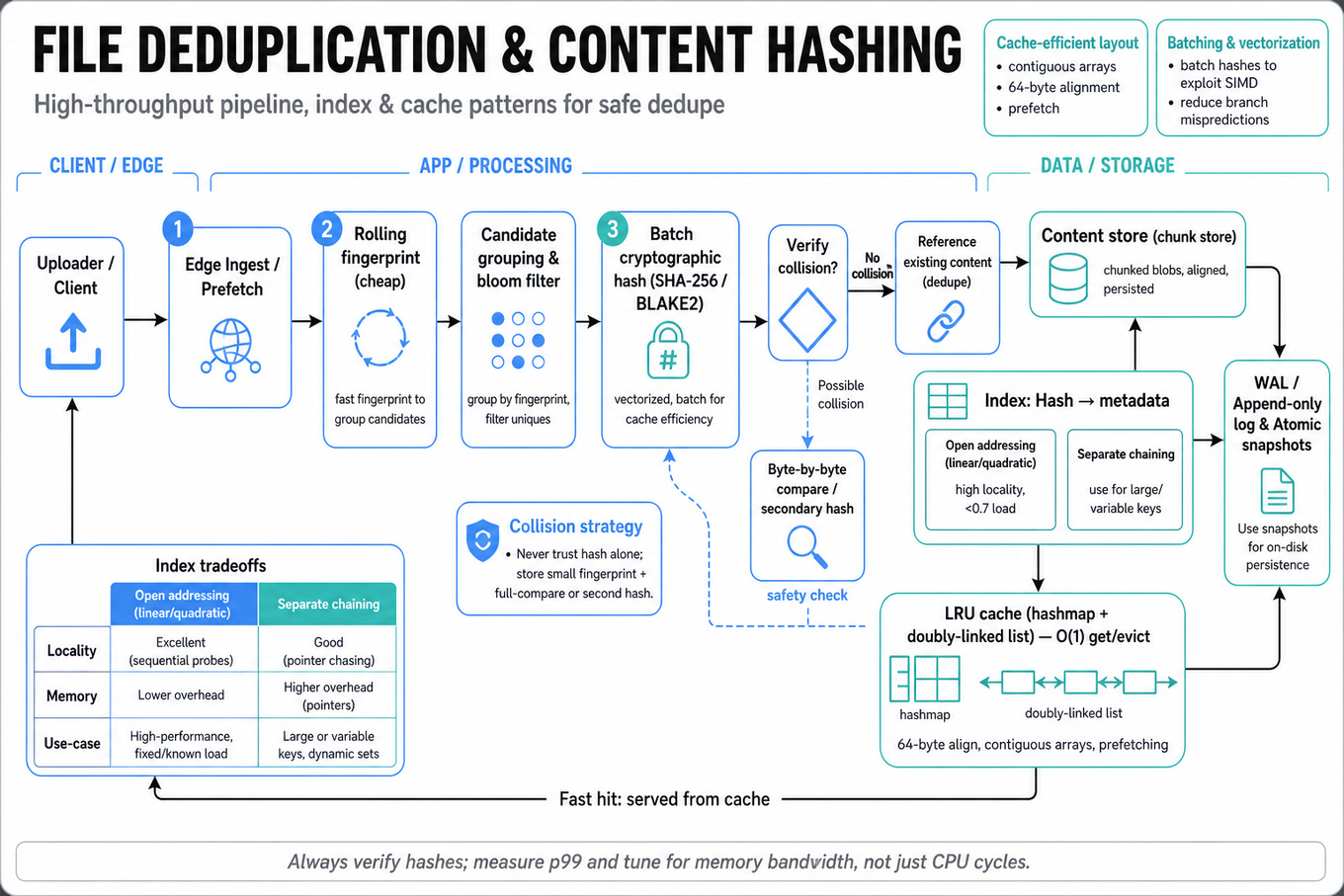
Candidates must show practical mastery of hashing for content-identification and of cache/eviction structures (esp. LRU) under performance constraints: correctness (collision handling, determinism) plus throughput (memory layout, prefetching, vectorized ops). Interviewers probe tradeoffs between speed, memory, and correctness in real-world deduplication and memoization.
Patterns & templates
-
Open addressing (linear/quadratic probing) — highest locality; target load factor < 0.7 to keep probe length short and
O(1)average lookup. -
Separate chaining — use when keys are large or variable; avoid pointer-heavy lists by using contiguous buckets (vector of vectors).
-
Canonical/deterministic hashing — canonicalize args (sorted keys, stable serialization) then hash with
SHA-256orBLAKE2to get fixed-length digests for persistence and cross-process equality. -
Collision strategy — never treat hash equality as proof; store and compare a small content fingerprint plus either full content or a second hash for safety.
-
Cache-efficient layout — favor contiguous arrays, 64-byte alignment, and prefetching; batch-hash multiple items to exploit CPU vectorization and reduce branch mispredictions.
-
LRU skeleton — combine a hashmap + doubly-linked list for
O(1)insert/get/evict; on-disk persistence via atomic snapshots or append-onlyWAL. -
Bulk dedupe — two-pass: cheap fingerprint (e.g., rolling hash) to group candidates, then byte-for-byte or cryptographic-hash verification.
Common pitfalls
Pitfall: Treating a cryptographic hash as collision-proof — always design a verification step for rare collisions or use a 2-stage fingerprint+full-compare.
Pitfall: Optimizing for hash CPU only — forgetting memory bandwidth and cache misses will kill real throughput; measure
p99lookups, not just cycles.
Pitfall: Non-deterministic key serialization — using unordered maps or non-stable encoders causes cache misses and incorrect persistence semantics.
Practice these
The practice cards below cover the canonical variants — solve all of them and time yourself.
Featured in interview prep guides
Practice questions
- Group Duplicate Files by ContentAnthropic · Software Engineer · Onsite · hard
- Find Duplicate FilesAnthropic · Software Engineer · Onsite · medium
- Find Duplicate Files by ContentAnthropic · Software Engineer · Onsite · hard
- Find duplicate files and apply image operationsAnthropic · Software Engineer · Technical Screen · hard
- Design high-throughput hashing for kernelsAnthropic · Software Engineer · Onsite · medium
- Detect duplicate files efficientlyAnthropic · Software Engineer · Onsite · medium
- Implement file deduplication at scaleAnthropic · Software Engineer · Onsite · medium
- Design file deduplication algorithmAnthropic · Software Engineer · Technical Screen · medium
- Design production-ready dedup serviceAnthropic · Software Engineer · Technical Screen · hard
- Identify and mitigate deduplication program risksAnthropic · Software Engineer · Technical Screen · hard
- Design file deduplication across nested directoriesAnthropic · Software Engineer · Technical Screen · medium
- Implement crawler, dedup, and persistent LRUAnthropic · Software Engineer · Onsite · medium
Related concepts
- Hashing-Based File IdentitySystem Design
- Hash-Based Counting And CanonicalizationCoding & Algorithms
- SQL Joins, Aggregations, And Deduplication
- Streaming, Large Inputs, And External MemorySoftware Engineering Fundamentals
- Numerical Coding And Algorithmic Data ProcessingCoding & Algorithms
- Hash Map Counting And Frequency AnalysisCoding & Algorithms