Funnel and Revenue Modeling
Asked of: Data Scientist
Last updated
-
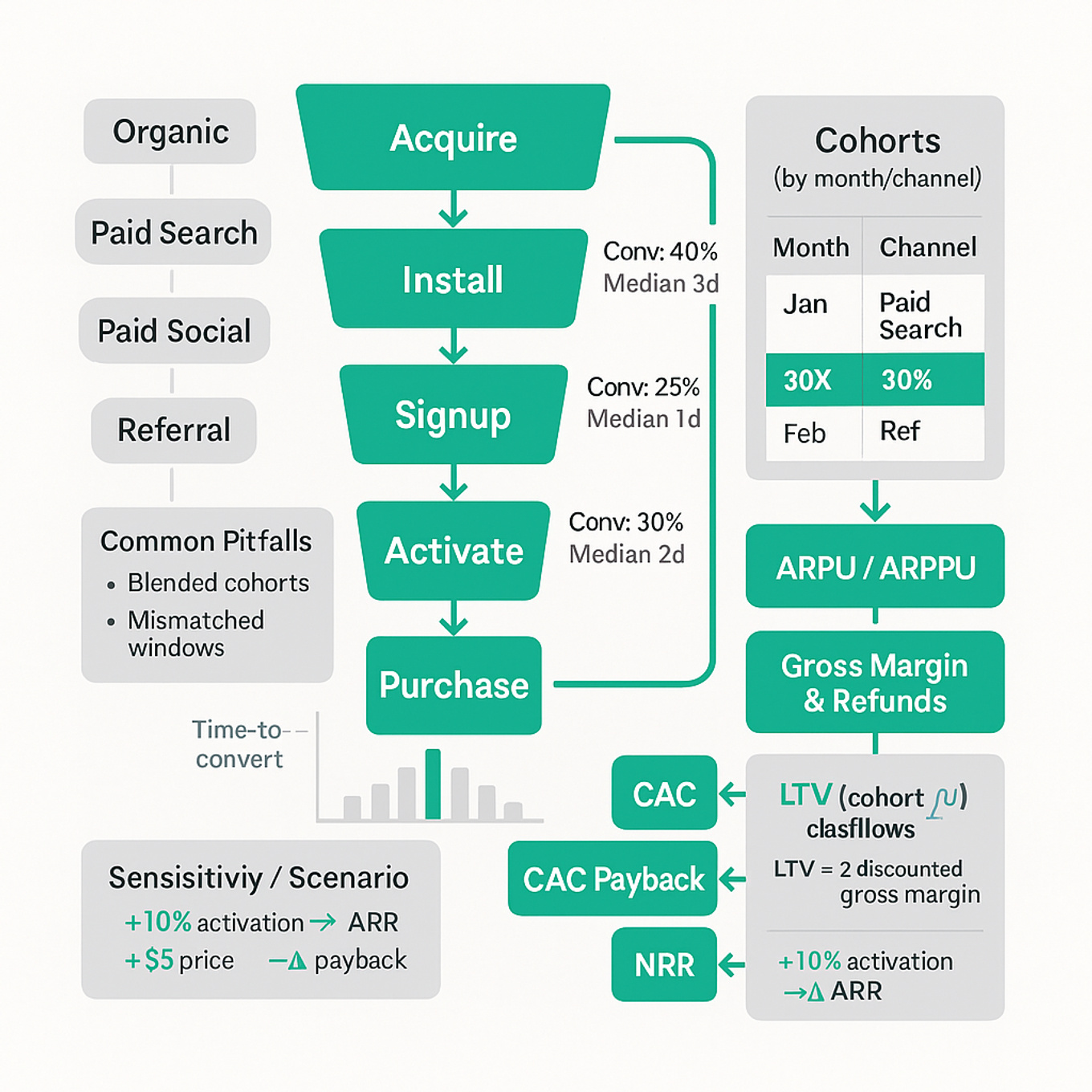
What it is Funnel modeling quantifies how users progress through defined steps (e.g., install → sign up → activate → purchase), showing where they drop off and how long steps take. Revenue modeling turns those behavioral flows into dollars via cohorts, pricing, retention, and margins to forecast LTV, NRR, and payback.
-
Why interviewers ask about it Data Scientists at companies like Meta must tie product changes and experiments to business impact, not just clicks. They expect you to translate event data into conversion, retention, and revenue forecasts, diagnose leaks, and size opportunities with clear assumptions and caveats.
-
Core ideas to know
- Define events and identity: user vs. session funnels, attribution windows, and de-duplication rules.
- Measure per-step and cumulative conversion, time-to-convert distributions, and drop-off reasons.
- Segment by cohort (acq. channel, country, device, pricing) to avoid blended metrics masking issues.
- Map funnel outputs to revenue: ARPU/ARPPU, take rate, refunds, and gross margin, not GAAP revenue.
- LTV options: churn-based, cohort cashflows, or probabilistic CLV (BG/NBD + Gamma-Gamma) with uncertainty.
- NRR/GRR, CAC, and CAC payback; use marginal CAC by channel, not blended averages.
- Sensitivity/scenario analysis: quantify impact of +x% activation or price change on ARR and payback.
-
A common pitfall Candidates often blend across cohorts and time windows, producing pretty but misleading numbers. Example: computing “add-to-cart within 7 days” but counting revenue over 30 days inflates step conversion and LTV. Another is touting a 3:1 LTV:CAC using average CAC while one channel’s marginal CAC actually destroys value; or celebrating 120% NRR driven by one outsized customer expansion. Fixes: cohort by acquisition month/channel, align windows to the customer cycle, model cashflows at gross margin, separate new vs. expansion revenue, and report uncertainty.
-
Further reading
- Amplitude — Discover Funnel Analysis: Clear, practitioner-oriented guide to step conversion, time-to-convert, and segmentation with concrete examples. https://amplitude.com/guides/funnel-analysis (amplitude.com)
- David Skok — SaaS Metrics 2.0 (For Entrepreneurs): Canonical breakdown of LTV, CAC, payback, and revenue engines; useful for interview back-of-envelope modeling. https://www.forentrepreneurs.com/saas-metrics-2/ (forentrepreneurs.com)
- Fader & Hardie — Probability Models for Customer-Base Analysis: Academic foundation for cohort/CLV modeling (BG/NBD, Pareto/NBD) and forecasting cashflows with uncertainty. https://journals.sagepub.com/doi/10.1016/j.intmar.2008.11.003 (journals.sagepub.com)