Graph Algorithms For Routing And Conversion
Asked of: Software Engineer
Last updated
What's being tested
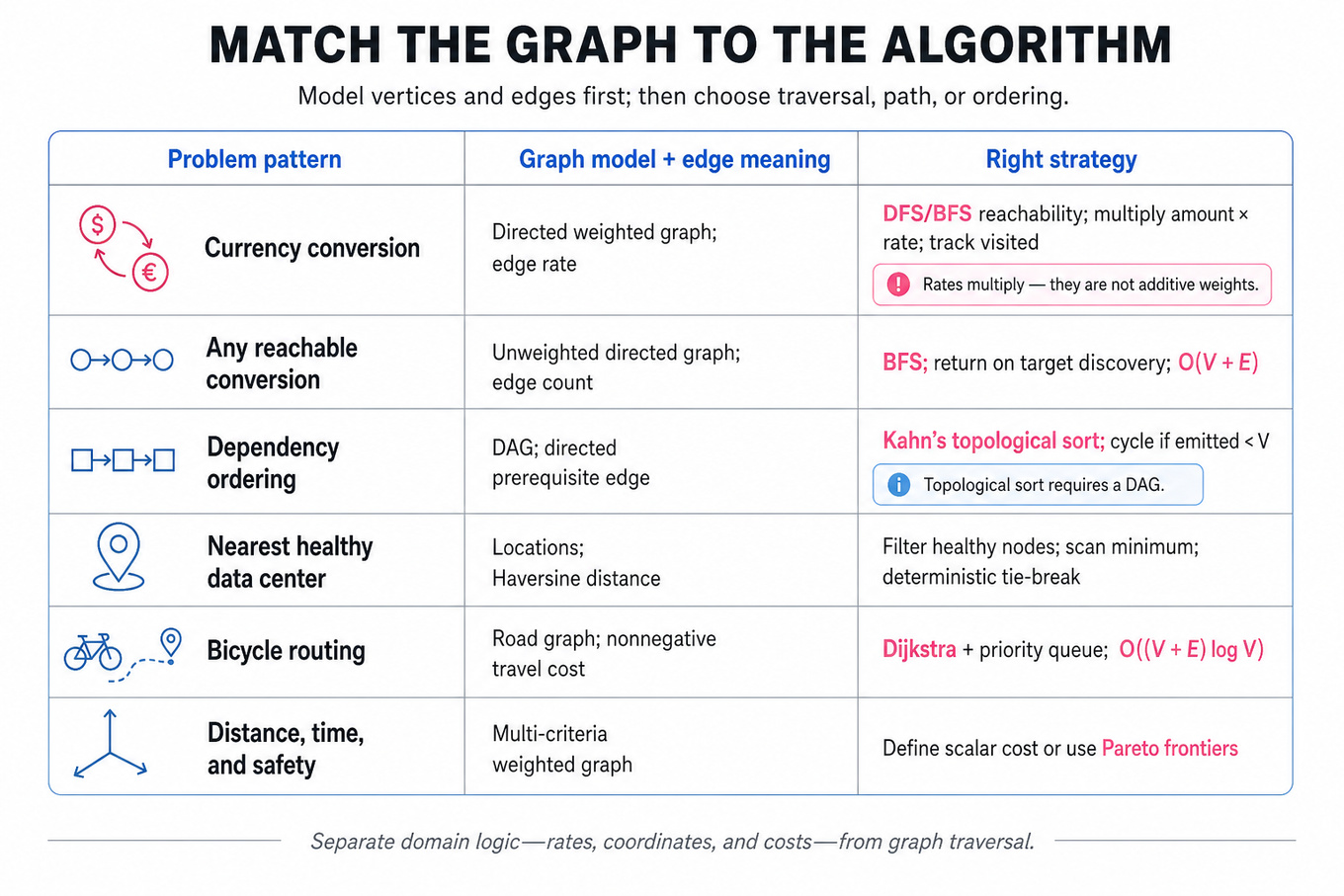
These problems test graph modeling: represent currencies, data centers, or map locations as vertices and relationships as directed or undirected weighted edges. You must choose the right traversal or shortest-path strategy, maintain clean adjacency structures, and reason about unreachable nodes, cycles, dynamic updates, and tie-breaking. Strong solutions also explain complexity and separate domain logic—such as Haversine distance or exchange-rate multiplication—from traversal.
Patterns & templates
-
Weighted directed graph for conversions: store
adj[src] = [(dst, rate)]; compose rates alongDFS/BFSpaths while tracking visited nodes. -
Use BFS for any reachable conversion when edge count is unweighted; return immediately on target discovery, with
O(V + E)time andO(V)space. -
For multiplicative paths, carry
amount *= rate; avoid revisiting nodes, and define behavior for missing currencies, self-conversions, and inconsistent cycles. -
Topological sort applies only to a DAG: compute indegrees with Kahn’s algorithm or use postorder
DFS; detect cycles when fewer thanVnodes are emitted. -
For nearest healthy data centers, filter unhealthy nodes first, compute Haversine distance, then select the minimum with deterministic tie-breaking; scan in
O(D)per query. -
For bicycle routing, use Dijkstra’s algorithm for nonnegative costs; use a priority queue and relax edges, yielding
O((V + E) log V). -
For multi-criteria routes, define one scalar cost or use Pareto frontiers; do not silently optimize distance while claiming to optimize time and safety.
Common pitfalls
Pitfall: Treating exchange rates as additive weights; conversion along a path multiplies rates, while shortest-path algorithms generally compare additive costs.
Pitfall: Using topological sort on a graph that may contain cycles, or assuming
DFSvisitation alone proves a valid ordering without tracking the active recursion state.
Pitfall: Mixing latitude/longitude degrees with Euclidean distance; convert degrees to radians and handle antimeridian, duplicate, empty, and unreachable cases explicitly.
Practice these
The practice cards below cover the canonical variants—solve all of them and time yourself.
Practice questions
- Data Center Health Registry, Haversine Distance and Nearest-Healthy RoutingStripe · Software Engineer · Technical Screen · medium
- Find linked user records by similarityStripe · Software Engineer · Technical Screen · medium
- Plan bicycle routes on a city mapStripe · Software Engineer · Technical Screen · medium
- Compute currency conversions with graph algorithmsStripe · Software Engineer · Onsite · medium
Related concepts
- Graph Algorithms For Relations And RoutingCoding & Algorithms
- Graph Algorithms, Dependency Resolution And ConnectivityCoding & Algorithms
- Graph Search And Weighted PathsCoding & Algorithms
- Graph Traversal And Shortest PathsCoding & Algorithms
- Graph Search, State Space, And Path OptimizationCoding & Algorithms
- Graph Search, Pathfinding, And ConnectivityCoding & Algorithms