Growth Loops, Monetization, and Estimation
Asked of: Product Manager
Last updated
What's being tested
Interviewers probe your ability to design and reason about sustainable user and revenue growth inside a two-sided marketplace: creating growth loops that scale, choosing monetization levers that preserve long-term health, and producing credible back-of-envelope estimates for impact. They want to see structured decomposition, metric-driven prioritization, tradeoff awareness (growth vs. unit economics vs. experience), and a clear experimental plan for validation. At DoorDash, this maps to increasing orders and lifetime value without eroding supply incentives or user satisfaction.
Core knowledge
-
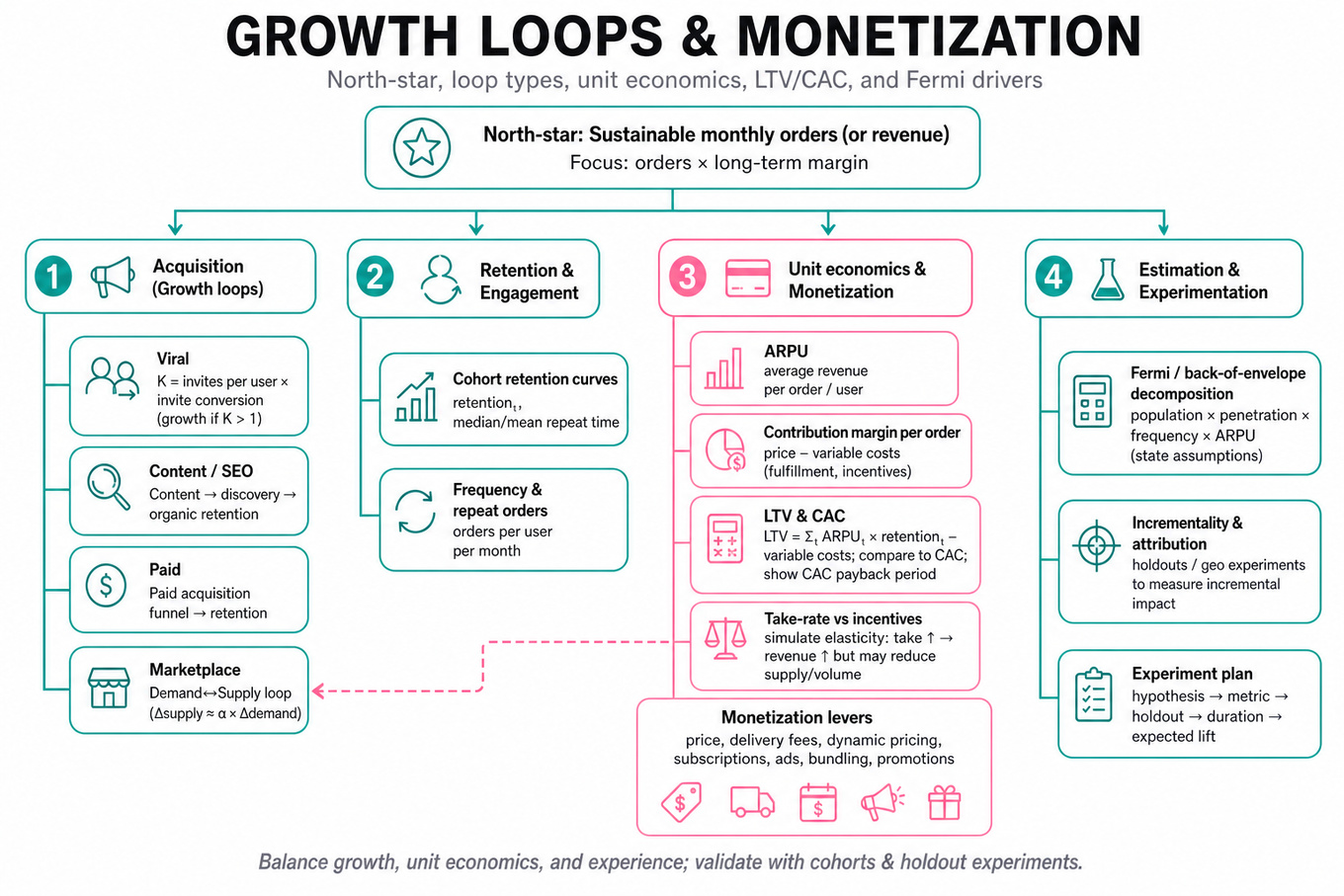
Growth loop taxonomy — Know the four common loop types: viral (user invites user), content/SEO (content leads to discovery), paid (acquisition funnels to retention), and marketplace (demand creates supply and vice versa). Explain how each feeds itself.
-
Loop math & K-factor — For viral loops, use K = invites per user × invite conversion; growth when K>1. For marketplace loops, model cross-side elasticity: Δsupply ≈ α × Δdemand.
-
Unit economics per order — Track
ARPU, contribution margin = price − variable costs (fulfillment, incentives), and incremental cost of acquisition per retained order. Use per-order contribution for decisioning. -
LTV and CAC — Use and compare to
CAC; track CAC payback period (months/orders). -
Take rate vs incentives tradeoff — Increasing take rate raises revenue but may reduce courier incentives and consumer affordability; model elasticity and simulate equilibrium impact on
order volumeandsupply. -
Monetization levers — Price increases, delivery fees, dynamic pricing, subscriptions (
DashPass), marketplace fees, in-app advertising, promotions, and bundling—each with different elasticity and experimentation complexity. -
Cohort & retention analysis — Use cohort retention curves and median/mean repeat time; separate acquisition quality (channel) and product stickiness (retention) when attributing growth.
-
Incrementality and attribution — Prioritize experiments that measure incremental impact (holdouts/geo experiments) versus mere correlation from observational changes.
-
Estimation / Fermi technique — Decompose problem into population × penetration × frequency ×
ARPU; state assumptions, pick conservative priors, and run sensitivity on largest-uncertainty variables. -
Guardrail metrics — For monetization experiments, protect
GMV,order_frequency,merchant satisfaction, andcourier acceptanceas negative signals to watch. -
Experiment design for loops — Test loop components independently (e.g., invite UX, referral incentive, conversion flow) with clear success metrics and pre-specified statistical thresholds for decisioning.
-
Time-horizon and scaling constraints — Early loop fixes may boost short-term metrics but break when scaled (supply constraints, fraud); always simulate behavior at target N
orders/day.
Worked example — Design a growth loop for a subscription like DashPass
Start by clarifying scope and constraints: target segment (frequent users), acceptable margin hit, and measurement window (90 days). Organize the solution around three pillars: (1) Acquisition: how to attract high-frequency users (trial, targeted promos); (2) Retention: subscription features that increase order_frequency (free delivery, lower fees, partner discounts); (3) Amplification: referral benefits that make subscribers invite others. Quantify success with leading metrics: activation_rate of trials, retention_rate lift for subscribers, and referral_conversion.
Tip: Explicit tradeoff: higher trial generosity can raise short-term acquisition but worsens
CACand may train users to expect discounts; model scenarios where trial reducesARPUby X% but increases repeat rate by Y% and compute payback.
Experimentation plan: randomized trial vs control with 90-day cohort LTV measurement and a separate holdout region for cross-side effects on merchant demand. Close by saying if time allowed you'd build supply-side simulations, A/B different referral structures, and a merchant contract test to ensure partner economics.
A second angle — Estimate revenue impact of raising delivery fee by $1
Frame clarifying questions: is this across the board or segmented, and do we roll it into merchant pricing or consumer checkout? Decompose: incremental per-order revenue = 1)×(1−0.05) minus any long-term LTV loss.
Pitfall: Flag cross-side effects: reduced demand could reduce courier earnings and acceptance, worsening delivery times. Recommend a staged experiment: small geographic rollouts, monitor short-term
order_count,conversion_at_checkout, and longer-term cohort retention andmerchant_cancellations.
Common pitfalls
Pitfall: Confusing correlation with incrementality — attributing seasonal lift or marketing halo to a loop component without a holdout leads to overestimating impact. Use randomized holdouts or geo experiments to measure true incremental effect.
Pitfall: Optimizing revenue per order instead of lifetime value — a higher per-order fee may increase immediate revenue but damage retention and reduce
LTV, producing a net loss. Always model payback andLTVchanges.
Pitfall: Not naming guardrail metrics — pitching a monetization change without specifying
order_frequency,supply_availability, andcustomer satisfactionalarms undermines credibility. Always list the negative signals you'd monitor and roll-back criteria.
Connections
These topics naturally pivot to experimentation design (building holdouts and interpreting heterogeneous treatment effects), marketplace design (incentives and matching), and unit-economics/finance (modeling contribution margin and forecasting).
Further reading
-
Andrew Chen — The Cold Start Problem — practical essays on building and scaling growth loops.
-
[Reforge essays on Monetization and Pricing] — frameworks and case studies for subscription and marketplace pricing strategies.
Related concepts
- Growth Diagnostics, Metric Trees, Estimation, and A/B Testing
- Diagnostics, A/B Testing, Estimation, and Growth Infrastructure Fundamentals
- DoorDash Growth Loops, Monetization, and Unit Economics
- Market Sizing And Estimation Cases
- Experimentation, Diagnostics, and Growth Infrastructure for Non-Technical PMs
- PM Technical Fundamentals for Growth Experimentation