In-Memory Databases And Query Engines
Asked of: Software Engineer
Last updated
What's being tested
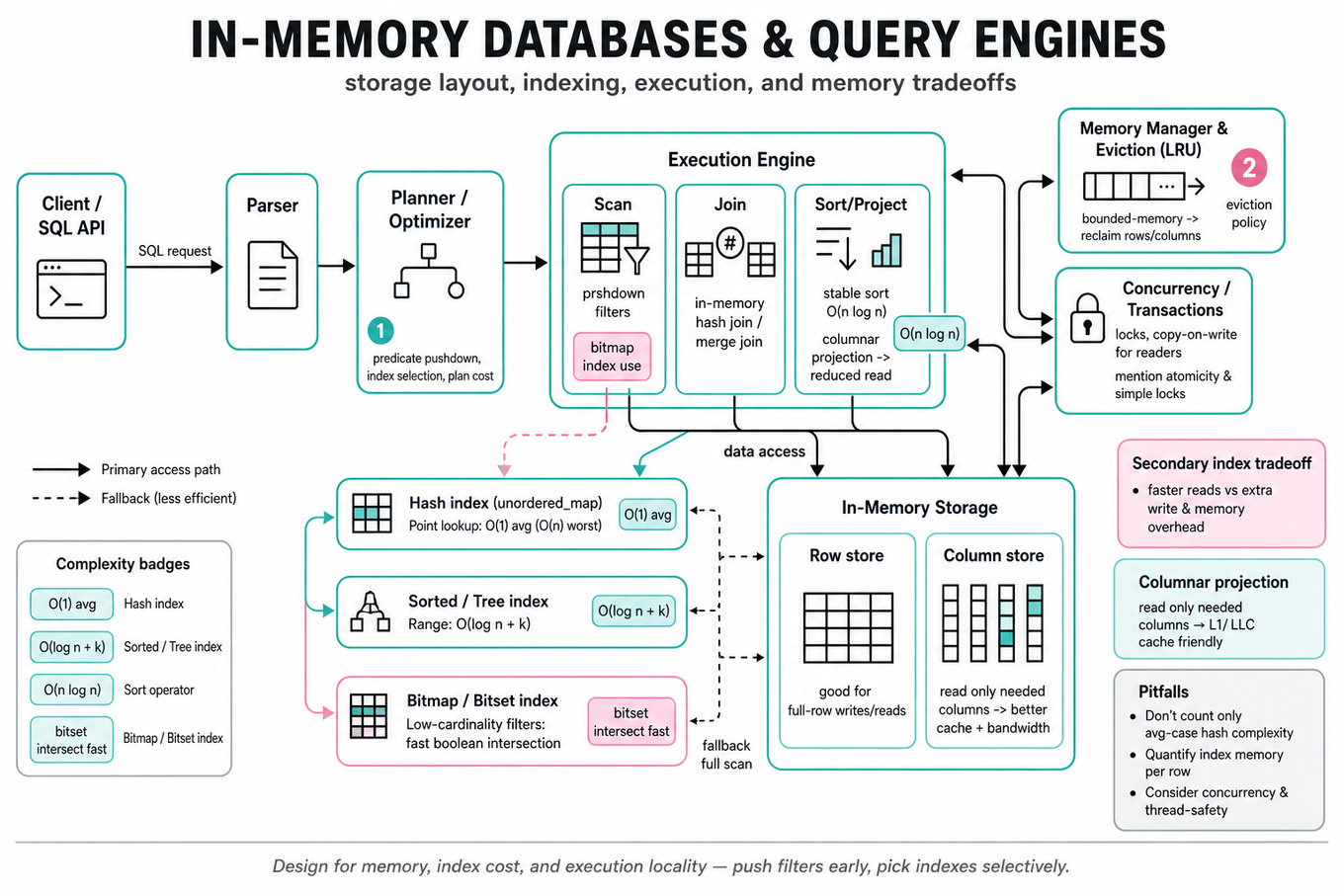
These prompts test translating SQL-like operations into efficient in-memory algorithms: data modeling, indexing, query execution (projection/filter/sort), and complexity reasoning. Interviewers probe choices of data structure (storage layout, indexes), algorithmic cost, and simple API/edge-case handling under memory constraints.
Patterns & templates
-
std::unordered_map/ hash table for point lookups —O(1)average,O(n)worst; good for exact-keyget/putworkloads. -
Sorted array or
std::map(tree) for range queries —O(log n + k)to locate start, then sequential scan forkresults. -
Columnar projection: read only needed columns to reduce memory bandwidth and cache misses; ideal when few columns are selected.
-
Predicate pushdown: apply filters early to shrink working set before expensive operations like sort or join.
-
Bitmap / bitset indexes for low-cardinality filters — fast boolean intersection, memory-efficient for millions of rows.
-
Secondary index tradeoff: faster reads vs extra write + memory; build only on frequently filtered columns.
-
Eviction/LRU for bounded-memory tests — maintain a recency queue and reclaim full rows or columns as configured.
-
Stable sort / tie-breaker: use
std::stable_sortwhen deterministic ordering (multi-key) matters; sorting costsO(n log n).
Common pitfalls
Pitfall: Counting only average-case hash complexity — interviewers will ask about worst-case and adversarial input; mention fallback (tree/hash with rehashing).
Pitfall: Ignoring memory for indexes — adding multiple secondary indexes can double/triple memory; quantify approximate per-row overhead.
Pitfall: Designing only for single-threaded access — at least mention concurrency/atomicity and simple locks or copy-on-write for reads.
The practice cards below cover the canonical variants — solve all of them and time yourself.
Practice questions
- Implement an in-memory SQL-like tableOpenAI · Software Engineer · Onsite · hard
- Design an in-memory databaseOpenAI · Software Engineer · Technical Screen · hard
- Design an in-memory key-value databaseOpenAI · Software Engineer · Technical Screen · hard
- Design in-memory database APIOpenAI · Software Engineer · Technical Screen · medium
- Implement in-memory DB queryingOpenAI · Software Engineer · Technical Screen · medium
Related concepts
- In-Memory Databases And Query ProcessingSystem Design
- In-Memory Stateful API DesignCoding & Algorithms
- Stateful In-Memory Data StructuresCoding & Algorithms
- Stateful In-Memory Domain APIsSoftware Engineering Fundamentals
- In-Memory Stateful Data ModelingCoding & Algorithms
- Stateful In-Memory Data Structures And Temporal SemanticsCoding & Algorithms