Intermediate Representations, DAGs, And Test Workflow Compilation
Asked of: Software Engineer
Last updated
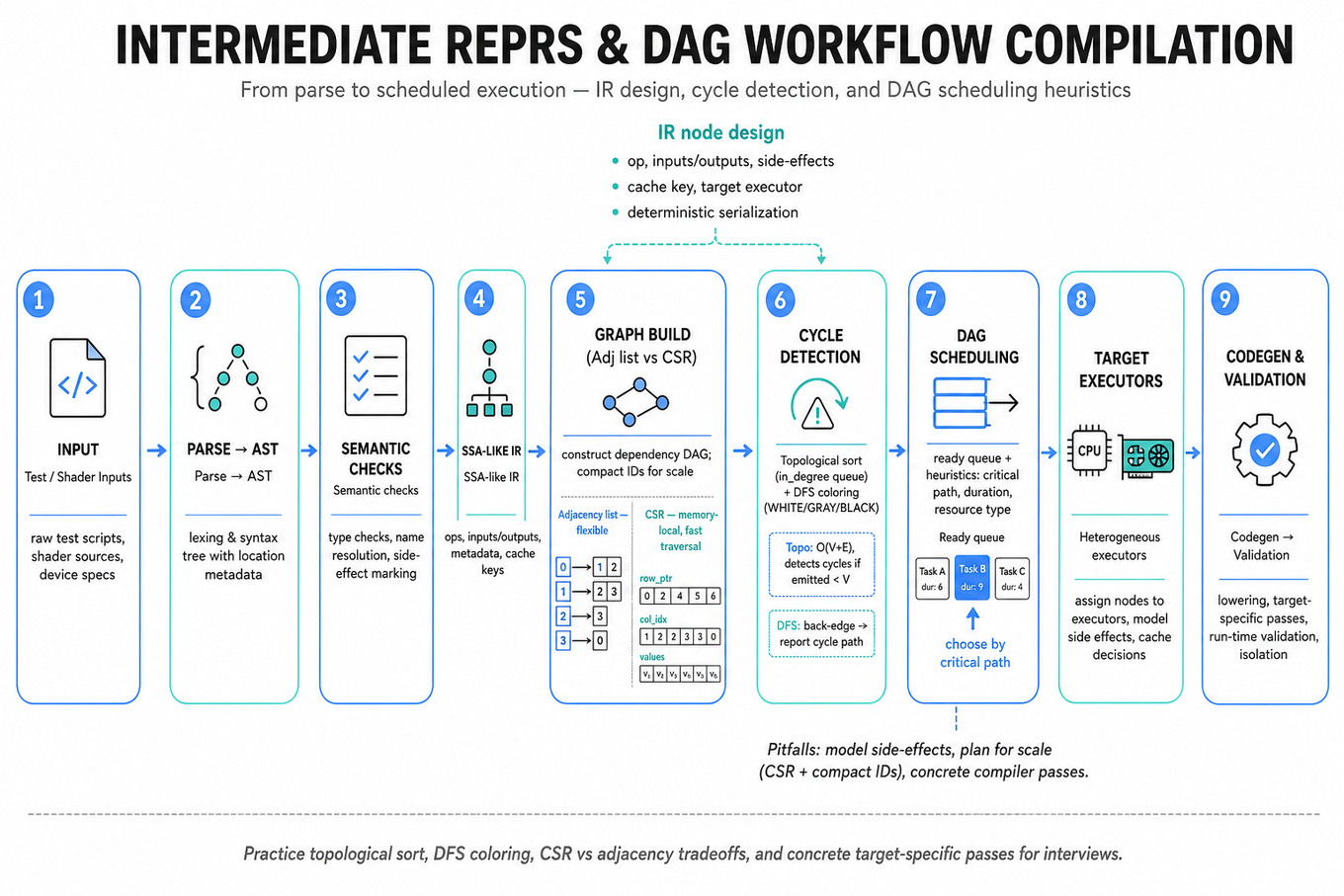
What's being tested
These prompts test compiler-style graph modeling: turning shader or test-workflow inputs into an intermediate representation, validating dependencies, then applying graph algorithms and scheduling heuristics. Interviewers look for clean APIs, correct O(V + E) traversals, and practical tradeoffs around caching, side effects, heterogeneous executors, and memory layout.
Patterns & templates
-
Topological sort with
in_degree+ queue —O(V + E)time; detects cycles when emitted count is less thanV. -
DFS coloring for cycle detection — states
WHITE/GRAY/BLACK; report the back edge path, not just “cycle exists.” -
DAG scheduling via ready queue — choose next node by critical path length, estimated duration, resource type, or priority metadata.
-
IR node design — represent
op, inputs, outputs, metadata, side effects, cache key, target executor, and deterministic serialization. -
Adjacency list vs CSR — lists are flexible for construction; CSR improves locality and parallel traversal for large static graphs.
-
Compiler pipeline template — lex/parse → AST → semantic checks → SSA-like IR → optimization passes → register allocation → codegen → validation.
-
Shortest path template — use
Dijkstrawith heap for nonnegative edge weights,O((V + E) log V); avoid it for pure DAG ordering.
Common pitfalls
Pitfall: Treating every workflow node as pure; tests with filesystem, GPU state, random seeds, or external devices need explicit side-effect and isolation modeling.
Pitfall: Giving only a high-level compiler answer;
NVIDIAinterviewers expect concrete passes like constant folding, dead-code elimination, SSA, register allocation, and target-specific lowering.
Pitfall: Ignoring scale; an
unordered_map<vector<Node>>graph may be fine for thousands of nodes, but millions require compact IDs, CSR, and memory-aware traversal.
Practice these
The practice cards below cover the canonical variants — solve all of them and time yourself.
Featured in interview prep guides
Practice questions
- Design algorithms for test schedulingNVIDIA · Software Engineer · Online Assessment · medium
- Explain a shader compiler pipelineNVIDIA · Software Engineer · Online Assessment · medium
- Implement core graph algorithms for graphicsNVIDIA · Software Engineer · Online Assessment · medium
- Design an IR for test workflowsNVIDIA · Software Engineer · Online Assessment · medium
Related concepts
- DAG Algorithms, Topological Sort, And Cycle DetectionCoding & Algorithms
- Dependency Graphs and Cycle HandlingSoftware Engineering Fundamentals
- Graph Search, State Space, And Path OptimizationCoding & Algorithms
- Graph, Grid, And Connectivity AlgorithmsCoding & Algorithms
- Dependency GraphsCoding & Algorithms
- Graph Algorithms, Dependency Resolution And ConnectivityCoding & Algorithms