LLM Evaluation And Guardrails
Asked of: Software Engineer
Last updated
What's being tested
Interviewers are probing your ability to design reliable, observable, and enforceable runtime protections for a production LLM-driven system: measurable evaluation pipelines, automated safety guardrails, deployment/rollout patterns, and operational controls that an engineer can implement. Expect to justify tradeoffs between latency, cost, false-positive filtering, and developer velocity while showing how you instrument and iterate on model quality in production.
Core knowledge
-
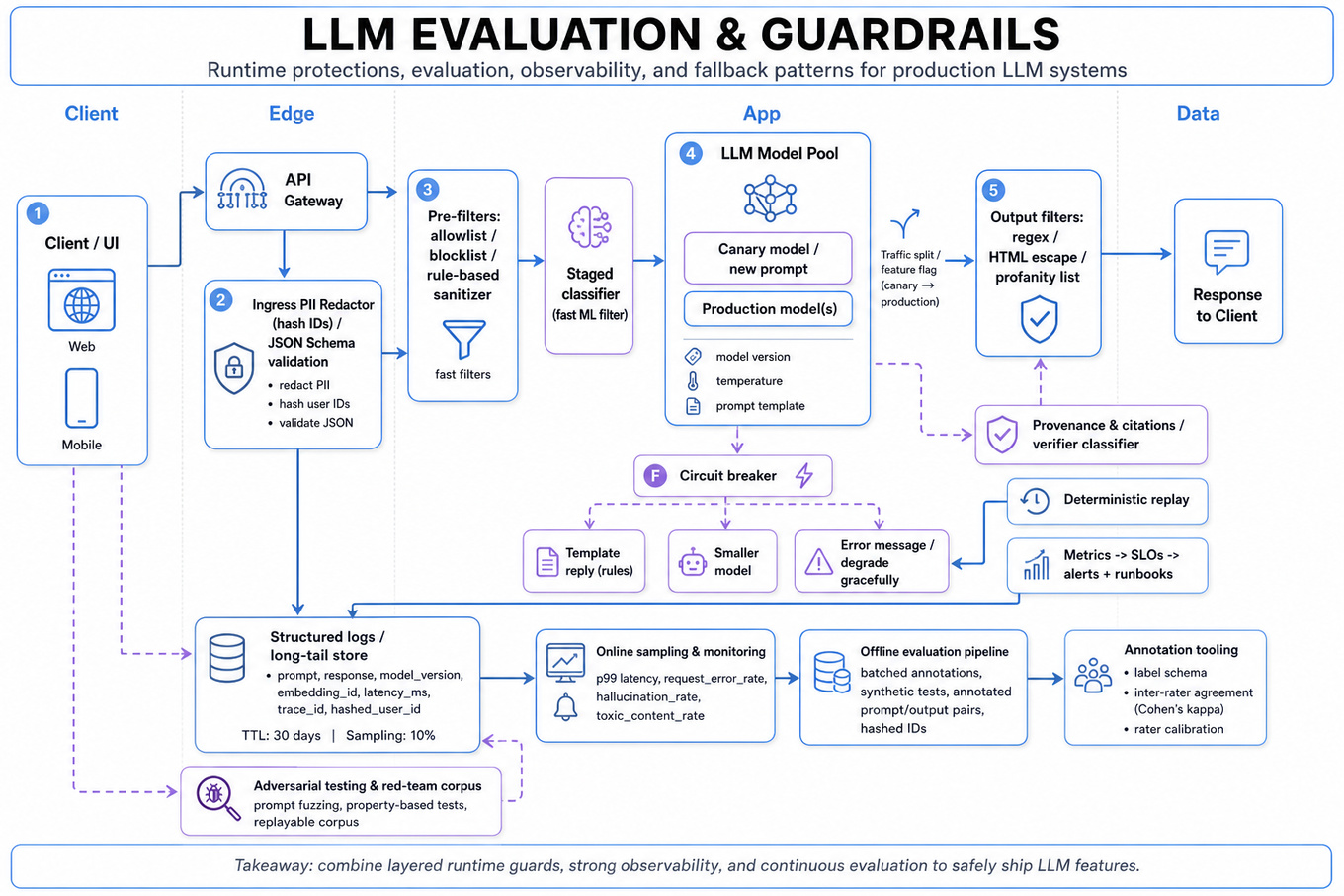
Evaluation pipeline: separate offline (batched annotations, synthetic tests) and online (production sampling) evaluation flows; store prompt/output pairs, metadata, and hashed user IDs for repro and privacy.
-
Factuality / hallucination metrics: define hallucination rate = false factual assertions / total factual assertions; estimate with binomial margin: for 95% confidence.
-
Quality & safety SLIs: common SLIs include
p99latency, request error rate, throughput, hallucination rate, and toxic-content-rate; bind these to observable SLOs with alert thresholds and runbooks. -
Annotation tooling: use standard schemas, inter-rater agreement (e.g., Cohen's kappa) to validate label quality; reduce label drift with periodic rater calibration.
-
Guardrail patterns: input validation via JSON Schema, allowlist/blocklist checks, rule-based sanitizers, staged classifiers (fast filter →
LLM), and output filters (regex, HTML escaping, profanity lists). -
Fallback & routing: implement circuit breakers, graded fallbacks (rule response, template reply, smaller model), and traffic splits/feature flags for canarying new models or prompts.
-
Adversarial testing: automated prompt fuzzing, property-based testing (e.g.,
Hypothesis-style), and red-team scenarios; log adversarial prompts to a replayable corpus. -
Observability & logging: log structured artifacts (prompt, response, model version, embedding id, latency, trace id) to a long-tail store with TTL and sampling; enable deterministic replay for debugging.
-
Confidence & verification: use provenance (citations), retrieval-augmented generation, or lightweight verifier classifiers for high-stakes responses; avoid trusting raw token probabilities alone.
-
Privacy & compliance: redact PII at ingress, hash identifiers for metrics, and avoid logging raw sensitive text unless explicitly allowed in policy and with access controls.
-
Performance tradeoffs: batching and caching embeddings reduce cost but increase tail latency; set
p99SLOs explicitly and pick batch-size vs latency tradeoff per endpoint. -
Deployment hygiene: automate canary rollouts, use idempotency keys for retries, implement backpressure and rate limits, and provide feature flags to disable
LLMpaths quickly.
Worked example — "Design an evaluation and guardrail pipeline for a customer-facing LLM chat service"
First 30 seconds you clarify: what are the high-risk failures (hallucination, toxicity, PII leakage), acceptable latency SLOs, and sampling budget for human review. Organize your answer into three pillars: (1) offline test-suite (unit tests, adversarial corpus, synthetic assertions), (2) online sampling + automated filters (fast classifier → block/fallback), and (3) ops (logging, canaries, alerts). Concretely, propose sampling 1–2% of production queries for full human review, keep a streaming classifier to catch high-risk outputs with a tuned threshold that prioritizes recall for toxicity, and store structured logs for repro with trace ids and model version tags. Flag the main tradeoff: stricter filters reduce risky outputs but increase false positives and user friction — propose metrics to track both. Close with rollout steps: start with internal-only canary, expand via feature flags to gradually increasing traffic, and iterate on annotation schema and thresholds. If you had more time, add simulated adversarial generation and automated A/B experiments measuring downstream user satisfaction.
A second angle — "How would you monitor hallucination and safety regressions at scale?"
Same core concepts but the framing emphasizes continuous detection: implement a lightweight online verifier that detects factual assertions and routes a sampled subset to fact-checkers; compute daily aggregated SLIs (e.g., hallucination rate per intent) and apply statistical change detection (e.g., control charts or simple proportion tests) to trigger alerts. Instrument histograms of output lengths, token-likelihood anomalies, and classifier score distributions to detect distributional shifts. Use canaries and shadow deployments to compare new model versions without user exposure. This angle forces tradeoffs: you must choose what to sample (uniform vs risk-weighted), how much human labeling budget you allocate, and which automated signals to trust for noisy pre-alarms.
Common pitfalls
Pitfall: Over-relying on proxy metrics like BLEU/ROUGE. These surface-level NLG scores rarely correlate with factuality or safety; pair them with human annotations or task-specific verifiers instead.
Pitfall: Logging everything without privacy controls. Dumping raw prompts/responses to logs violates compliance and creates attack surfaces; redact PII, hash identifiers, and apply strict access controls.
Pitfall: Designing one-off manual filters as the only guardrail. Rule-based filters rot quickly under adversarial input and scale badly; combine classifiers, staged fallbacks, and an iterative red-team corpus to keep defenses current.
Connections
This topic naturally pivots to model serving & autoscaling, feature-flag driven rollouts / canarying, and observability for ML (traceability, lineage, and metric alerting). Interviewers may probe deployment orchestration (autoscale, batching), or how you'd pair evaluation with CI/CD for models.
Related concepts
- LLM Evaluation And Product Understanding
- LLM Evaluation, Human Preference, And Safety
- LLM Evaluation: Faithfulness, Hallucination, And Human Review For Meta AI
- LLM Evaluation And RAG Product Understanding
- ML Evaluation, Uncertainty, And Safety GuardrailsML System Design
- LLM Evaluation, Red-Teaming, And Safety Monitoring