Meta Ranking And Retrieval Case Framework
Asked of: Data Scientist
Last updated
What's being tested
Meta ranking and retrieval cases test whether you can reason from user value and product constraints to a measurable, scalable recommendation/search system. Interviewers are not looking for a memorized ML architecture; they are probing whether you can decompose a large product surface like Feed, Reels, Search, Marketplace, Groups, or Ads into candidate generation, scoring, ranking, evaluation, and iteration. For Data Scientists, the key skill is connecting model behavior to product metrics, experimentation, and failure modes: what should be optimized, what should be constrained, and how you would know if the system improved. Meta cares because small ranking changes affect billions of impressions, engagement quality, creator ecosystems, advertiser value, and integrity risk.
Core knowledge
-
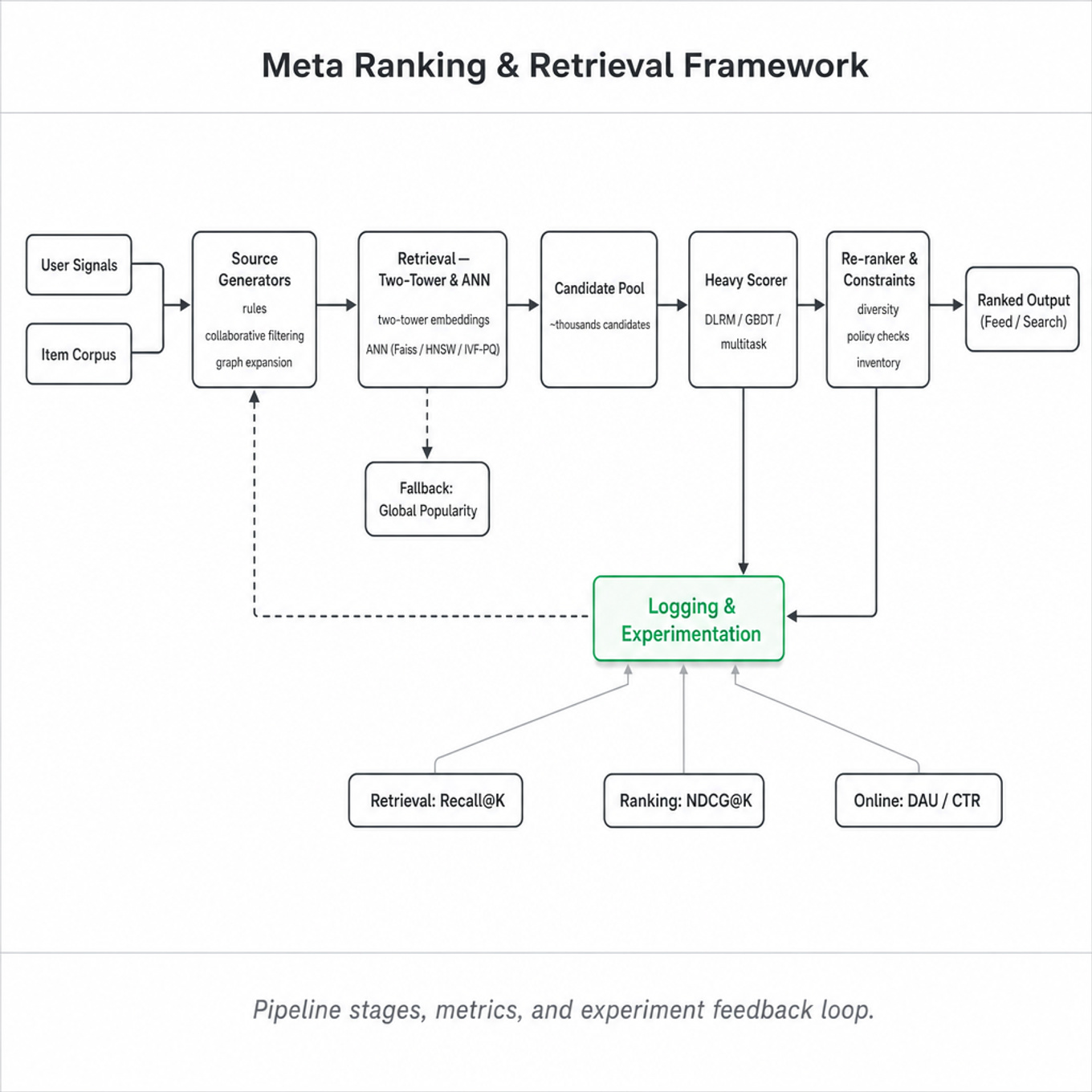
Most Meta-scale ranking systems are multi-stage: retrieve thousands of candidates, rank hundreds, then apply final re-ranking, diversity, policy, and inventory constraints. A typical flow is: source generation lightweight retrieval heavy scorer business/integrity rules logging and experimentation.
-
Retrieval optimizes recall under latency constraints. Common methods include collaborative filtering, two-tower embeddings, approximate nearest neighbor search, graph expansion, and rule-based source generators. For millions of items, exact nearest neighbor may work offline; at hundreds of millions or billions, use ANN systems such as Faiss, HNSW, IVF-PQ, or ScaNN.
-
Two-tower retrieval models encode users and items separately:
This enables precomputing item embeddings and fast ANN lookup. The tradeoff is reduced interaction expressiveness versus cross-attention or deep ranking models that jointly model user-item features. -
Ranking models optimize fine-grained ordering among retrieved candidates. Common approaches include gradient-boosted decision trees, deep neural networks, DLRM-style architectures, multitask models, LambdaMART, and learning-to-rank losses. Heavy rankers can use expensive features because they score hundreds, not billions, of candidates.
-
Choose metrics by stage. Retrieval uses Recall@K, coverage, source contribution, and freshness. Ranking uses NDCG@K, MRR, MAP, calibration, pairwise accuracy, and online product metrics. A common ranking metric is:
-
Online success should be product-specific, not just CTR. Feed may track meaningful interactions, dwell, comments, hides, reports, creator distribution, and return rate. Ads may track conversion value, advertiser ROI, and user ad load. Search may track successful sessions, query reformulation, and long-click rate.
-
Ranking objectives are often multi-objective. A simplified score could be:
Strong answers explain how weights are learned, calibrated, constrained, or tuned through experiments rather than treated as arbitrary constants. -
Calibration matters when combining predictions. If or is miscalibrated across surfaces, languages, creators, or cohorts, rankers can over-promote certain content. Use reliability plots, isotonic regression, Platt scaling, segment-level calibration checks, and post-launch monitoring.
-
Freshness and exploration are first-class constraints. Pure exploitation can create filter bubbles and starve new creators/items. Techniques include time-decay features, epsilon-greedy exploration, Thompson sampling, contextual bandits, cold-start priors, and exploration buckets with guardrail metrics.
-
Integrity and negative feedback are not afterthoughts. Meta ranking must downrank misinformation, spam, clickbait, low-quality engagement bait, policy-violating content, and borderline content. These systems often combine classifier scores, human-review labels, trusted reporter signals, and hard eligibility filters.
-
Beware position bias and logging bias. Observed clicks are not true relevance because users click what they are shown. Countermeasures include randomized interleaving, inverse propensity weighting, exploration traffic, counterfactual evaluation, and models that include examination probability.
-
Latency and reliability shape model design. A Feed or Reels ranker may have tens to low hundreds of milliseconds for online scoring, with strict p95/p99 requirements. Expensive features should be cached, precomputed, approximated, or moved to later stages only when incremental value justifies cost.
Worked example
How would you rank posts in Facebook News Feed?
A strong candidate would start by clarifying the product goal: “Are we optimizing short-term engagement, meaningful social interactions, long-term retention, or reducing negative experiences?” They would also ask about eligible inventory: friends’ posts, Groups, Pages, recommended content, ads, and whether the ranking is for an existing user with history or a cold-start user. The answer should be organized around four pillars: candidate generation, ranking objective, evaluation, and safeguards. For candidate generation, they might describe pulling candidates from social graph edges, Groups, followed Pages, recent interactions, and recommendation sources, then filtering by privacy, block relationships, policy eligibility, and freshness. For ranking, they would propose a multitask model predicting probabilities of click, reaction, comment, share, dwell, hide, report, and downstream retention, then combining these with calibrated weights or constrained optimization.
A strong tradeoff to flag is engagement versus quality: maximizing comments may amplify controversial or low-quality content, so the ranker needs negative feedback, integrity classifiers, and guardrails such as hide/report rate, survey quality, and policy violation prevalence. Evaluation should include offline ranking metrics like NDCG@K and calibration, but the candidate should emphasize that final judgment comes from A/B tests on meaningful interactions, session quality, retention, negative feedback, and ecosystem metrics for creators. They should also mention network effects and interference: changing what one user sees can affect creators’ future posting behavior and friends’ engagement. A good close would be: “If I had more time, I’d go deeper on cold start, exploration for new creators, and how to monitor segment-level regressions across countries, languages, and sensitive user cohorts.”
A second angle
How would you improve retrieval for Marketplace search?
The same framework applies, but the emphasis shifts from feed-style personalized ranking to query intent, item relevance, local availability, and conversion. Retrieval should combine lexical matching such as BM25, semantic embeddings from a two-tower query-item model, category constraints, geography, price filters, and freshness of listings. Ranking would then optimize not just clicks but buyer actions: message seller, save item, purchase completion, seller response quality, and reduced scams or bad experiences. The biggest difference is that user intent is explicit in the query, so query understanding, spelling correction, synonyms, category classification, and exact-match precision become more important than broad engagement prediction. A strong answer would also discuss cold-start listings, duplicate listings, local inventory sparsity, and trust/safety filters for fraudulent sellers.
Common pitfalls
Analytical mistake: optimizing only CTR.
A tempting answer is “rank by predicted click probability,” but that can reward clickbait, sensational content, or misleading listings. A better answer defines a utility function with positive and negative outcomes, then names guardrails such as hide/report rate, long-term retention, survey quality, conversion quality, and integrity prevalence.
Communication mistake: jumping directly into models.
Saying “I’d use a neural network ranking model with embeddings” before defining the goal makes the answer feel generic. Start with product objective, users, inventory, constraints, and success metrics; then introduce retrieval and ranking models as tools serving those objectives.
Depth mistake: ignoring retrieval.
Many candidates discuss only final ranking, but at Meta scale the ranker can only score what retrieval surfaces. If candidate generation has low recall for new creators, minority-interest content, or fresh listings, the best ranker cannot recover them; discuss Recall@K, source diversity, ANN tradeoffs, and exploration explicitly.
Connections
Interviewers may pivot from ranking design into experimentation, especially A/B testing, guardrail metrics, heterogeneous treatment effects, and network interference. They may also probe recommender-system fairness, cold start, causal inference for biased logs, or ads auction mechanics such as expected value ranking and budget pacing. Adjacent technical areas include learning to rank, approximate nearest neighbor retrieval, counterfactual evaluation, and multi-objective optimization.
Further reading
- “Deep Learning Recommendation Model for Personalization and Recommendation Systems” — Naumov et al., Meta/Facebook — Canonical reference for DLRM-style recommendation architectures used in large-scale ranking.
- “Billion-scale similarity search with GPUs” — Johnson, Douze, Jégou — Foundational paper behind Faiss and practical ANN retrieval at massive scale.
- “Practical Lessons from Predicting Clicks on Ads at Facebook” — He et al. — Useful for understanding calibration, feature engineering, and large-scale prediction tradeoffs.