Meta Ranking And Retrieval Case Framework
Asked of: Data Scientist
Last updated
What's being tested
Meta ranking and retrieval interviews test whether you can reason from an ambiguous product goal to a measurable, scalable recommendation system. The interviewer is probing for more than “use a model to rank items”: they want to see whether you can define candidate generation, ranking objectives, evaluation metrics, experiment design, and failure modes under real business and integrity constraints. For a Data Scientist, the key skill is connecting ML system behavior to user outcomes: engagement, retention, creator ecosystem health, ad value, safety, and long-term satisfaction. Strong answers show you can trade off relevance, diversity, freshness, latency, fairness, and causal measurement without overfitting to a single metric.
Core knowledge
-
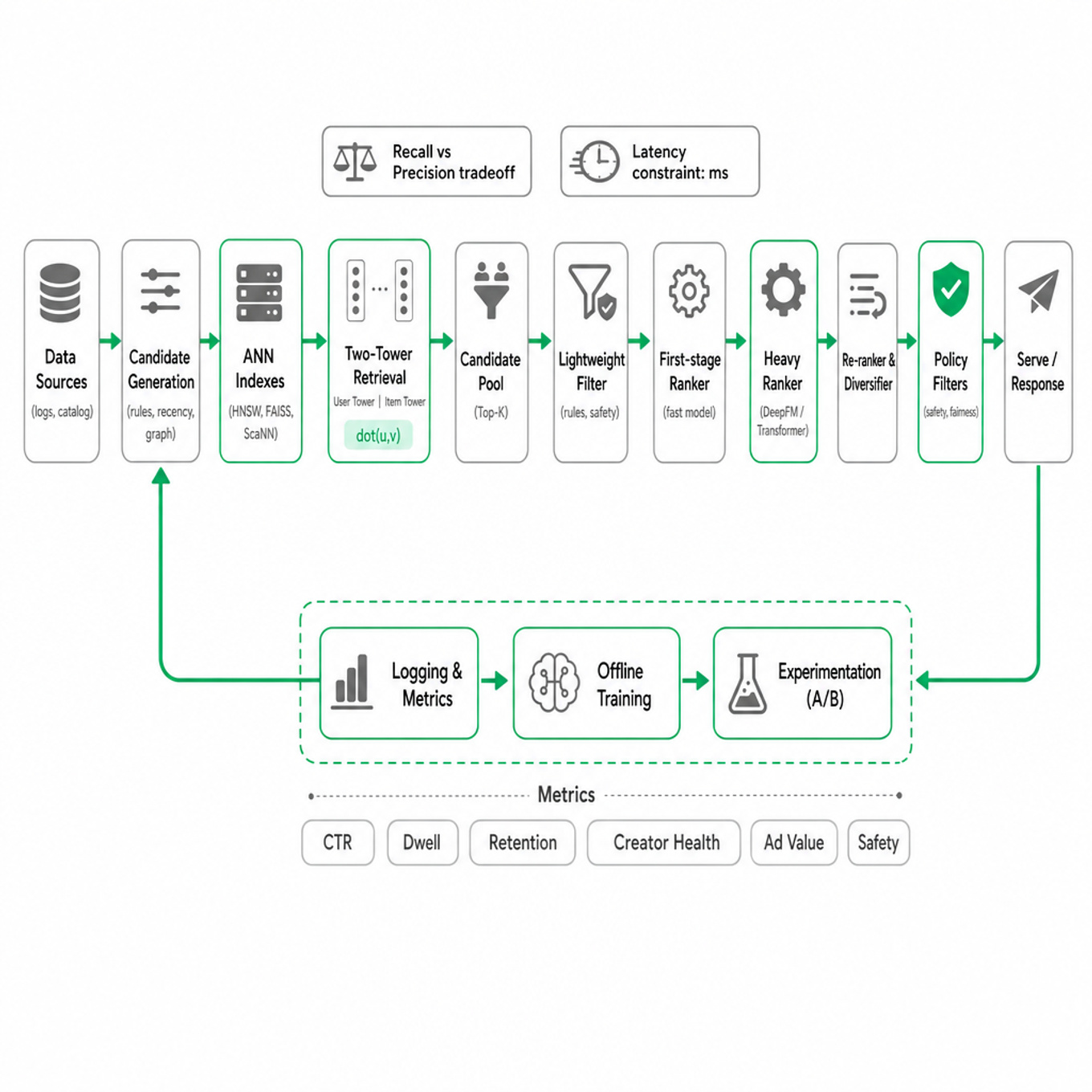
Separate retrieval from ranking. Retrieval narrows millions or billions of possible items to hundreds or thousands; ranking orders those candidates. Typical pipeline: source generation → lightweight filtering → first-stage ranker → heavy ranker → re-ranking/diversification → policy filters. Confusing these layers is a common failure.
-
Candidate generation must optimize recall under latency. For large-scale recommendation, exact nearest-neighbor search is infeasible beyond roughly tens of millions of items. Use approximate nearest neighbor methods such as HNSW, IVF-PQ, FAISS, ScaNN, or two-tower embedding retrieval to get top- candidates in milliseconds.
-
Two-tower retrieval models are standard. A user tower and item tower produce embeddings and , scored by dot product or cosine similarity:
They scale well because item embeddings can be precomputed, but they underperform cross-encoders on complex user-item interactions. -
Ranking models can be much richer than retrieval models. Common rankers include logistic regression with feature crosses, GBDTs such as XGBoost/LightGBM, Wide & Deep, DeepFM, DLRM-style architectures, sequence models, or transformers. The heavier model can use real-time features, cross features, social context, and content understanding signals.
-
Define the prediction target carefully. Optimizing click-through rate alone can reward clickbait. Better objectives often combine multiple labels: click, dwell time, like, comment, share, hide, report, follow, session return, creator follow, or “meaningful social interaction.” Multi-task learning is common when outcomes are correlated but not identical.
-
Ranking metrics should match the product surface. For ordered lists, use Precision@K, Recall@K, MAP, MRR, or NDCG:
NDCG is useful when position matters and relevance is graded. -
Offline metrics are not enough. AUC, log loss, calibration, and NDCG can improve while user satisfaction worsens. Offline evaluation is biased by historical exposure: you only observe labels for items the old system showed. Use A/B tests, interleaving, counterfactual evaluation, or exploration buckets where appropriate.
-
Logged-policy bias matters. If item was shown because the old ranker favored it, observed engagement is not an unbiased relevance label. Counterfactual estimators use inverse propensity scoring:
but high variance and missing propensities are practical challenges. -
Latency and freshness are product constraints, not implementation details. Feed, Reels, Ads, Search, and Marketplace ranking often need p95 latency targets in tens to hundreds of milliseconds. Fresh content, breaking news, new creators, and cold-start items require streaming features, fallback rules, and exploration.
-
Cold start requires fallback signals. For new users, use onboarding interests, geo, device, language, demographic-safe aggregates, popularity, and social graph priors. For new items, use creator quality, content embeddings, text/image/video understanding, early engagement velocity, and similarity to known content.
-
Ranking should manage ecosystem externalities. Optimizing immediate engagement may concentrate impressions on already-popular creators, reduce diversity, amplify low-quality content, or harm long-term retention. Re-ranking can enforce constraints on diversity, source balance, freshness, integrity risk, or inventory fairness.
-
A good experiment plan includes guardrails. Primary metrics might be sessions per user, retention, meaningful interactions, watch time, or revenue. Guardrails include hides, reports, unfollows, negative feedback, latency, crash rate, creator distribution, ad load, and integrity violations. Segment by new users, power users, geography, language, and content type.
Worked example
Improve Facebook Feed ranking
A strong candidate would start by clarifying the product objective: “Are we optimizing short-term engagement, long-term retention, meaningful social interactions, or reducing negative feedback?” They would also ask what surface is in scope: home Feed only, organic posts only, or a mix of friends, Groups, Pages, Reels, and ads. The answer should be organized around four pillars: candidate generation, ranking objective, evaluation, and risk controls. For candidate generation, they might describe pulling candidates from friend posts, Groups, followed Pages, recommendations, and recent popular content, then filtering blocked, seen, policy-violating, or stale items. For ranking, they would propose a multi-task model predicting probabilities of click, dwell, comment, share, hide, report, and return-session impact, then combining them with a utility function such as
They should explicitly flag that the weights are not purely statistical; they reflect product strategy and should be validated experimentally. A strong tradeoff to call out is engagement versus content quality: ranking for comments may accidentally promote polarizing posts, so negative feedback and integrity classifiers must be first-class inputs or constraints. For evaluation, they would use offline NDCG/log loss/calibration plus online A/B tests measuring retention, meaningful interactions, hides, reports, and latency. They could close by saying: “If I had more time, I’d add counterfactual evaluation for exposure bias, creator-side metrics, and long-term holdouts to detect engagement hacking.”
A second angle
Recommend Groups You Should Join
The same framework applies, but the constraints shift from ranking a frequently refreshed feed to recommending durable entities with slower feedback loops. Retrieval might use graph-based signals such as friends in the group, shared interests, locality, and embedding similarity between user activity and group descriptions. The ranking label is not just “click join”; a better target includes joining, visiting again, posting/commenting after joining, muting/leaving, or reporting the group. Cold start and safety become more important because new or small groups may lack engagement history, while harmful groups can look engaging. The experiment should include downstream quality metrics such as active membership, notification opt-outs, group reports, and long-term retention, not just join conversion.
Common pitfalls
Analytical mistake: optimizing the easiest label. A tempting answer is “rank by predicted CTR” because clicks are abundant and easy to model. That is too shallow for Meta surfaces: clicks can reward sensational content, low-quality recommendations, or accidental taps. A stronger answer defines a multi-objective utility and includes negative feedback, retention, and integrity guardrails.
Communication mistake: jumping into algorithms before defining the product goal. Saying “I’d use a neural network and embeddings” before clarifying the objective makes the answer sound generic. Start with the product surface, users, inventory, success metric, and constraints; then choose retrieval and ranking methods that fit those constraints.
Depth mistake: ignoring the retrieval layer. Many candidates discuss ranking as if all possible items can be scored by a heavy model. At Meta scale, you cannot run a deep cross-feature ranker over billions of posts, Reels, people, ads, or Marketplace items. You need approximate retrieval, source-specific generators, filtering, and staged ranking.
Connections
Interviewers often pivot from ranking into experimentation, especially A/B testing, heterogeneous treatment effects, network effects, and long-term holdouts. They may also probe causal inference for biased logged data, recommender-system fairness, marketplace dynamics, ads auction ranking, or integrity tradeoffs such as misinformation and harmful content suppression.
Further reading
- “Deep Neural Networks for YouTube Recommendations” — Covington, Adams, Sargin, 2016 — canonical two-stage retrieval/ranking recommender architecture.
- “Practical Lessons from Predicting Clicks on Ads at Facebook” — He et al., 2014 — real Meta-scale lessons on feature engineering, calibration, and ranking for ads.
- “Counterfactual Reasoning and Learning Systems” — Bottou et al., 2013 — useful foundation for logged-policy bias and counterfactual evaluation.