Order Book And Matching Engine Data Structures
Asked of: Software Engineer
Last updated
What's being tested
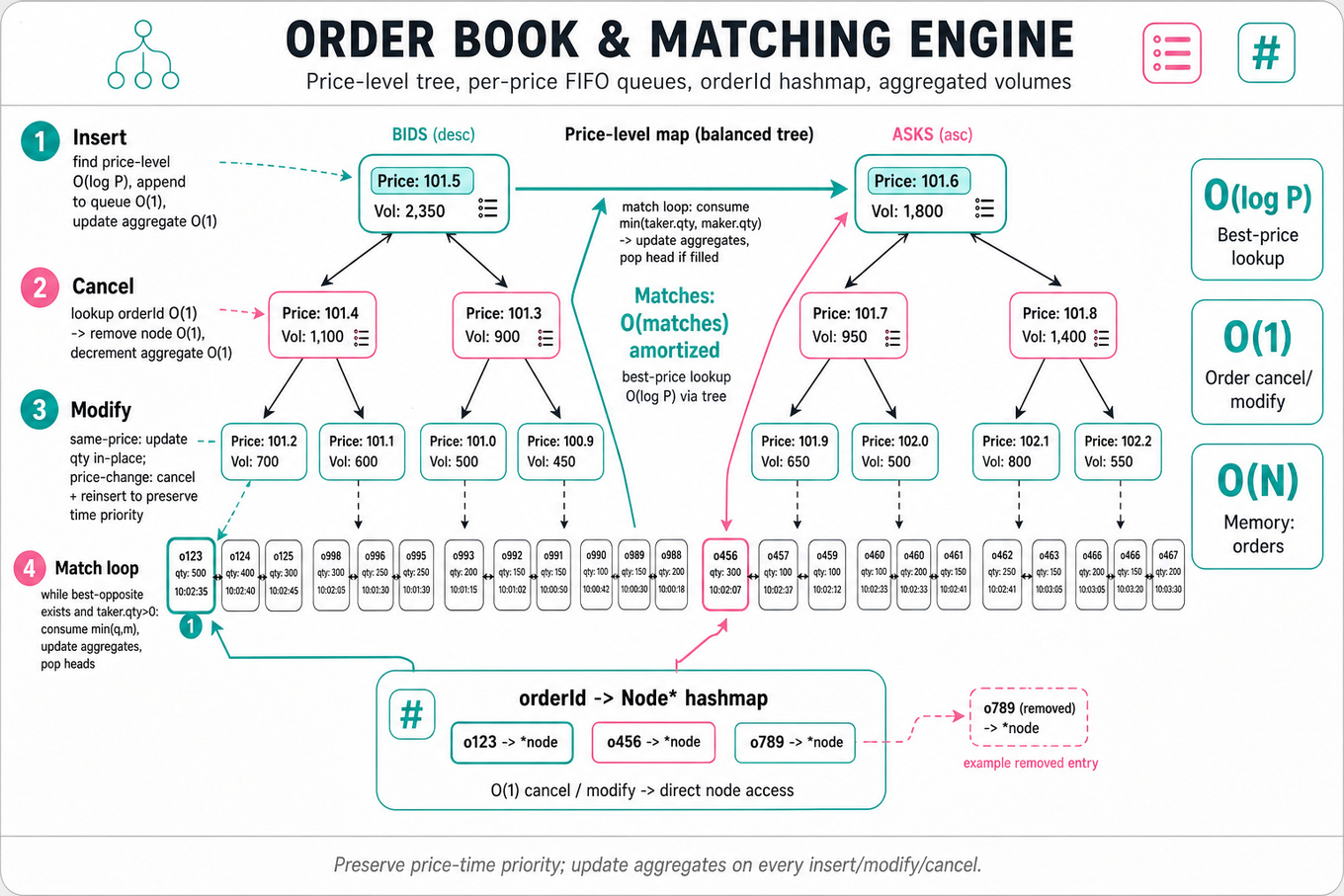
These problems test building an efficient, order book and matching engine for a single symbol: maintaining side-specific best prices, aggregating quantities, and deterministic tie-breaking. Interviewers probe algorithmic choices, data-structure invariants, and correctness under inserts, cancels, modifies, and matches.
Patterns & templates
- Use a price-level map implemented with a balanced tree (
std::map) for best-price lookup — best bid/ask inO(log P)where P is active price levels. - Maintain a per-price FIFO queue (e.g.,
dequeor linked list) to enforce price-time priority andO(1)head pops for fills. - Keep an
unordered_map<orderId, Node*>for directcancel/modifyinO(1)to the order's node and price-level. - Store aggregated volume per price-level and update on every insert/modify/cancel to answer quantity-at-price in
O(1). - Matching loop: while best-opposite-price exists and top-order.qty > 0, consume min(taker.qty, maker.qty); operations are
O(matches * 1)amortized. - For order modification, treat as cancel+reinsert if price changes to preserve time priority; otherwise update quantity in-place.
- Memory is linear: orders ->
O(N); price-levels typically << N; consider node pooling to avoid GC/allocator overhead.
Common pitfalls
Pitfall: Forgetting to decrement the price-level aggregated quantity on cancel leads to incorrect depth and stale best-price decisions.
Pitfall: Using a binary heap for best-price with mutable orders complicates modify/cancel operations and makes
O(n)removal common.
Pitfall: Re-inserting a modified order without clarifying whether it should preserve original time priority — always state the assumption and implement accordingly.
Practice these
The practice cards below cover the canonical variants — solve all of them and time yourself.
Practice questions
Related concepts
- Limit Order Book Price-Time MatchingCoding & Algorithms
- Auctions, Ticketing, And Real-Time MessagingSystem Design
- Greedy, Heaps, And Scheduling OptimizationCoding & Algorithms
- Crypto Trading And Order Routing SystemsSystem Design
- Large-Scale Marketplace System DesignSystem Design
- Cart Service And Pricing Engine DesignSystem Design