Pricing, Demand, And Capacity Optimization
Asked of: Data Scientist
Last updated
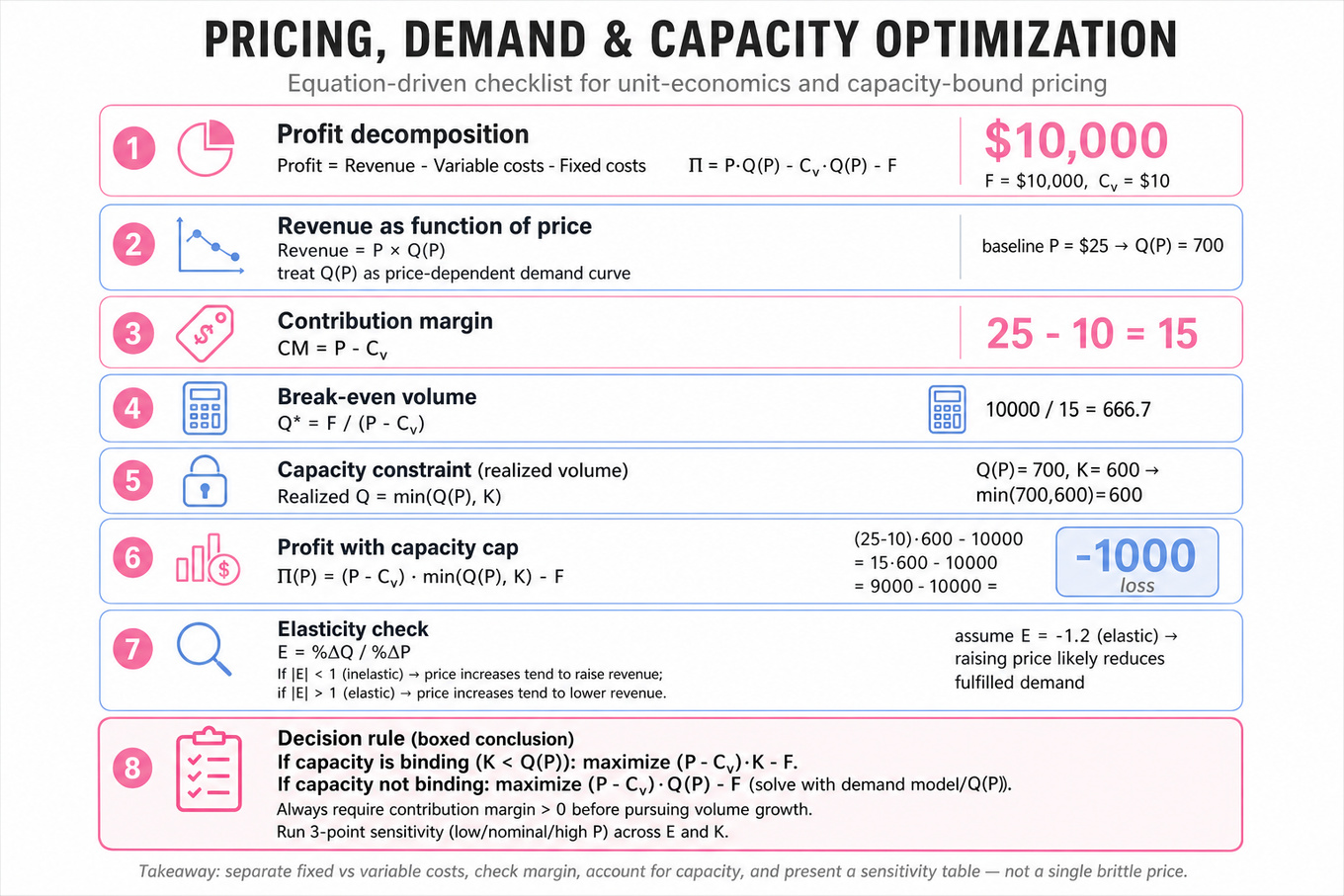
What's being tested
Interviewers are testing whether you can turn an ambiguous business scenario into a unit-economics model, identify the binding capacity constraint, and reason about pricing under uncertain demand. For a Data Scientist at Capital One, this maps directly to decisions like offer pricing, credit line utilization, acquisition incentives, servicing capacity, fraud-review queues, and profitability tradeoffs across customer segments. The interviewer is probing for structured thinking: define objective function, separate fixed vs variable costs, estimate demand response, account for constraints, and recommend a decision with sensitivity analysis rather than a single brittle number.
Core knowledge
-
Profit decomposition is the foundation:
For pricing problems, write revenue as , where is price and is demand at that price. Always separate one-time fixed costs from per-unit marginal costs. -
Contribution margin determines whether growth helps:
where is variable cost per unit. If contribution margin is negative, selling more units worsens profit even if revenue rises. This is a common trap in surge, rent, subscription, and park-ticket problems. -
Break-even volume and break-even price are different tools. Break-even quantity is
where is fixed cost. Break-even price with fixed demand is
but if demand changes with price, solve instead. -
Capacity constraints create discontinuities. If capacity is capped at , realized volume is . The profit function becomes
This matters when a higher price reduces excess demand without lowering fulfilled volume, increasing profit and improving customer experience. -
Demand elasticity measures price sensitivity:
If , demand is inelastic and price increases may raise revenue; if , price increases may reduce revenue. For profit, elasticity must be evaluated against margin, not revenue alone. -
Segment-level heterogeneity is often the difference between a weak and strong answer. Demand response may differ by customer segment, geography, channel, risk band, time of day, or product tier. Averages can hide profitable targeted strategies, but segmentation should be justified by sample size and business actionability.
-
Optimization objective should be explicit. Common objectives include maximizing profit, maximizing revenue subject to margin constraints, maximizing customer lifetime value, minimizing unmet demand, or maintaining occupancy above a threshold. In financial services, constraints may include fairness, compliance, credit risk, operational capacity, and customer experience.
-
Discrete choices require careful handling. If prices, room counts, content volumes, or staffing levels can only take integer values, do not rely solely on calculus. For small option sets, use grid search or scenario tables; for larger constrained problems, use linear programming, mixed-integer programming, or simulation-based optimization.
-
Uncertainty should be modeled, not ignored. Use scenario analysis, confidence intervals, or Monte Carlo simulation when demand, costs, or conversion rates are uncertain. A strong answer reports expected profit plus downside risk, e.g., “At the recommended price, expected profit is positive, but the 10th percentile outcome is near break-even.”
-
Experimentation is the cleanest way to estimate causal price effects when feasible. A randomized price or offer test can estimate demand curves, but watch for interference, seasonality, customer fairness, and long-term behavior. Use metrics like
conversion_rate,average_order_value,gross_margin,retention_rate, andcustomer_complaints. -
Causal inference is needed when experiments are unavailable. Methods like difference-in-differences, synthetic control, propensity score weighting, or regression with fixed effects can help estimate price sensitivity from historical changes. Be clear that observational estimates are more assumption-heavy than randomized tests.
-
Sensitivity analysis is not optional. Vary the highest-leverage assumptions: demand elasticity, occupancy, fixed costs, variable costs, churn, utilization, and conversion rate. A decision is stronger when you can say, “This recommendation remains profitable unless demand falls more than 18% or variable costs exceed $X.”
Worked example
For Compute profit and surge break-even price, a strong candidate would first clarify whether demand exceeds capacity, whether surge pricing changes demand, what costs are fixed versus per-service, and whether the objective is profit maximization or simply break-even. I would frame the problem as a unit-economics and capacity-constrained pricing exercise: define base demand, capacity cap, price, variable cost per fulfilled unit, and fixed cost for the period. The answer skeleton would have four pillars: calculate current profit, identify whether capacity is binding, derive the break-even surge price, and test sensitivity to demand drop from higher prices.
The key equation would be , not just revenue minus cost using unconstrained demand. If demand is well above capacity, a modest price increase may not reduce fulfilled units, so profit rises mechanically through higher contribution margin. If demand is close to capacity, the tradeoff becomes sharper because surge pricing may reduce quantity below the cap. I would explicitly flag that treating demand as fixed under surge is a simplifying assumption and should be stress-tested with elasticity scenarios. I would close by saying that if I had more time, I’d estimate price elasticity from historical surge events or a randomized test and recommend the price that maximizes expected profit while monitoring cancellation rate and customer complaints.
A second angle
For Decide content volume and price under uncertainty, the same logic applies, but the capacity decision is made before demand is fully observed. Instead of a service cap like drivers or seats, the decision variable might be how many content units to produce, with fixed production costs and uncertain conversion or consumption. The framing shifts from break-even pricing to joint optimization: choose volume and price to maximize expected profit under demand uncertainty. A strong answer would compare conservative, base, and aggressive production scenarios, then identify where marginal expected revenue no longer exceeds marginal production cost. The interviewer is looking for whether you recognize that more content can increase demand, but also raises fixed or semi-fixed costs before revenue is guaranteed.
Common pitfalls
Pitfall: Optimizing revenue instead of profit.
A tempting answer is “raise price until revenue is maximized” or “maximize occupancy,” but neither guarantees profitability. A better answer explicitly models contribution margin, fixed costs, capacity utilization, and the possibility that lower volume at higher margin can be better than high volume at low margin.
Pitfall: Giving one number without assumptions.
Interviewers do not expect perfect real-world estimates, but they do expect transparent assumptions. If you say “the break-even price is $20” without stating demand, capacity, variable cost, and whether demand changes with price, the answer sounds mechanical rather than analytical.
Pitfall: Ignoring causal identification.
Historical correlations between price and demand are often biased because prices change during peak times, holidays, or high-demand markets. A stronger answer says how you would estimate elasticity: randomized test if feasible, otherwise quasi-experimental methods with controls for seasonality, geography, segment mix, and marketing intensity.
Connections
This topic often pivots into A/B testing, causal inference, customer segmentation, forecasting, and lifetime value modeling. For Capital One, the same reasoning can also connect to credit risk pricing, offer optimization, marketing spend allocation, fraud-review capacity, and operational queue management.
Further reading
-
Pricing and Revenue Optimization by Robert Phillips — practical treatment of demand curves, capacity constraints, and revenue management.
-
Mostly Harmless Econometrics by Angrist and Pischke — strong foundation for causal estimation when randomized pricing tests are not available.
-
Trustworthy Online Controlled Experiments by Kohavi, Tang, and Xu — useful for designing and interpreting experiments that estimate demand and pricing effects.
Featured in interview prep guides
Practice questions
- Decide content volume and price under uncertaintyCapital One · Data Scientist · HR Screen · medium
- Set membership fee under investment constraintsCapital One · Data Scientist · HR Screen · medium
- Graph WTP vs content and explain capCapital One · Data Scientist · HR Screen · easy
- Optimize amusement park pricing, capacity, and testingCapital One · Data Scientist · Technical Screen · hard
- Compute profit and surge break‑even priceCapital One · Data Scientist · Technical Screen · medium
- Design a profit growth strategyCapital One · Data Scientist · Technical Screen · hard
- Optimize theme park queues and revenueCapital One · Data Scientist · Onsite · hard
- Determine Rent Price Factors for Multi-Family Apartment ProfitabilityCapital One · Data Scientist · Technical Screen · medium
- Estimate Revenues and Costs for New Amusement Park LaunchCapital One · Data Scientist · Onsite · medium
- Evaluate Financial Feasibility of Ride-Sharing ServiceCapital One · Data Scientist · Onsite · medium
- Visualize Price Impact on Demand and Profit TrendsCapital One · Data Scientist · Onsite · easy
Related concepts
- Pricing And Promotion OptimizationStatistics & Math
- Greedy, Heaps, And Scheduling OptimizationCoding & Algorithms
- Unit Economics And Pricing AnalyticsAnalytics & Experimentation
- Dynamic Programming, Scheduling, And Set CoverCoding & Algorithms
- Unit Economics, Break-Even, And Profit DecompositionStatistics & Math
- Queueing Theory, Probability, And DistributionsStatistics & Math