Phone Screen Coding Execution
Asked of: Software Engineer
Last updated
What's being tested
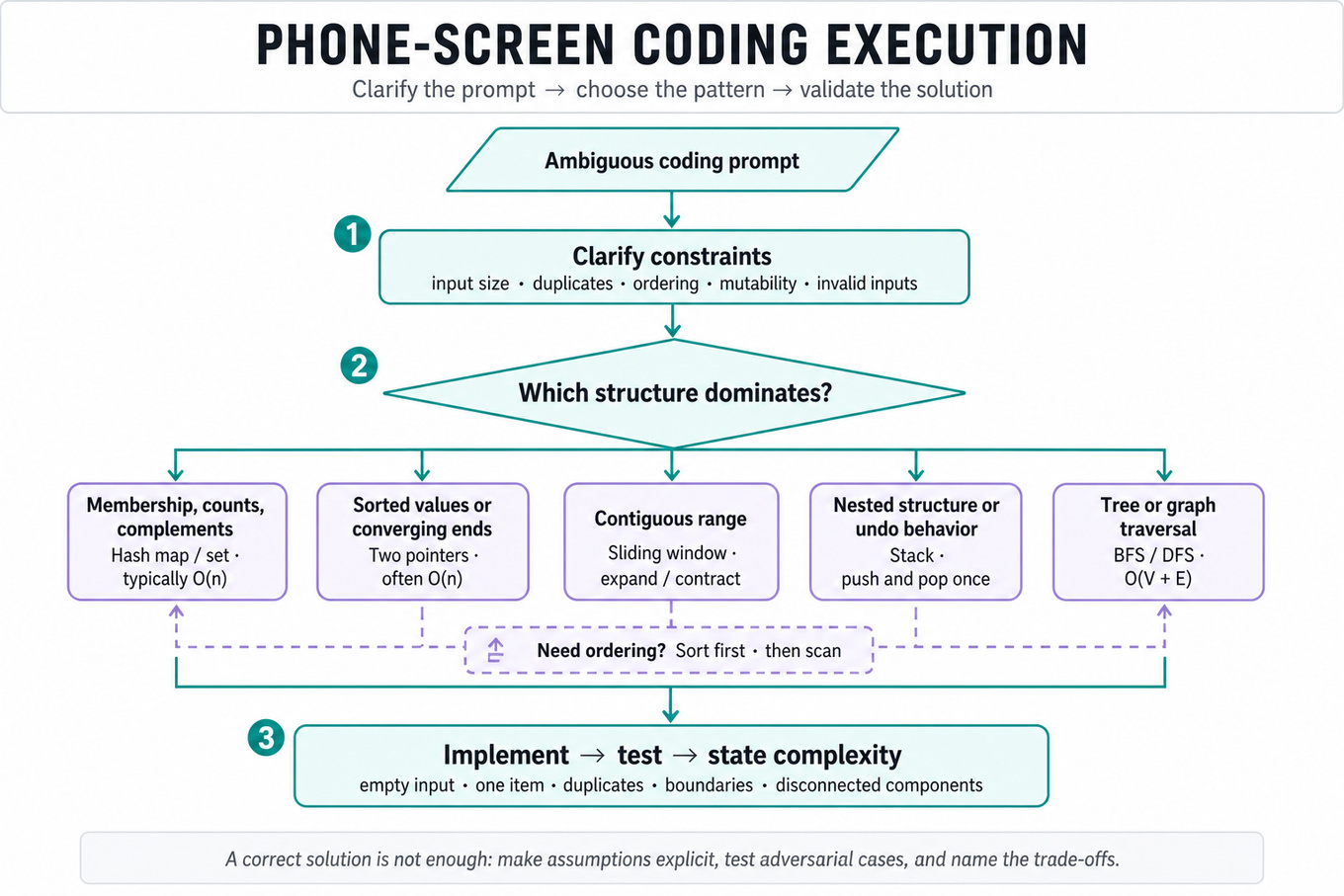
Phone-screen coding execution tests whether you can translate an ambiguous prompt into a correct algorithm, implement it cleanly, and validate it aloud. The core skill is recognizing common patterns—hashing, two pointers, sliding windows, stacks, trees, graphs, and sorting—while managing edge cases and complexity under time pressure.
Patterns & templates
-
Clarify and constrain — define input size, duplicates, ordering, mutability, invalid inputs, and expected output before choosing an algorithm.
-
Hash map/set lookup — use
dictorsetfor membership, counts, and complements; typicallyO(n)time andO(n)space. -
Two pointers — exploit sorted input or opposite/fast-slow movement; target
O(n)scans instead of nestedO(n²)loops. -
Sliding window — maintain a valid contiguous range with left/right pointers; expand, contract, and update state incrementally in
O(n). -
Stack templates — use a stack for matching delimiters, undo-like behavior, or monotonic next-greater-element scans; each item is pushed and popped once.
-
BFS/DFS traversal — track a
visitedset, define the base case, and stateO(V + E)time for graph traversal. -
Complexity and testing — state time/space complexity, then test empty input, one element, duplicates, boundaries, and adversarial ordering.
Common pitfalls
Pitfall: Coding immediately without confirming whether inputs are sorted, whether duplicates matter, or whether modifying the input is allowed.
Pitfall: Producing a correct-looking solution but missing off-by-one errors, empty collections, duplicate values, or disconnected graph components.
Pitfall: Overengineering with dynamic programming or custom classes when a linear scan, hash table, or standard library operation is sufficient.
Practice these
The practice cards below cover the canonical variants—solve all of them and time yourself.
Related concepts
- Clean Coding, Requirements, and Edge CasesCoding & Algorithms
- Coding: Time-Window Counters, Heaps, And Stateful Stores
- Adobe-style coding patterns: DP, graphs, parsing, backtracking, stacks/heaps
- Sliding Window And Time Window Counters
- Coding: Greedy, Interval, Counting, And Grid Patterns
- Clean Implementation, Performance, And CommunicationBehavioral & Leadership