Prioritization And Tradeoff Frameworks
Asked of: Product Manager
Last updated
What's being tested
Interviewers are probing your ability to make high-quality, defensible product tradeoffs under uncertainty: prioritize features, define success metrics, sequence launches, and mitigate operational/ethical risks. They want a PM who can translate user/merchant pain into a metric tree, pick a prioritization method (with clear assumptions), and communicate tradeoffs to engineering, design, and legal partners. Expect questions to evaluate stakeholder framing, launch sequencing, and how you reason about automation vs. human-in-the-loop risk.
Core knowledge
-
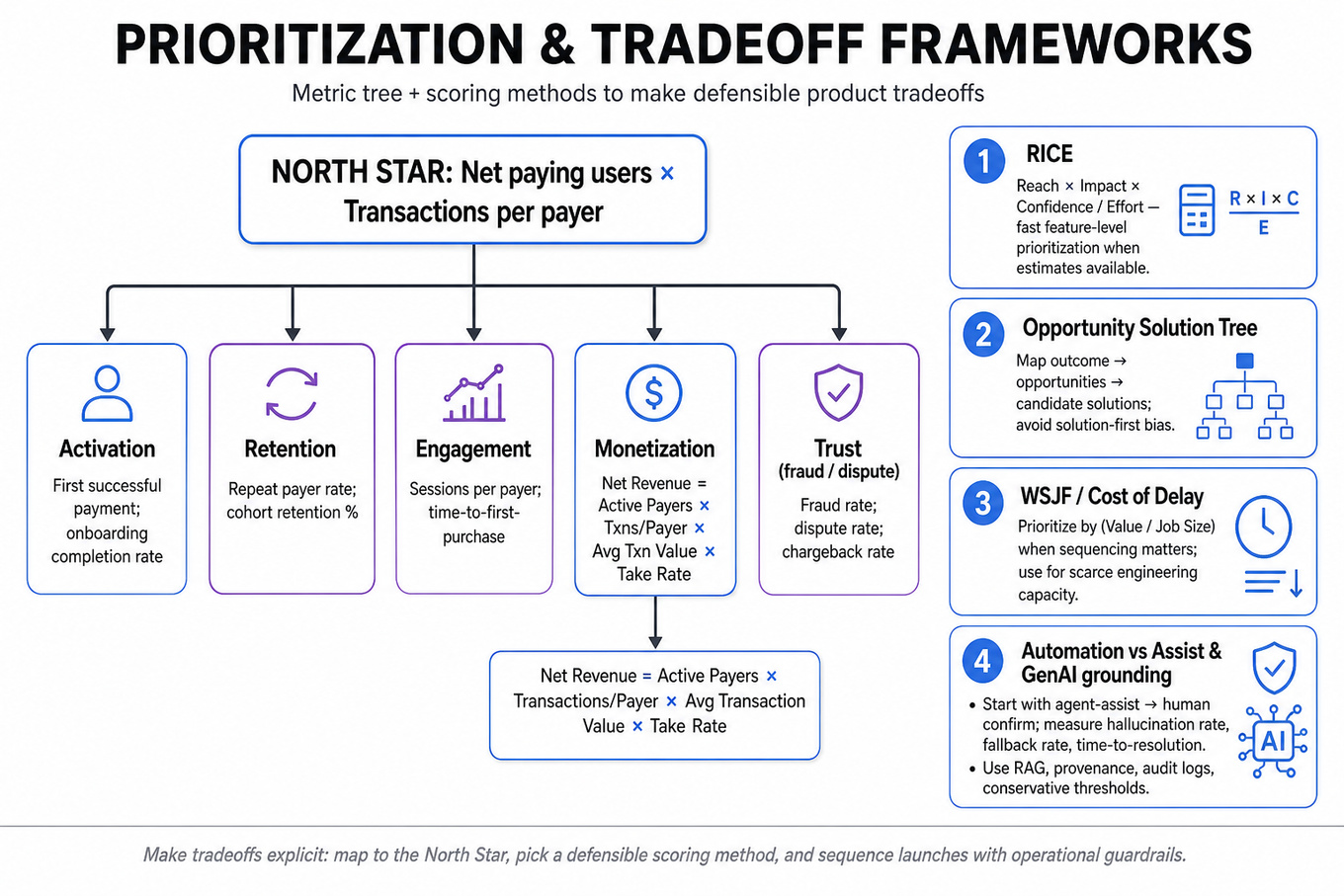
North Star— a single user-centric metric that captures long-term value (e.g., net paying users × transactions per payer); everything else maps to it via a metric tree. -
Metric tree — decompose
North Starinto Activation, Retention, Engagement, Monetization, and Trust (fraud/dispute). Use formulas like:
Net Revenue = Active Payers × Transactions/Payer × Avg Transaction Value × Take Rate. -
RICEscoring —RICE= Reach × Impact × Confidence / Effort; useful for feature-level prioritization when inputs can be estimated quickly and compared across many ideas. -
Opportunity Solution Tree — map desired outcomes to opportunities and candidate solutions; use to avoid solution-first decisions and keep focus on user problems.
-
Cost of Delay / WSJF — prioritize by (Value / Job Size) when delivery sequencing matters; apply for scarce engineering capacity or cross-team dependencies.
-
Automation vs Assist tradeoff — automation improves efficiency but raises hallucination, privacy, and legal risks; start with agent assist (suggest, human confirms), then partial automation with strong fallback and audit logs.
-
GenAI grounding — use retrieval-augmented generation (RAG), source provenance, and conservatism thresholds; measure hallucination rate, fallback rate, and time-to-resolution.
-
Payments-specific levers — activation (first successful payment), fraud rate, dispute rate, merchant onboarding friction, unit economics (take rate − cost per transaction), and regulatory constraints (KYC/AML).
-
Launch sequencing — MVP → closed beta (power users/merchants) → ramp via cohorts; validate with qualitative feedback and short A/B tests focused on critical funnel steps.
-
Operational metrics to include — error rates, latency percentiles (
p50,p95), support volume per transaction, fraud false positive / negative rates; these affect retention and unit economics. -
Experiment guardrails — define primary metric, guardrail metrics (fraud, disputes, customer satisfaction), and minimum detectable effect planning; be explicit about sample size and run duration assumptions.
-
Stakeholder map — list Product, Eng, Design, Legal/Compliance, Ops, Sales/Partnerships, and Customer Support; involve early for payments and GenAI safety decisions.
Worked example — "Apply GenAI to Business Messaging"
First 30s: clarify the primary customer (retail merchants, customer-support agents, end customers), success horizon (90-day efficiency vs. 1-year revenue), and data access (past transcripts, product catalog, order status). Structure your answer around three pillars: Use-case prioritization, safety & grounding, and rollout + metrics. Prioritize by ROI: low-risk high-repeat tasks (reply drafts, templated responses, order-tracking queries) before high-risk tasks (refund approvals). For safety, require RAG with provenance, conservative confidence thresholds, and human review for actions affecting money or personal data. Launch plan: 1) suggestion-only in closed beta; 2) allow adoption metrics + UI tweaks; 3) semi-automated flows for selected intents; 4) full automation after sustained low-hallucination rates. Flag explicit tradeoff: enabling full automation speeds resolution but amplifies legal and reputational risk if hallucination or incorrect order-updates occur. Close by stating next steps: instrument metrics, design quick rollback, and run targeted A/B tests on automation levels.
A second angle — "Define Meta Pay Success"
Different constraints: payments need clear unit economics, anti-fraud, and compliance. Frame success through a North Star (e.g., Net Payment Revenue or Active Payers) and build a metric tree to surface upstream problems: acquisition → activation → repeat transactions → ARPU. Use prioritization frameworks (RICE for feature ideas, WSJF for platform work) but weight fraud and compliance heavily as guardrail metrics. For a flat adoption despite lower transaction costs, investigate funnel metrics (conversion from install → link payment method → first successful transaction), friction points (KYC, UI), and external factors (merchant acceptance, promo exhaustion). Consider partnership levers (Stripe, Plaid) vs. building in-house, and explicitly model merchant economics (take rate vs. subsidy) before scaling.
Common pitfalls
Pitfall: Optimizing a local metric that breaks the north star.
Focusing on increasing transactions by lowering verification creates fraud and chargebacks; always show how proposed metrics map to the North Star and guardrail metrics.
Pitfall: Not naming assumptions.
Interviewers reject vague prioritization. State assumptions for Reach, Impact, Confidence, and Effort numerically when using RICE or WSJF, and explain sensitivity if those change.
Pitfall: Skipping operational costs and regulatory work.
Treat fraud detection, dispute flows, compliance, and support load as first-order costs—omitting them makes launch plans unrealistic.
Connections
Interviewers may pivot to experimentation design (A/B testing setup, MDE, blocking effects), growth loops (virality/merchant network effects), or platform/partnership strategy (integrations, SDKs). Be prepared to discuss product economics and legal/regulatory tradeoffs for payments and GenAI.
Further reading
-
Teresa Torres, "Opportunity Solution Tree" — practical method to stay outcome-focused.
-
Marty Cagan, Inspired — prioritization and product discovery rituals for PMs.
Practice questions
- Program Execution Deep DiveMeta · Product Manager · Onsite · medium
- Meta Pay: Metrics & PrioritizationMeta · Product Manager · Onsite · medium
- Meta PM Interview QuestionsMeta · Product Manager · Onsite · hard
- Apply GenAI to Business MessagingMeta · Product Manager · Onsite · medium
- Prioritize voice-to-text or assistant?Meta · Product Manager · Technical Screen · hard
- Define Meta Pay SuccessMeta · Product Manager · Technical Screen · hard
Related concepts
- Technical Tradeoffs And Pilot ExecutionProduct / Decision Making
- Technical Leadership, Impact, And Trade-OffsBehavioral & Leadership
- Product Metrics, Trade-Offs, And CommunicationAnalytics & Experimentation
- Build Vs Buy And Partnership EvaluationProduct / Decision Making
- Launch Decisions And Metric Tradeoffs
- Ownership, Prioritization, Ambiguity, and Project Deep DivesBehavioral & Leadership