Product Metrics and Guardrails Framework
Asked of: Data Scientist
Last updated
-
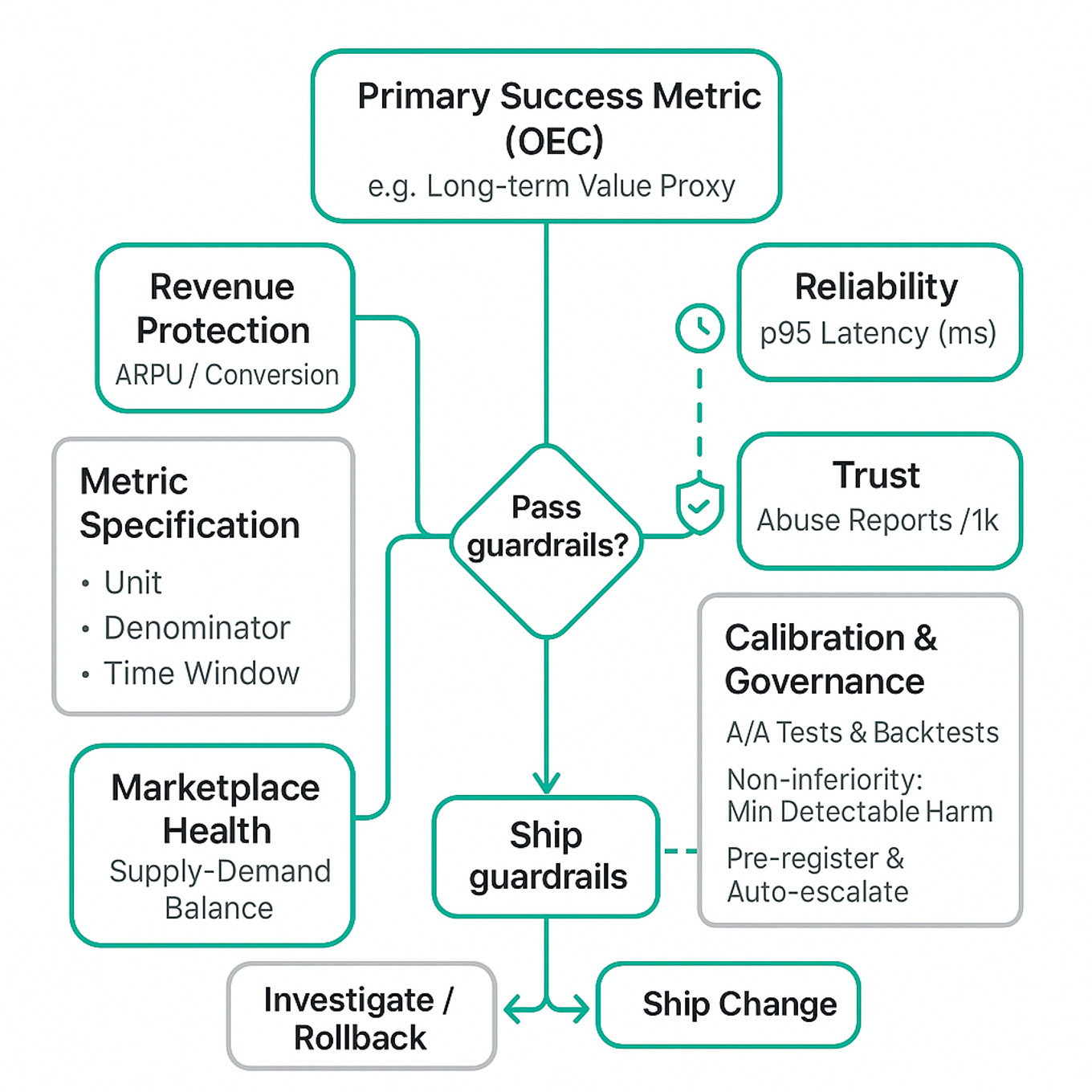
What it is A practical way to define a primary success metric for a product and a small set of “guardrail” metrics that prevent wins from causing hidden harm (e.g., latency, trust, ecosystem health). In experimentation, the primary metric often plays the role of an Overall Evaluation Criterion, while guardrails enforce non‑negotiable constraints during decision‑making. (cambridge.org)
-
Why interviewers ask about it Data Scientists are expected to turn ambiguous goals into measurable objectives and ship changes safely. At Meta-scale, one team’s win can degrade other surfaces or system SLOs, so candidates must show they can balance growth with reliability, integrity, and long‑term value. Strong answers demonstrate concrete metric choices, thresholds, and tradeoffs in A/B tests.
-
Core ideas to know
- Define a primary metric (OEC) aligned with long‑term value but sensitive within experiment windows. (cambridge.org)
- Choose few guardrails covering reliability, user trust, marketplace health, and revenue protection. (medium.com)
- Use non‑inferiority tests for guardrails with explicit “minimum detectable harm”; adjust beta, not alpha multiplicity. (arxiv.org)
- Specify metrics precisely: unit, denominator, filters, and time windows to avoid ambiguity and gaming.
- Calibrate with A/A tests and backtests to understand variance and reduce false‑alert fatigue. (cambridge.org)
- Automate governance: pre‑register metrics, auto‑escalate on breaches, and document exceptions. (medium.com)
-
A common pitfall Candidates optimize a local metric (e.g., CTR or session time) without stating a business‑relevant OEC or guardrails. In practice, the “win” ships, only to spike p95 latency, cancellations, or abuse reports, or to cannibalize other surfaces. Another failure mode is listing dozens of guardrails, creating low‑power, high‑noise decision gates and constant false alarms. Interviewers want a crisp, minimal set with clear thresholds, statistical tests, and rollback/escalation rules.
-
Further reading
- Kohavi, Tang, Xu — Trustworthy Online Controlled Experiments (Chapter 7: Metrics and OEC) — canonical guidance on selecting OECs and making metrics experiment‑ready. Cambridge University Press
- Airbnb Engineering — Designing Experimentation Guardrails — concrete, production‑tested framework with impact/power/stat‑sig‑negative guardrails and escalation mechanics. Airbnb Tech Blog
- Schultzberg et al. — Risk‑aware product decisions in A/B tests with multiple metrics — theory for success, guardrail, deterioration, and quality metrics; non‑inferiority testing details. arXiv 2402.11609
Related concepts
- Product Metrics And Guardrails
- Product Metrics, Guardrails, And RetentionAnalytics & Experimentation
- Product Metrics, Guardrails, And Launch Decisions
- Product Metric Frameworks
- Product Metric Frameworks And Diagnostic AnalyticsAnalytics & Experimentation
- Product Metrics, Trade-Offs, And CommunicationAnalytics & Experimentation