Production Bias And Fairness Evaluation Pipelines
Asked of: Machine Learning Engineer
Last updated
What's being tested
The interviewer is testing whether you can turn fairness from an offline model-analysis exercise into a reliable production evaluation pipeline. You should be able to define protected and operational slices, choose metrics appropriate to the prediction task, detect regressions after deployment, and connect alerts to model rollback or review actions. General cares because a model can preserve aggregate accuracy while systematically degrading outcomes for a subgroup; an MLE must make that failure observable, reproducible, and actionable without taking ownership of product policy or legal interpretation.
Core knowledge
-
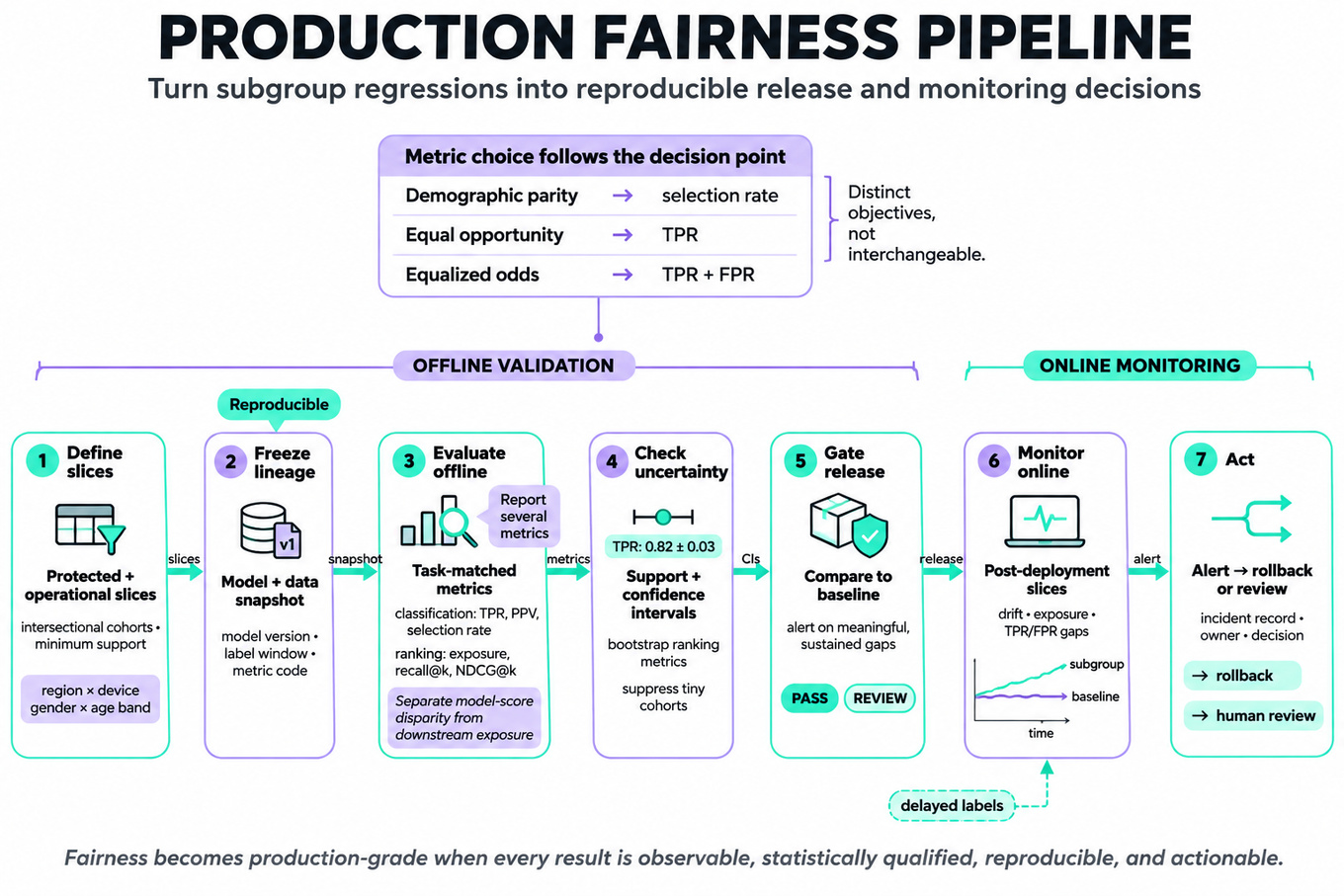
Fairness metrics must match the task and decision point. For binary classification, recall parity compares across groups; precision parity compares , while selection-rate parity compares .
-
Fairness is not one constraint. Demographic parity requires equal selection rates, equal opportunity requires equal true-positive rates, and equalized odds requires equal TPR and FPR. These objectives can conflict, especially when base rates differ, so the pipeline should report several metrics rather than silently choosing one.
-
For ranking or recommendation models, classification metrics are insufficient. Track subgroup exposure, average rank, recall@
k, NDCG@k, and qualified-item exposure; distinguish model-score disparity from downstream exposure caused by inventory, filtering, or serving rules. -
Use intersectional slices, not only one attribute at a time: for example, region × device type or gender × age band. Require minimum support and confidence intervals; suppress or aggregate tiny cohorts to avoid unstable ratios and privacy leakage.
-
Statistical uncertainty matters in monitoring. For a rate with sample size , approximate standard error is ; bootstrap intervals are often safer for ranking metrics. Alert on sustained or statistically meaningful gaps, not one noisy batch.
-
Preserve evaluation lineage: model version, feature snapshot, label window, protected-attribute availability, slice definition, threshold, and metric code version. A fairness result that cannot be reproduced from the same model artifact and data snapshot is not suitable for a release gate.
-
Separate offline validation from online monitoring. Offline tests use delayed ground truth and counterfactual or replay datasets; online checks can immediately monitor score distributions, selection rates, missingness, and slice coverage, then evaluate outcome disparity when labels arrive.
-
Watch label and feedback-loop bias. Historical approvals, complaints, or engagement may reflect prior model decisions rather than true outcomes. Document label provenance and avoid claiming fairness from a biased proxy; compare against human-reviewed samples where feasible.
-
Handle thresholding and calibration explicitly. A single threshold may create unequal error rates when score distributions differ; group-specific thresholds may improve one fairness criterion but raise policy, consistency, and maintenance concerns. Calibration itself can conflict with equalized odds.
-
Build fairness checks into CI/CD and model promotion. A candidate should pass accuracy or latency gates plus slice-level regression bounds against the incumbent, with tolerances, minimum sample sizes, and an approved exception path for statistically justified tradeoffs.
-
Production monitoring needs drift decomposition. A disparity increase may come from population shift, feature drift, label prevalence change, threshold changes, or serving bugs. Compare current and reference distributions using PSI, Jensen–Shannon divergence, or subgroup-specific distribution checks before attributing it to model behavior.
-
Make alerts operationally meaningful. Define severity, ownership, dashboard links, rollback criteria, and escalation for missing protected attributes or delayed labels. A temporary “unknown” slice should not be silently excluded, because missingness can itself differ by subgroup.
Worked example
Representative prompt: Design a production bias and fairness evaluation pipeline for a binary decision model. In the first 30 seconds, clarify the decision being automated, the protected attributes available under approved governance, the timing of ground-truth labels, the business-critical errors, and whether the system is a classifier, ranker, or human-assist tool. State that you will organize the answer around metric definitions, reproducible offline evaluation, online monitoring, and remediation or rollback. I would compute overall and intersectional confusion matrices, report equal opportunity and false-positive-rate gaps with confidence intervals, and compare the candidate against the incumbent. I would build a versioned evaluation artifact containing model, data, slice, threshold, and metric-code identifiers, then run it as a promotion gate. After deployment, I would monitor immediate proxy signals such as score and selection-rate shifts, followed by delayed outcome metrics when labels mature. The explicit tradeoff is that group-specific thresholds may reduce error-rate disparity but can complicate calibration, consistency, and policy review, so I would present it as an evaluated option rather than an automatic fix. If I had more time, I would add replay evaluation, human-audit sampling, and tests for fairness regression under realistic population-shift scenarios.
A second angle
Representative prompt: Diagnose why a ranking model’s exposure disparity increased after deployment. The framing changes from release validation to root-cause isolation: first separate inventory and traffic-mix changes from ranking-score changes, then compare subgroup exposure at each funnel stage. I would inspect exposure@k, rank distributions, candidate-generation recall, filtering rules, and serving fallbacks rather than applying a classification fairness metric blindly. The key tradeoff is whether to alter ranking scores, re-rank with exposure constraints, or fix upstream candidate coverage, since each affects relevance, latency, and system complexity. I would close by requiring an online shadow or canary evaluation before changing the production ranker.
Common pitfalls
Pitfall: Treating demographic parity as universally correct. Equal selection rates can be inappropriate for unequal base rates or asymmetric costs; state the decision objective and report the relevant error-rate gaps instead.
Pitfall: Saying “we monitor fairness” without specifying data timing, slice support, uncertainty, or action thresholds. A stronger answer names the metric, reference window, alert condition, owner, and rollback or investigation path.
Pitfall: Over-focusing on building ingestion infrastructure or making legal judgments. For an MLE answer, emphasize evaluation code, model/version lineage, serving parity, monitoring, and controlled remediation; identify policy constraints without pretending to set them.
Connections
The interviewer may pivot to calibration, concept drift, counterfactual evaluation, privacy-preserving telemetry, or human-in-the-loop review. They may also ask how fairness gates interact with A/B testing, model rollback, feature-store training/serving skew, and ranking-quality metrics.
Further reading
- Fairness and Machine Learning — comprehensive treatment of fairness definitions, impossibility results, and measurement tradeoffs.
- Equality of Opportunity in Supervised Learning — foundational distinction between equal opportunity and equalized odds.
- Aequitas — practical open-source patterns for subgroup fairness auditing and metric reporting.
Related concepts
- Model Calibration And EvaluationMachine Learning
- Model Evaluation, Calibration, And ValidationMachine Learning
- Machine Learning Model Evaluation And CalibrationMachine Learning
- ML Model Evaluation, Metrics, And ExperimentationML System Design
- Model Evaluation and Calibration
- Data Quality, Reconciliation, And Observability